ATS Keywords That Actually Get Read: A Field-Tested Workflow to Tailor Your Resume
Learn how to use ATS keywords to match a specific job description without guessing what an ATS “wants.” This guide shows a repeatable workflow, examples, and a review-before-submit approach.

Free Chrome extension
See your resume's match score for any job
JobWizard compares your resume to each job description and shows the exact keywords to add — free.
If you’ve searched for ats keywords, you’ve probably run into a frustrating truth: lots of “keyword guides” tell you to paste terms everywhere—but not how to choose the right terms from this job description, or how to keep your resume accurate. The result is common: you tailor to words, not requirements, and you end up with a resume that’s either unreadable or misaligned with what the role actually asks for.
In this guide, you’ll learn a practical, repeatable workflow for selecting ats keywords from a specific job posting, matching them to your real experience, and reviewing changes before you apply. We’ll also show how to use JobWizard features to turn a long job description into a structured checklist and help you spot resume expression gaps—without treating scores as guarantees.
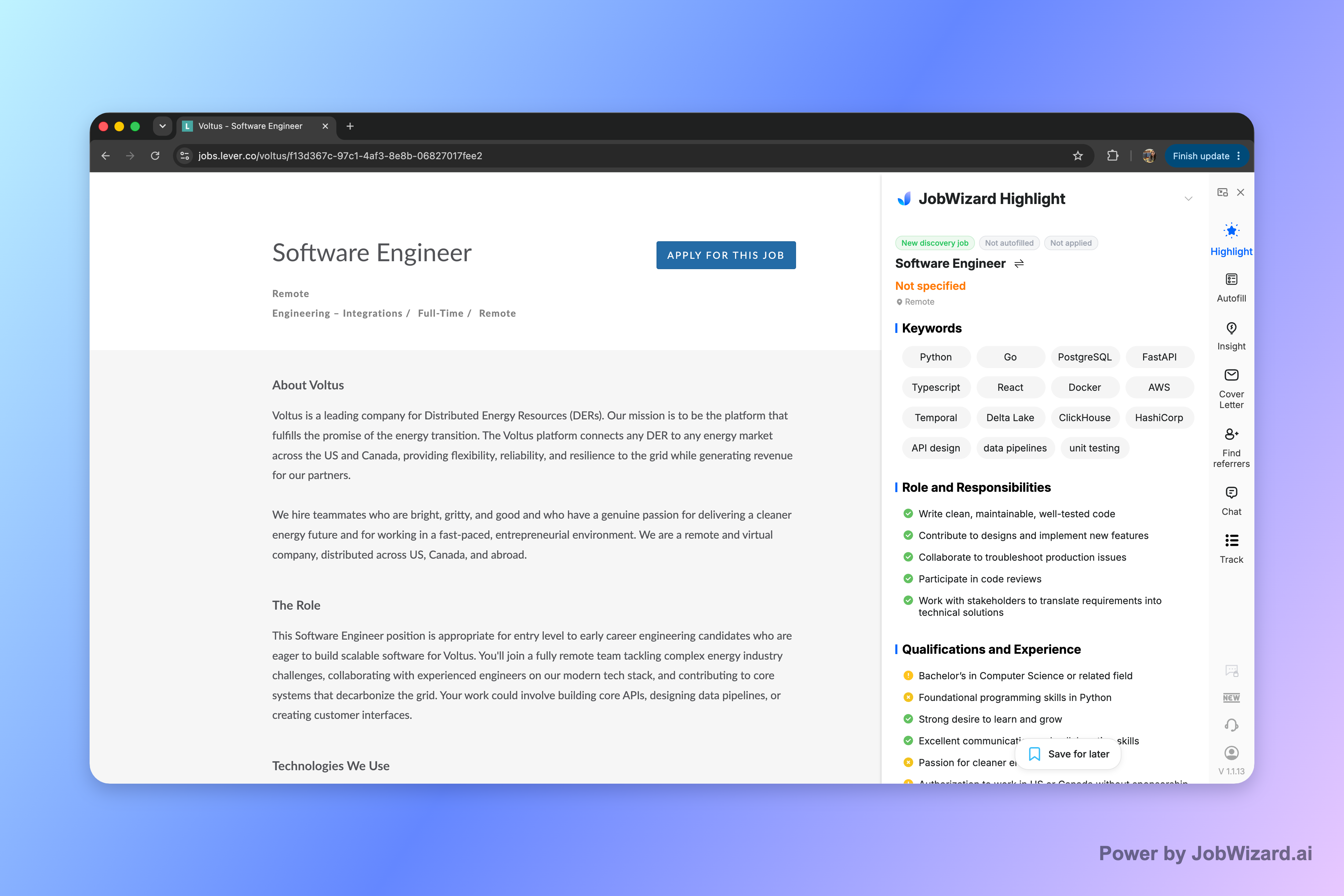
To start tailoring correctly, break the job posting into requirements you can verify. JobWizard can organize a job description into keywords, role responsibilities, and qualifications so you can review the requirements more systematically.
What ATS keywords really are (and what they aren’t)
When people say “ATS keywords,” they usually mean the terms and phrases a hiring system looks for to understand your background—especially around skills, responsibilities, tools, and qualifications mentioned in the job description.
Important: ats keywords are not a magic spell. Using the right words isn’t the same as promising an outcome. Your goal is alignment: make your resume clearly and honestly reflect the requirements the employer listed.
Ats keywords you should prioritize
- Core skills named in the job requirements (e.g., “SQL,” “stakeholder management,” “customer support,” “month-end close”).
- Responsibilities described as what the person will do (e.g., “analyze pipeline data,” “own onboarding,” “prepare reconciliations”).
- Qualifications and experience constraints (e.g., “3+ years,” “B.S. in…,” “experience with X environment”).
- Role-specific phrases that show how the employer frames the work (e.g., “KPI reporting,” “inventory forecasting,” “A/R aging”).
Ats keywords you should be cautious about
- Unverifiable buzzwords that don’t map to an actual project or responsibility you can support.
- Everything you’ve ever done—keyword stuffing usually hurts readability and may dilute signal.
- “ATS guarantees” language (no score, label, or checklist can promise ATS passage or an interview).
A workflow to find ats keywords from the exact job posting
The best ats keywords come from the job description you’re targeting. Instead of guessing, treat the job post like a specification document and convert it into a checklist you can map to your resume.
Step 1: Extract keywords, responsibilities, and qualifications
Start by reading the job post with a purpose: don’t skim for “cool words.” Break it into three buckets:
- Keywords (skills/tools/major concepts)
- Responsibilities (what success looks like day-to-day)
- Qualifications (must-haves and constraints)
With JobWizard’s JD Highlights, you can organize a long posting into a structured view of the role’s key requirements—so you review them systematically before you edit.
Once you’ve got the structured view, you’re ready to create a tight “keyword map” between the posting and your experience (not a loose list).
Step 2: Build a keyword map (requirements → your evidence)
Create a simple mapping table for yourself. For each keyword or requirement in the job description, write down the resume evidence that proves you can do it.
| Job requirement (ATS keyword) | Your truthful evidence | Where it goes on your resume | Review notes |
|---|---|---|---|
| “SQL” | Wrote queries to validate reporting datasets and investigate data discrepancies | Skills section + 1–2 bullets under Analytics/Reporting | Use plain wording; keep it accurate to your scope |
| “stakeholder management” | Coordinated with Sales and Ops to confirm requirements and handle change requests | Experience bullet emphasizing ownership + communication | Don’t claim executive-level sponsorship if you didn’t do that |
| “A/R aging” | Reviewed aging reports and resolved past-due invoices through follow-ups | A/R role bullets + relevant accounting tool mentions (only if true) | Keep metrics only if you can defend them |
Step 3: Rewrite bullets to mirror responsibilities (without keyword stuffing)
Don’t just insert ats keywords—embed them into bullets that describe outcomes and actions you can stand behind. A strong bullet usually includes:
- Action (what you did)
- Context (what system/team/domain)
- Method (tools/skills)
- Impact (what improved or what changed)
Example (before → after):
- Before: “Responsible for reporting and dashboards.”
- After: “Built weekly KPI dashboards and used SQL queries to reconcile reporting metrics with source data.”
The second bullet uses job-style language (“weekly KPI dashboards,” “SQL queries,” “reconcile…with source data”) while staying grounded in real work.
Step 4: Choose a consistent skills section strategy
Your skills section is a fast scan area for both humans and automated parsing. Use it to reinforce the keywords that show up in your experience bullets.
Practical rule: if a keyword appears in the job’s responsibilities/qualifications and you can prove it with an experience bullet, it belongs in your skills section or at least in one relevant bullet (preferably both).
Use JobWizard Insight to find resume expression gaps (and verify changes)
Even when you’re tailoring manually, it’s easy to miss that your resume describes the right work but uses different wording than the job posting. That’s where JobWizard’s Insight / Match Score helps: it compares your selected resume with the current job description and presents a match score, an overall assessment, and improvement suggestions.
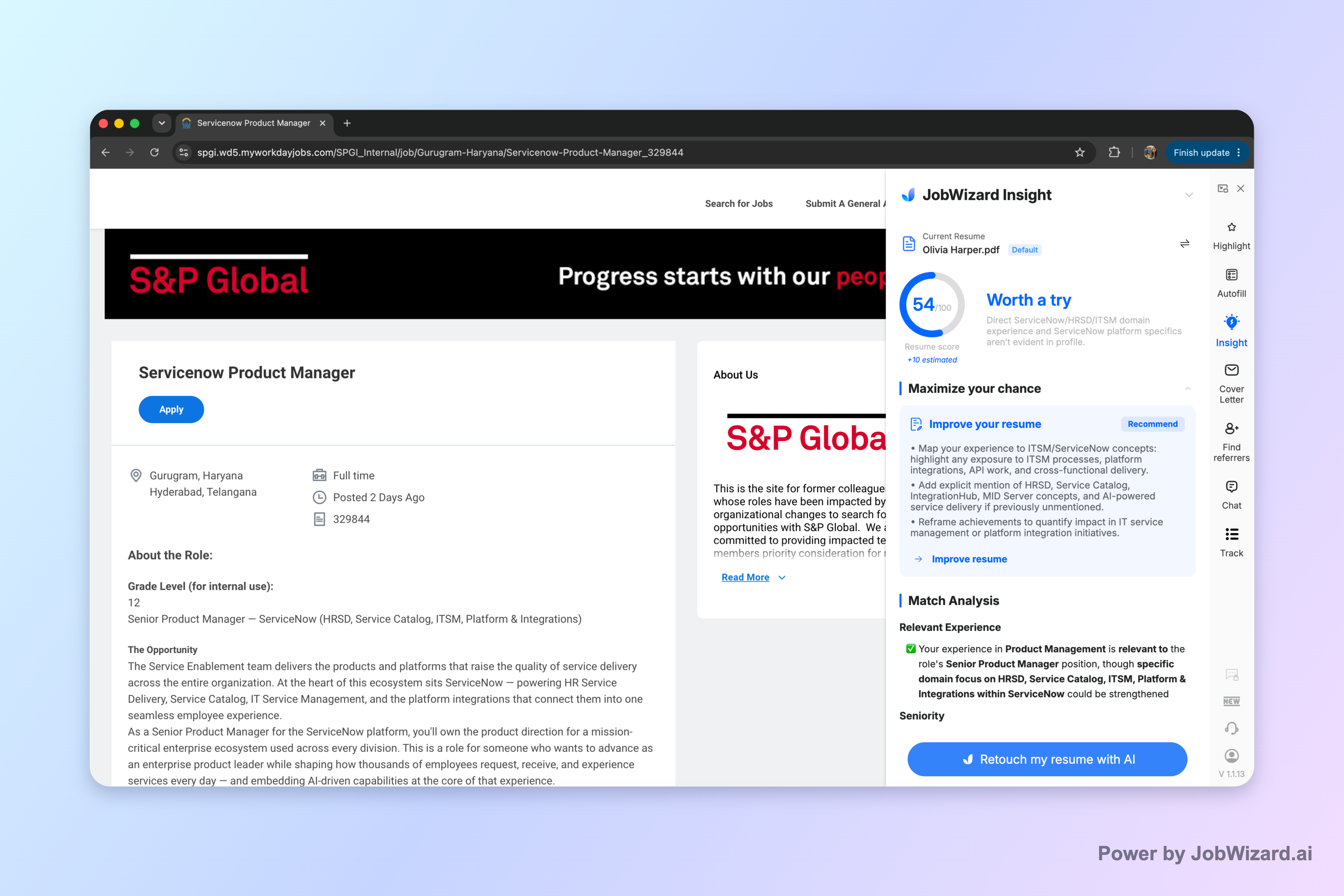
Insight is designed to identify resume expression gaps and turn them into an editable resume revision draft—so you can adjust wording to match the job’s requirements more clearly.
What to do with the match score (so you don’t misuse it)
The score is not a hiring probability and does not guarantee ATS passage or an interview. Users must verify every suggested resume change and keep only accurate experience.
So treat the output like a “gap radar,” not a verdict. Here’s a safe review loop:
- Compare the job requirements you extracted from the posting to the evidence in your resume.
- Review every suggestion and check that it’s truthful. If a suggested change would stretch your experience, reject it.
- Keep the strongest, most specific bullets aligned to the role. Don’t compress your experience just to fit keywords.
- Re-check your final draft against the job description’s responsibilities and qualifications.
Common gap patterns you can fix immediately
- Right skill, different phrasing: You did the work, but your resume says “analysis” while the job says “data validation” or “reporting QA.” Use the job’s phrasing only if it accurately reflects what you did.
- Tool present, context missing: You mention “Excel” but don’t describe how you used it for the responsibility the employer wants (e.g., “reconciliation,” “pivot-based reporting,” “process tracking”).
- Experience exists, but not in the right section: A requirement appears in qualifications; you should reinforce it where it will be seen quickly (experience bullets and/or skills section).
Examples of ATS keyword tailoring by role type
Because ats keywords vary by industry, the best approach is to tailor from the role’s responsibilities and qualifications. Below are concrete patterns you can adapt to your target job.
Example 1: Customer-facing operations (responsibilities + communication)
Job post signals to capture: “resolve customer issues,” “document cases,” “own escalations,” “maintain service quality,” “work cross-functionally.”
Resume evidence to craft: bullets that show the process you used—how you tracked issues, what tools you used, and how you escalated and resolved cases.
- “Investigated recurring issue types using case history and documented root causes for cross-functional teams.”
- “Managed escalations, coordinated responses with relevant stakeholders, and updated records to ensure a consistent customer experience.”
Example 2: Accounts receivable (precision keywords + evidence)
Job post signals to capture: “A/R aging,” “reconciliation,” “invoice follow-up,” “collections support,” “billing discrepancies,” “journal entries” (only if true).
Resume evidence to craft: bullets that name the accounting workflow you performed: what you reviewed, what you corrected, and how you ensured accuracy.
- “Reviewed A/R aging reports and initiated follow-ups to resolve past-due invoices.”
- “Reconciled billing discrepancies by comparing remittance activity to invoicing records.”
If you want role-specific help, use these guides to tighten keyword selection for common ATS patterns:
- How to Optimize Resume for ATS: A Practical 2026 Checklist
- Accounts Receivable Resume Keywords: Beat ATS with Targeted AR Phrases That Match the JD
Example 3: Sales jobs (pipeline verbs + reporting)
Job post signals to capture: “manage pipeline,” “forecast,” “CRM hygiene,” “outbound outreach,” “qualify leads,” “track conversion metrics” (only if in the posting).
Resume evidence to craft: bullets with the verbs and artifacts the job expects: pipeline stages, CRM usage, reporting cadence, and qualification approach.
- “Maintained CRM pipeline health by updating stages after discovery calls and logging next steps consistently.”
- “Produced weekly forecast updates using pipeline conversion trends to flag risks early.”
For a deeper sales-focused keyword system, reference:
Example 4: Turning job descriptions into resume phrases (so keywords fit naturally)
Many applicants know what skills they need, but struggle to phrase them the way employers expect. If you want a structured method for translating the posting into resume-ready language, see:
Do this automatically with JobWizard
Skip the manual work — JobWizard's Match Score handles this for you.
Frequently asked questions about ats keywords
Do ats keywords have to match the job posting word-for-word?
Not always word-for-word, but you should mirror the meaning and the most important phrases from the job description. If you use a different term, make sure it’s accurate and maps to the same requirement (for example, “data visualization” vs. “dashboarding” only if your experience truly covers both).
Will a match score guarantee my resume passes the ATS?
No. A match score (including job description–based diagnostics) is not a hiring probability and doesn’t guarantee ATS passage or an interview. Use it to find expression gaps, then verify every suggested change and keep only what’s accurate.
What if my job history doesn’t contain the exact ats keywords listed in the posting?
If you don’t have the exact phrasing, focus on accurate equivalents. Use the job description to identify the underlying skill or responsibility, then rewrite your resume bullets so they honestly describe what you did. If you can’t support a requirement with your experience, leave it out rather than stretching keywords.
Should I use the job requirements section as my main source for ats keywords?
Yes. Responsibilities and qualifications are usually the highest-signal sections for ats keywords, because they describe what the employer is screening for. Pull keywords from those areas, then confirm you can back them up with specific, truthful examples on your resume.
How do I avoid keyword stuffing while still using ats keywords?
Aim for clarity and specificity. Add keywords where they naturally fit the context of your experience (for example, in a bullet that describes the work you actually did). Avoid repeating terms in a way that makes your resume read like a list—ATS friendliness matters, but so does human readability.
Ready to tailor your resume with the right ats keywords?
The fastest way to improve your ats keywords strategy is to stop guessing and start mapping your resume to the requirements in the exact job description. Open the target role, review its responsibilities, qualifications, and keywords—and then use JobWizard to turn that job post into a structured checklist and help identify resume expression gaps.
CTA: Try JobWizard now: paste the job description you’re targeting, use JD Highlights to organize the role’s key requirements, and run Insight to compare your resume against the posting—then review the suggested edits and keep only what’s accurate before you apply.
Frequently Asked Questions
See your resume's match score for any job
JobWizard compares your resume to each job description and shows the exact keywords to add — free.