Resume Keywords for Sales Jobs: A Targeted System to Beat ATS Filters (2026)
Learn resume keywords for sales jobs that map to real job requirements, not guesswork. Use a JD-to-resume workflow to close skills gaps before you apply.
Free Chrome extension
See your resume's match score for any job
JobWizard compares your resume to each job description and shows the exact keywords to add — free.
Why resume keywords for sales jobs can make or break your shortlist
When you’re applying for sales roles, “looking qualified” isn’t enough—your resume has to signal specific capabilities quickly. That’s where resume keywords for sales jobs come in: they help your document reflect the skills, responsibilities, and qualification language hiring systems (including ATS) scan for. The catch is that most candidates either guess what to include or blindly copy from the posting—both approaches can lead to a resume that either misses key requirements or reads like keyword stuffing.
JobWizard can help you handle this systematically. It can organize a job description into keywords, role responsibilities, and qualifications so you can review requirements more clearly and tailor your messaging instead of guessing.
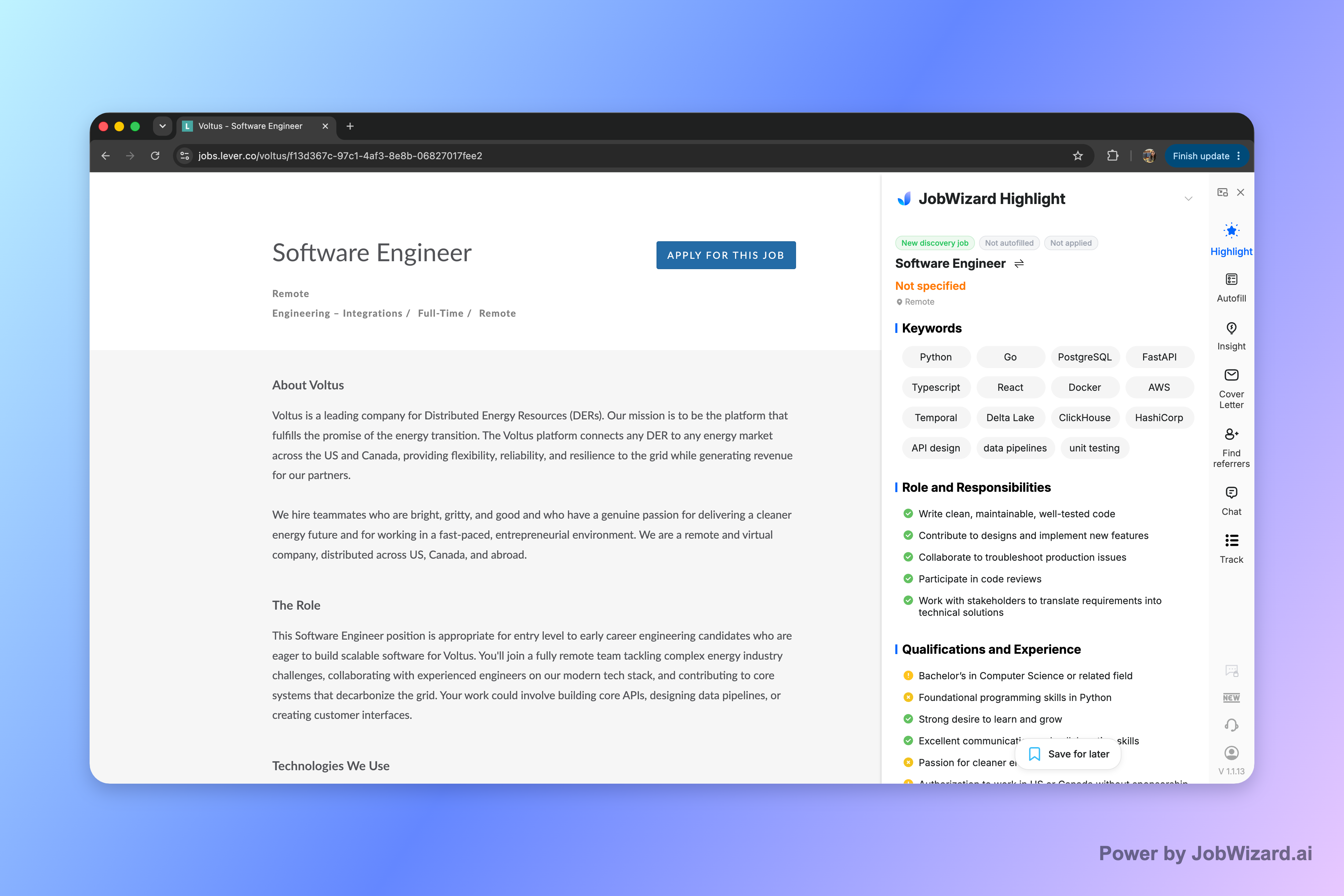
With the right workflow, you end up with targeted sales resume phrasing that maps to what the employer asked for—then you verify that every change is accurate before submitting.
Start with the job description: extract the right keyword categories
The most effective resume keywords for sales jobs usually fall into predictable categories. Instead of searching for a universal list, treat each posting as its own “keyword map.” Here’s what to extract first:
1) Responsibilities (what you’ll actually do)
Responsibilities often contain the highest-value terms because they describe day-to-day sales work. Pull keywords that reflect actions and outcomes you can support. For example, look for phrases related to:
- Prospecting and lead generation
- Pipeline creation and pipeline management
- Lead qualification and discovery calls
- Product demos / presentations
- Negotiation and closing activities
- Forecasting and reporting
- Account management or expansion (if applicable)
- Cross-functional collaboration (Sales + Marketing/CS)
2) Qualifications (what they require)
Qualifications usually include education, experience level, and specific tools or competency statements. These are where keyword coverage matters most because the posting is explicitly telling you what they will screen for.
- CRM experience (e.g., “CRM,” “Salesforce,” “HubSpot,” etc., if mentioned)
- Sales methodology terms (e.g., qualification frameworks, discovery structure)
- Territory or segment requirements (SMB, mid-market, enterprise)
- Deal cycle or sales motion language (inbound vs outbound, transactional vs complex)
- Experience expectations (years, types of deals, relevant industries)
3) The skills and tools they repeat
Sales roles often repeat certain keywords across the responsibilities, qualification bullets, and sometimes the top “requirements” section. Your job is to capture those repeats—but only use what you can truthfully support.
Key limitation to keep in mind: highlighted keywords don’t predict an ATS decision or hiring outcome. Use the JD extraction to tailor your resume responsibly and accurately, not to assume the system will “approve” you automatically.
Turn keywords into bullet-proof sales experience phrasing
Once you’ve pulled the keyword categories from the posting, the next step is turning them into resume bullets that read like real sales work. The goal is to use resume keywords for sales jobs where they belong: in context, tied to your actions and results.
Use a “keyword + proof” structure for sales bullets
Instead of a bullet that simply lists terms, write bullets that show the activity. A practical structure:
- Action: what you did (qualify, demo, negotiate, forecast)
- Object: what you worked on (leads, accounts, opportunities, pipeline)
- Method/tool (if accurate): CRM, reporting cadence, discovery process
- Scope: segment, region, deal type, inbound/outbound motion
- Outcome (truthfully): improvement, volume, cycle time, retention, expansion—only if you can support it
Map your resume to “expression gaps,” not just missing words
Two candidates can both “have the skills,” but one writes them in the language the employer expects. That’s an expression gap. JobWizard’s Insight compares your selected resume with the current job description and presents a match score, overall assessment, and improvement suggestions—and it can turn JD-based diagnosis into an editable resume revision draft.
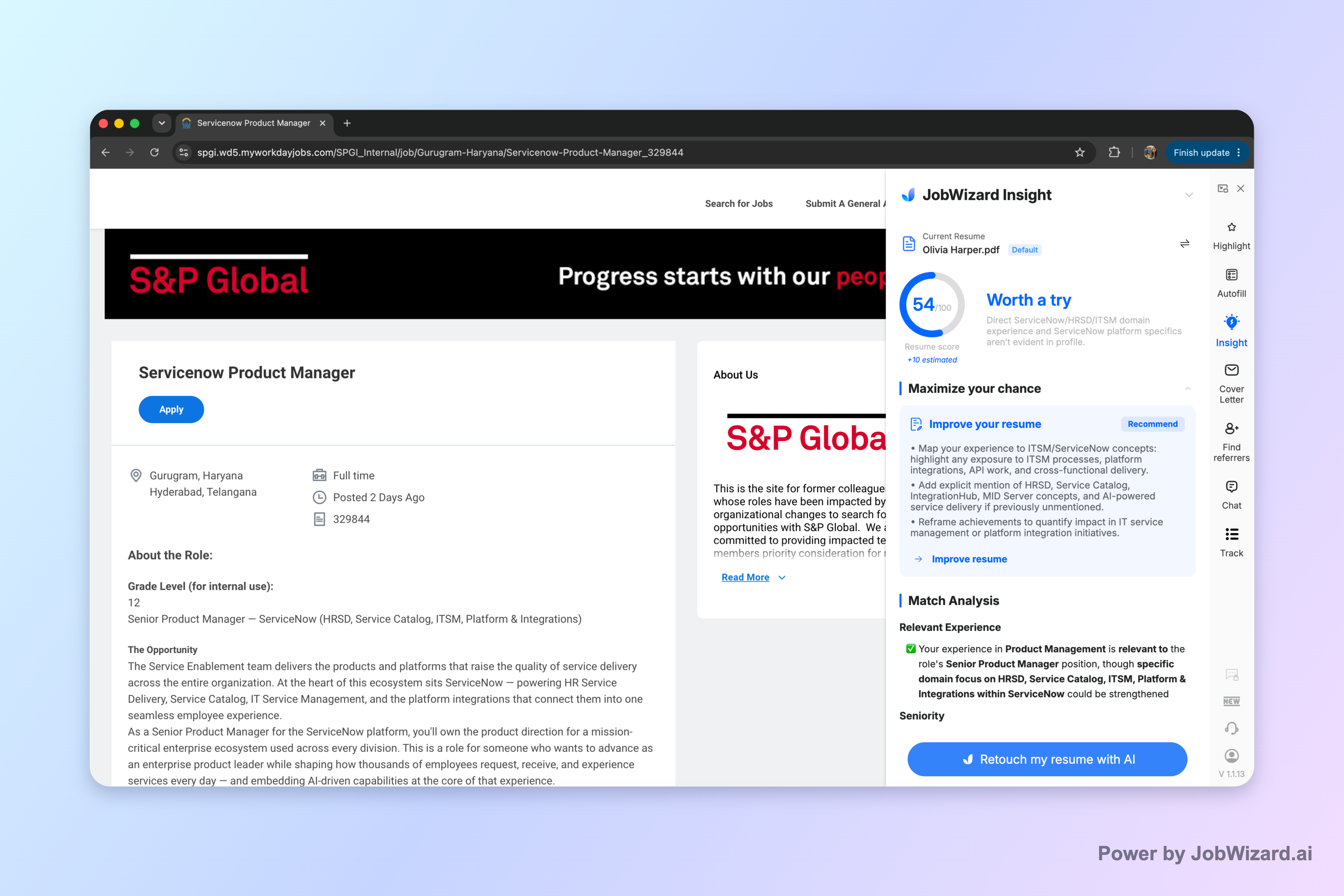
Use it as a tool to identify where your resume may not be expressing experience in the same terms the job is asking for. Then verify every suggested change and keep only what’s accurate and true to your history.
Be strategic about what NOT to force
It’s tempting to fill every keyword that appears in the posting. Don’t. If a keyword doesn’t match an activity you’ve actually performed (or a credential you truly have), replace it with the closest accurate phrasing. That’s how you maintain credibility while still building resume keywords for sales jobs that help you get noticed.
A sales-resume keyword cheat sheet (by function)
Use this as a starting point while you tailor to each job description. Only include items that align with the posting and your background.
| Sales function | Keyword examples to consider | Where to place them on your resume |
|---|---|---|
| Pipeline & opportunity management | pipeline management, opportunity management, CRM updates, deal tracking | Experience bullets, Skills section, “Sales Process” line in summary |
| Qualification & discovery | lead qualification, discovery calls, needs assessment, solution fit | Experience bullets, relevant projects/clients, summary |
| Product demos & presentations | product demos, presentations, value proposition, stakeholder alignment | Experience bullets, Skills (if tools/methods are clear) |
| Closing & negotiation | closing, negotiation, mutual action plan (if used), contract review | Experience bullets, selected achievements |
| Forecasting & reporting | forecasting, pipeline reporting, weekly forecasting, sales reporting | Experience bullets, Tools/Systems section |
| Account management (if relevant) | account management, renewals, expansion, customer retention | Experience bullets, “Current Accounts” style details |
| Sales motion & scope | inbound/outbound, territory coverage, segment targeting (SMB/mid-market/enterprise) | Summary, experience bullets, skills scope line |
| Tools | CRM (and specific tools if named in the JD), email sequencing (if accurate) | Skills section, “Tools” line in summary |
Resume keyword examples for sales jobs (tailored, not stuffed)
To make this concrete, here are examples of how candidates can incorporate resume keywords for sales jobs in a natural way. Replace the bracketed sections with what you truly did and what the job description actually emphasizes.
Example 1: SDR / BDR lead qualification
- Qualified inbound and outbound leads by conducting discovery calls, mapping needs to solution value, and routing high-fit opportunities to Account Executives.
- Maintained CRM pipeline accuracy by updating opportunity stages after calls and ensuring next steps were documented for follow-up.
- Partnered with Sales and Marketing to improve lead handoff by clarifying qualification criteria and feedback loops.
Example 2: Account Executive closing & negotiation
- Led full-cycle opportunity management, from discovery and product demos to negotiation and contract execution.
- Developed and presented ROI-based recommendations to key stakeholders, aligning product capabilities to business requirements.
- Performed forecasting and pipeline reporting to communicate deal stage health and risk factors for leadership.
Example 3: Sales role requiring CRM reporting
- Used CRM to manage pipeline hygiene, maintain accurate reporting, and support weekly sales performance reviews.
- Streamlined pipeline tracking workflows by standardizing fields used for forecasting, improving visibility into deal movement.
Reminder: suggested phrasing must reflect accurate experience. If you can’t support a keyword with truth, don’t include it. ATS-readability is important, but so is credibility.
Where to find the right phrasing (and how to apply it across roles)
Sales recruiting keywords can vary by role type (SDR vs AE vs Customer Success vs Account Manager) and by company industry. Instead of relying on one generic keyword list, use role-specific resources—and then tailor to the specific posting you’re applying to.
Start with these guides for deeper, role-aligned keyword framing:
- How to Optimize Resume for ATS: A Practical 2026 Checklist (for overall ATS-ready structure)
- ATS Resume Keywords for Sales Representatives: Beat Filter Confusion with Targeted Phrases (for sales-rep keyword targeting)
- The Sales Representatives Resume Keywords That Beat ATS Filters (for sales keywords that align with screening language)
- ATS Resume Keywords for Product Managers (if you’re pivoting into product-adjacent work and want a structured keyword approach)
Quick workflow you can repeat for every application
- Open the job posting and identify responsibilities, qualifications, and repeated terms.
- Extract and organize keywords so you can review requirements systematically.
- Compare your resume to the JD to identify expression gaps and generate revision ideas.
- Rewrite bullets so keywords appear in context (action + proof), not as a list.
- Verify every edit and submit yourself—don’t treat the process as blind automation.
Important limitation: match score tools don’t guarantee ATS passage or an interview. Treat the insights as a starting point to improve clarity and alignment, then make final decisions based on what’s accurate and relevant.
Do this automatically with JobWizard
Skip the manual work — JobWizard's Match Score handles this for you.
FAQ: Resume keywords for sales jobs
Do I need to use the exact wording from the job description for resume keywords for sales jobs?
You don’t necessarily need to copy exact wording, but you should mirror the meaning. Use the job description’s responsibilities and qualifications to choose phrasing you can truthfully support from your experience, then review every edit and keep only accurate experience.
What are the most important resume keywords for sales jobs besides “sales” and “quota”?
Prioritize role-specific keywords tied to responsibilities and qualifications, such as CRM and pipeline management, lead qualification, forecasting and reporting, discovery calls and demos, negotiation and closing, and territory/segment scope—then ensure those phrases match what the job posting emphasizes.
How can I avoid ATS keyword stuffing when tailoring a sales resume?
Don’t force keywords into your resume everywhere. Only include keywords in sections where they accurately describe your work—especially your experience bullets and skills that directly reflect the posting. If you can’t back up a keyword, swap it for a more accurate match.
Is a match score the same thing as getting an interview for sales roles?
No. A match score is not a hiring probability and doesn’t guarantee ATS passage or an interview. It’s meant to help identify expression gaps and suggest next steps—then you must verify and keep only accurate experience.
What’s the fastest workflow to build resume keywords for sales jobs before applying?
Extract the job requirements into structured keywords (responsibilities and qualifications), compare your resume to the posting to find expression gaps, rewrite your experience bullets to include the right keywords in context, and verify every change before submitting.
Ready to tailor faster? Use JobWizard to organize the job description into requirements you can review systematically, then compare your resume to the posting to spot expression gaps—so your resume keywords for sales jobs are aligned, accurate, and ready for your next application.
Frequently Asked Questions
See your resume's match score for any job
JobWizard compares your resume to each job description and shows the exact keywords to add — free.