Sales Keywords List for Job-Seekers: The Exact Phrases to Mirror in Your Resume
Use this sales keywords list to mirror the language in real job descriptions—so your resume and cover letter match what recruiters search for. Includes examples for SDR, AE, and sales ops roles.

Free Chrome extension
See your resume's match score for any job
JobWizard compares your resume to each job description and shows the exact keywords to add — free.
Sales keywords list: the fastest way to sound “on-mission” for sales roles
If you’re applying for sales jobs, a sales keywords list helps you mirror the language the hiring team is already using—job responsibilities, qualifications, and the exact capabilities they expect you to bring. That alignment makes it easier for recruiters and hiring managers to see your fit in the first scan.
Instead of stuffing your resume with buzzwords, use keywords as a map. Your goal is to translate each requirement into a concrete, role-relevant bullet: what you owned, how you worked, and what changed because you were involved.
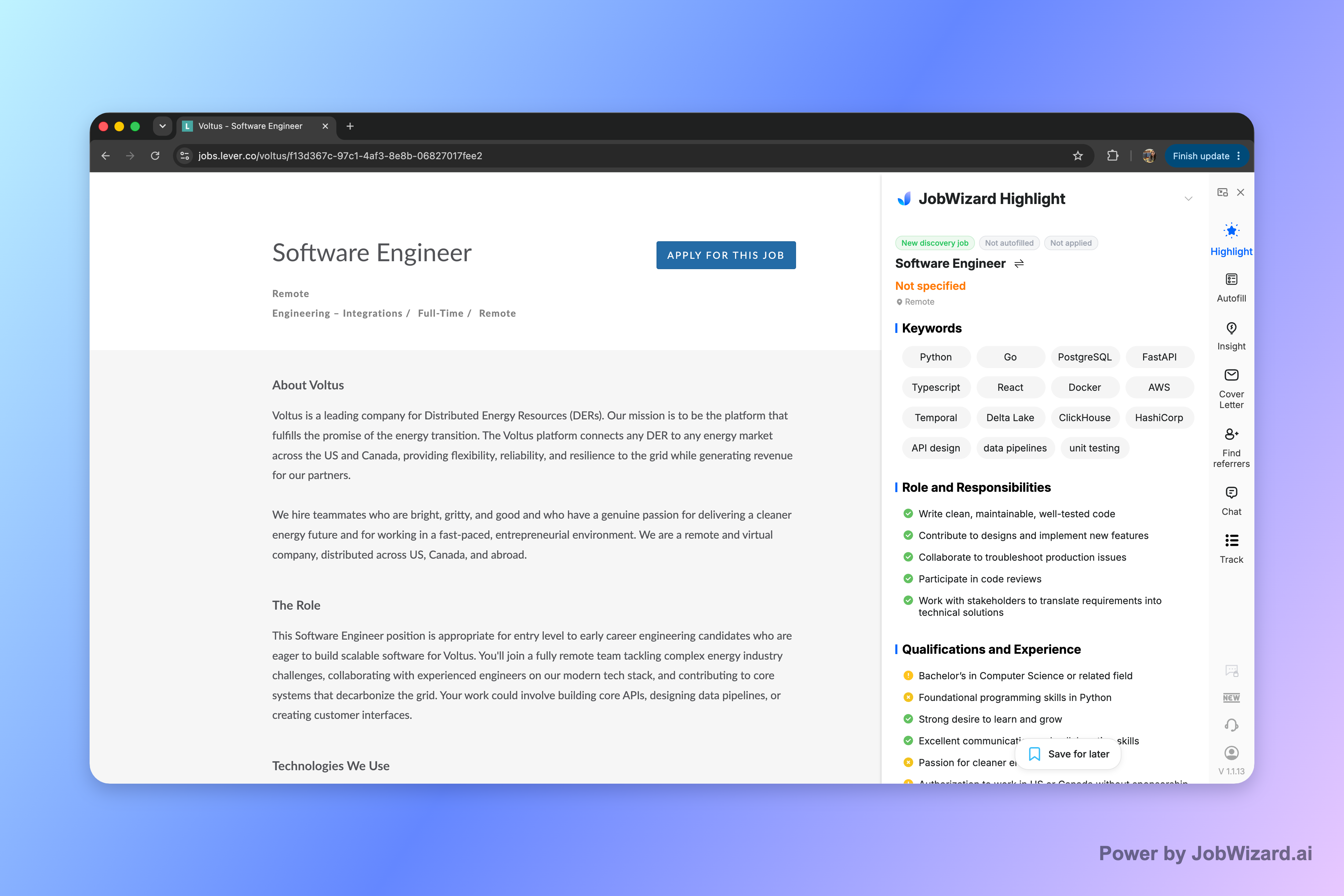
JobWizard can organize a job description into keywords, role responsibilities, and qualifications so you can review the requirements more systematically—without guessing what the employer actually emphasized.
Sales keywords list by job type (SDR, AE, sales ops)
The best sales keywords list is the one you tailor to the job type—because “the same sales role” often means different activities and metrics. Use the lists below as a starting point, then confirm the exact terms in each posting you apply to.
SDR / Business Development keywords
- Lead generation: outbound prospecting, inbound qualification, list building
- Prospecting: targeted outreach, prospect research, cold email, cold calling
- Qualification: discovery, MEDDICC/GPCT/CHAMP-style qualification (if listed), objection handling
- Scheduling & pipeline creation: meeting setting, opportunity creation, handoff to AE
- CRM hygiene: Salesforce, HubSpot, pipeline stages, activity logging
- Outbound cadence: sequences, A/B testing messaging, email + call mix
- Reporting: weekly pipeline review, conversion rates, activity metrics
Account Executive (AE) keywords
- Pipeline management: building and managing pipeline, forecast accuracy (only if you can support it)
- Discovery & deal qualification: needs analysis, stakeholder mapping, intent signals
- Sales process: stages, deal strategy, mutual action plans
- Negotiation & closing: pricing, contract negotiation, closing strategy
- Cross-functional collaboration: working with CS, solutions, product, implementation teams
- Demonstrations: product demos, value-based selling, proof of concept (if mentioned)
- Customer relationships: account planning, retention motions, expansion (if applicable)
Sales Operations (RevOps) keywords
- Enablement & process: sales playbooks, sales process design, SOPs
- CRM operations: Salesforce/HubSpot administration, data integrity, field mapping
- Reporting & analytics: dashboards, KPI tracking, funnel visibility
- Attribution & forecasting: data modeling, forecast methodologies (only if you used them)
- Workflow & automation: workflow rules, integrations, lead routing
- Sales tooling: CPQ, sequencing tools, documentation systems (only as listed)
- Sales governance: pipeline definitions, lifecycle stages, QA checks
Sales “core” keywords that show up across roles
- Stakeholder management: cross-functional alignment, executive communication
- Territory/account planning: segmentation, prioritization, target lists
- Objection handling: rebuttals, deal friction analysis
- Value proposition: ROI framing, pain-point based messaging
- Compliance & process: documentation, approvals, governance
- Customer success touchpoints: handoffs, adoption collaboration (when relevant)
- Continuous improvement: iterating messaging, refining pipeline strategy
Tip: If the posting emphasizes specific tools (e.g., a CRM or sequencing platform), list those only in the sections where you can honestly demonstrate experience.
How to turn a sales keywords list into resume bullets (with examples)
A sales keywords list is only useful when it becomes evidence. The fastest way is to build bullets that follow the same structure as the job description: responsibility → method → outcome.
Simple bullet formula for sales roles
- Responsibility keyword: pull the phrase from the posting (e.g., “pipeline management”).
- What you did: describe your action (e.g., “built a weekly pipeline review cadence”).
- How you worked: add the process detail (CRM fields, stages, cadence, discovery steps).
- Impact proof: quantify or clearly state change you achieved.
SDR bullet examples using common keywords
- Lead generation: Ran targeted prospect research to build high-fit outbound lists and increased qualified meeting bookings.
- Prospecting: Executed a multi-touch cold outreach cadence (email + call) focused on specific use cases and pain points.
- Qualification: Conducted structured discovery to confirm need, timeline, and decision process before scheduling for AEs.
- CRM hygiene: Maintained pipeline stage accuracy in Salesforce/HubsSpot (as applicable) with consistent activity logging.
AE bullet examples using common keywords
- Pipeline management: Managed end-to-end deal pipeline and maintained forecast inputs aligned to defined sales stages.
- Discovery & qualification: Led stakeholder discovery and built deal strategy based on quantified business outcomes.
- Negotiation & closing: Negotiated terms and secured commitments by aligning scope to customer requirements.
- Sales process: Built mutual action plans and coordinated internal resources to keep deals on track.
Sales ops / RevOps bullet examples using common keywords
- CRM operations: Administered Salesforce objects and fields to ensure consistent pipeline definitions across teams.
- Reporting & analytics: Built dashboards to monitor conversion rates and funnel health by stage.
- Workflow & automation: Streamlined lead routing and follow-up triggers to reduce manual handoffs.
- Sales enablement: Updated sales playbooks and documentation to align execution with process requirements.
When you rewrite bullets like this, your sales keywords list becomes a set of “chapters” your resume can support—not filler. Also, avoid implying things you didn’t do; keyword alignment should match your lived experience.
Where to pull your sales keywords list from (job descriptions, not guesses)
The most accurate sales keywords list comes directly from each job description. Recruiters often search for specific capability language, so you want the same terms the employer uses.
Extract keywords the same way a recruiter reads
- Responsibilities: Find the actions they expect you to own (e.g., “manage pipeline,” “run discovery,” “maintain CRM”).
- Qualifications: Pull the skills and requirements they claim you must have (tools, methods, compliance, experience).
- Repeated phrases: If a term appears multiple times, it usually reflects priority.
JobWizard’s JD Highlights can help you review a long job posting in a structured view of keywords, role responsibilities, and qualifications—so your resume updates are based on what’s actually in the posting.
Build a “role match” checklist for your resume
- Summary: Include 1–2 lines that reflect the role’s top themes (not every keyword).
- Skills section: Place the most relevant tool/method keywords that match your experience.
- Experience bullets: Rewrite 4–6 bullets to mirror responsibilities and qualifications.
- Optional add-ons: Certifications, projects, or early-career examples—only where they support the keywords.
Reality check: Keyword matching helps your resume reflect the role’s requirements, but it doesn’t guarantee an ATS decision or a hiring outcome. Your content still needs proof and clarity.
Sales keywords list for ATS-style scanning (and human scanning)
To win both ATS-style scanning and human reviews, your sales keywords list should appear in the right places, in context. The goal is not “keyword density”—it’s role clarity.
Best places to include your keywords
- Resume summary: 2–4 sentences that translate the job’s core focus into your experience.
- Core skills: a concise list of tools and methods relevant to the posting.
- Experience bullets: place keywords next to actions you performed (e.g., “pipeline management” → “weekly pipeline reviews”).
- Relevant projects: when your experience is indirect, show the work you did that maps to the keywords.
Common mistakes that weaken keyword strategy
- Copying the whole job description: large blocks read poorly and dilute your strongest proof.
- Using keywords without actions: “sales leadership” is vague unless you show what you led.
- Mixing role types: SDR keywords in an AE bullet can sound unfocused unless you explain how the skills transfer.
- Leaving out the process: sales roles often care about how you run deals, not just what you achieved.
If you’re applying across multiple sales roles (SDR → AE → RevOps), keep a tailored version of your resume. A single one-size-fits-all keyword set usually produces weaker matches than a role-specific version.
Do this automatically with JobWizard
Skip the manual work — JobWizard's Match Score handles this for you.
FAQ: Sales keywords list questions job-seekers ask before applying
What’s the best way to use a sales keywords list without sounding generic?
Use it to mirror the job description’s exact themes—then add a specific proof point for each theme (numbers if you have them). If the posting mentions “pipeline,” pair that with an action you owned (e.g., “built and maintained a forecast pipeline”).
Should I paste every keyword from the job description into my resume?
No—only include keywords that you can support with your experience. A good approach is to map each keyword to a relevant bullet: one accomplishment that matches the responsibilities and qualifications the employer lists.
How do I find the right sales keywords list for each role?
Start with the job description and pull out its recurring requirements: responsibilities, qualifications, and the most repeated terms. Then tailor your resume sections (summary, skills, and bullets) to reflect that structure so your content follows what the employer is looking for.
Will keyword-matching alone get me hired?
No. Keyword matching is a means to help your resume reflect the role’s requirements, but it doesn’t guarantee an ATS decision or a hiring outcome. Pair keywords with real, role-specific accomplishments and a clear story.
What’s a quick workflow to tailor my resume to a sales role?
1) Read the job responsibilities and qualifications. 2) Extract the key phrases into a sales keywords list for that specific role. 3) Rewrite 4–6 resume bullets to match those phrases. 4) Review before submitting so sponsorship/salary/EEO/custom questions are accurate.
Ready to tailor faster? Open the target role in JobWizard and review its keywords, responsibilities, and qualifications—then update your resume bullets using your role-specific sales keywords list so your application reads like you already do the job.
Frequently Asked Questions
See your resume's match score for any job
JobWizard compares your resume to each job description and shows the exact keywords to add — free.