ATS Software Keywords: Turn Job Descriptions Into Resume Phrases Hiring Teams Can Parse
ATS software keywords aren’t magic—they’re structured phrases you mirror from the job description. Learn how to extract requirements, map them to your experience, and review before you apply.
Free Chrome extension
See your resume's match score for any job
JobWizard compares your resume to each job description and shows the exact keywords to add — free.
Why “ATS software keywords” fail when they’re not tied to real job requirements
Most job seekers don’t lose to ATS because they “didn’t use the right words.” They lose because their resume keywords don’t map to what the job actually asks for—so recruiters see a mismatch, and automated parsing can’t confidently connect your background to the role. That’s why ATS software keywords should come directly from the job description, then be rewritten into your own experience bullets, skills section, and project descriptions.
Instead of guessing, you need a repeatable workflow: extract the key requirements and responsibilities from the posting, translate them into resume-ready phrases, and then review everything before submitting. JobWizard supports this exact step by organizing a job description into structured keywords, responsibilities, and qualifications so you can review the requirements more systematically.
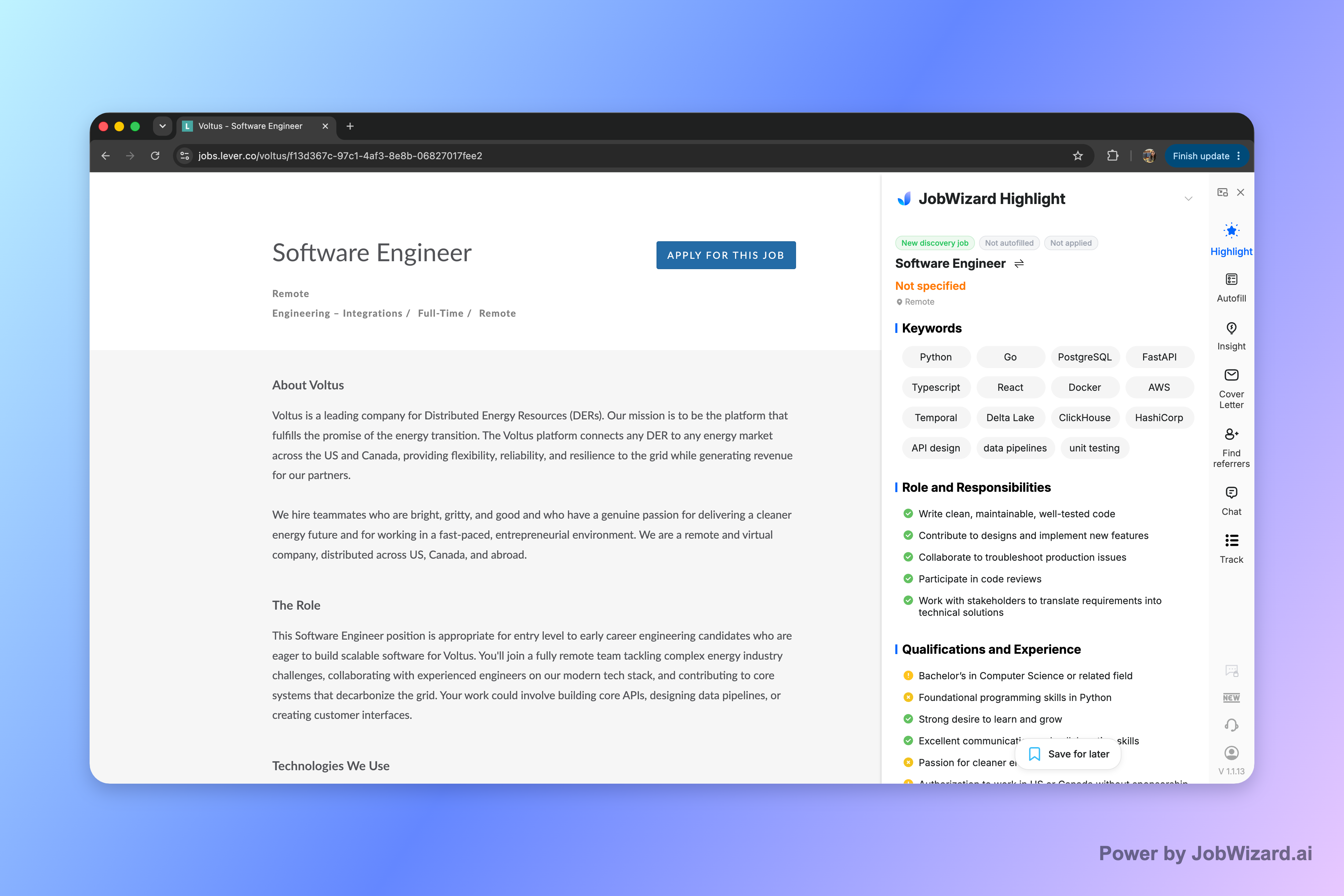
JobWizard turns a long Lever job description into a structured view of the role’s key requirements.
How to extract ATS software keywords from a job description (without copying it blindly)
For ATS software keywords to help, the keywords have to reflect the posting’s real intent. Your goal is not to paste text into your resume—it’s to identify the underlying requirements and then phrase your experience in a way an ATS can parse.
Step 1: Pull requirements from the “Qualifications” and “Job Requirements” areas
Scan for words and phrases tied to eligibility: years of experience, tools, systems, frameworks, security practices, data skills, and domain knowledge. These are usually the most reliable sources for ATS software keywords because they represent what the employer is explicitly asking for.
- Technology keywords: languages, frameworks, cloud services, databases, testing tools
- System/quality keywords: performance, scalability, reliability, latency, observability, availability
- Process keywords: CI/CD, Agile, code reviews, incident response, documentation
- Domain keywords: payments, healthcare, ads, identity, analytics, developer tools
Step 2: Turn “Responsibilities” into proof points
Responsibilities tell you what you’ll actually do on the job. Map them to outcomes you can show: shipped features, improved workflows, built systems, reduced errors, supported incidents, collaborated with cross-functional teams, and more.
When you translate responsibilities into bullets, aim for:
- Action + scope (what you did and where it ran)
- Methods/tools (the keyword terms that match the posting)
- Impact (the measurable result—when you have it; otherwise a clear description of the change)
Step 3: Consolidate keywords into a small, relevant set
It’s tempting to include every keyword you see. Instead, shortlist the ones that reflect your best match. A good rule: if you can’t write a bullet that supports the keyword, don’t force it.
For example, if the posting repeatedly uses terms like:
- “distributed systems”
- “observability”
- “API reliability”
…then you should look for your experience bullets that support those concepts (monitoring/alerting, tracing/logging, error budgets, uptime work, incident response, resilience patterns, etc.).
Step 4: Keep your wording ATS-friendly (but human-truthful)
Ats software keywords should appear in the sections where they naturally belong. That means your resume structure should make it easy for both an ATS and a recruiter to understand what you did and with what. Avoid vague “keyword stuffing.”
Match ats software keywords to your resume sections (by role and evidence type)
Different software roles emphasize different keyword types. The trick is to place ats software keywords where the employer expects to see evidence.
Software engineer roles: skills + experience bullets + projects
For software engineering positions, recruiters typically look for evidence in three places: a technical skills summary, your most relevant experience bullets, and projects (especially if you’re early career or switching tracks).
If the job description mentions specific patterns (like API design, performance tuning, or testing), translate them into bullets that reflect your actual work. For deeper guidance on role-specific keyword matching, use:
- ATS Resume Keywords for Software Engineers
- ATS Resume Keywords for Software Engineer Roles: How to Match
Product manager roles: outcomes + domain language + collaboration keywords
Product manager postings often look for different evidence than pure coding roles. Ats software keywords in PM listings may include product strategy language, metrics thinking, experimentation, roadmap ownership, user research, stakeholder management, and cross-functional coordination.
When you build your resume, place those keywords into bullets that show:
- How you defined problems and shaped requirements
- How you measured impact
- How you coordinated engineering, design, and other partners
- How you communicated decisions and tradeoffs
For more targeted keyword guidance, refer to:
Cross-role baseline: qualifications-to-proof mapping
Regardless of role, you want a simple mapping mindset:
- Keyword/requirement from JD
- Where it goes on your resume (skills, experience, project, education)
- Proof bullet that demonstrates you’ve done it
If you treat ats software keywords like a “requirements checklist,” you’ll naturally avoid stuffing while still covering what the employer asked for.
Concrete examples: rewriting job requirements into ats software keywords you can actually support
Here are practical examples of how to turn job description language into resume-ready phrases. Use these as templates for your own rewrite process.
Example A: Technology + responsibility
Job description: “Build and maintain RESTful APIs; improve reliability and performance.”
Resume-friendly rewrite using ats software keywords:
- Designed and implemented RESTful APIs with production-grade reliability, collaborating with backend engineers to improve performance and reduce request errors.
- Contributed to API reliability initiatives by improving monitoring and debugging workflows for faster incident triage.
Example B: Quality attributes + process
Job description: “Ensure scalability; participate in code reviews; support CI/CD.”
Resume-friendly rewrite using ats software keywords:
- Built features with an emphasis on scalability, supporting growth requirements through careful design and performance validation.
- Participated in code reviews and maintained standards for maintainability and correctness across the team.
- Used CI/CD workflows to streamline deployments and improve consistency across releases.
Example C: Qualification you must evidence
Job description: “Experience with observability and troubleshooting production issues.”
Resume-friendly rewrite using ats software keywords:
- Supported production troubleshooting using logs/metrics/alerts, improving time-to-diagnosis for recurring incidents.
- Partnered with cross-functional stakeholders to address reliability gaps by enhancing observability signals and documentation.
Common mistakes to avoid
- Repeating the same keyword without evidence: If “observability” appears, include a bullet showing what you did (monitoring, alerts, debugging, tracing, etc.).
- Using trendy terms you can’t explain: If you include a framework or practice, be ready to back it up in interviews.
- Ignoring section placement: A keyword in a single line at the bottom of the resume may not be as useful as the same keyword in your skills summary or experience bullets.
How JobWizard fits the ats software keywords workflow (review-first, not blind auto-submit)
If your process currently looks like “scan job posts, paste random keywords, submit,” you’ll get inconsistent results. A better approach is to break the job into steps: extract requirements, write proof bullets, and review before submitting.
JobWizard can help with the extraction step. It can organize a job description into keywords, role responsibilities, and qualifications so you can review the requirements more systematically before applying. Then you use that structured view to tailor your resume language and decide what to include.
Key limitation to keep in mind: highlighted keywords should not be treated as proof that ATS will “choose” you or that they guarantee a hiring outcome. Your resume still has to match your real experience.
To make this concrete, use the following workflow:
- Open the target role and read the responsibilities and qualifications end-to-end.
- Use JobWizard to structure the requirements into keywords, responsibilities, and qualifications.
- Rewrite your resume bullets so each important requirement is supported by a specific example.
- Do a last review: remove anything you can’t defend, and ensure the phrasing still sounds like you.
JobWizard has been used extensively for the mechanics of applying, including 720,000+ applications submitted and 600,000+ autofill sessions run through JobWizard. In those workflows, JobWizard fills an average of ~18 repetitive fields per application, typically between 11–23 fields. It also supports major career platforms, with the largest share on Workday (~65%). The important nuance: autofill + review-before-submit means repetitive fields are filled fast while the parts that matter most to your fit—like sponsorship / salary / EEO / custom questions—remain for your review before submission.
Next step: Start with one job you actually want. Open it, review its responsibilities and qualifications, and use the structured output to build a resume that naturally includes the ats software keywords tied to evidence. Then apply with confidence.
Do this automatically with JobWizard
Skip the manual work — JobWizard's Match Score handles this for you.
Ats software keywords FAQ
What are ats software keywords, exactly?
Ats software keywords are the specific terms and phrases that appear in a job posting’s qualifications, responsibilities, and requirements—then show up (naturally) in your resume sections where they fit your experience. They help the system parse your background alongside the role’s stated needs.
Should I copy the job description word-for-word to rank for ats software keywords?
No. Instead, translate the job description into resume-ready wording that matches your actual work. Mirror the concepts and common phrasing, but ensure every keyword is backed by something you can truthfully claim in your bullet points.
Where on my resume should ats software keywords go?
Focus on the areas ATS typically parses well: a skills/technical summary, your most relevant experience bullets, and—when appropriate—projects, certifications, and key tools. If a keyword is a qualification, support it in the section that best proves it (experience, projects, or education).
How do I know which keywords matter most for ats software keywords?
Start with the job description: qualifications and job requirements usually carry the highest signal. Prioritize repeated or emphasized requirements (like specific technologies, frameworks, system qualities, or domain terms), then confirm you can support each one with a concrete resume example.
Can JobWizard help me find ats software keywords from a job posting?
Yes. JobWizard can organize a job description into keywords, role responsibilities, and qualifications so you can review requirements more systematically before you apply. You still control what you submit—review the content and ensure it matches your experience.
CTA: Ready to stop guessing? Open your target job in JobWizard, review the structured keywords, responsibilities, and qualifications, and then tailor your resume so your ats software keywords reflect what the role actually needs—before you apply.
Frequently Asked Questions
See your resume's match score for any job
JobWizard compares your resume to each job description and shows the exact keywords to add — free.