How to Check If Your Resume Is ATS-Friendly Before You Apply
Learn how to compare your resume to a job description, spot ATS keywords, and fix formatting issues before you apply....
Free Chrome extension
See if your resume matches the job
JobWizard scores your resume against the posting and shows what to fix.
Quick answer: Yes—you can check your ATS-readiness in minutes by comparing your resume to the exact job description
If you’re asking, “How do I know if my resume is ATS-friendly before I apply?”, the most reliable approach is to cross-check your resume against the specific job description you plan to use. That lets you verify whether your experience is expressed with the right ATS keywords, skills language, and structure to help your application be machine-readable. In this guide, you’ll learn a practical ATS-friendly resume checklist, plus a job-description-first workflow that helps you tailor faster and reduce “skills gap” surprises.
Start with the job description: your ATS-friendly resume is job-specific, not one-size-fits-all
Many job seekers treat ATS optimization as a formatting problem only. Formatting matters, but ATS passage often hinges on whether your resume clearly reflects what the role is looking for—especially when the job description uses specific terms for skills, tools, and responsibilities. Before you touch your resume, print or copy the job posting text so you can compare it directly to your current resume.
Make a focused “target list” from the posting. This becomes your quality-control layer when you review formatting, keywords, and experience coverage.
- Skills and tools: Name every system, programming language, platform, or methodology mentioned.
- Core responsibilities: Capture 5–10 recurring action phrases (for example, “build,” “analyze,” “own,” “support,” “optimize”).
- Role qualifiers: Note years of experience signals, level (“senior,” “manager”), industry constraints, or location requirements.
Decision point: If your resume doesn’t contain language aligned to the target list, your next step is tailoring—either by editing phrasing to match how you performed the work or by adjusting the way you describe relevant experience.
Run a match diagnosis before you edit: identify resume “expression gaps” tied to the job description
Instead of guessing what an ATS will miss, use a job-description comparison to detect likely resume expression gaps—places where your experience is real but not written in the same way the posting expects. JobWizard’s Insight / Match Score compares the selected resume with the current job description and presents a match score, an overall assessment, and improvement suggestions.
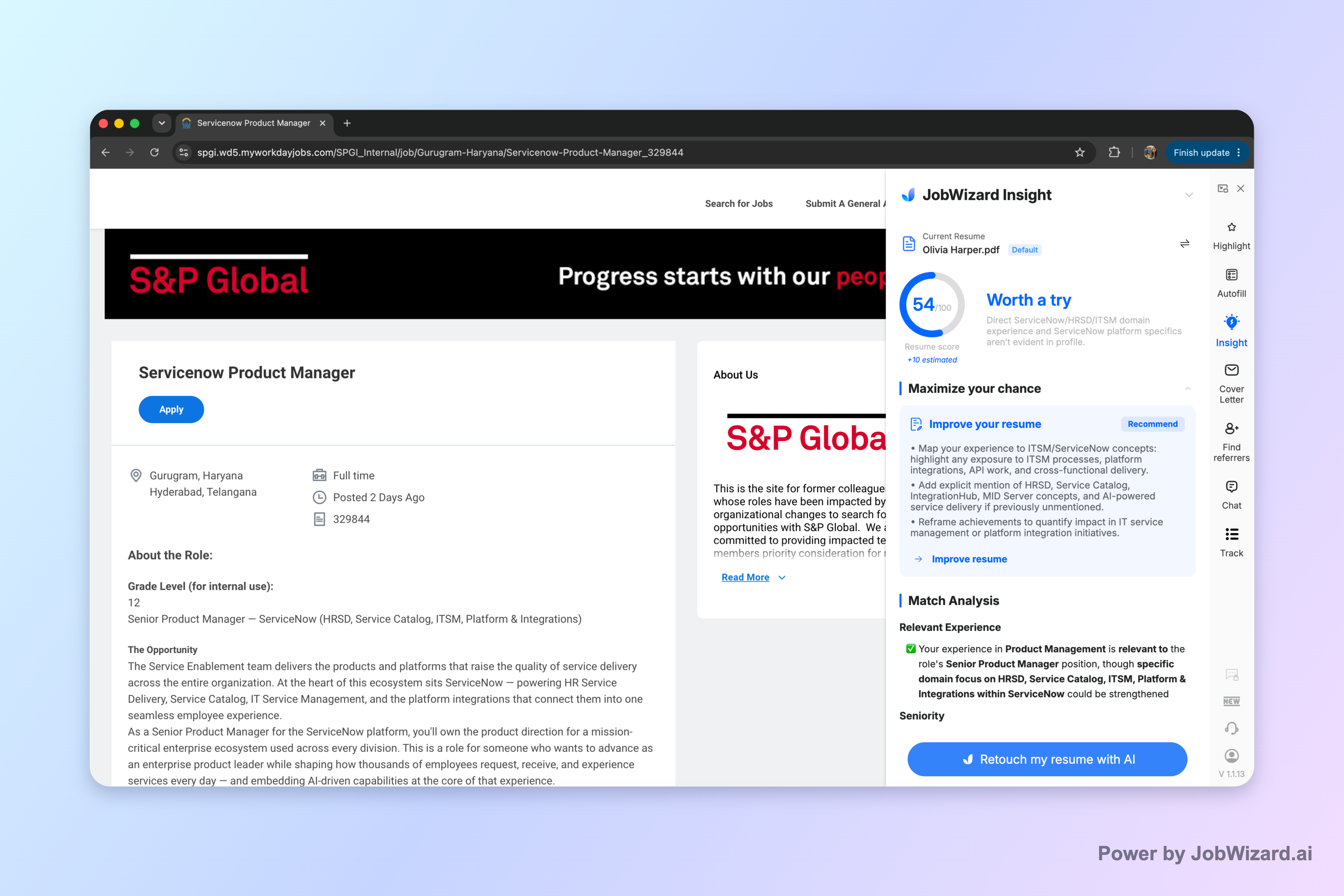
Crucially, the JD-based diagnosis can identify resume expression gaps and turn them into an editable resume revision draft. That means you can move from “I think I’m qualified” to “here are the exact wording/coverage gaps to address,” then decide what to keep.
How to use Insight safely (and avoid false confidence)
ATS screening tools are useful, but they’re not the same thing as hiring. JobWizard’s limitations are important: the match score is not a hiring probability and does not guarantee ATS passage or an interview. You still need to verify every suggested resume change and keep only accurate experience.
Workflow step: Use the match diagnosis as a gap-finder, not an authority. Your job is to confirm that each suggested change reflects what you actually did.
- Verify, don’t copy blindly: Check that each suggested skill/tool or responsibility is truly reflected in your history.
- Keep truthful specificity: If you used a tool or owned a project, ensure the wording matches your real scope.
- Don’t overstuff keywords: Add only what you can support with accurate experience.
What to look for when reviewing the match results
When the tool flags gaps, it’s usually telling you one of three things. Either your resume doesn’t mention a key term from the job description, the phrasing doesn’t map cleanly to how the role is described, or the experience summary doesn’t make your fit obvious at a glance.
- Missing ATS keywords: The posting uses a skill or tool you never named (even if you used it—your resume may still be missing the label).
- Skills gap by wording: Your resume may describe something, but not in the same terms the job posting uses.
- Qualification clarity: The posting’s requirements may appear earlier or more directly than your resume does, so your relevance is harder to detect.
Do an ATS formatting and readability check (so the ATS can parse your content)
Even with perfect keyword alignment, your resume can fail to parse if the structure is hard for automation to read. ATS systems typically extract text and section content in predictable ways, so your goal is to use a simple, consistent layout that won’t confuse the parser.
Use this formatting review as a decision tool. If you spot any of the items below, update your resume before you apply.
- Use standard section headings: “Experience,” “Education,” “Skills,” and “Projects” are clearer than creative alternatives.
- Avoid multi-column dependence: If key content exists only in columns, it may not extract reliably.
- Keep tables and heavy graphics minimal: They may not translate cleanly into extracted text.
- Use clean bullets: Bullet points generally extract more reliably than dense paragraphs.
- Check file type: Use a widely accepted format (commonly PDF or DOCX, depending on what the application asks for).
Limitation to remember: A formatting change alone won’t fix a real skills gap. Formatting helps ATS passage; alignment helps the system (and the human reviewer) understand fit.
Tailor with evidence: update wording to match the job description without misrepresenting your work
ATS-friendly resumes often succeed because your experience is described in a way that maps directly to the job posting. The best tailoring is evidence-based: each edited line should be supported by something you genuinely did, with accurate details.
Here’s a practical approach that combines job-description language with truthful specificity.
Step-by-step resume tailoring workflow
- 1) Pick the top 6–10 job terms: Use the target list you created from the posting.
- 2) Locate where they belong: Put the terms in sections where ATS extraction and human scanning both make sense (Skills section, role bullets, or project summaries).
- 3) Rewrite bullets, not your entire resume: Tailor the bullets under the most relevant roles first.
- 4) Preserve accuracy: If a term is missing because you didn’t do it, don’t add it—use the closest accurate phrasing that reflects your experience.
- 5) Confirm you didn’t distort scope: Match verbs and outcomes to what you actually owned.
Examples of “keyword-aligned” bullets (truthful, not stuffed)
Use these patterns to express experience in a way ATS systems can recognize, while staying credible.
- Instead of: “Worked on reporting dashboards for stakeholders.”Try: “Built automated reporting dashboards for stakeholders using SQL and BI tools; summarized KPI trends and flagged exceptions.”
- Instead of: “Helped with customer support processes.”Try: “Supported incident triage and resolution workflows; documented recurring issues and collaborated with engineering to improve response times.”
- Instead of: “Did some analytics.”Try: “Performed cohort and funnel analysis to identify drop-off points; produced recommendations for product and growth teams.”
Tip: Replace vague phrases with specific action + tool/skill + outcome. That naturally increases keyword coverage and improves clarity for both ATS and humans.
Use the match diagnosis to iterate—then submit with confidence (but not certainty)
Once you revise your resume, don’t stop at “looks good.” Re-run the job-description comparison so you can validate that the edits actually addressed the flagged expression gaps. This loop helps you avoid spending time polishing sections that don’t improve job match quality.
As you iterate, remember the limitation: the match score is not a hiring probability and does not guarantee ATS passage or an interview. It’s still valuable because it turns the job description into an actionable checklist of what your resume should communicate.
A practical final pre-apply checklist
- Job-specific alignment: Does your resume reflect the posting’s skills and responsibilities in its own language?
- Verified changes: Did you confirm every suggested improvement is accurate to your experience?
- Readable structure: Are headings and bullets easy for ATS extraction?
- No keyword stuffing: Did you add only supportable terms, backed by real project or role context?
- Consistency: Do dates, titles, and locations make sense and stay consistent across the resume?
When you should adjust strategy instead of editing more
If the match diagnosis still shows major gaps after a careful rewrite, you may need a different approach: apply to roles that better match your experience level, use a more targeted resume for that job category, or highlight different projects that align with the posting. In other words, treat ATS-friendliness as both communication and fit.
Rule of thumb: If you can’t honestly align to the job’s core requirements, don’t force it. Use the diagnosis to decide whether the role is truly a match.
Do this automatically with JobWizard
Skip the manual work — JobWizard's Match Score handles this for you.
FAQ
Can a resume be ATS-friendly but still get rejected?
Yes. ATS-friendly formatting and keyword alignment don’t guarantee an interview. The match score is not a hiring probability, and you should treat ATS diagnosis as helpful guidance—not a guarantee.
What’s the best way to check ATS keywords before applying?
Start with the job description’s target list and compare it to your resume content. If you use JobWizard Insight / Match Score, review the identified gaps, then verify that any suggested wording changes are accurate to your experience.
Should I copy the exact job description wording into my resume?
No—your edits should reflect what you actually did. Use job-description language to clarify your work (tools, responsibilities, outcomes), but keep the content truthful and evidence-based.
How do I know if my issue is formatting or skills gap?
If the resume reads cleanly but the comparison flags missing or mismatched terms, it’s likely a skills gap or expression gap. If extraction looks broken or content is unclear, it may be a formatting/readability issue.
Does match score guarantee ATS passage?
No. The match score does not guarantee ATS passage or an interview. It’s a job-description-based diagnostic to help you improve your resume alignment before you apply.
Ready to validate your ATS-friendly resume for a specific role? Compare your resume with the exact job description using JobWizard’s Insight / Match Score, then review the identified gaps and update only what you can verify as accurate.
Frequently Asked Questions
See if your resume matches the job
JobWizard scores your resume against the posting and shows what to fix.