Mechanical Engineer Resume Keywords: JD-Driven ATS Terms (Plus a Match Score Workflow)
Learn how to pick the right mechanical engineer resume keywords from real job descriptions—then verify gaps with a match score workflow before you submit.
Free Chrome extension
See your resume's match score for any job
JobWizard compares your resume to each job description and shows the exact keywords to add — free.
Using mechanical engineer resume keywords the right way is the difference between a resume that sounds generic and one that matches what hiring teams (and ATS parsing) are actually looking for. The trick isn’t guessing—it’s pulling the terms from each job description and tightening your resume around them.
In this guide, you’ll learn a JD-driven workflow for mechanical engineer resume keywords, plus how to use JobWizard to highlight requirements and diagnose gaps before you apply.
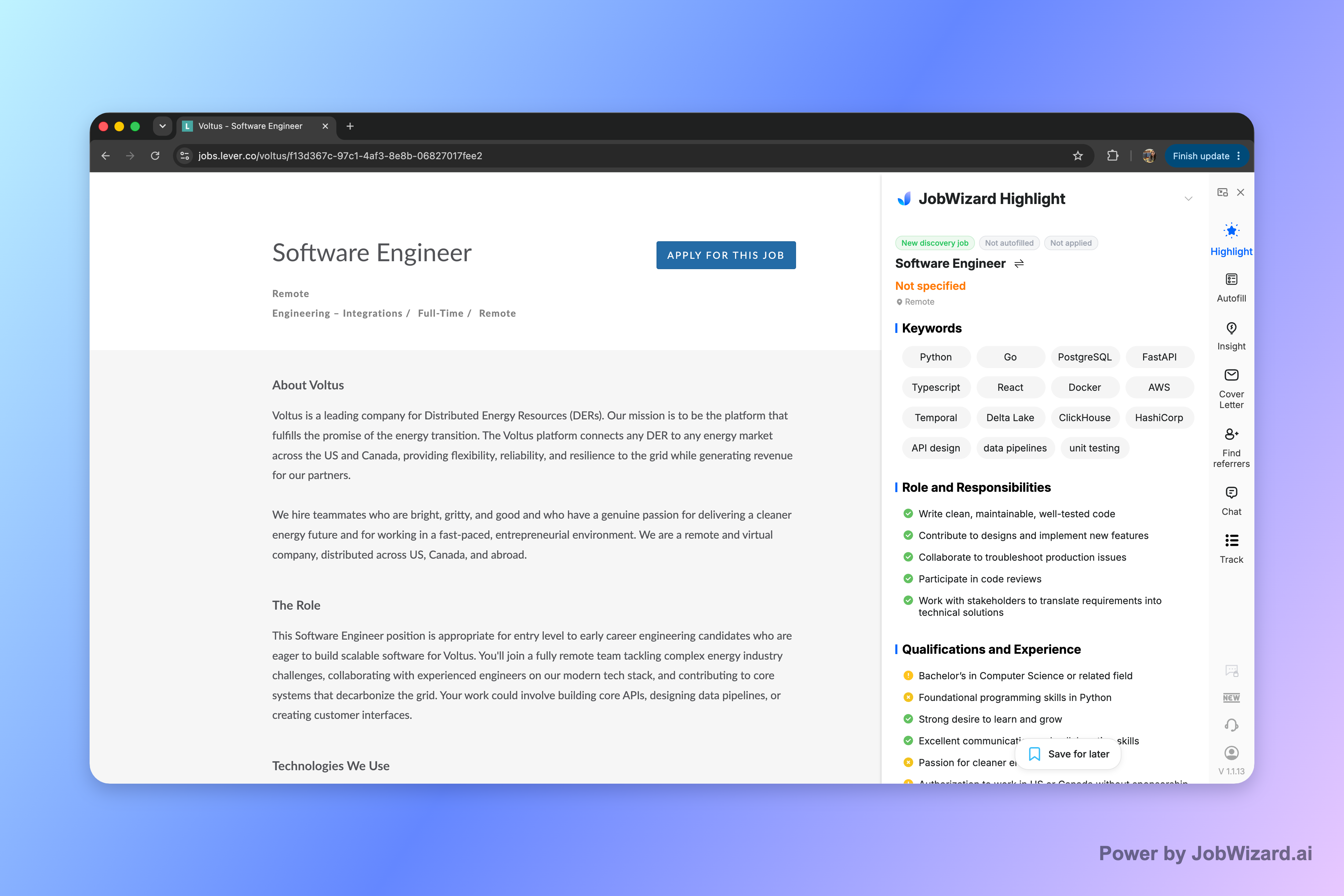
JD Highlights helps you organize a job description into keywords, role responsibilities, and qualifications so you can review requirements more systematically. You’ll use this structure to decide which mechanical engineer resume keywords to incorporate—and which ones to ignore if they don’t match your experience.
Start with the job description: extract mechanical engineer resume keywords that are actually “on the page”
Mechanical engineer resume keywords should come directly from the role you’re targeting, not from a one-size-fits-all list.
Most job descriptions signal what the ATS needs by repeating concepts across sections like responsibilities, qualifications, and “preferred” requirements. Your job is to translate those signals into resume language while keeping it accurate to your background.
Use the JD as your keyword source of truth
When you read a mechanical engineering job description, capture these keyword buckets first:
- Core responsibilities: What you’ll actually do day-to-day (design, analysis, testing, documentation, cross-functional collaboration).
- Qualifications: Required education, years of experience, certifications, domain experience, and must-have tools or methods.
- Tooling and methods: Software, analysis methods, and technical approaches named explicitly in the posting.
Then, map each bucket to a resume location—like a Skills section, a Technical Projects bullet, or a job-specific accomplishment—so keywords show up in context (not just as isolated terms).
Mirror phrasing without copy-pasting your life story
It’s fine to align your wording with the posting. It’s not fine to fabricate. A strong approach is to reuse key terms while preserving your original meaning.
- If the JD says “FEA”, include it where you describe analyses you personally performed or owned.
- If the JD emphasizes verification and validation, connect the keyword to tests, acceptance criteria, or qualification activities you can describe.
- If the JD calls out technical documentation, reference reports, design documentation, work instructions, or reviews you authored or maintained.
Build keyword coverage with a mechanical engineer resume template that hiring managers can scan
Mechanical engineer resume keywords work best when they’re distributed across the sections recruiters scan fastest.
Instead of forcing one “keyword dump,” structure your resume so ATS can pick up relevant terms as it moves through categories. This also helps humans quickly confirm you match the role.
Recommended section-by-section keyword placement
| Resume Section | What to Put There | Mechanical Engineer Keyword Purpose |
|---|---|---|
| Professional Summary | 1–2 lines that match the JD focus (domain + strengths) | Immediate relevance signal for the top of the document |
| Core Skills / Technical Skills | Tooling, methods, and technical disciplines from the JD | Dense keyword signals in a structured location |
| Experience Bullets | Responsibilities rewritten as outcomes you achieved | Contextual keyword use tied to credible scope and results |
| Projects (if helpful) | Specific work that mirrors the JD’s must-have activities | Fills gaps when your job history doesn’t cover everything |
| Education / Certifications | Only items that match qualification requirements | Hard filters (school, credentials, licensure, training) |
Examples of keyword-aligned bullet patterns (truth-first)
Use JD terms as anchors, then fill in specifics you actually did. Here are patterns you can adapt:
- Design + documentation: “Designed [component/system] using [method/software], documented [deliverable(s)], and supported design reviews.”
- Analysis + iteration: “Performed [FEA/analysis type] to evaluate [failure modes/performance goals], iterated the design, and prepared findings for engineering stakeholders.”
- Test/validation: “Built/ran [test type], assessed results against acceptance criteria, and coordinated fixes with cross-functional teams.”
- Manufacturability: “Collaborated on design-for-manufacturing considerations, translating constraints into engineering changes and documentation updates.”
If you want more ATS keyword strategy across engineering resumes, review these focused guides: How to Optimize Resume for ATS: A Practical 2026 Checklist and Keywords for Electrical Engineer Resume: 35 ATS-Ready Terms to Match Real Job Requirements. While the toolchains differ, the keyword-to-structure mindset stays the same.
Use JobWizard Insight to confirm what’s missing (and turn gaps into a draft)
Insight / Match Score helps you compare your resume with the job description and spot where expression gaps are likely hurting match quality.
After you identify mechanical engineer resume keywords from the JD, don’t stop there. The next step is verifying whether your current resume actually contains the right terms and aligned phrasing in the right places.
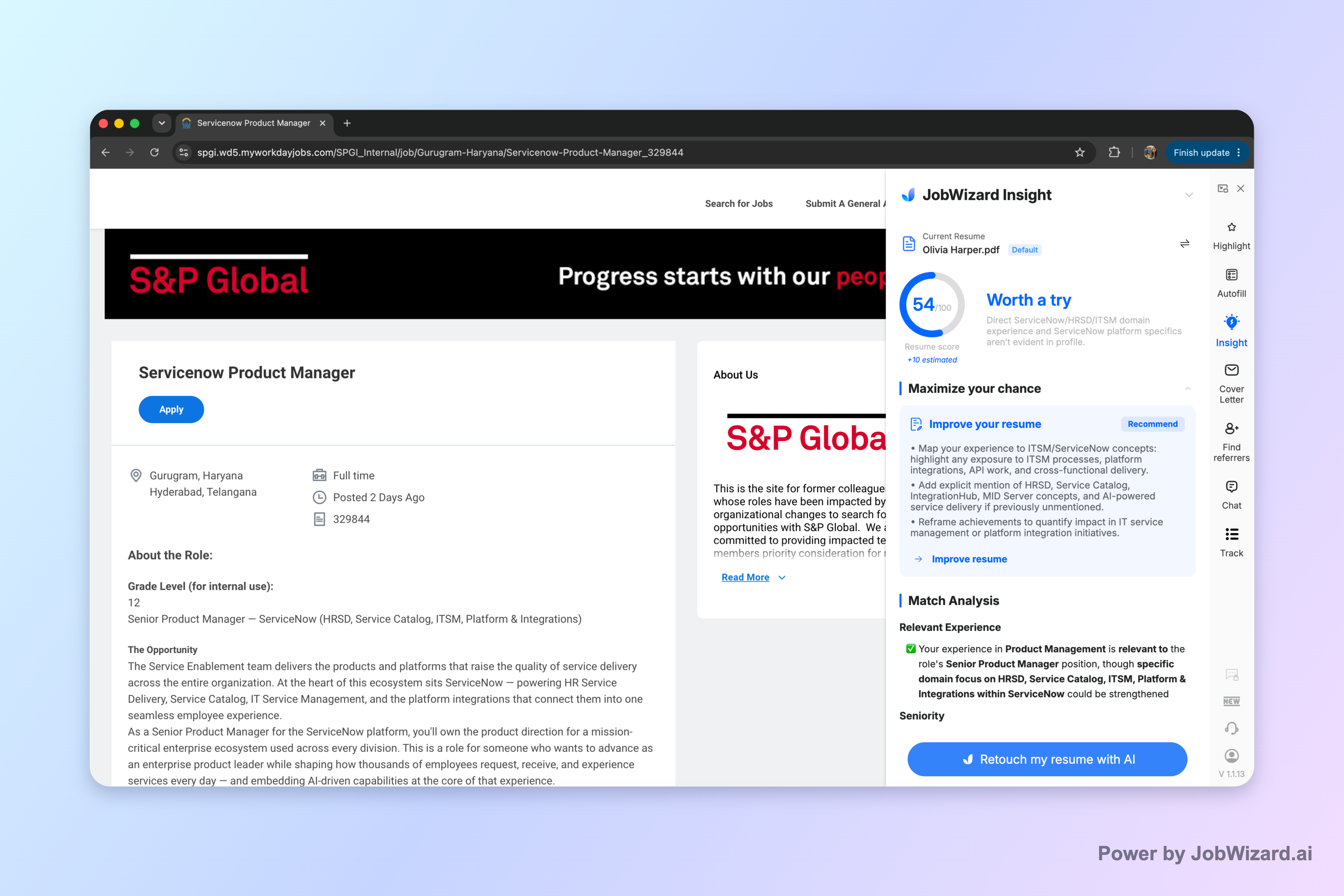
JobWizard Insight compares the selected resume with the current job description and presents a match score, an overall assessment, and improvement suggestions. It can identify resume expression gaps and turn them into an editable resume revision draft.
How to use the match score workflow responsibly
A match score is diagnostic, not destiny. Treat it like a checklist of places to improve clarity and relevance.
- Review the suggested gaps: Look at what the tool flags as missing or mismatched in your current wording.
- Decide what you can honestly claim: Only update bullets and skills where your experience supports the change.
- Keep the meaning consistent: Replace vague descriptions with JD-aligned terms, but don’t exaggerate scope or tools.
- Validate before you submit: Every suggested change needs your verification.
JobWizard’s JD-based diagnosis is designed to help you improve relevance and clarity—not to guarantee ATS passage or a hiring outcome. Users must verify every suggested resume change and keep only accurate experience.
When to prioritize keyword changes vs. content changes
If your resume already contains the core mechanical engineer resume keywords, the issue may be context. You might need to:
- Move a keyword into the section where the ATS expects it (Skills vs. Experience).
- Rewrite a bullet so the keyword appears in the action + scope (not just in a list).
- Add a missing responsibility-style bullet that matches the JD’s “what you’ll do.”
If your target role is in software-adjacent engineering or systems work, the same diagnostic approach can help. See ATS Resume Keywords for Software Engineers and ATS Resume Keywords for Software Engineer Roles: How to Match for examples of how to translate job requirements into resume language.
Keyword strategy for mechanical engineers: prioritize by frequency and requirement level
Mechanical engineer resume keywords should be prioritized, not treated equally—because the JD gives you ranking signals.
Hiring teams usually emphasize required requirements more strongly than preferences. Your resume should reflect that hierarchy by focusing first on what’s required, then what’s repeatedly referenced, then what’s “nice to have.”
Practical prioritization rules
- Required tools/methods first: If a method or software is repeatedly tied to qualifications, make it show up clearly.
- Repeated responsibilities second: If multiple responsibilities revolve around the same workflow (design → analysis → verification), structure bullets around that chain.
- Domain terms third: Industries or system domains (automotive, aerospace, HVAC, robotics integration) can be supporting signals—especially in summaries and project sections.
Avoid the “keyword list” trap
Mechanical engineering resumes that only paste keywords under Skills can be easy for ATS to parse—but weak for humans. The best approach is to pair each mechanical engineer resume keyword with credibility: the job role, the scope you owned, and what you produced.
For example, instead of only listing “GD&T” or “DFM,” connect them to real work:
- GD&T: “Applied GD&T to [drawings/part features] to clarify tolerances and reduce rework.”
- DFM: “Partnered with manufacturing to incorporate DFM changes and update documentation for revised part requirements.”
Do this automatically with JobWizard
Skip the manual work — JobWizard's Match Score handles this for you.
FAQ: Mechanical engineer resume keywords and ATS tailoring
Mechanical engineer resume keywords raise common questions—here are direct answers you can use while tailoring your resume.
How do I find the best mechanical engineer resume keywords for each job?
Start with the job description: extract the repeated responsibilities, required qualifications, and tooling keywords, then mirror those terms in your resume only where you can back them with your real experience. Use JobWizard’s JD Highlights to organize the JD into keyword-ready sections, then confirm each suggested wording matches your background before you apply.
Will mechanical engineer resume keywords guarantee ATS approval or an interview?
No. Using mechanical engineer resume keywords can improve relevance, but no keyword set guarantees ATS passage or a hiring decision. Always keep the content truthful and tailored to the job’s responsibilities, qualifications, and any custom questions.
What is a “match score” in a resume vs. job description workflow?
In JobWizard Insight, the selected resume is compared to the current job description, and it returns an overall assessment, improvement suggestions, and a match score. The goal is to surface expression gaps you can turn into an editable draft—then you verify every change and submit only what’s accurate.
Which mechanical engineering keyword categories should I prioritize first?
Prioritize (1) core technical skills/tools named in the job description, (2) relevant responsibilities and methods (e.g., analysis, design, verification), and (3) qualifications like years, certifications, or specific domain experience. If the JD lists structured items—such as design-for-manufacturing, FEA, GD&T, or test/validation—use those phrases as anchors for your resume sections, not just a keyword list.
Ready to tailor faster? Use JobWizard for JD Highlights + match-score verification
JobWizard helps you turn a specific mechanical engineering job description into structured keyword guidance, then check your resume against that JD so you can revise with confidence.
Open the target role, review its responsibilities, qualifications, and keywords, and use JD Highlights to extract the terms that matter. Then use Insight to compare your resume to the JD and review the identified gaps before you apply.
Start with JobWizard today—tailor your resume using mechanical engineer resume keywords pulled from the job itself, and verify updates with a resume vs. JD match workflow.
Frequently Asked Questions
See your resume's match score for any job
JobWizard compares your resume to each job description and shows the exact keywords to add — free.