
Computer Science Resume Keywords That Match Real Job Requirements (Without Guessing)
Learn how to choose computer science resume keywords that mirror a specific job description—then use JobWizard to review gaps before you submit. This guide shows ATS-ready phrasing for software, systems, and data roles.

Free Chrome extension
See your resume's match score for any job
JobWizard compares your resume to each job description and shows the exact keywords to add — free.
Computer science resume keywords start with the job description, not guesswork
If you’re hunting for computer science resume keywords, the fastest way to get unstuck is to stop guessing what “ATS wants” and instead extract what your target job description is asking for. Most roles repeat the same expectations across responsibilities and qualifications—those repeated terms are the signal you can mirror in your resume.
JobWizard can help you do this systematically by organizing a posting into keywords, role responsibilities, and qualifications so you can review requirements in a more structured way. That matters because tailoring isn’t just “add a list of skills”—it’s aligning your actual experience with the exact kinds of proof the role is evaluating.
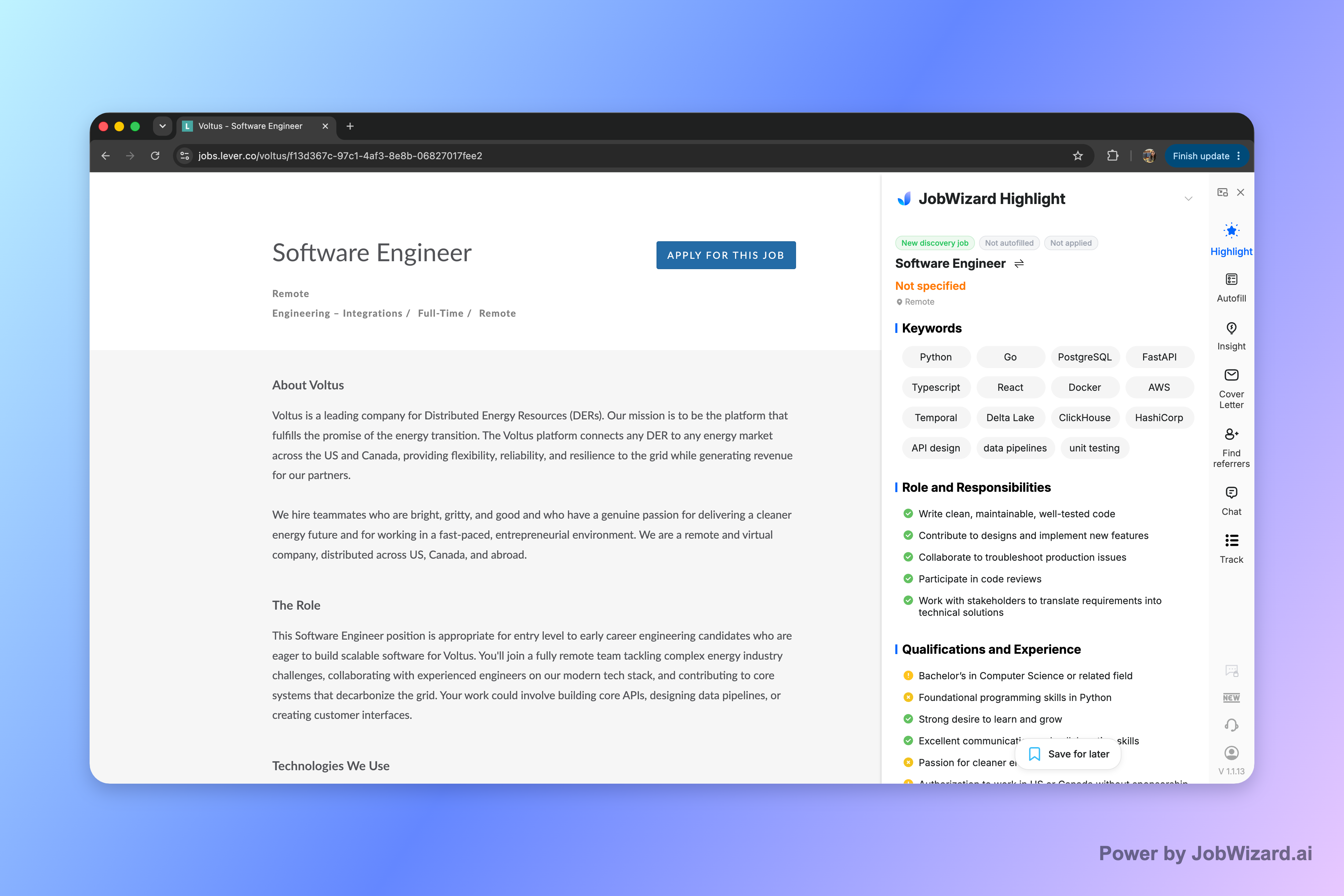
JD Highlights turns a long job posting into a structured view of key requirements—so you can focus your resume updates on what’s really being evaluated.
Extract the right keywords from the JD (and keep them truthful)
The best computer science resume keywords are the ones that map directly to what you’ve done and the way the role describes the work. When you pull keywords from the JD, you’re matching the terminology the hiring team uses to evaluate fit.
Here’s a practical way to extract keyword candidates from a JD without turning your resume into keyword spam:
- Scan responsibilities first for recurring verbs and systems language (build, design, optimize, debug, automate, deploy).
- Pull qualifications and requirements verbatim for tools, frameworks, and environments (example categories: backend frameworks, cloud platforms, CI/CD, data stores).
- Group into “proof buckets” (e.g., “backend APIs,” “data pipelines,” “testing,” “infrastructure,” “security”) so you can attach your experience to each bucket.
- Translate only what you can support—if the JD demands AWS and you used it, you can include it; if not, don’t copy it.
For many computer science roles, your keyword set will typically include a mix of:
- Programming languages (e.g., Java, Python, JavaScript/TypeScript, C++—include only those you can discuss confidently).
- Frameworks and libraries (e.g., React, Node.js, Spring, Django, .NET) tied to specific projects.
- Data and storage (e.g., SQL, PostgreSQL/MySQL, Redis, Kafka, Spark) based on your actual pipeline or service work.
- Cloud and deployment (e.g., AWS/GCP/Azure, Docker, Kubernetes) matched to your deployment experience.
- Quality and reliability (e.g., unit/integration testing, CI, monitoring, logging) anchored in outcomes you can defend.
- Systems and security (e.g., authentication/authorization, performance tuning, threat modeling) only if relevant.
Tip: Instead of adding every keyword you see, prioritize the ones that appear repeatedly or cluster into multiple qualification statements. That’s where recruiters tend to focus.
Use keyword “templates” for common CS tracks
Computer science resume keywords become much easier to use when you organize them into role-specific templates you can customize per job. Below are keyword groupings you can adapt for different computer science career paths.
Software engineering (backend / full-stack)
- Backend keywords: REST/GraphQL APIs, microservices, service design, authentication/authorization, caching, performance tuning.
- Stack keywords: Java/Spring or Python/Django or Node/Express—plus ORM tools if applicable (e.g., Hibernate, SQLAlchemy).
- Data keywords: SQL, indexing, migrations, query optimization; plus message queues if you used them.
- Delivery keywords: CI/CD, Docker, version control (Git), test automation, monitoring/logging.
Data engineering / analytics engineering
- Pipeline keywords: data ingestion, transformations, ETL/ELT, schema design, data quality checks.
- Tooling keywords: SQL + specific engines (Spark, etc.) and orchestration if listed in the JD.
- Storage keywords: data warehouses/lakes, partitioning strategies, and file formats if mentioned.
- Reliability keywords: backfills, idempotency, alerting, and monitoring of pipeline health.
Machine learning / ML engineering
- ML keywords: model training, feature engineering, evaluation metrics, experimentation/AB testing.
- Production keywords: deployment/inference pipelines, model versioning, drift monitoring, reproducibility.
- Data keywords: dataset curation, labeling pipelines, data preprocessing.
- Engineering keywords: Python tooling, testing, performance profiling—only if you used them.
Systems / infrastructure / security-adjacent roles
- Systems keywords: Linux, networking concepts, performance profiling, observability.
- Infrastructure keywords: infrastructure automation, configuration management, containerization (if used).
- Security keywords: authentication/authorization, secrets management, secure coding practices.
As you tailor, keep your resume readable. Keyword alignment works best when each keyword is backed by concrete project context (what you built, what changed, what you improved, and what you learned).
Tailor faster with JobWizard Insight (match score + revision suggestions)
Keyword alignment is easier when you have feedback on what your resume is missing compared with the specific job description. JobWizard Insight is designed for that kind of targeted iteration.
With Insight, JobWizard compares your selected resume with the current job description and provides a match score, an overall assessment, and improvement suggestions. It can also identify resume expression gaps and turn them into an editable resume revision draft—so you can update wording and structure without starting from scratch.
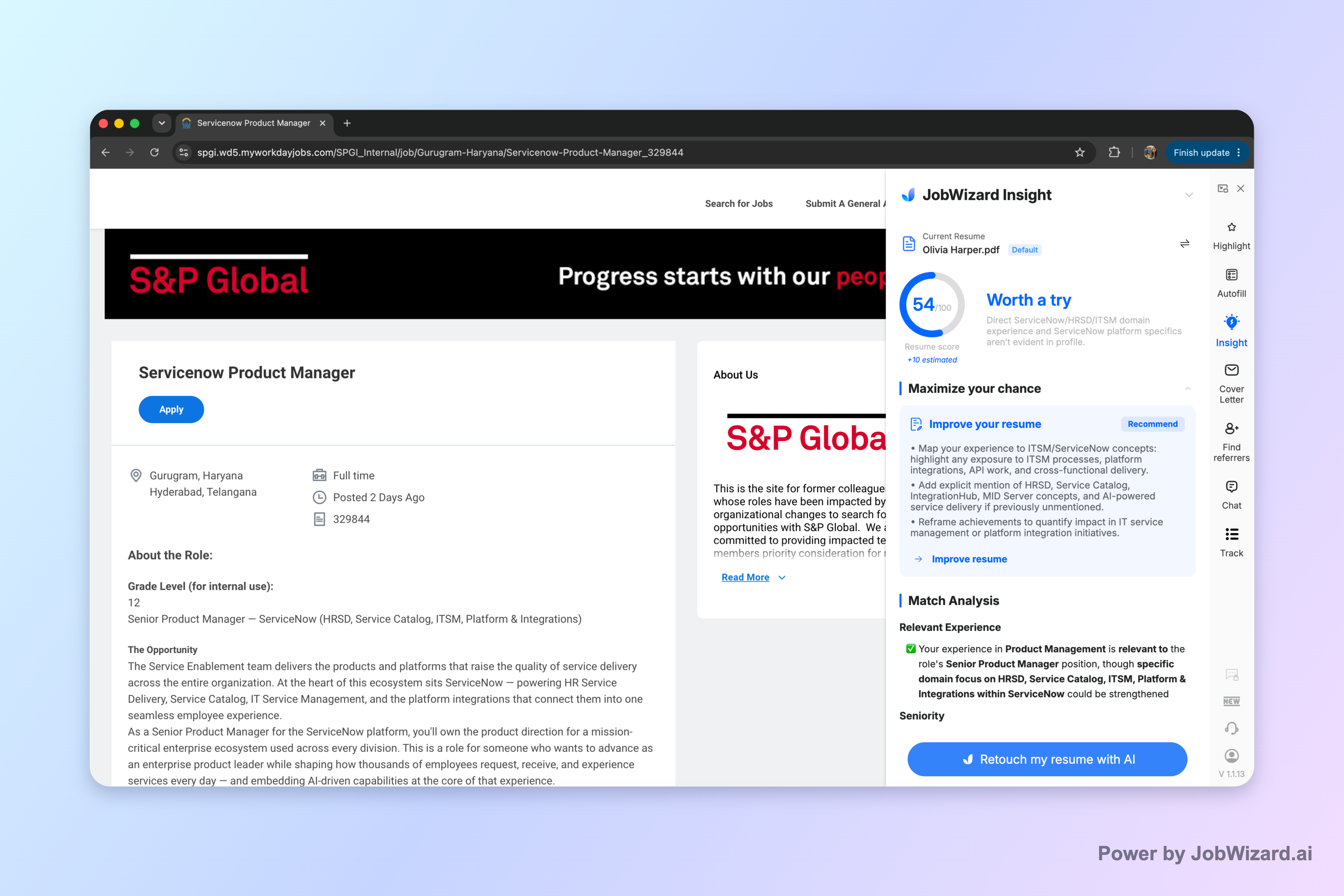
Insight compares your resume to the job description and highlights gaps you can turn into specific next steps.
Important: The match score is not a hiring probability and does not guarantee ATS passage or an interview. You still need to verify every suggested resume change and keep only accurate experience.
Use this workflow when you’re tailoring for computer science roles:
- Run the comparison between your resume and the exact job description you plan to apply to.
- Review the gaps and identify which missing phrases map to real experiences you can credibly support.
- Update phrasing, not truth—only keep improvements that match your actual work.
- Re-read for clarity so your bullet points remain specific, not just keyword-stuffed.
- Submit yourself after you confirm everything is accurate and complete.
If you want deeper keyword strategy for different roles, you can also use these resume keyword guides as additional references:
- How to Optimize Resume for ATS: A Practical 2026 Checklist for a broader ATS-ready workflow.
- Executive Resume Keywords: Match the JD Without Sounding Generic if you’re applying above entry-level and need keyword precision without filler.
And if you’re cross-applying across adjacent engineering disciplines, these can help you think about how keywords shift by role:
- Keywords for Electrical Engineer Resume: 35 ATS-Ready Terms to Match Real Job Requirements
- Pharmaceutical Sales Resume Keywords: JD-Matched Phrases That Pass ATS Without Sounding Generic
Avoid common CS keyword mistakes that hurt your resume
Computer science resume keywords can backfire when they’re added in the wrong way—either misleadingly or without context. Here are the most common pitfalls and how to fix them.
1) Keyword lists instead of proof
If your resume reads like a dump of technologies with no description, it can look non-credible. Make sure each major keyword appears in context (what you built, what you changed, and what you measured or improved).
2) Copy-pasting the JD without matching your experience
Exact wording is useful only when it reflects your actual work. If you didn’t do it, replacing “similar” with “identical” creates inconsistency and reduces trust.
3) Missing the “how” behind the “what”
For CS roles, it’s rarely enough to list tools. Hiring teams look for signals like testing approach, performance considerations, data quality, deployment process, and operational ownership—based on what the JD emphasizes.
4) Over-indexing on one keyword category
Even for the same job title, some postings emphasize backend APIs while others emphasize data, reliability, or infrastructure. Tailor across categories to match the responsibilities and qualifications you actually see in the JD.
5) Forgetting to keep changes verifiable
Use tooling to identify gaps, but always verify that each suggested resume change is accurate. JobWizard Insight specifically expects you to review and keep only truthful updates.
Fast reminder: Tailoring is best thought of as “autofill + review-before-submit” — repetitive fields can be filled quickly, but sponsorship/salary/EEO/custom questions and any edits you approve should remain under your control.
If you’re planning to apply soon, take advantage of the JD-based workflow: open the target role, review responsibilities, qualifications, and keywords, then use JobWizard to identify gaps you can update while keeping your experience accurate.
Do this automatically with JobWizard
Skip the manual work — JobWizard's Match Score handles this for you.
Computer science resume keywords FAQ
What are computer science resume keywords, exactly?
Computer science resume keywords are the technical terms, skills, tools, and experience phrases recruiters and ATS look for—usually pulled directly from the job description’s responsibilities, qualifications, and requirements.
How do I find the right computer science resume keywords for a specific job?
Start by reading the job description closely, then extract the repeated requirements (skills, frameworks, cloud platforms, data formats, testing and deployment tools). Use JobWizard’s JD Highlights to organize those keywords so you can tailor your resume around what the role actually asks for.
Will adding more computer science resume keywords guarantee ATS passage or an interview?
No. Adding relevant terms can improve how well your resume matches the job description, but it does not predict ATS decisions or guarantee an interview. You still need to keep every change accurate to your real experience.
What’s the fastest way to tailor my resume without rewriting everything?
Use JobWizard Insight to compare your resume with the current job description. It provides a match score, an overall assessment, and improvement suggestions that identify resume expression gaps—then you can turn those into an editable resume revision draft and verify everything before submitting.
Should I use the exact wording from the job description?
Use the job description’s terminology when it reflects your experience, but don’t copy what you can’t support. Aim for keyword alignment with truthful, specific accomplishments and project details—so your resume reads naturally while still matching requirements.
Ready to tailor your resume with confidence? Open the job you want, review its responsibilities and qualifications, then use JobWizard Insight to compare your resume to that exact job description and update the keyword gaps before you submit.
Frequently Asked Questions
See your resume's match score for any job
JobWizard compares your resume to each job description and shows the exact keywords to add — free.