Executive Resume Keywords: Match the JD Without Sounding Generic
Learn executive resume keywords that map to job description (JD) requirements—so your resume reads executive-level while staying ATS-friendly.

Free Chrome extension
See your resume's match score for any job
JobWizard compares your resume to each job description and shows the exact keywords to add — free.
Executive resume keywords help you mirror the JD’s requirements without changing who you are—here’s the playbook to do it
When you’re targeting leadership and C-suite roles, executive resume keywords are more than “ATS phrases.” They’re the specific wording a job description uses to describe leadership scope, transformation initiatives, governance, and the skills needed to run a business unit—so your resume signals fit fast to both ATS and human reviewers.
The problem: many tailored resumes become either (a) keyword soup that sounds generic, or (b) an impressive executive narrative that quietly misses what the JD is actually asking for. The solution is a structured workflow: extract what matters, map it to your real experience, then revise your bullets and sections so they read like an executive wrote them—only more aligned.
Start with JD highlights to extract the real keyword clusters executives are judged on
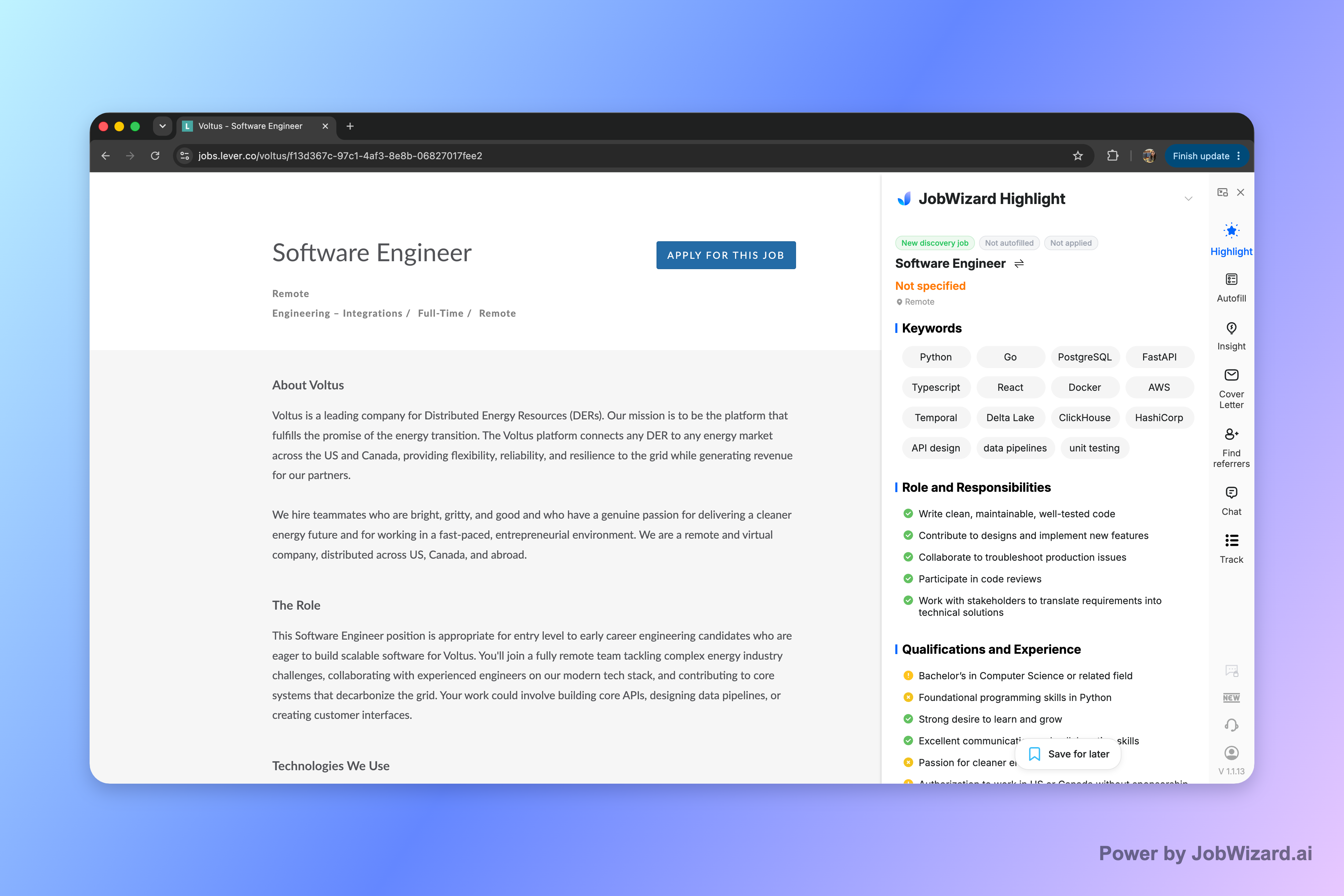
The job description is the authoritative source for what the hiring team is filtering for. Start by selecting your target role and reviewing its requirements in a structured view so you can clearly separate keywords, responsibilities, and qualifications.
JobWizard can organize a job description into keywords, role responsibilities, and qualifications so you can review the requirements more systematically. That matters because executive resumes typically fail in one of three ways: the right skills are present but expressed differently, the leadership scope is missing, or the governance/operating requirements aren’t reflected in the language of the role.
Use keyword clusters (not random words)
For executive roles, the best keyword strategy is clustering: themes you can point to across your Summary, Experience bullets, and Skills. Common clusters include:
- Leadership scope: “enterprise,” “cross-functional,” “VP-level,” “board/exec stakeholders,” “global operations,” “P&L ownership.”
- Transformation & operating model: “turnaround,” “process redesign,” “operating cadence,” “continuous improvement,” “org effectiveness.”
- Strategic execution: “strategy development,” “roadmap,” “portfolio prioritization,” “business planning,” “OKRs.”
- Functional mastery: the role’s domain requirements (e.g., finance governance, risk/compliance, supply chain operations, commercial execution).
- Measurement & outcomes: the JD’s preferred metrics language (cost, revenue growth, margins, cycle time, quality, risk reduction).
Where to place executive resume keywords
To keep your resume executive-forward (not stuffed), place keywords where they naturally do work:
- Summary: reflect the highest-level “fit signals” (scope, transformation, outcomes, enterprise systems) in 3–4 lines.
- Experience bullets: mirror JD responsibilities using one “what you owned” + one “how you led” + one “what changed” pattern.
- Skills/Competencies: include functional and leadership categories, plus tools/controls if they’re relevant to the JD.
Tip: Don’t paste the JD. Instead, translate the JD’s intent into your verified experience using the same concept vocabulary.
For role-specific keyword patterns, you may find it useful to compare approaches across functions. If you’re aiming at leadership roles with heavy ATS filtering, you’ll likely benefit from these related guides: How to Optimize Resume for ATS: A Practical 2026 Checklist and Resume Keywords for Managers: ATS-Ready Phrases That Prove Leadership Impact. If your executive target sits in a specific domain, use the cluster approach from Supply Chain Resume Keywords: Build a JD-Accurate ATS Strategy (Without Guessing) or the JD-matched phrasing mindset from Pharmaceutical Sales Resume Keywords: JD-Matched Phrases That Pass ATS Without Sounding Generic.
Revise your bullets with a “JD intent → your evidence” method so keywords feel earned
Once you extract the right clusters, the real work is rewriting bullets so they map to the JD’s intent. The goal is accuracy plus alignment: executive resume keywords should appear in the exact places where your achievements already support them.
Follow this 4-step executive rewrite workflow
- Underline the JD verbs: responsibilities often start with specific verbs (“own,” “lead,” “drive,” “develop,” “oversee”).
- Choose your closest real ownership: what did you personally lead—scope, geography, org size, budgets, stakeholder groups?
- Match the measurement language: use the JD’s preferred way of describing results (cost/risk/growth/efficiency) when it fits your history.
- Rewrite, then verify: keep wording natural, ensure every claim is true, and remove anything that can’t be defended.
Before/after examples (executive-level, not keyword soup)
Below are examples of how to align to common leadership keyword patterns without turning your resume into a copy of the JD.
| JD intent keyword cluster | What “good” sounds like | What to avoid |
|---|---|---|
| Operating model & cadence | “Established an enterprise operating cadence to align strategy-to-execution across functions, improving delivery predictability and decision turnaround.” | “Operating cadence, operating model, cadence improvement, alignment, alignment alignment…” |
| Governance & risk/compliance | “Overhauled governance controls and escalation pathways to reduce enterprise risk exposure while maintaining compliance requirements.” | “Governance, risk, compliance, controls, compliance controls…” (no action, no scope, no evidence) |
| Transformation / turnaround | “Led a turnaround program by redesigning the cost structure and stakeholder communications, restoring margin performance within the planning cycle.” | “Turnaround transformation turnaround transformation.” |
| Cross-functional leadership | “Partnered with Finance, Operations, and Engineering to deliver a prioritized portfolio roadmap, aligning resourcing to business outcomes.” | “Cross-functional leadership skills: finance operations engineering portfolio roadmap…” |
Common executive resume keyword traps
- Keyword stuffing: repeating the same phrase without adding meaning.
- Scope mismatch: using terms like “enterprise” or “global” when your actual ownership was narrower.
- Outcome mismatch: using metrics language from the JD even if you can’t substantiate comparable results.
- Section mismatch: listing leadership competencies in a Skills section but not reflecting them in Experience bullets.
If you want a deeper ATS foundation before or alongside this tailoring step, revisit How to Optimize Resume for ATS: A Practical 2026 Checklist and then focus on the leadership phrasing approach from Resume Keywords for Managers: ATS-Ready Phrases That Prove Leadership Impact.
Use Insight to spot resume expression gaps and turn them into an editable revision draft
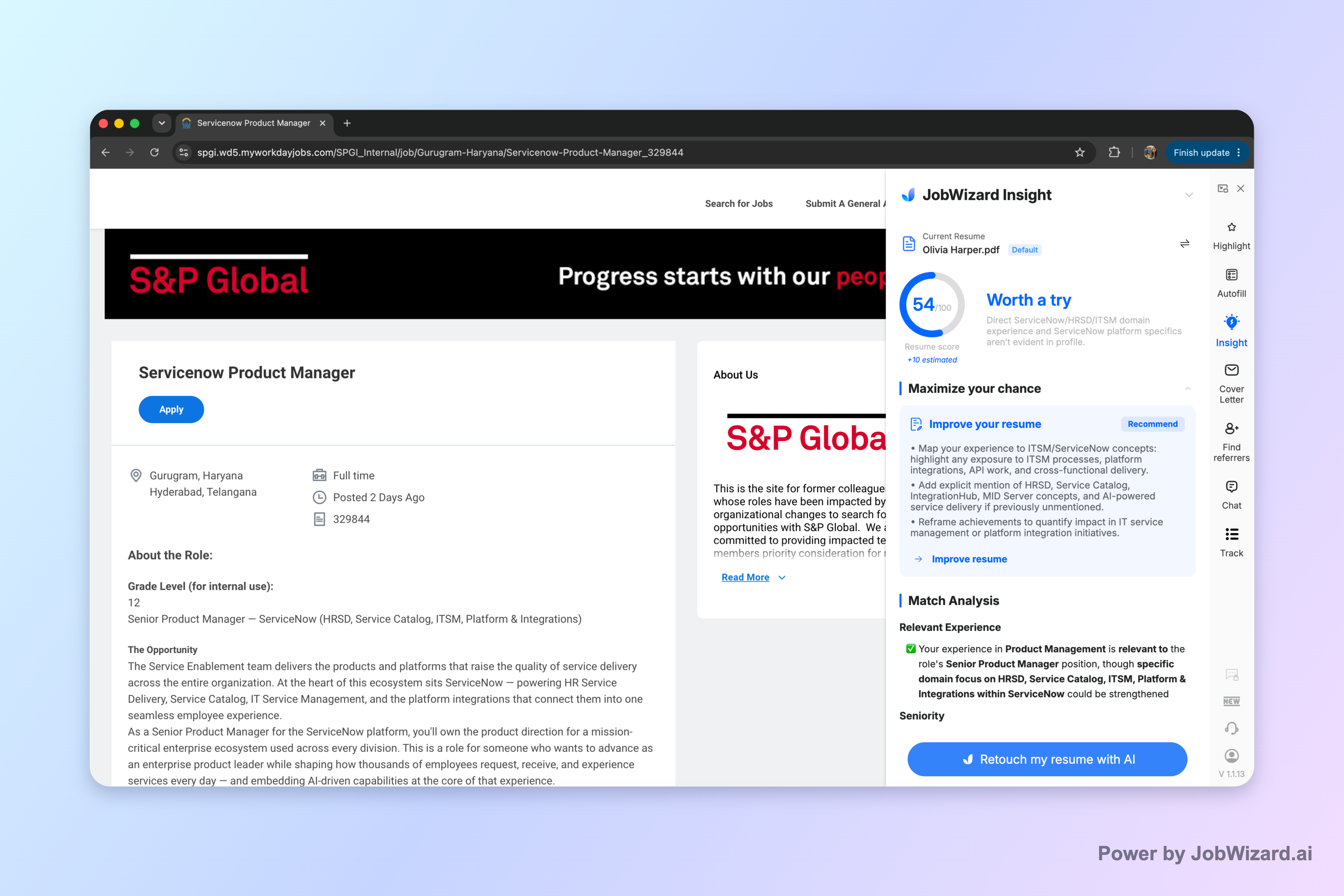
Even careful tailoring can miss the way a JD expresses requirements. That’s where a JD-to-resume comparison helps you find gaps in expression—so you can revise with confidence instead of guessing. JobWizard Insight compares the selected resume with the current job description and presents a match score, an overall assessment, and improvement suggestions.
What Insight does (and what it doesn’t)
JobWizard’s JD-based diagnosis can identify resume expression gaps and turn them into an editable resume revision draft. That means you can translate “missing themes” into concrete bullet changes.
Important limitation: the score is not a hiring probability and does not guarantee ATS passage or an interview. Users must verify every suggested resume change and keep only accurate experience.
How to use the match score without overreacting
Think of the match score as a prioritization tool, not a verdict. If the diagnosis flags gaps, your job is to decide whether you can responsibly close them with real evidence.
- If the gap is true: update bullets/Summary and ensure the new wording matches your experience.
- If the gap is unclear: refine the bullet to reflect the closest verified equivalent (same intent, accurate facts).
- If the gap is not yours: don’t add the keyword. Instead, remove the placeholder phrasing and keep your resume honest.
Executive-tailoring checklist (quick scan)
- Summary includes enterprise scope + transformation theme + measurement language you can defend.
- Experience bullets mirror JD responsibilities with leadership verbs and credible outcomes.
- Skills/Competencies reflects functional and governance categories that appear in the JD.
- Consistency: titles and ownership are aligned (no inflated scope).
Build an executive keyword bank you can reuse across roles—then tailor the top 20%
Executive hiring managers reward specificity. The best approach is a two-layer system: a reusable keyword bank for your proven strengths, plus role-specific tailoring for the JD’s unique priorities. The result is that executive resume keywords stay consistent with your executive brand while still aligning to each job.
Create your executive keyword bank (with proof)
Start with your strongest, most defensible themes. For each theme, write the evidence you’d use in a bullet (scope, action, metric/outcome). Build categories like:
- Enterprise leadership & stakeholder management
- Transformation programs (operating model, turnaround, PMO cadence)
- Governance, risk, compliance controls (only if relevant)
- Strategic planning & portfolio prioritization
- Functional excellence (domain-specific)
Tailor the top 20% that changes the impression
When you target a new executive role, you don’t need to rewrite everything. Focus on the parts most likely to affect ATS expression and recruiter scanning.
- Top Summary lines: swap in role-relevant scope and transformation framing.
- 2–4 Experience bullets per role: revise the ones closest to JD responsibilities.
- Skills categories: update only the categories that appear in the JD.
- Keywords in context: ensure every keyword is tied to an action or outcome.
How to keep it from sounding generic
- Use your language: match JD intent but keep your phrasing executive and concrete.
- Add credible constraints: “under tight timelines,” “across multiple geographies,” “within compliance requirements.”
- Vary your verbs: leaders don’t “managed managed managed.” Use “owned,” “led,” “redesigned,” “governed,” “transformed,” “scaled,” when truthful.
If your executive path crosses a specific domain, you can adapt the cluster strategy from these pages: Supply Chain Resume Keywords: Build a JD-Accurate ATS Strategy (Without Guessing) and the JD-phrase alignment mindset from Pharmaceutical Sales Resume Keywords: JD-Matched Phrases That Pass ATS Without Sounding Generic.
Do this automatically with JobWizard
Skip the manual work — JobWizard's Match Score handles this for you.
FAQs about executive resume keywords (and how to apply them safely)
What are executive resume keywords (and where should I put them)?
Executive resume keywords are the specific phrases from a job description—especially around leadership scope, transformation, metrics, and functional requirements—that you reflect accurately in your resume. Put them in your Summary, the most relevant Experience bullets, and the Skills/Competencies section (without forcing unrelated terms).
How do I choose executive resume keywords without sounding generic?
Pick only keywords you can support with real experience. Use the JD highlights to extract responsibilities and qualifications, then rewrite your most relevant bullets so they mirror the intent (scope, outcomes, tools, governance) while keeping your wording natural and verifiable.
Will adding executive resume keywords guarantee ATS approval or an interview?
No. Adding executive resume keywords can improve alignment, but it does not predict an ATS decision or guarantee an interview. You still need to verify each change is accurate to your background and meets the role’s actual requirements.
What executive resume keyword gaps should I look for during tailoring?
Look for gaps in expression: missing functional requirements (e.g., operating model, turnaround, compliance, enterprise systems), leadership scope (org size, stakeholders), and the way the JD frames outcomes (cost, growth, risk, transformation). A JD-based diagnosis can surface these gaps as an editable revision plan, but you must review for accuracy.
How can JobWizard help me find and revise executive resume keywords for a specific role?
JobWizard can turn a long job description into a structured view of keywords, role responsibilities, and qualifications so you can review requirements systematically. Then Insight compares your resume with the job description, shows a match score and improvement suggestions, and turns gaps into specific next steps you can edit before submitting.
Ready to tailor like an executive? Open the target job description, extract its responsibilities and qualifications, then use JobWizard Insight to identify resume expression gaps—so your executive resume keywords are aligned, accurate, and written to pass review-before-submit.
Frequently Asked Questions
See your resume's match score for any job
JobWizard compares your resume to each job description and shows the exact keywords to add — free.