
Supply Chain Resume Keywords: Build a JD-Accurate ATS Strategy (Without Guessing)
Learn how to use supply chain resume keywords to mirror job requirements, pass ATS keyword matching, and tailor your resume with evidence from each job description.

Free Chrome extension
See your resume's match score for any job
JobWizard compares your resume to each job description and shows the exact keywords to add — free.
If you’re applying for supply chain roles and getting “no” responses, the issue is often not your experience—it’s your supply chain resume keywords not aligning with what the job description actually asks for. ATS systems frequently scan for specific terms tied to qualifications, responsibilities, and tools, so generic wording can under-match even a strong resume.
The fastest way to improve is to treat keyword selection as evidence-based: pull the terms from the posting, then revise your resume language to match what you truly did. In this guide, you’ll learn a repeatable workflow for finding the right supply chain resume keywords, placing them in the right resume sections, and tailoring without guesswork.
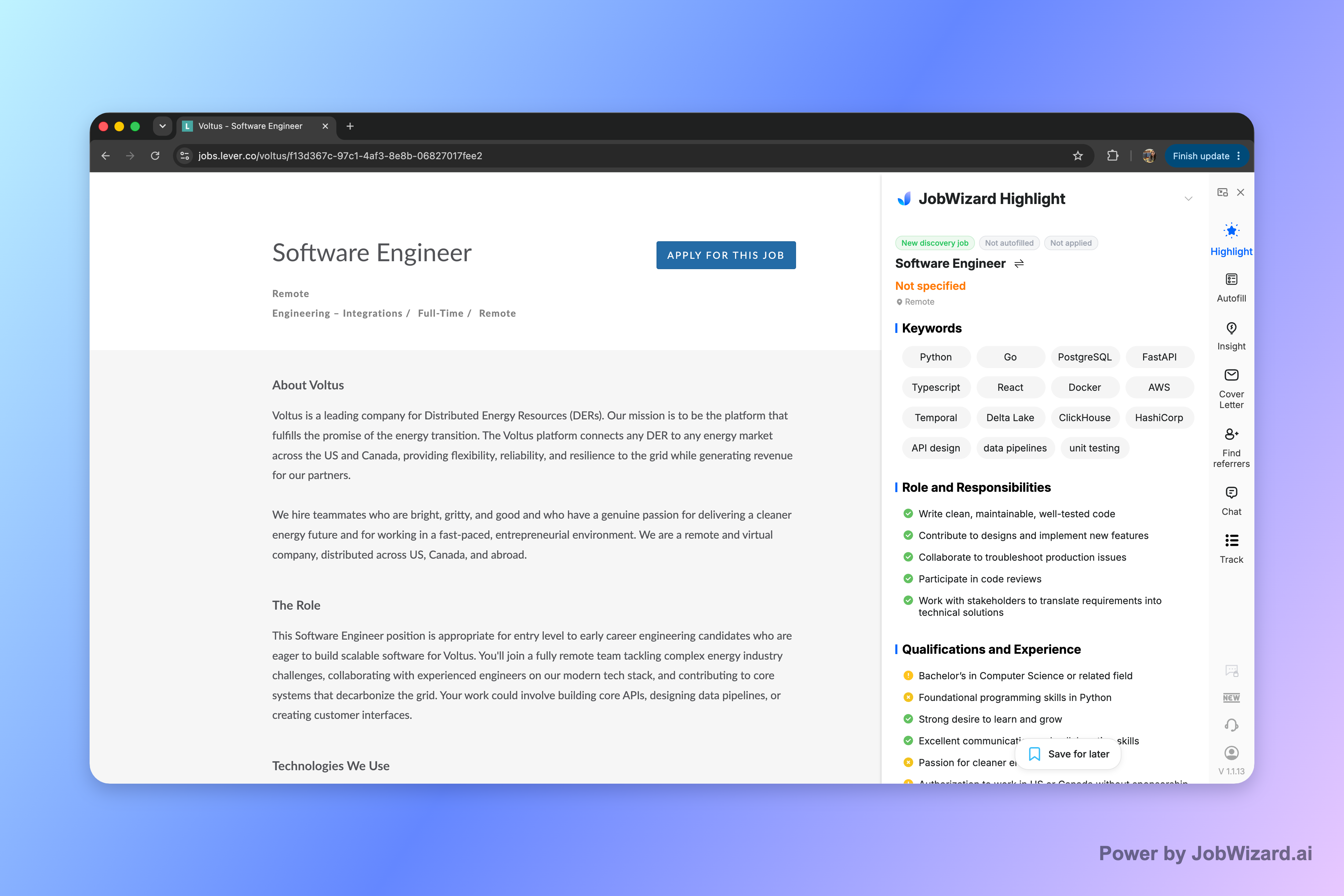
JobWizard turns a long job description into a structured view of keywords, responsibilities, and qualifications so you can review the requirements more systematically.
Start with job-description keywords, not guesswork
Your first move should be extracting the hiring team’s language. For supply chain roles, the “correct” keyword set changes by function (planning vs. warehouse vs. procurement vs. logistics) and by seniority (coordinator vs. analyst vs. manager).
Use the job description (JD) as your source of truth, and capture three buckets of terms: qualifications (what you must have), responsibilities (what you’ll do), and tools/process terms (systems and methods). This prevents the common mistake of stuffing your resume with a random “keywords list” that doesn’t reflect the posting.
What to extract from the posting (copy and paste friendly)
- Responsibilities: verbs and action phrases (e.g., forecast, coordinate, reconcile, expedite, monitor).
- Qualifications: required skills and experience statements (e.g., “2+ years in inventory control”).
- Systems & methods: ERP/WMS/TMS names, metrics, and process terms (e.g., inventory accuracy, cycle counting, S&OP;).
- Cross-functional scope: who you partner with (production, procurement, customer service, 3PLs, carriers).
If you want a structured approach, use JobWizard’s JD Highlights view to break the posting into the keywords and requirement sections you’ll need to review before you apply.
Map supply chain resume keywords to your experience
Once you have JD terms, you need to prove them with your resume content. The goal isn’t to repeat every keyword—it’s to express the same capabilities in a way that matches the posting.
A strong mapping step reduces “skills gap” ambiguity: you can see where your resume uses different wording than the JD, then revise with accuracy. JobWizard’s Insight feature can compare your resume with the job description and identify expression gaps, turning them into specific next steps.
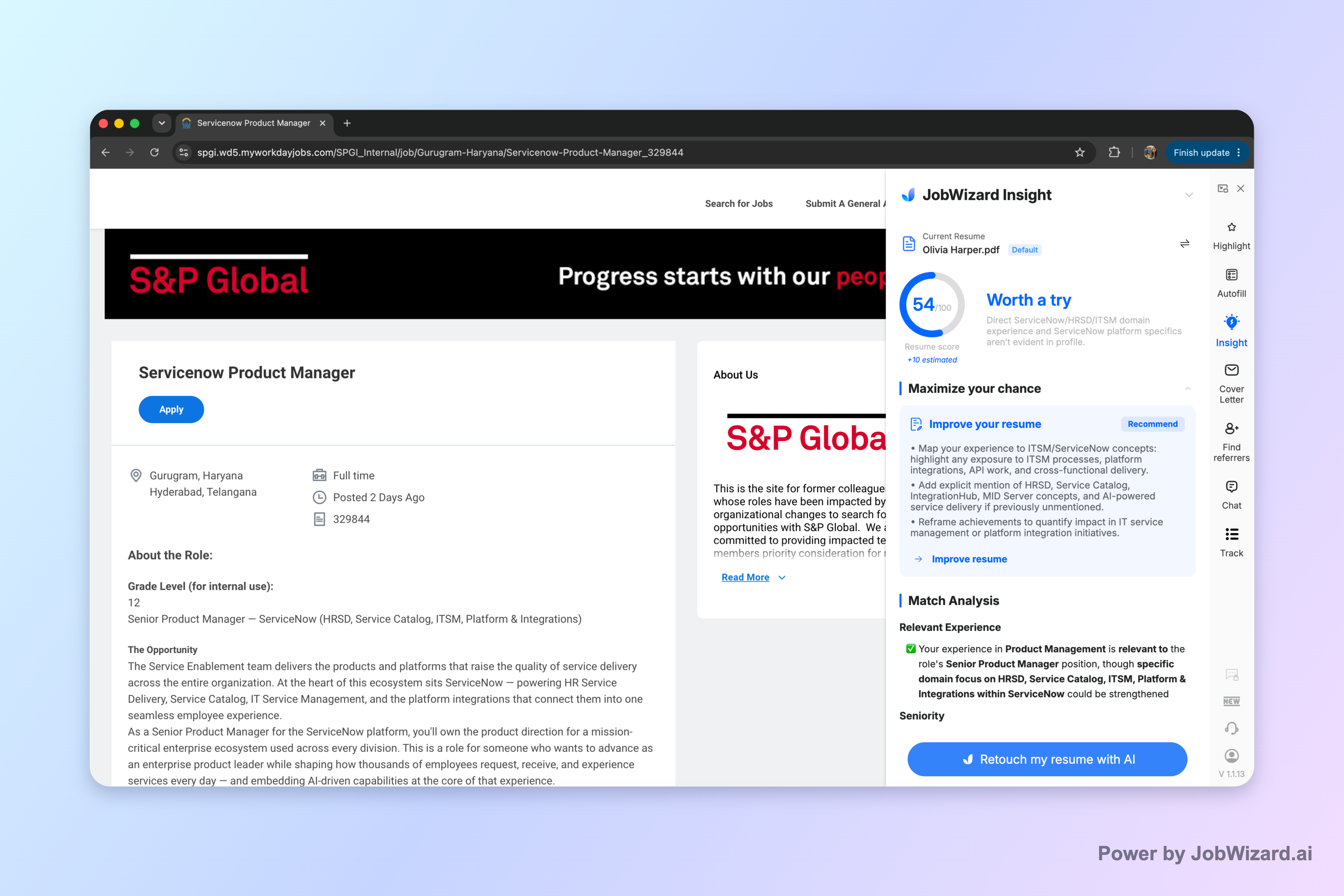
Insight compares your resume with the job description and shows a match score, improvement suggestions, and an editable revision draft based on identified gaps.
How to map keywords without padding
- Pick 8–15 highest-signal terms from the JD (not every keyword on the page).
- Attach each term to a real task you owned (what you did, for what scope, using what process).
- Use the JD’s wording when it’s true—especially for tools, certifications, and core processes.
- Keep metrics factual: only include numbers you can explain and defend.
- Review-before-submit: verify every suggested change still reflects your actual experience.
Important: the match score is not a hiring probability and does not guarantee ATS passage or an interview. Use it as a diagnostic tool, then confirm accuracy yourself.
Examples of keyword-to-bullet alignment (practical)
| Job description language | What to revise on your resume | Example bullet you can adapt |
|---|---|---|
| Inventory accuracy / inventory control | Experience section needs the same inventory-control framing | “Supported inventory accuracy through cycle counts, discrepancy investigation, and root-cause follow-up across stocked locations.” |
| Demand planning / forecasting | Planning responsibilities should include forecast inputs and cadence | “Contributed to demand forecasting by consolidating historical orders, SKU-level constraints, and lead-time considerations for planning reviews.” |
| Procurement / supplier coordination | Procurement scope must show supplier interaction, order management, and timeline control | “Coordinated with suppliers to confirm lead times, manage purchase order status, and resolve order issues to meet production needs.” |
| Warehouse operations / logistics coordination | Warehouse bullets should show operations flow (receiving, picking, shipping) and outcomes | “Assisted with warehouse logistics coordination by tracking inbound/outbound movements, updating shipment status, and escalating exceptions for resolution.” |
| 3PL / carrier communication | Include the same “third-party logistics” language where it fits | “Partnered with 3PLs and carriers to coordinate pickups, monitor delivery milestones, and support issue resolution for time-sensitive shipments.” |
Place supply chain resume keywords where ATS expects them
Even great keyword selection can fail if the terms aren’t placed in scannable sections. ATS systems typically parse structured resume areas and emphasize experience/skills language that mirrors the JD.
Use this placement checklist to make your supply chain resume keywords easy for recruiters and ATS to find—without turning your resume into a keyword dump.
Where keywords should go
- Experience bullets: best location for action + scope + tools (e.g., “coordinated shipments using TMS”).
- Skills section: tools, systems, and core process terms (only what you can support).
- Summary (if you use one): 3–5 lines that align to the JD’s function and seniority.
- Certifications / training: include only if relevant (e.g., safety, quality, logistics programs—when applicable).
- Education: add logistics/supply chain coursework only if it strengthens the target role.
A quick “section-fit” test
For each target keyword, ask: “Is this keyword describing something I actually did, or is it just a term I’m hoping the ATS wants?” If it’s not backed by your experience, revise bullets or remove the term.
This keeps your resume credible and reduces time wasted on revisions that don’t improve alignment.
Build a tailored keyword process you can repeat for every posting
Tailoring doesn’t need to be slow. The trick is to make a repeatable loop: extract → map → revise → verify. That’s also where JobWizard’s workflow helps you stay consistent.
Use the process below for every supply chain application so your resume language stays evidence-based and job-specific, including JD Highlights review and Insight-driven gap diagnosis.
Repeatable workflow (15–30 minutes per role)
- Open the target role and review responsibilities, qualifications, and keyword cues.
- Extract the priority keywords (focus on tools, core processes, and qualification phrases).
- Map keywords to your bullets by rewriting 2–4 bullets to mirror the JD’s responsibilities language.
- Run a resume-vs-JD comparison to find expression gaps and generate an editable revision draft.
- Review-before-submit: verify each suggested change is accurate, then keep only what you can defend.
That’s the real advantage of this approach: you’re not chasing “what an ATS wants,” you’re matching the JD’s evidence expectations with your real experience.
Supply chain resume keywords by job type (use as a starting point)
Below are common keyword categories you’ll see across supply chain postings. Treat these as prompts to start your extraction step—not as a one-size-fits-all list.
Pick the categories that match the job’s function, then use the JD to select the exact phrasing and scope.
Common keyword clusters (by supply chain function)
| Job function | High-signal keyword categories | What to look for in the JD |
|---|---|---|
| Inventory control | inventory accuracy, cycle counting, discrepancy resolution | methods/cadence, root-cause ownership, systems used |
| Demand planning | forecasting, demand signals, planning cadence | inputs (orders, seasonality), collaboration, forecasting tools |
| Procurement | purchase orders, supplier management, lead times | vendor communication, supplier scorecards, PO lifecycle |
| Warehouse operations | receiving, picking/packing, shipping coordination | workflow responsibilities, WMS/TMS language, exception handling |
| Logistics / transportation | expedite, shipment tracking, carrier coordination | lanes, milestone SLAs, escalation triggers |
| 3PL management | third-party logistics, handoffs, performance monitoring | what “performance” means (on-time, damage, volume) |
If you want a fast evidence-based refinement, use JobWizard to organize the job description into keywords, responsibilities, and qualifications—then update your resume bullets using the JD wording only where it matches your experience.
Do this automatically with JobWizard
Skip the manual work — JobWizard's Match Score handles this for you.
FAQ about supply chain resume keywords
What are supply chain resume keywords, and why do they matter for ATS?
Supply chain resume keywords are the specific terms hiring teams use for logistics, procurement, inventory, warehouse operations, planning, and related responsibilities. They matter because ATS systems often scan resumes for those exact (or close) terms as part of matching against the job description’s requirements.
How do I find the right supply chain resume keywords for a specific job?
Pull the keywords directly from the job description: responsibilities, job requirements/qualifications, and any listed tools or systems. Then map each keyword to real, accurate experience on your resume (project outcomes, scope, processes you owned, and tools you used). Avoid adding keywords you can’t support with your background.
Should I use a “keyword list” section on my supply chain resume?
In most cases, you’ll get better results by embedding supply chain resume keywords in the experience and skills sections where they naturally describe what you did. Add a keyword-focused skills line only if it still matches your real experience and the job description—otherwise you risk looking padded or inaccurate.
Can JobWizard help me tailor supply chain resume keywords to my target role?
Yes. JobWizard can organize a job description into keywords, role responsibilities, and qualifications so you can review requirements systematically, and it can compare your resume against the job description to surface expression gaps and produce an editable revision draft. You still need to verify every change and keep only accurate experience before applying.
Do match scores guarantee ATS passage or an interview?
No. The match score is not a hiring probability and does not guarantee ATS passage or an interview. Use it as a diagnostic signal to improve alignment, then review-before-submit to ensure your resume remains accurate and truthful.
Quick reality check: the goal is better alignment with the job description—not blind keyword stuffing or assumptions. You’ll get the best results when your supply chain resume keywords reflect your real scope, tools, and responsibilities.
If you’re ready to tailor faster, open your target job posting in JobWizard, use JD Highlights to capture responsibilities/qualifications keywords, then run Insight to compare your resume and tighten expression gaps—so your supply chain resume keywords match the role you’re actually applying for.
CTA: Try JobWizard now—start by pasting the job description, then review the highlighted keywords and use the gap suggestions to revise your resume before you submit.
Frequently Asked Questions
See your resume's match score for any job
JobWizard compares your resume to each job description and shows the exact keywords to add — free.