Business Intelligence Resume Keywords That Beat ATS: JD-Matched Phrases for Real Work
Use business intelligence resume keywords to translate your experience into ATS-friendly phrases—then verify each change against the job description and requirements before you apply.

Free Chrome extension
See your resume's match score for any job
JobWizard compares your resume to each job description and shows the exact keywords to add — free.
If you’re applying for business intelligence roles and getting generic rejections, it’s often because your business intelligence resume keywords don’t line up with the language in the job description. ATS systems typically scan for recognizable skills, responsibilities, and qualification phrases—so your resume needs to speak the same “keyword language” as the posting.
In this guide, you’ll learn how to select strong business intelligence resume keywords, tailor them to the exact job requirements, and avoid the most common keyword mistakes. You’ll also see how JobWizard can help you structure a JD and diagnose expression gaps so your updates stay accurate.
Start with the job description: turn BI requirements into resume keywords
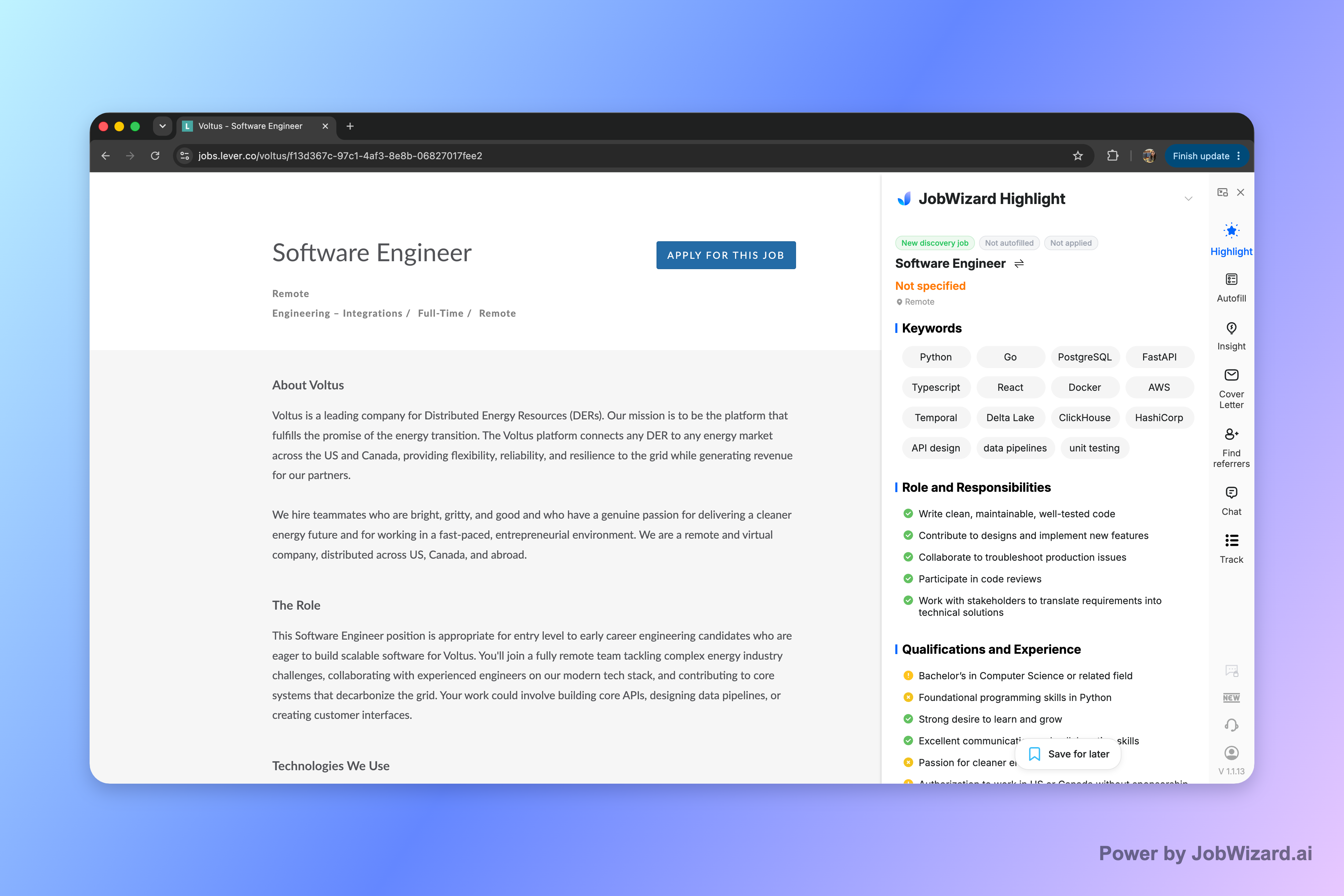
The fastest way to get the right business intelligence resume keywords is to extract them directly from the job description, not from a generic list. JobWizard can organize a job description into keywords, role responsibilities, and qualifications so you can review requirements more systematically.
Job postings for business intelligence often include repeating “themes” that translate into ATS-searchable phrases. Use your JD review to capture these buckets:
- Responsibilities: reporting ownership, dashboarding, KPI tracking, stakeholder reporting, data interpretation, and automation
- Qualifications: analytics experience, data modeling familiarity, ETL concepts, SQL comfort, visualization tools, and domain experience
- Requirements: specific tools and platforms (for example, SQL, Python, Tableau/Power BI, data warehousing concepts), plus relevant metrics or compliance expectations
Once you have the buckets, map your resume bullets to them. Don’t just add keywords—add the exact work they represent. A simple “keyword-to-proof” approach keeps your resume both ATS-aligned and truthful.
Keyword-to-proof mapping (copy this workflow)
- Collect the JD phrases under responsibilities and qualifications.
- Match each phrase to one resume bullet that shows the work (what you did, what data you used, what you delivered).
- Rewrite only the wording that’s missing—so your experience is expressed in the JD’s language.
- Verify every edit remains accurate. If you can’t support it with your real experience, remove it.
For example, if the JD says “build executive dashboards” and “monitor KPIs,” your resume should include bullet language that reflects dashboarding and KPI monitoring—not just a generic “worked with metrics.”
Example: how to translate JD language into BI resume bullets
- JD phrase: “Develop dashboards for executive stakeholders.” Resume bullet: “Built interactive dashboards for executive stakeholders, tracking core KPIs and trend changes to support weekly decision-making.”
- JD phrase: “Identify insights and present recommendations.” Resume bullet: “Analyzed customer and operational data to identify drivers of performance, then presented findings and recommendations to cross-functional partners.”
- JD phrase: “Collaborate with engineering/data teams on data pipelines.” Resume bullet: “Partnered with data teams to support reporting datasets by validating logic, reviewing outputs, and ensuring data definitions aligned with business requirements.”
Because ATS scanning is keyword-driven, this mapping matters—your resume becomes searchable for the same phrases the recruiter expects to see.
Build a targeted keyword bank for BI roles (not a one-size list)
To improve your business intelligence resume keywords, build a keyword bank based on your target role’s responsibilities and tools, then choose only the ones you can back up with your experience.
Below is a practical BI keyword bank you can start from. Treat it as a menu—you’ll still tailor to the specific job description wording you captured in the first step.
| BI resume keyword theme | Examples of phrases to look for in JDs | What proof to include in your resume bullets |
|---|---|---|
| SQL & querying | “SQL”, “querying”, “data extraction”, “data validation” | Tables touched, validation checks, query use cases (reporting, joins, KPI definitions) |
| Analytics & insights | “analyze”, “insights”, “root cause”, “trend analysis” | What you investigated and how you communicated insights (findings + next steps) |
| Dashboards & reporting | “dashboards”, “executive reporting”, “KPI reporting”, “visualization” | Stakeholders, cadence, dashboard purpose, metric sets, and how updates improved clarity |
| Visualization tools | “Tableau” / “Power BI” / “Looker” (whatever the JD states) | What you built in that tool and the types of views (filters, drilldowns, KPI layouts) |
| Data modeling concepts | “data modeling”, “schema”, “dimensions/facts” | How modeling supported reporting correctness (consistent definitions, reusable datasets) |
| ETL / data pipelines | “ETL”, “pipelines”, “data transformation”, “data quality” | Where you validated logic, reconciled outputs, or improved data quality for reporting |
| Stakeholder collaboration | “partner with”, “cross-functional”, “requirements gathering” | Examples of translating business questions into data outputs and definitions |
| Governance & compliance (when relevant) | “access”, “PII”, “security”, “governance” (only if in the JD) | How you handled data safely and supported access rules for reporting workflows |
The key is selectivity. If you add every keyword you’ve ever heard, you risk sounding unfocused and may still miss what the ATS expects for that particular job. Instead, pick what the job description highlights and express it through real bullets.
Use Insight / match diagnosis to find expression gaps before you apply
Even when you have relevant BI experience, your resume may not use the same wording as the job description—this is an “expression gap,” and it’s fixable.
JobWizard’s Insight compares the selected resume with the current job description and presents a match score, an overall assessment, and improvement suggestions. The JD-based diagnosis can identify resume expression gaps and turn them into an editable resume revision draft.
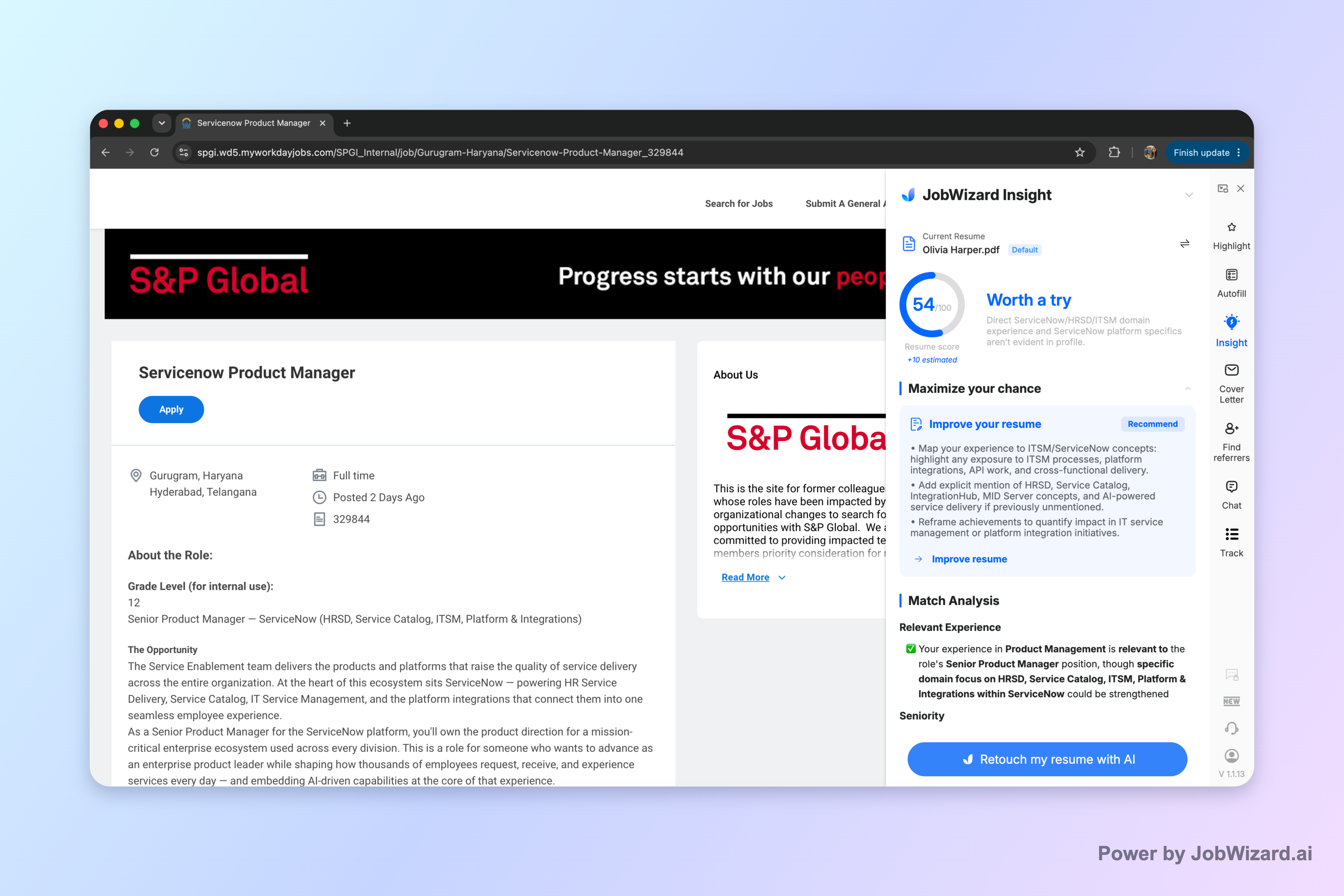
Important: the score is not a hiring probability and does not guarantee ATS passage or an interview. Users must verify every suggested resume change and keep only accurate experience.
How to act on an Insight-style diagnosis (step-by-step)
- Compare your resume language to the job description requirements.
- Review gaps where your resume is missing or differently expressed (especially skills and deliverables).
- Rewrite carefully using the editable revision draft as a starting point.
- Verify truth by confirming each change reflects your actual projects, tools, and responsibilities.
This workflow helps you refine business intelligence resume keywords without turning tailoring into guesswork. It’s also a good sanity check when you think your resume already “covers the basics,” but the posting emphasizes a specific responsibility or tool.
Example: fixing a common BI expression gap
Imagine the JD repeatedly mentions “KPI monitoring” and “executive dashboards,” but your bullets focus on “reporting” in general. You can keep your underlying work the same while adjusting the phrasing to match the role. The goal is alignment with the JD’s responsibilities and qualifications—not keyword repetition.
- Before: “Created weekly reports to track performance.”
- After: “Monitored KPIs through weekly dashboard and reporting updates for executive stakeholders, highlighting performance trends and exceptions for decision-making.”
That rewrite improves clarity for both ATS and humans because it names the deliverable (dashboards/reporting), the purpose (KPI monitoring), and the audience (executive stakeholders).
Choose where BI keywords go on your resume (ATS-friendly placement)
Once you know the right business intelligence resume keywords for a specific JD, place them where ATS systems (and recruiters) expect to find them.
Use this placement guide to keep your resume scannable and consistent.
- Summary: 2–3 lines aligning to the job’s focus (analytics/reporting/dashboarding/KPI ownership and tools). Include only keywords you can support.
- Skills section: mirror tool and competency phrases from the JD (e.g., SQL, dashboarding tool names, data modeling concepts). Keep it concise and accurate.
- Experience bullets: prioritize responsibilities and deliverables—especially dashboards, KPI reporting, data validation, and stakeholder communication.
- Projects (optional): if you lack direct work experience, use project bullets that map to the same responsibilities and qualification phrases in the JD.
Tip: If the JD mentions requirements like “data validation” or “data quality,” don’t hide them. Put those phrases in relevant bullets so they show up where scanners look first.
A BI keyword checklist you can use in 10 minutes
- Responsibilities coverage: every major responsibility in the JD is represented by at least one bullet.
- Tool alignment: your skills section matches the tools named in the JD (only those you’ve used).
- Deliverable language: bullets use JD wording for dashboards, reporting cadence, KPI monitoring, and stakeholder audiences.
- Verification: every keyword you add is supported by an actual accomplishment or workflow you can explain.
If you want a systematic way to do this, the next section and FAQ will help you translate tailoring into a repeatable process.
Do this automatically with JobWizard
Skip the manual work — JobWizard's Match Score handles this for you.
FAQ: Business intelligence resume keywords
What business intelligence resume keywords should I use for ATS?
Start by pulling the exact wording from the job description (role responsibilities, qualifications, and requirements), then map your experience to those phrases. Keep your wording accurate to your actual work—especially for tools, metrics, and deliverables.
Should I rely on a match score to decide whether I’m qualified?
No—treat the match score as a diagnostic, not a hiring probability. Verify every suggested change, keep only what’s true to your experience, and confirm you can meet the role’s responsibilities and qualifications.
How do I tailor my resume for a specific BI job without overstuffing keywords?
Use keywords where they naturally describe your work: projects, bullet points, skills sections, and measurable outcomes. Focus on coverage of responsibilities and qualifications from the JD, but avoid repeating the same phrase in every line.
What if my resume skills don’t exactly match the job description wording?
That’s where “expression gaps” matter: your skills may be the same, but described differently. Use the JD-based diagnosis to find where your resume wording can be revised into an editable draft, then double-check that the new phrasing reflects what you actually did.
What should I do before I submit after keyword tailoring?
Invite yourself to review the target role’s responsibilities, qualifications, and keywords before applying, and verify every AI- or JD-based change remains accurate. You’re the final reviewer—keep only experience you can confidently explain.
If you want to go deeper on ATS-ready formatting and JD matching, start with How to Optimize Resume for ATS: A Practical 2026 Checklist. And for more keyword-driven examples by role type, explore Accounts Payable Resume Keywords: JD-Matched Phrases That Help ATS Read Your Experience, Account Manager Resume Keywords: The ATS Phrases That Match Your JD (and How to Use Them), and Account Executive Resume Keywords: How to Tailor Your CV for JD Success.
CTA: Open your target BI job description and review its responsibilities, qualifications, and keywords—then use JobWizard to structure the JD and diagnose expression gaps so you can update business intelligence resume keywords with confidence.
Frequently Asked Questions
See your resume's match score for any job
JobWizard compares your resume to each job description and shows the exact keywords to add — free.