Sending a Follow Up Email After Interview: Choose the Right Note for the Moment
Sending a follow up email after interview can mean thanking the panel, adding a detail you missed, or checking in on a decision. Use these examples and timing cues to write a clear, specific message without guessing what the employer will do next.
Free Chrome extension
Autofill your next job application
JobWizard is a free Chrome extension that fills applications, tracks statuses, and optimizes your resume.
Choose the right follow-up before you open your inbox
The best interview follow-up depends on what you need to do next: thank the interviewer, add a missed detail, or ask about the hiring timeline. Sending a follow up email after interview is not one fixed message, and the right timing depends on whether you are following up immediately or checking in later.
Start by identifying the purpose of your email. A thank-you note supports the conversation you just had; a clarification adds useful context; a status check asks where the process stands. Keeping those purposes separate helps your message feel considerate rather than like a demand for an immediate decision.
For a broader way to connect interviews, applications, and next steps, see How to Track Job Applications: A Practical System (JobWizard + Beyond). It is the pillar guide for organizing your search, while the examples below focus on what to write after an interview.
When to send a follow-up email after an interview
Send a thank-you note within 24 hours, but time a status check around the employer’s stated decision timeline. A quick message after the conversation and a later check-in serve different purposes, so do not treat them as interchangeable.
If the interviewer gave you a date or range, wait until that point has passed before asking for an update. For example, if they expect to make a decision by Friday, a brief check-in the following week is more considerate than writing on Thursday.
If no timeline was shared, wait about a week after your last conversation before checking in. The hiring process may involve additional interviews or internal coordination, and silence by itself does not tell you what the decision will be.
- Within 24 hours: Send a thank-you message that refers to a real detail from the discussion.
- After the promised date: Send a polite status check if the employer’s timeline has passed.
- About a week later: If no timeline was given, check in once after a reasonable pause.
- After a new interview: Send a fresh thank-you note rather than relying on an earlier message.
Use your judgment if the interviewer gave specific instructions, such as contacting a recruiter rather than the panel. Following that direction is more useful than applying a generic schedule.
Write a thank-you note that sounds specific
A strong thank-you email names something you discussed and briefly connects it to your interest or experience. A generic “thanks for your time” is polite, but a concrete reference makes the note more personal and easier for the interviewer to place.
Use a simple structure: thank the person, mention one relevant conversation detail, reinforce your interest, and close with a brief offer to provide anything else they need. Keep the email short enough to scan, and avoid repeating your entire résumé or interview answers.
Subject: Thank you — [Role] interview
Hi [Name],
Thank you for speaking with me about the [Role] position today. I enjoyed hearing how the team is approaching [specific project or responsibility].
Our conversation about [specific challenge] reinforced my interest in the role. My experience with [relevant skill or example] would help me contribute to that work.
Please let me know if I can provide any additional information. Thanks again for your time.
Best,[Your name]
Before sending, replace every bracketed phrase with a true detail from your conversation. If you interviewed with several people and have their contact information, write each person a distinct note using a detail from that person’s discussion.
For advice focused specifically on a post-interview thank-you, use this guide to a follow up thank you email after an interview. It complements the examples here when you need to keep a longer interview process moving thoughtfully.
Use a clarification or status-check email for a different purpose
Use a clarification note to add a relevant detail, and a status check to ask politely about the next step. Choose one purpose per email so the interviewer can quickly understand why you are writing.
If you forgot an important detail
If you left out a relevant example or want to clarify an answer, keep the addition short and connected to the interview. Avoid framing it as a correction unless you actually need to correct a factual mistake.
Subject: One additional detail — [Role] interview
Hi [Name],
Thank you again for our conversation about the [Role] position. I wanted to add one relevant example to our discussion of [topic]: [one- or two-sentence example showing your action and its relevance].
I appreciated learning more about the role and remain interested in the opportunity. Please let me know if any other information would be helpful.
Best,[Your name]
If the decision timeline has passed
A status check should be brief, courteous, and easy to answer. Refer to the interview and timeline without implying that the employer owes you an immediate response.
Subject: Checking in — [Role] interview
Hi [Name],
I’m following up on my interview for the [Role] position on [date]. You mentioned that the team hoped to share an update around [timeline], so I wanted to ask whether there is any news about next steps.
I remain interested in the opportunity. Thank you for your time, and I understand the process may still be underway.
Best,[Your name]
If you have already followed up and still have not received a reply, this follow-up email after no response sample and timing guide can help you decide whether another message makes sense. For a message sent after submitting a résumé rather than after an interview, see what to write in a follow-up email after sending your résumé.
Keep interview follow-ups organized without over-messaging
Record the date, recipient, purpose, and next check-in point so you can follow up consistently without sending duplicate messages. A simple tracker can help you distinguish a thank-you already sent from a later status check you may still need to write.
JobWizard’s Activity view shows application status and which JobWizard tools were used for each role. It gives you a place to review application activity and keep the next step in view; it does not mean every employer update is detected automatically or predict an outcome.
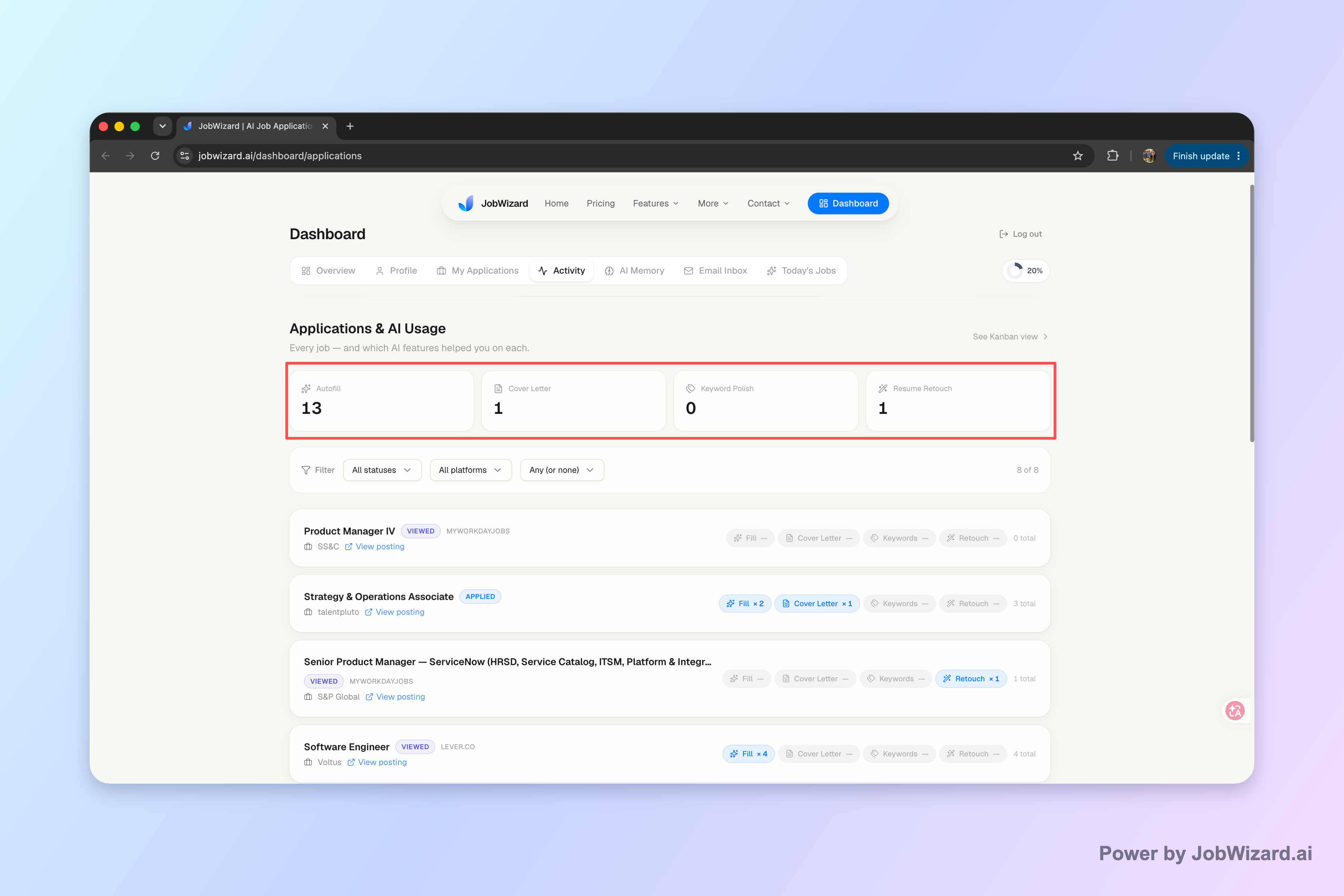
After an interview, record the interview date, the timeline the employer shared, and whether you sent a thank-you note. If the promised date passes, you can review the application’s activity and decide whether a concise check-in is appropriate.
- Log the conversation: Note the role, interview date, and people you spoke with.
- Capture the timeline: Record any date or range the interviewer gave you.
- Mark your message: Note when you sent a thank-you or clarification email.
- Choose a next step: Check in only when the stated timeline has passed or a reasonable wait has elapsed.
Use the tracker to support your own judgment, not to create a reason to email repeatedly. If an employer asks you to wait or directs you to a particular contact, follow those instructions.
Do this automatically with JobWizard
Skip the manual work — JobWizard's Application Tracker handles this for you.
Interview follow-up email FAQs
These answers cover timing, wording, recipients, and what to do when a reply does not arrive. Adapt each message to the actual conversation and any instructions the employer shared.
When should I send a follow-up email after an interview?
For a thank-you note, aim to send it within 24 hours of the interview. For a status check, use the timeline the interviewer gave you; if they did not provide one, wait about a week after your last conversation before checking in.
What should I say when sending a follow up email after interview?
Thank the interviewer, mention a specific part of the conversation, and briefly connect it to your experience or interest in the role. For a later status check, refer to the interview date and ask politely whether there is an update on the hiring timeline.
Should I email every interviewer separately?
If you spoke with multiple people, send each person a brief, individualized note when you have their contact information. Use a distinct detail from each conversation rather than sending identical messages to everyone.
What if I do not hear back after my interview follow-up?
Wait several business days before sending one concise check-in, unless the employer gave you a different timeline. If there is still no reply, keep pursuing other opportunities and record the application’s next step so you can decide whether another message is appropriate.
Keep your next step visible. Use JobWizard’s Activity view to review each application’s status and the JobWizard tools used for that role, then decide when a thoughtful follow-up is appropriate.
Frequently Asked Questions
Autofill your next job application
JobWizard is a free Chrome extension that fills applications, tracks statuses, and optimizes your resume.