Follow Up Email After Sending Resume: What to Write by Status (and When)
Learn exactly how to write a follow up email after sending resume, using status-based lines and a simple tracking plan so you know what to send next.
Free Chrome extension
Track all your applications in one place
JobWizard auto-tracks status changes across Workday, Greenhouse, and every major job site — free.
Submitting your resume is only step one—now you need a follow up email after sending resume that gets read, not ignored. The trick is timing and wording: you want to sound proactive and specific, but not pushy or repetitive.
Below you’ll get status-based follow-up lines you can copy, a simple “when to send what” schedule, and a lightweight tracking plan. If you use JobWizard, you can also organize each role’s status and your next step in one place.
Use a status-based follow up email after sending resume so your message matches where you are
The fastest way to write a strong follow-up is to match your email to the employer’s application status—because “no response” can mean many different stages. Instead of asking a generic “Any update?”, tailor the question to the role’s current situation.
Here’s the practical framework: choose one role, confirm the status you see, then pick one of the short templates below. Keep it to 3–6 sentences so it’s easy to skim.
Template: after submission (status = “under review” / “under consideration”)
- Subject: Follow up on [Role Title] application
- Body: Hi [Name/Team], I applied for the [Role Title] position on [date]. I’m writing to check in on the status of my application and to reaffirm my interest. With my background in [1 relevant skill from the job post], I’d be excited to contribute. If there’s anything else you need from me, I’m happy to provide it. Thank you, [Your Name]
Template: in progress (status = “in process” / “actively being considered”)
- Subject: Re: [Role Title] application — next steps?
- Body: Hi [Name/Team], I’m following up regarding my [Role Title] application submitted on [date]. The process is listed as in progress, so I wanted to ask whether there’s an expected timeline for next steps. I remain very interested in the role and would welcome the chance to discuss how I can help with [specific job responsibility]. Thanks again for your time, [Your Name]
Template: interview status (you should switch goals)
If you already moved into interviews, stop using resume follow-ups. Use an interview follow-up instead—your goal becomes gratitude + logistics + continued interest.
- Subject: Thank you — [Interview date] [Role Title]
- Tip: Keep it aligned to what they discussed and reference one small detail.
For the exact wording strategy, see Follow Up Thank You Email After Interview: The Message That Keeps You in the Loop.
Send the right follow up email after sending resume at the right time (and keep it brief)
Timing matters because employers are juggling volume. A follow up email after sending resume should be frequent enough to stay on their radar, but not so frequent that it reads like pressure.
General rule of thumb: wait long enough for the submission to be reviewed, then follow up politely and briefly. If the posting provides a timeline, follow it; otherwise, use a steady cadence and keep the message focused on next steps.
- Day 0–early window: Submit and save your notes (role, date, any confirmation).
- First follow-up: Send a short status check referencing the role and date you applied.
- If no response: Send one additional follow-up (or switch approach if the status changes).
- If you get an interview: Stop resume check-ins and send the interview thank-you/follow-up.
If you want even more “what to say” guidance, you’ll probably like What to Say in a Follow Up Email After Applying: 9 Lines for Every Status. Use it to pick the tightest sentence that matches your situation.
What to include (and what to avoid)
- Include: role title, application date, 1–2 proof points connected to the job posting, and one clear question.
- Avoid: long life stories, multiple attachments, or repeating the entire resume.
If you’re worried about tone, use a reply-first habit: pretend the employer is busy and you want to make it easy for them to answer with one line. That’s the mindset behind Job Application Follow Up Email Example: Reply-First Notes for After You Apply.
Write copy that gets replies: specific questions and “one proof point” structure
Your follow-up should make it effortless to respond. The best emails use a one proof point structure: you remind them of a fit detail, then ask about next steps.
Try this fill-in structure for nearly any stage (except interview follow-ups):
- Sentence 1: Confirm role + application date.
- Sentence 2: Express interest and connect to one job requirement.
- Sentence 3: Ask a simple question about timing or next steps.
- Close: Thank them and offer anything else they need.
Example (tailored to “under review”)
Subject: Follow up on Data Analyst application
Hi Hiring Team, I applied for the Data Analyst role on August 25. I’m reaching out because I’m very interested in the position, especially the work around [data visualization / dashboards / SQL reporting—choose one]. Is there an expected timeline for next steps? Thank you for your time, [Your Name].
Notice what’s missing: no attachments (unless requested), no overly long explanation, and no “just checking in” without substance. That’s what keeps a follow up email after sending resume from feeling generic.
Track status so your follow up email after sending resume is based on facts, not hope
If you don’t track, follow-ups turn into guesswork. A reliable application tracker helps you send the right message at the right stage.
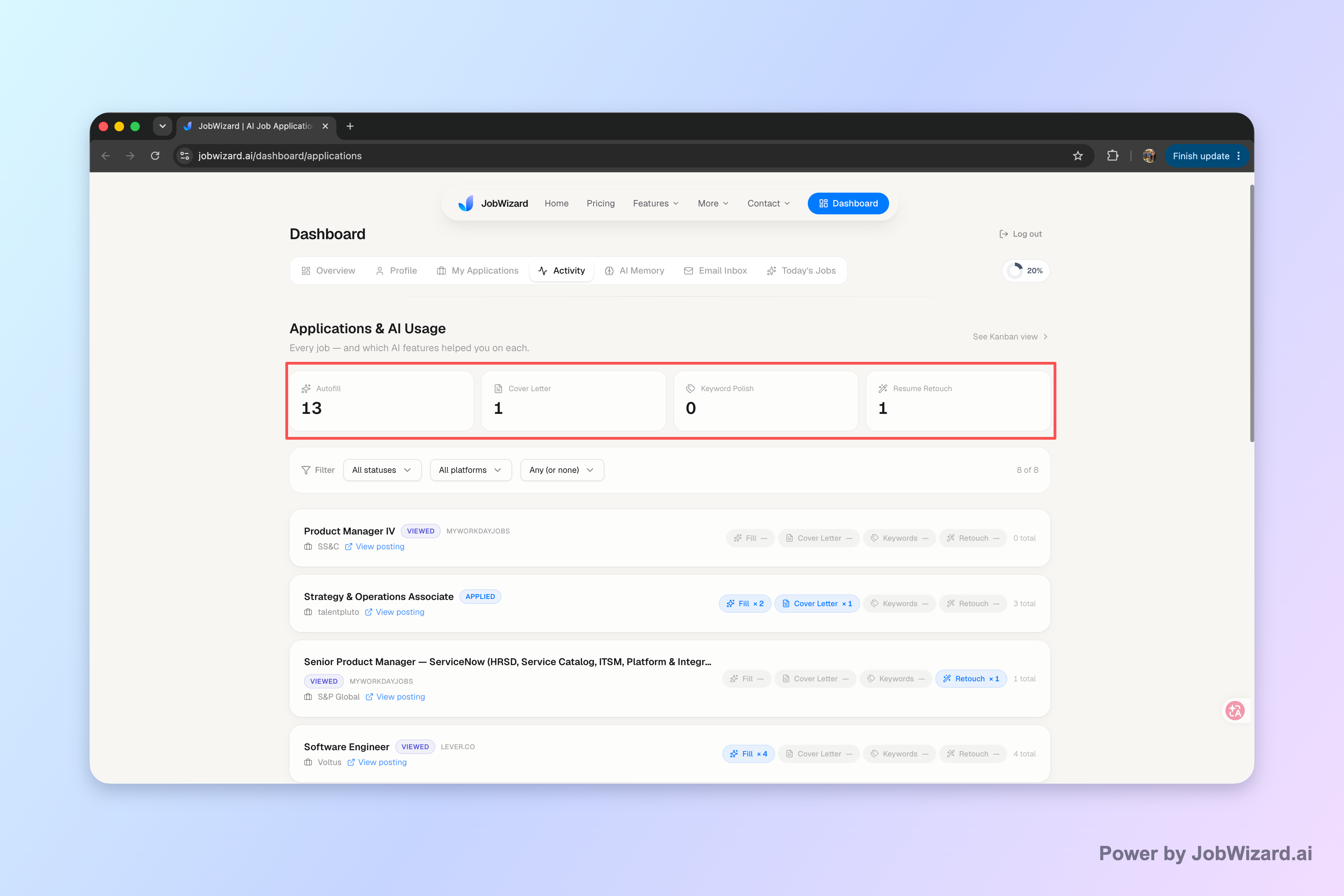
JobWizard’s Activity view shows application status and which JobWizard tools were used for each role—so you can see what’s happening and what you did along the way, without mixing up applications.
Key benefit: The Activity view shows where each application stands and which JobWizard tools were used for each role.
Limitations to keep in mind
Tracking tools can help you organize your workflow, but you shouldn’t assume every update is detected automatically or that tracking improves hiring outcomes. The goal is clarity: you review what’s shown and decide what to send next.
When to use “Insight” to strengthen the follow-up context
If you’re preparing follow-ups and you want to be extra relevant, compare your resume wording to the job description. JobWizard’s Insight compares your selected resume with the current job description and presents a match score plus improvement suggestions.
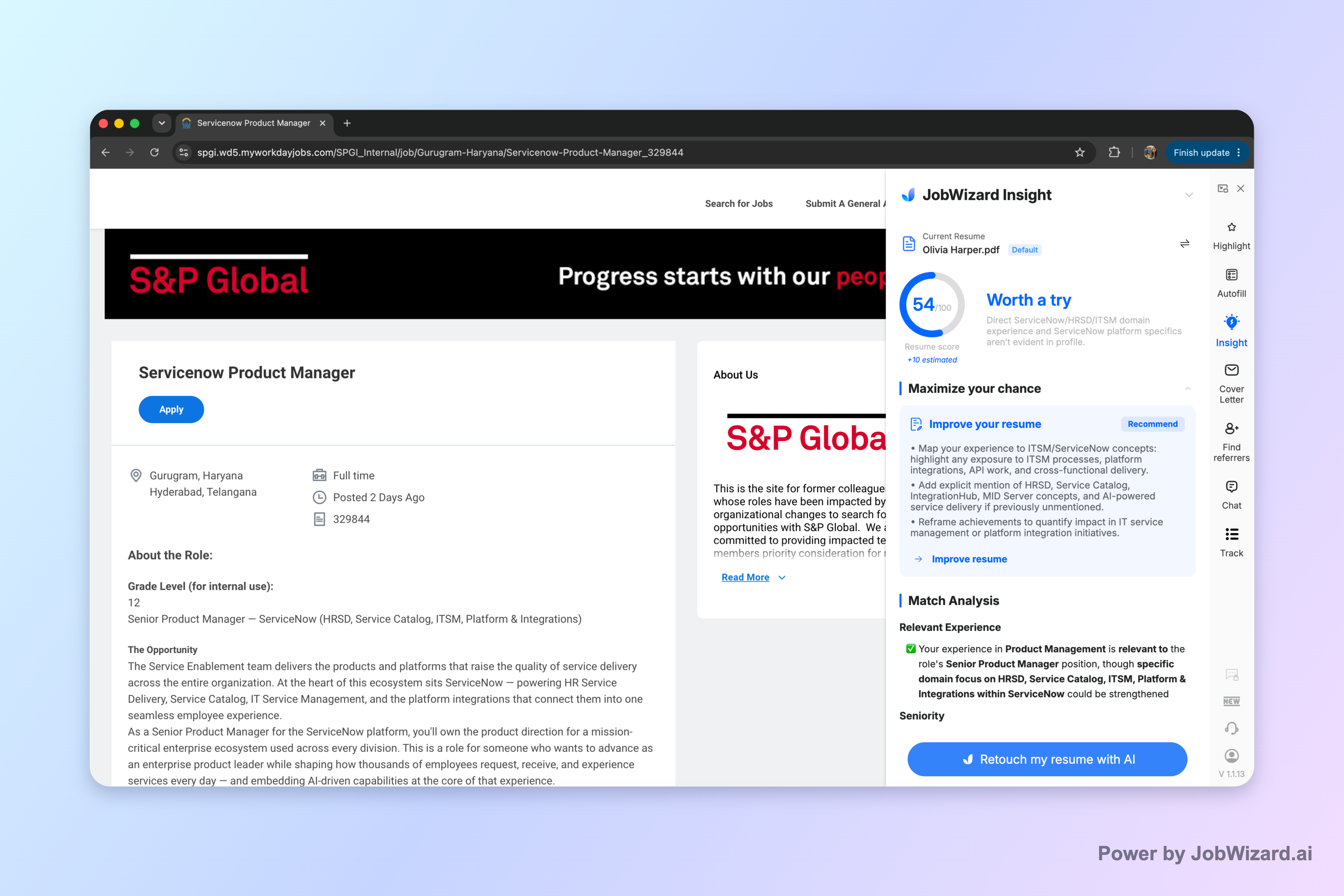
One caution: the match score is not a hiring probability and doesn’t guarantee ATS passage or an interview—so always verify changes and only keep what’s accurate.
If you’re trying to qualify better before (or between) follow-ups, see how Insight turns gaps into next steps in the job description context.
Do this automatically with JobWizard
Skip the manual work — JobWizard's Application Tracker handles this for you.
FAQ: follow up email after sending resume
When should I send a follow up email after sending my resume?
A common rule of thumb is to wait long enough for the employer to review the submission—then follow up politely and briefly. If the posting includes a stated timeline, align with that; otherwise, use a steady cadence (for example, one follow-up after a reasonable first window, and one more only if you still don’t hear back). If you see an application has moved to an interview stage, switch to an appropriate interview follow-up instead of another resume check-in.
What should I say in a follow up email after sending resume if I don’t hear back?
Keep it short: re-state the role and when you applied, add one line that reminds them of your fit (ideally a specific skill from the job description), and ask a simple question about next steps. Avoid sounding demanding; aim for “Is there anything else you need from me?” or “Could you share the next step in the process, if available?”
Should I include my resume again in the follow up email after applying?
Usually you don’t need to resend your entire resume attachment if you already submitted through the application portal. If you’re emailing directly to a person and your first email lacked attachments, you can include it; otherwise, mention that you applied and offer to share anything else if needed. When possible, keep the follow-up email focused on next steps rather than re-sending documents.
How do I write a follow up email after sending resume when the application status changes?
Match the tone to the status. For example, if it’s marked “in process,” ask about timing; if it’s “under consideration,” express continued interest; if it shows “not retained,” thank them and ask whether there’s an opportunity for other roles. If you get an interview invitation, stop resume follow-ups and send the interview follow-up instead.
How can an application tracker help with follow ups?
An application tracker helps you avoid guessing by keeping each application’s current status and your next planned step in one place. JobWizard’s Activity view shows where each application stands and which JobWizard tools were used for each role, so you can follow up based on what you see—not what you assume.
Make follow-ups easier by keeping each role’s status and next step in one place
Once you can see where each application stands, writing a follow up email after sending resume becomes less stressful and more effective. Keep your wording status-matched, ask one clear question, and track your next step so you don’t duplicate messages.
Ready to stay organized? Use JobWizard to keep each application and its next step in one Activity view, then write your follow-up based on the status you actually see.
Frequently Asked Questions
Track all your applications in one place
JobWizard auto-tracks status changes across Workday, Greenhouse, and every major job site — free.