Resume for Artist: How to Tailor Your CV to the Job Description and Win ATS
A strong resume for artist roles isn’t just creative—it’s job-description proof. Learn how to tailor your CV for ATS, then review gaps with JobWizard’s match score.
Free Chrome extension
See your resume's match score for any job
JobWizard compares your resume to each job description and shows the exact keywords to add — free.
Resume for artist: Build a JD-tailored CV that both humans and ATS can parse
If you’re searching for a resume for artist that actually gets reviewed, the fix usually isn’t more creativity—it’s tighter alignment with the job description and ATS keyword patterns. A great artist resume makes it easy to answer three questions fast: What do you do? What have you shipped? What tools and skills match this role?
Job searches often fail when artists submit a beautiful, general-purpose CV that doesn’t reflect the exact requirements in the posting. Instead of starting from scratch every time, you can use a repeatable “tailor → verify → submit” process that keeps your voice while upgrading keyword relevance.
Start with the posting, then translate its requirements into your resume language
Your goal is not to “stuff keywords.” It’s to express your experience in the same categories and terminology the employer used in their hiring post. That’s how you earn both a quick human scan and a stronger ATS match.
When you tailor, you’ll typically do three things:
- Map requirements to your experience (turn “production-ready” into your deliverables, timelines, and outputs).
- Mirror role-specific skills (tools, mediums, software, and production workflow terms).
- Prioritize your best-match projects (so the first page reads like proof, not a list).
Choose the right structure for a resume for artist jobs (and keep it ATS-friendly)
The best structure for a resume for artist is the one that makes your strongest proof appear early and clearly. ATS tools generally read straightforward sections in a logical order, and hiring managers do the same thing—fast.
Use this “clean proof” structure as your default template, then reorder sections based on the role type.
| Section | What to include | Example of artist-specific proof |
|---|---|---|
| Header | Name, city/state (optional), phone, email, portfolio link | Portfolio URL as the primary link for selected work |
| Artist statement (brief) | 2–4 lines on focus + style + outcomes | “Visual storytelling for product marketing and editorial illustration.” |
| Selected exhibitions / commissions / clients | Reverse chronological, include role and deliverable | “Commissioned series—concept, production, and delivery for print + web.” |
| Skills (specific tools + mediums + processes) | Software, mediums, production workflows, collaboration | Photoshop, Illustrator, Procreate; color grading; client reviews; file prep |
| Experience (role-based bullets) | Impact-focused bullets tied to the job’s priorities | “Created 12 campaign assets aligned to brand guidelines and deadlines.” |
| Education / training | Degree, programs, workshops—only if relevant | Studio art program, certificate in graphic production |
| Selected work | Short list of 3–8 pieces/projects with links or brief descriptors | “Editorial illustration series (links) — theme: migration.” |
Make your bullets do the work (ATS can’t read your intent—your words must show it)
Your bullets should translate creative activities into job-description language. Instead of “Created artwork,” aim for “Delivered X using Y for Z, meeting W.” That’s how your resume for artist roles becomes specific enough to score well and convince a reviewer.
- Lead with the output: illustration set, campaign assets, mural section, packaging art.
- Add the process: ideation, composition, revisions, production, export/format prep.
- Finish with the context: brand guidelines, client review cadence, installation or distribution needs.
If you also need help tightening general ATS performance, start with How to Optimize Resume for ATS: A Practical 2026 Checklist.
Tailor your resume for artist to the job description using a “gap-to-draft” workflow
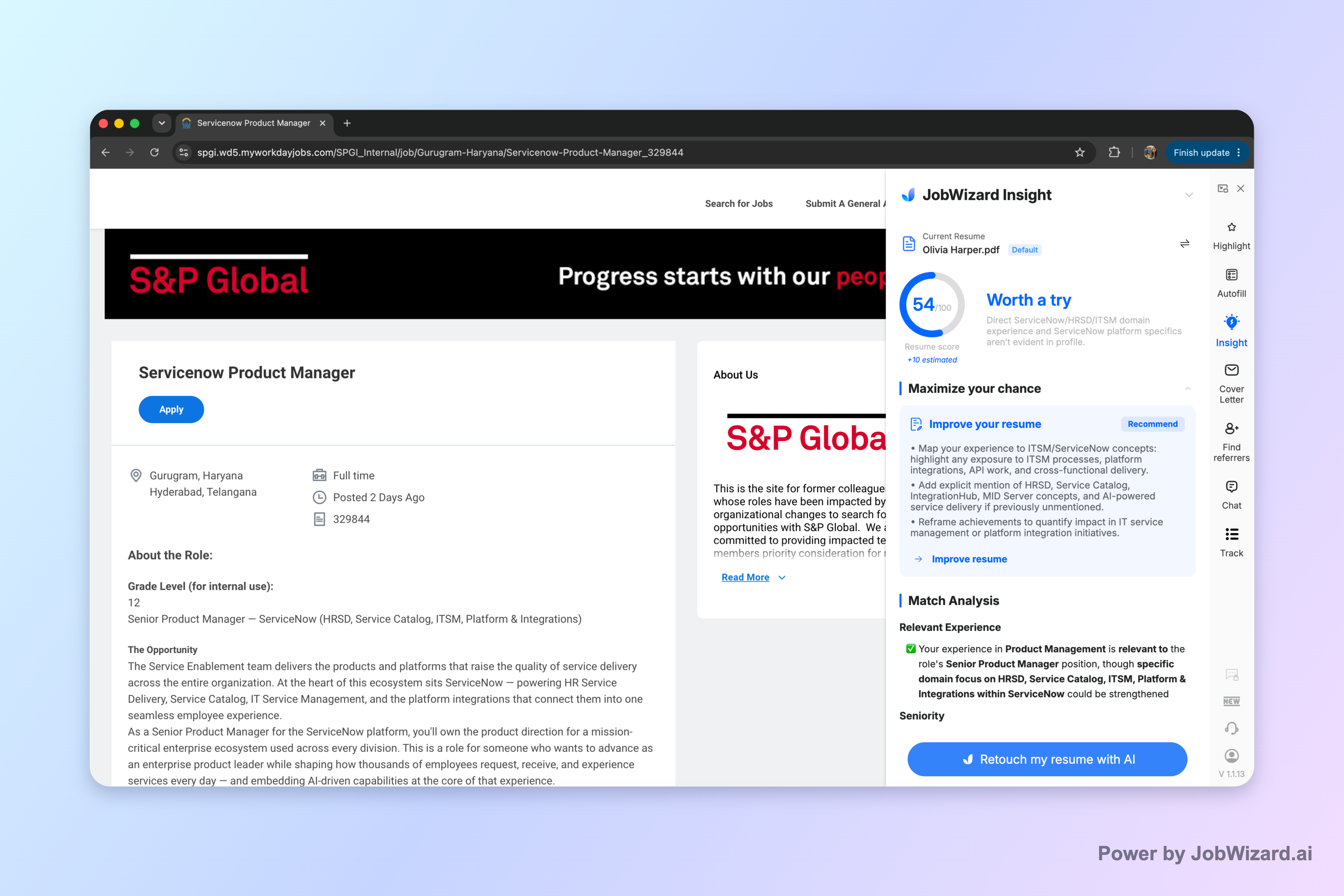
Tailoring a resume for artist is easier when you treat it like an audit: compare your CV to the job description, identify expression gaps, then revise into an editable draft. That’s exactly the mindset behind JobWizard’s “match score” workflow.
JobWizard Insight compares the selected resume with the current job description, presents a match score plus an overall assessment, and generates improvement suggestions. It can also diagnose expression gaps and turn them into an editable resume revision draft—so you can focus on making accurate updates rather than guessing.
What a match score can (and can’t) tell you
Important limitation: the score is not a hiring probability and doesn’t guarantee ATS passage or an interview. You still must review every suggested resume change and keep only accurate experience.
That’s why this workflow works best as “autofill + review-before-submit,” not blind auto-submit. For artist resumes, the safest approach is to use the diagnosis to strengthen keyword coverage and readability, then verify each edit against your real work.
Use the job description categories to decide what to edit first
When your resume feels “close” but not quite right, the missing piece is usually how your content is expressed—not your underlying talent. Look for these common categories in the posting and compare them to your resume.
- Tools and software: do you name the exact applications/skills the posting expects?
- Deliverables: does your resume mention formats, outputs, or production artifacts (not just “art”)?
- Workflow: revision cycles, approvals, handoff/exports, file preparation, install/delivery constraints.
- Collaboration: client-facing communication, teamwork, cross-functional coordination.
- Role focus: editorial, marketing, studio production, public-facing installations, packaging, or brand systems.
Turn “skills gaps” into specific bullet edits
Here’s a practical example. If the job description asks for “production-ready illustration” and your resume says “illustration,” you can revise toward production language while staying truthful.
- Weak: “Created illustration for marketing.”
- Stronger: “Produced marketing illustrations following brand guidelines; handled client review rounds and delivered print + digital-ready exports.”
If you want a broader approach to ATS keyword strategy, you can also use these JD-driven resources as complements: CIO Resume Keywords That Beat ATS: A JD-Driven Checklist for Real Requirements and Resume for Administrative Assistant? Use a JD Match Score to Fix ATS Keyword Gaps Fast. Even though they target different roles, the method—extract requirements, then write bullet evidence—translates cleanly to artist applications.
Common artist resume mistakes that hurt ATS match (and how to fix them fast)
Most resume for artist issues come from avoidable mismatches: vague bullets, missing tool keywords, and portfolio details that never show up in your resume text. Fix these and you’ll usually improve both skim-read clarity and ATS relevance.
1) Your first page doesn’t prove the job’s top priorities
If the posting emphasizes production deliverables, your resume shouldn’t lead with an unfocused background section. Move your most relevant experience and 3–6 best-match projects into the top section(s) so a reviewer sees fit immediately.
2) Skills are too generic to match a job description
“Design” or “creative” won’t help. Replace broad phrases with specific tools, mediums, and workflow tasks the employer names. When you review the job description line-by-line, convert requirements into your skills and bullet evidence.
3) You list achievements without stating deliverables or outcomes
ATS and humans both scan for concrete proof. Instead of “Worked on album art,” add what you delivered and how the workflow operated (formats, revisions, production constraints, distribution or installation needs).
4) You hide relevant information in images, icons, or unparseable formatting
Keep layouts simple. Use clear headings and text that can be read by automated systems. Your portfolio can be visual; your resume should be structured proof.
5) You submit the same resume to every posting
Artist roles vary—editorial illustration vs. studio production vs. marketing systems vs. install work. Treat each application like a new tailoring pass: compare requirements, update keywords and bullets, then verify accuracy.
JobWizard’s approach: Compare your resume to the job description, then revise what’s missing
If you want a resume for artist that stays personal while meeting job-description expectations, JobWizard Insight helps you spot gaps between your CV and the posting—and then generate editable improvement suggestions.
With Insight, JobWizard compares your selected resume against the current job description and provides a match score, an overall assessment, and improvement suggestions. It also turns the JD-based diagnosis into a resume revision draft you can review and edit. Remember: the score isn’t a hiring guarantee, and you must verify every suggested change and keep only accurate experience.
How to use this workflow for your next application
- Choose the job posting and copy the requirements into the application context you’re tailoring for.
- Compare resume to JD using JobWizard Insight so you can see what expression gaps might be holding you back.
- Review the suggested edits and update only what’s true for your experience.
- Submit yourself—your final review matters more than any automated fill.
When you want deeper ATS keyword tailoring guidance, use role-specific examples as inspiration. For instance, if you’re coming from an engineering background and need stronger keyword coverage patterns, this resource is useful for the keyword method: Keywords for Electrical Engineer Resume: 35 ATS-Ready Terms to Match Real Job Requirements.
Next step: Open JobWizard Insight, compare your resume against the exact job description, review the identified gaps, and revise your resume draft so it clearly matches the role you want—then submit with confidence.
Do this automatically with JobWizard
Skip the manual work — JobWizard's Match Score handles this for you.
FAQ: Resume for artist
What sections should I include on a resume for artist roles?
Include a clear header, an artist statement (2–4 lines), selected exhibitions/commissions (reverse chronological), relevant skills (tools + mediums), education/training, and a short “Selected Work” link or list. If the job is studio-focused, add a tools-and-process section; if it’s production-focused, emphasize reproducible workflows and deliverables.
How do I tailor a resume for artist positions when I have diverse projects?
Pick 2–4 projects that best match the job description’s goals, then mirror the same categories in your bullet points (e.g., concept → production → install/delivery). Keep the rest as a longer “Selected Work” list so you maintain credibility without diluting the ATS keywords the hiring manager will scan.
Will an AI match score guarantee ATS passage or an interview?
No. The match score is not a hiring probability and doesn’t guarantee ATS passage or an interview. Treat it as a resume diagnosis: review the suggested changes, verify your experience, and keep only edits that are accurate.
What ATS keywords should I use on an artist resume?
Use keywords that appear in the job description—tools/software, relevant mediums, production terms, and role-specific requirements (e.g., “illustration,” “graphic production,” “installation,” “client presentations”). For accuracy, align your wording to the actual requirements and keep your skills list specific rather than generic.
Should I submit my portfolio instead of a resume for artist jobs?
Most artist roles still expect a resume for artist jobs alongside portfolio links. Use your resume to summarize credibility (experience, education, exhibitions/commissions, and tools) and use your portfolio for depth. If the application asks for specific documents, follow the instructions exactly.
Frequently Asked Questions
See your resume's match score for any job
JobWizard compares your resume to each job description and shows the exact keywords to add — free.