CIO Resume Keywords That Beat ATS: A JD-Driven Checklist for Real Requirements
CIO resume keywords help your resume mirror the job description, so you can close skills gaps before you apply. Use JD highlights and match feedback to tailor fast.
Free Chrome extension
See your resume's match score for any job
JobWizard compares your resume to each job description and shows the exact keywords to add — free.
If you’re searching for cio resume keywords that help your resume pass ATS screens, you’re really trying to solve one problem: your resume needs to match the job description’s language closely enough that screening tools can recognize your fit—without turning your executive story into copy/paste.
In practice, the easiest way to do this is JD-first: extract the responsibilities and qualifications, then translate them into accurate CIO experience bullets and skill phrasing. JobWizard can help you do that systematically so you can tailor faster while still keeping your content truthful and reviewable before you submit.
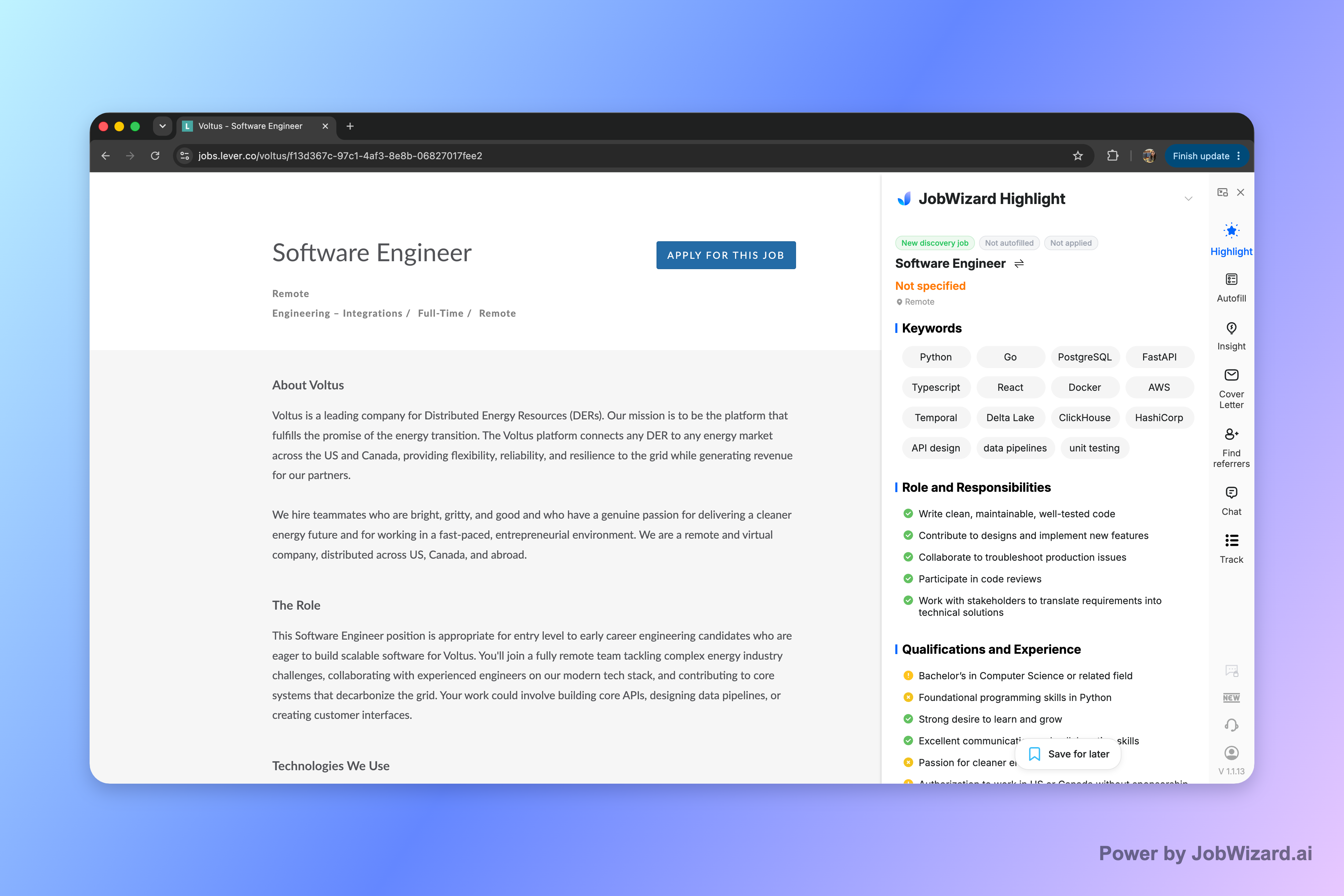
Step one is to convert the job description into CIO-ready requirements. JobWizard can organize a job description into keywords, role responsibilities, and qualifications so you can review what actually matters more systematically.
Start with CIO resume keywords pulled from the job description (not guesswork)
Your best CIO resume keywords are the ones already in the job posting—especially in the responsibilities and qualifications sections. ATS systems tend to look for keyword matches and recognizable skill/competency phrasing, so tailoring starts with extracting those terms before you edit your resume.
Most CIO roles include recurring requirement buckets. Scan the JD and pull keywords that represent these buckets, then map them to your own experience. For example:
- IT leadership & governance: IT strategy, governance, operating model, org leadership, stakeholder management
- Architecture & engineering: enterprise architecture, platform modernization, application strategy, integration, data architecture
- Cloud & infrastructure: cloud migration, cloud operations, hybrid environments, infrastructure modernization
- Security & risk: cybersecurity, risk management, IAM, incident response, security governance
- Delivery & transformation: transformation programs, portfolio management, SDLC/Agile, change management
- Vendors & partnerships: vendor management, contract/renewal oversight, third-party risk
Then turn those concepts into resume language you actually own. A common mistake is listing keywords as standalone items. Instead, place the keywords in context: your executive summary and the bullets where you describe scope, stakeholders, and outcomes.
If you want a broader ATS refresher to use alongside this CIO-specific workflow, start with How to Optimize Resume for ATS: A Practical 2026 Checklist.
Use JD highlights to build a “keyword map” for your CIO sections
Once you have the JD keyword set, organize it into a keyword map that mirrors how a CIO resume is typically screened and skimmed.
JobWizard’s JD Highlights view supports exactly this workflow by structuring the job description into keywords, responsibilities, and qualifications—so you can compare them against your resume content line by line.
Build your CIO keyword map (simple template)
Use a quick worksheet like this while you tailor:
- Keyword/Concept: (e.g., “enterprise architecture”)
- Where the JD says it: responsibilities vs qualifications
- Your matching experience: bullet(s) or summary line(s)
- Evidence details: teams led, domains (apps/data/infrastructure), governance mechanisms
- Truth check: keep only what you can defend accurately
Now apply the map to the sections that most often determine whether ATS parsing and human review agree on your fit:
- Executive summary → 2–4 lines aligning your scope to the role’s leadership themes.
- Core skills / technologies → skills phrased consistently with the JD’s concepts (cloud, security, architecture, delivery).
- Experience bullets → responsibilities written as “what you owned + how you delivered + governance/impact context.”
- Selected certifications → security/cloud/architecture certs only if real and relevant to the JD.
Rewrite CIO bullets so keywords appear naturally
For executive roles, keywords work best when embedded in bullets that explain leadership—not when dropped into a list. For example, if a JD emphasizes “enterprise architecture” and “platform modernization,” you might structure a bullet like this:
- Before (too generic): “Led technology modernization initiatives.”
- After (keyword-aware, specific): “Led enterprise architecture and platform modernization across core applications, establishing governance for integration patterns, lifecycle standards, and delivery prioritization.”
That “after” version doesn’t just include terms—it connects them to a leadership mechanism (governance, standards, prioritization) that typical CIO qualifications expect.
For keyword strategies tailored to executives and requirements matching, you may also find it helpful to review Consulting Resume Keywords That Win Interviews: Match Job Requirements Fast (2026)—even if your background isn’t consulting, the requirement-mirroring logic transfers well.
Use Insight/match feedback to find CIO resume expression gaps
After you draft, use match feedback to locate where your resume expression doesn’t line up with the JD. This is where many candidates improve quality fastest—because you’re not guessing what ATS might miss.
JobWizard’s Insight feature compares your selected resume with the current job description and provides an improvement-focused diagnosis. It can identify resume expression gaps and turn them into an editable resume revision draft.
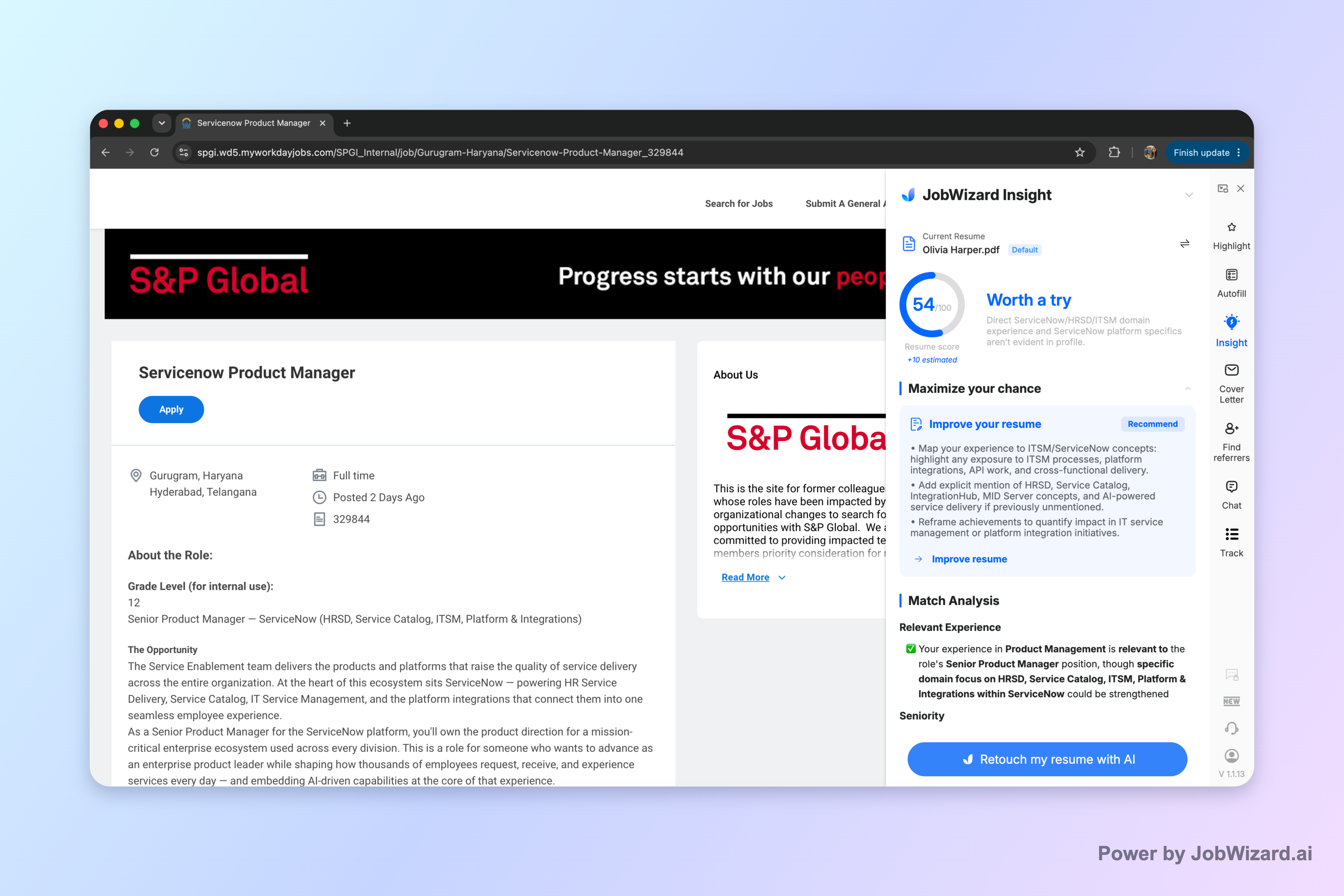
Keep the match score mindset practical: use it to guide edits, not to treat it like a hiring probability. Insight helps you review suggested changes, verify accuracy, and fill genuine keyword/scope gaps before you submit.
How to apply the match feedback without over-editing
Follow this process so you improve the resume while protecting credibility:
- Review each gap suggestion and decide whether it reflects a real omission or just different phrasing.
- Update only what you can verify (scope, ownership, tools/approaches—no “stretch” claims).
- Prefer leadership phrasing over buzzwords (governance, operating model, delivery oversight, risk controls).
- Retain your strongest achievements and insert keywords only where they naturally support the story.
Remember the limitation: the score is not a hiring probability and does not guarantee ATS passage or an interview. The goal is to improve alignment with the job description so your resume is easier to interpret.
If you want a deeper ATS process for tailoring content (beyond keyword matching), return to How to Optimize Resume for ATS: A Practical 2026 Checklist and run that checklist after your keyword map updates.
Choose the right CIO keyword categories (and avoid “keyword stuffing”)
CIO resume keywords should cover competencies, not just technology names. Executive screening often looks for both breadth and ownership—strategy, governance, risk, delivery, and stakeholder alignment.
Use these CIO keyword categories as a guide for what to include and where. The best resumes cover most categories, but you don’t need every single term—just the ones that align with the job requirements.
| CIO requirement category | Keyword examples (concept-first) | Where to place them | How to keep it non-stuffed |
|---|---|---|---|
| Strategy & governance | IT strategy, governance, operating model, portfolio prioritization | Executive summary + experience bullets | Use mechanisms (councils, standards, lifecycle policy) |
| Architecture & modernization | enterprise architecture, platform modernization, integration standards | Experience bullets + core skills | Describe what you modernized and how you governed it |
| Cloud & infrastructure | cloud migration, cloud operations, hybrid environments | Core skills + relevant leadership bullets | Link to delivery ownership (migration program, ops model) |
| Security & risk | cybersecurity, IAM, risk management, incident response | Core skills + bullets on governance and controls | Show oversight and frameworks you implemented/ran |
| Data & analytics (if required) | data governance, data architecture, analytics enablement | Experience bullets + summary (only if role emphasizes it) | Explain ownership and the decision/operational use case |
| Transformation & delivery | transformation, change management, delivery oversight | Experience bullets | Clarify cross-functional alignment and outcomes |
Also consider the role’s industry context. A CIO in healthcare, finance, or manufacturing may have additional compliance language in the qualifications. Use the JD highlights to ensure your resume reflects those specifics accurately.
Tailor the final application details—before you submit
Keyword alignment is only one part of CIO applications. Before you submit, review the entire application package (resume + any custom questions) so your CIO resume keywords match what the process is asking.
At a high level, JobWizard is designed to speed up repetitive application field entry while you keep control of what gets submitted. Across 720,000+ applications submitted and 600,000+ autofill sessions run through JobWizard, the product is used for faster repetitive fields (with an average of ~18 repetitive fields per application). Of those applications, ~65% are on Workday, ~19% Greenhouse, ~12% Ashby, and ~4% Lever. Importantly, the workflow is autofill + review-before-submit, not blind auto-apply/auto-submit—so you can leave sponsorship/salary/EEO/custom questions for your own review.
Practical reminder: even with autofill, verify every resume-relevant detail and keep only accurate, job-aligned edits.
Quick CIO pre-submit checklist (10 minutes)
- Resume keyword pass: does each major JD requirement concept appear in your bullets or skills in a truthful way?
- Scope clarity: are you clearly stating ownership (what you led, governed, or transformed)?
- Security/cloud/architecture alignment: do the keywords reflect your actual domains and responsibilities?
- Custom questions: ensure your answers match the resume story (no contradictions).
If your CIO role is strongly technical, you might also find additional keyword phrasing ideas in Computer Science Resume Keywords That Match Real Job Requirements (Without Guessing)—then translate those technical terms into executive-level ownership language.
When you’re ready, open the target job posting, review the responsibilities/qualifications, and use JobWizard to highlight the key requirements and diagnose where your cio resume keywords need tighter alignment—then apply with confidence.
Do this automatically with JobWizard
Skip the manual work — JobWizard's Match Score handles this for you.
FAQ about cio resume keywords
What are the most important cio resume keywords for ATS?
The most important cio resume keywords are the ones that show up in the job description’s responsibilities, qualifications, and required skills—then appear in your experience in a way that’s accurate to your background. Instead of guessing, pull the role’s key requirements from the JD and mirror them with your own measurable IT leadership outcomes and platform/architecture language.
How do I find cio resume keywords without copying the job post word-for-word?
Use the job description to identify concepts (e.g., “enterprise architecture,” “IT governance,” “cloud migration,” “cybersecurity,” “vendor management”), then rewrite those concepts using your real experience and scope (what you led, the systems you owned, and the teams/stakeholders involved). Keep the wording aligned to the role’s intent, but make sure every change stays truthful and specific.
Should I use a match score to decide whether I’m a qualified CIO candidate?
Use a match score as a gap detector, not as a hiring probability. The best approach is to compare your resume against the specific job description, review the suggested expression gaps, and keep only changes you can verify as accurate—then decide whether to apply based on your genuine fit.
Which ATS-targeted CIO sections should I tailor first?
Tail the sections that map most directly to the job description: your executive summary (role alignment), your core skills/technologies (keyword coverage), and your most relevant leadership bullets (responsibilities and qualifications). Then use a quick final pass over certifications, cloud/security/architecture keywords, and any custom questions or executive screening details the application requests.
How can JobWizard help me tailor cio resume keywords faster?
JobWizard can organize the job description into keywords, responsibilities, and qualifications (JD Highlights) so you can systematically compare what the role asks for. Then Insight compares your resume with the job description, identifies expression gaps, and turns them into an editable revision draft—while you still review and verify every change before submission.
Ready to tailor your cio resume keywords the right way? Open the target job posting and use JobWizard’s JD Highlights + Insight workflow to map requirements to your resume, close expression gaps, and submit with a resume that’s aligned to the role.
Frequently Asked Questions
See your resume's match score for any job
JobWizard compares your resume to each job description and shows the exact keywords to add — free.