Consulting Resume Keywords That Win Interviews: Match Job Requirements Fast (2026)
Learn how to pick consulting resume keywords that reflect real job requirements—using JD Highlights and match-gap suggestions—so your resume reads like the role you want.

Free Chrome extension
See your resume's match score for any job
JobWizard compares your resume to each job description and shows the exact keywords to add — free.
Consulting resume keywords: use the job description, not guesswork
If you’re tailoring for consulting, consulting resume keywords are the specific phrases your target posting highlights—responsibilities, qualifications, and required skills you should mirror in your resume bullets (as long as they’re accurate). The hard part isn’t finding words; it’s finding the right words that map to what you’ve actually done.
Recruiters often skim for signals like case-style problem solving, stakeholder communication, and deliverable ownership. Meanwhile, ATS systems tend to scan for recognizable keyword matches from the job description. The winning approach is structured tailoring: extract what the role asks for, then rewrite bullets so the keywords appear in credible, experience-based language.
Start with the exact role you’re applying to and treat the job description as your source of truth. That means you’re not just listing “consulting skills,” you’re translating your background into the terms the posting uses.
How to extract consulting job requirements into keyword-ready sections
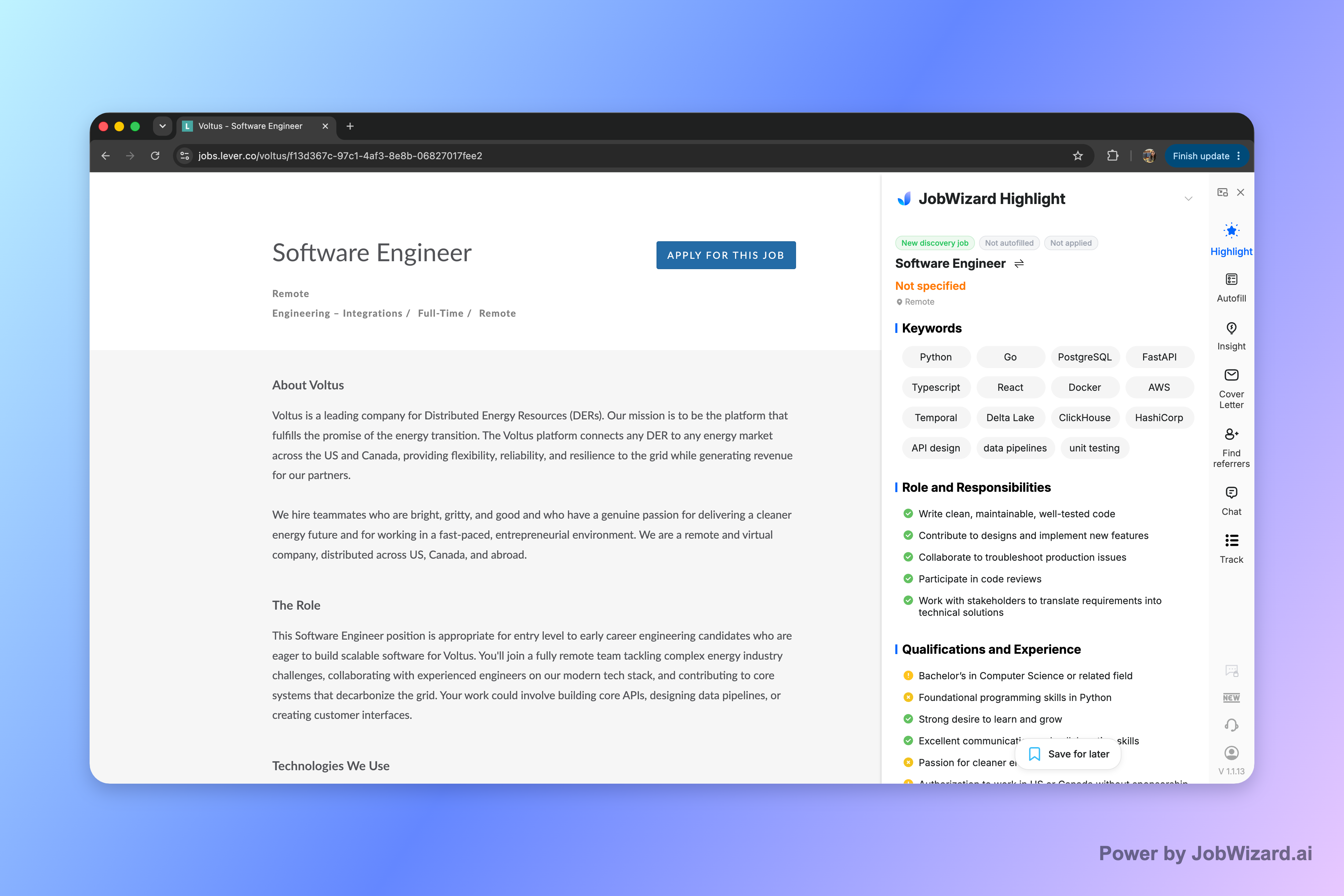
JD Highlights helps you turn a long job description into a structured view of the role’s key requirements—so you can review qualifications and responsibilities more systematically.
Instead of scanning for a few obvious terms, use the job posting to separate what matters into buckets you can later convert into resume language:
- Responsibilities / deliverables: the outputs the team expects (e.g., client presentations, analyses, recommendations).
- Qualifications / requirements: the competencies they explicitly ask for (e.g., experience with financial modeling or stakeholder management).
- Keywords and tool/method mentions: frameworks, analytic approaches, and systems the posting calls out.
Job descriptions often reuse words that reflect how consultants work: “workstream,” “stakeholder,” “analysis,” “recommendations,” “executive-ready,” “client deliverables,” and “problem solving.” Your job is to lift the meaning and express it with your own proof.
Keyword extraction examples you can copy into your workflow
Use these as “translation prompts” while you’re building your keyword list for consulting resume keywords:
- If the JD says “client deliverables”, pick bullet phrases that show you produced something (slides, reports, recommendations, or decision memos).
- If the JD says “stakeholder management”, choose language about presenting status, aligning teams, or coordinating across groups.
- If the JD says “financial / business analysis”, add the analysis method or model type you actually used (not vague “analyzed data”).
- If the JD says “structured problem solving”, mirror how you organized work: frameworks, workstreams, assumptions, and how you reached conclusions.
Important: don’t claim frameworks or tools you’ve never used. Add keywords only when your experience supports them.
Consulting resume keywords that map to bullet writing (templates + examples)
The fastest way to use consulting resume keywords well is to rewrite bullets using templates that keep the structure consistent with how consulting work is described.
When a resume bullet feels “consulting-native,” keywords show up naturally because the sentence already matches the job’s mental model. That beats stuffing isolated terms into a Skills section.
Bullet template: deliverable + method + scope + stakeholder
Use this template to convert a requirement into a convincing experience bullet:
- Action + deliverable: what you produced.
- Method/tool: how you produced it.
- Scope/constraint: what scale, timeframe, or data context.
- Stakeholder / communication: who needed it and how you communicated.
Here are keyword-aligned examples (replace bracketed text with your real details):
- Client deliverables: “Built executive-ready recommendations decks for [client/internal stakeholders] by synthesizing [analysis] and translating findings into [decision/action].”
- Workstream leadership: “Led a workstream covering [topic] across [team size/functions], coordinating inputs, defining assumptions, and delivering [output] by [deadline].”
- Financial modeling / business analysis: “Developed [model type] to evaluate [business question], improving forecasting accuracy by [real improvement/metric if you have it].”
- Stakeholder management: “Managed stakeholder alignment through [cadence/reviews], ensuring deliverables reflected [requirements/feedback].”
- Structured problem solving: “Applied a structured approach to break down [problem], defining hypotheses, validating with [data/method], and presenting recommendations.”
What to do with “skills lists” and keyword repetition
Skills sections can help ATS indexing, but they shouldn’t replace bullet proof. If you have a keyword list for consulting resume keywords, treat the Skills section as the “index,” and the experience section as the “evidence.”
If the job description mentions specific competencies, mirror them in your Skills section only when they’re supported elsewhere. Then ensure each major requirement appears in at least one bullet where it makes sense.
Use Insight match gaps to revise wording—without inflating claims
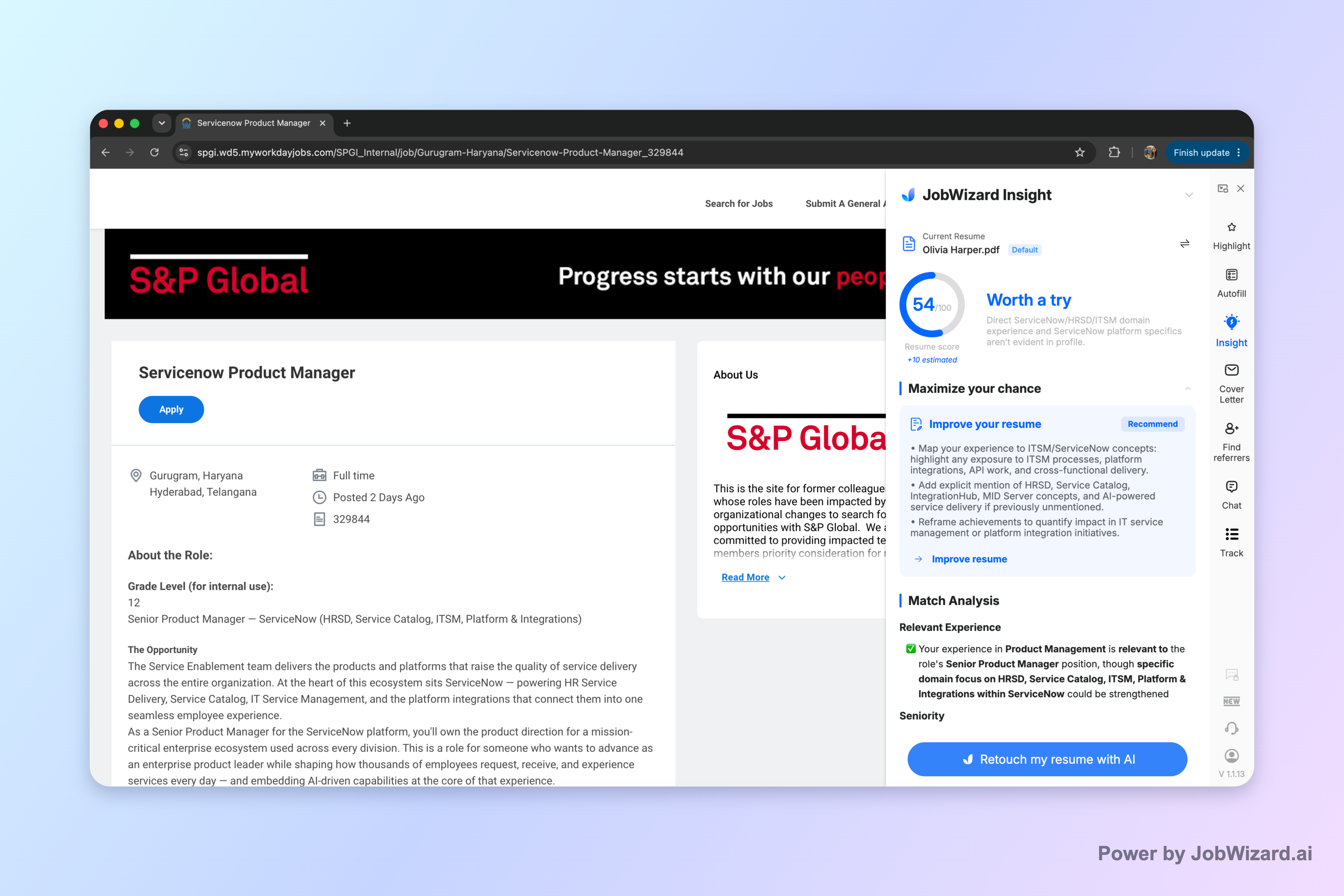
Insight / match score compares your resume with the current job description and provides an overall assessment and improvement suggestions.
It can also identify expression gaps and turn them into an editable resume revision draft. Think of it as a gap-finding tool, not a “set-and-forget” auto-tailor.
How to use the match-gap results correctly
The match score is a diagnostic, not a hiring prediction. Use it to locate areas where your resume might be missing the job’s phrasing—even if your experience is present but described differently.
- Verify every suggested resume change against your actual experience.
- Keep sponsorship / salary / EEO / custom questions for your review before submitting.
- Rewrite for clarity: make sure each added keyword still fits your sentence and your proof.
Key limitation: The score is not a hiring probability and does not guarantee ATS passage or an interview.
A practical “rewrite loop” (10–20 minutes per target posting)
Use this loop each time you tailor for a new consulting role:
- Extract responsibilities + qualifications keywords from the JD.
- Map each major requirement to one experience bullet.
- Rewrite bullets using the deliverable + method + scope + stakeholder template.
- Check that every new keyword is accurate (no invented tools/frameworks).
- Validate match gaps, then refine wording—not meaning.
This approach keeps your resume grounded while improving keyword alignment to the job you’re targeting.
Consulting keyword strategy by firm type: management vs strategy
Not every consulting posting uses the same emphasis, so consulting resume keywords should be prioritized based on what the job actually stresses.
Use the job description to decide which cluster of keywords matters most. Below is a practical way to think about common differences.
| Consulting track | Common emphasis in job requirements | Keyword examples to look for (from your JD) |
|---|---|---|
| Management consulting | Deliverables, workstream execution, client-facing outputs, implementation-oriented impact | “client deliverables,” “workstream,” “stakeholder management,” “executive-ready presentations,” “recommendations” |
| Strategy consulting | Analysis depth, decision support, structured research, frameworks, hypothesis-driven work | “structured problem solving,” “market/competitive analysis,” “frameworks,” “decision support,” “insights synthesis” |
| Operations / transformation | Process improvement, measurable outcomes, cross-functional coordination | “process optimization,” “operating model,” “cross-functional alignment,” “implementation planning,” “performance metrics” |
Rather than memorizing lists, treat these as “keyword categories.” Then use JD Highlights to confirm what your specific target posting emphasizes—because the best keyword list is the one that matches the role’s wording.
Cross-check with other role-specific keyword guides
If you’re switching into consulting from a functional background, you can blend keyword patterns from related guides:
- How to Optimize Resume for ATS: A Practical 2026 Checklist (overall ATS checklist and formatting discipline)
- Computer Science Resume Keywords That Match Real Job Requirements (Without Guessing) (helpful when your consulting angle is analytics/tech)
- Admin Assistant Resume Keywords That Beat ATS: How to Match JD Requirements Fast (useful if your proof is coordination, schedules, and stakeholder communication)
- Keywords for Electrical Engineer Resume: 35 ATS-Ready Terms to Match Real Job Requirements (helpful for technical consulting variants)
These won’t replace consulting tailoring, but they can speed up your “keyword mapping” mindset and help you avoid random guesswork.
Do this automatically with JobWizard
Skip the manual work — JobWizard's Match Score handles this for you.
FAQs: Consulting resume keywords answered
What are consulting resume keywords, and do I need them for every application?
Consulting resume keywords are the exact terms recruiters and ATS systems look for—typically from the job description’s requirements, responsibilities, and qualification sections (for example: “client deliverables,” “financial modeling,” “stakeholder management,” or “problem solving”). You should not reuse one generic list every time; instead, match the keywords to each target job’s wording and keep them grounded in your real experience.
How do I find consulting job keywords if the posting is vague or uses unusual phrasing?
Start by pulling the role’s themes from the job description—responsibilities, qualifications, and any stated tools or methods—then translate them into practical resume phrases you already demonstrate (e.g., “built a model,” “led workstreams,” “presented findings to executives”). Use JD Highlights to organize what the posting emphasizes, and then confirm you can truthfully support each keyword with a specific bullet.
Will a resume “match score” guarantee ATS passage or an interview?
No. A match score is not a hiring probability and doesn’t guarantee ATS passage or an interview. It’s a diagnostic to help you identify expression gaps between your resume and the specific job description, then turn those gaps into an editable draft you can verify for accuracy before submitting.
What’s the fastest way to rewrite consulting resume bullets using keywords without sounding robotic?
Use keyword-first bullet templates: (1) Action + consulting deliverable (2) Method/tool (3) Scope/impact (4) Stakeholder or context. Then swap in the job’s phrasing only where it reflects what you actually did. The goal is keyword alignment plus credibility—every added term should connect to a real task, output, or metric from your background.
Which consulting keywords matter most for management consulting versus strategy consulting?
While there’s overlap (problem solving, structured communication, stakeholder management), management consulting postings often emphasize client deliverables, workstream leadership, and implementation-oriented outputs. Strategy consulting postings more often emphasize frameworks, analysis depth, market/competitive research, and decision support. Use the job description you’re targeting to decide which sub-skill keywords to emphasize, then validate they match your experience.
Ready to tailor your resume for the next consulting job? Open your target role in JobWizard, use JD Highlights to extract the requirements, then review Insight match-gap suggestions to rewrite keywords into experience-based bullets before you apply.
Frequently Asked Questions
See your resume's match score for any job
JobWizard compares your resume to each job description and shows the exact keywords to add — free.