Cyber Security Resume Keywords: The JD-Driven Checklist to Beat ATS (and Impress Humans)
Learn how to use cyber security resume keywords from the job description to tailor your ATS-ready skills, tools, and experience—without guessing.
Free Chrome extension
See your resume's match score for any job
JobWizard compares your resume to each job description and shows the exact keywords to add — free.
Cyber security resume keywords start with the job description you’re actually targeting.
If you’re searching for cyber security resume keywords to pass ATS, the fastest path is to stop guessing and start extracting requirements from the exact job description (JD) you want. Most “keyword” lists miss the key point: ATS tuning works best when your wording reflects what the employer is asking for in their own language.
In practice, you’ll build a keyword map from the JD and then place those terms in the sections recruiters and parsers scan most. That typically means your summary, skills, certifications, and the first 1–2 bullets of each relevant experience entry.
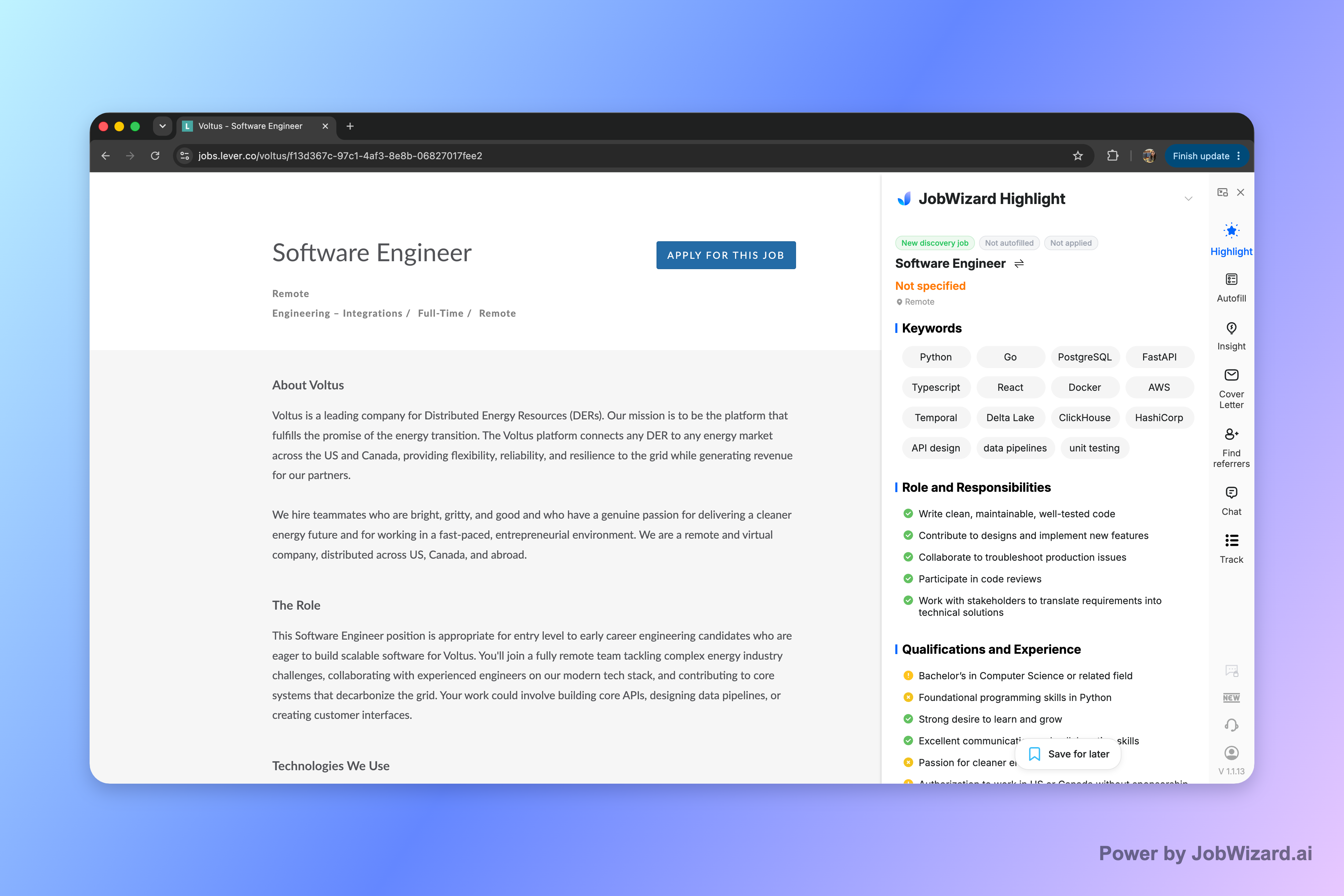
JobWizard’s JD Highlights helps you turn a long JD into a structured view of role responsibilities, qualifications, and keywords—so you can review the requirements more systematically. Then you tailor your resume using only what you can truthfully support.
Turn the JD into a keyword map (so your resume matches reality).
When you extract cyber security resume keywords from the JD, treat them like categories—not a pile of terms. Your goal is to align your resume to the job’s security scope: monitoring/detection, incident response, vulnerability management, cloud security, governance/compliance, or security operations leadership.
Start by scanning these JD areas and capturing the exact recurring requirements:
- Responsibilities: actions you must perform (triage, investigation, remediation, reporting, detection improvement, auditing).
- Qualifications: required or preferred competencies (tooling, years of experience, education, certifications, security domain knowledge).
- Keywords/tools: named technologies and frameworks (SIEM/SOAR, EDR, ticketing, IAM, cloud services, OWASP, NIST, CIS).
Then map each keyword category to a resume location:
| JD Keyword Type | What It Looks Like | Best Resume Placement | Example (Adapt to Your Experience) |
|---|---|---|---|
| Security domain | “Incident response,” “SOC operations,” “threat detection” | Summary + experience bullets | “Supported incident response workflows for alerts and escalations; documented investigation findings.” |
| Tools (SIEM/EDR) | “Splunk,” “Microsoft Sentinel,” “CrowdStrike,” “Elastic” | Skills + specific bullets | “Used SIEM queries/dashboards to investigate alerts and track remediation status.” |
| Detection & response actions | “Triage,” “investigate,” “containment,” “remediation” | Experience bullets | “Triage and investigation of suspicious activity; coordinated containment steps and follow-up improvements.” |
| Vulnerability management | “Scan,” “prioritize,” “remediation,” “risk-based” | Skills + bullets under IT/security ops | “Assisted with vulnerability scanning and worked with engineering to validate patches and reduce exposure.” |
| Compliance/governance | “NIST,” “SOC 2,” “ISO 27001,” “audit support” | Certifications + summary + bullets | “Contributed to audit readiness by maintaining evidence for security controls and incident documentation.” |
Keyword example bundles you can adapt (SOC, AppSec, Cloud)
Below are realistic keyword bundles to help you structure your “keyword map.” Don’t copy these blindly—use them as prompts to find the same terms in your JD and connect them to your actual work.
- SOC analyst bundle: incident response, alert triage, investigation, SIEM, detection rules, escalation workflow, EDR, incident documentation, threat hunting (if applicable).
- Application security (AppSec) bundle: OWASP, secure SDLC, vulnerability assessment, SAST/DAST (if you used them), code review support, remediation collaboration, risk reporting.
- Cloud security bundle: IAM, access control, cloud security posture, logging/monitoring, incident detection support, policy-as-code (if applicable), audit readiness.
Place keywords where ATS and recruiters actually scan.
Even well-chosen cyber security resume keywords underperform if they’re hidden or scattered. ATS parsing tends to reward resumes with clear section headings and consistent terminology that matches the JD.
Use this checklist while editing your resume. Each step is designed to keep your resume easy to parse and easy to verify.
- Rewrite your summary with JD-aligned language: include 4–7 relevant competencies, not a general “results-driven” statement.
- Populate a skills section with categorized keywords: tools + capabilities + security domains. Avoid stuffing.
- Update experience bullets to mirror responsibilities: start bullets with action + security task (triage, investigate, remediate, report, validate).
- Add certifications and training using the exact credential names: match what the JD lists (when truthful).
- Keep wording accurate and specific: if you didn’t use a tool, don’t claim it—use adjacent experience you can support.
What “accurate mirroring” looks like (not keyword spam)
A common mistake is inserting keywords as isolated fragments. Instead, embed them into sentences that show the responsibility context from the JD. For example:
- Weak: “Splunk, SIEM, incident response, compliance.”
- Stronger: “Used Splunk SIEM searches to triage alerts, investigate indicators of compromise, and document incident timelines for escalation and follow-up.”
This kind of phrasing helps ATS match the terms while still reading like a real security workflow.
Use an evidence-based workflow: extract → map → revise → verify.
You’ll get better outcomes when your cyber security resume keywords process is repeatable and auditable. Think of it as a short loop you run each time you apply.
Here’s a practical workflow you can use:
- Extract requirements: pull keywords, responsibilities, and qualifications from the JD.
- Map to your resume sections: decide where each requirement belongs (summary, skills, experience, certifications).
- Draft revised bullets: rewrite 2–4 key experience entries so they reflect the JD responsibilities.
- Verify every suggested change: keep only what you can truthfully support and what you’d feel comfortable explaining in an interview.
If you want an assistance step that helps you compare your resume to the JD more systematically, JobWizard includes Insight. It compares the selected resume with the current job description and presents a match score, an overall assessment, and improvement suggestions. It can also turn gaps into an editable resume revision draft for you to review before submitting.
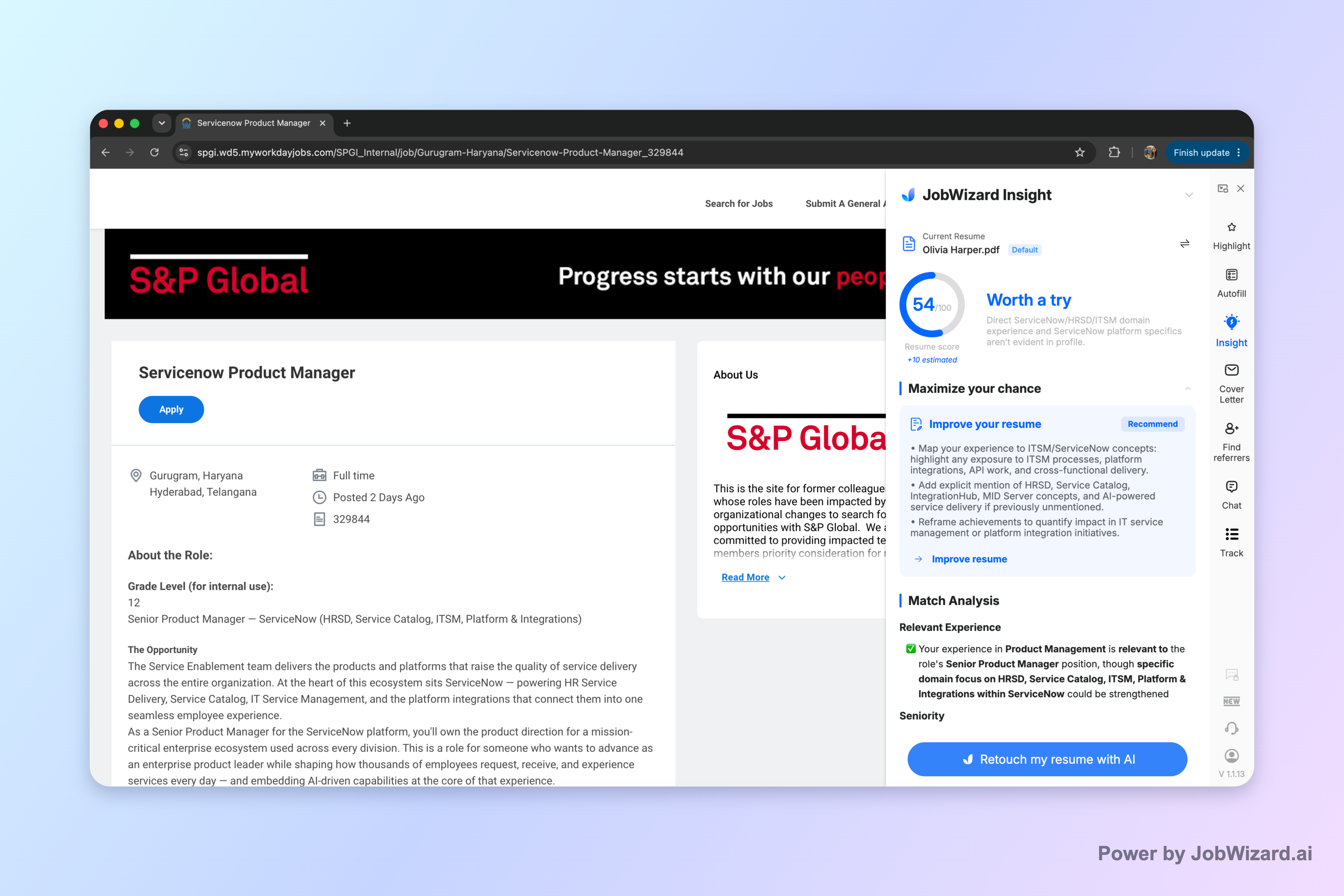
Important: The Insight score is not a hiring probability and doesn’t guarantee ATS passage or an interview. You must verify every suggested resume change and keep only accurate experience.
This workflow is also a good fit if you’re doing targeted applications and want to avoid the “one resume for everything” trap. If you’re optimizing in general for ATS, also review How to Optimize Resume for ATS: A Practical 2026 Checklist for formatting and parsing best practices.
Keyword strategy for different security roles (and how to avoid common traps).
Different cyber security roles emphasize different cyber security resume keywords, so your tailoring should reflect the security function—not just the industry.
SOC vs. SOC leadership vs. Incident response
- SOC analyst: prioritize alert triage, investigation steps, SIEM/EDR tooling, incident documentation, and escalation workflows.
- Incident response / IR support: emphasize investigation-to-containment handoffs, evidence handling, communications/reporting, and lessons-learned follow-through.
- Leadership roles: include security governance language, process ownership, cross-team coordination, and metrics/reporting responsibilities that match the JD.
When the JD asks for management, you’ll typically need more than tool keywords—you’ll want responsibility keywords that reflect leadership activities (planning, reviews, ownership, stakeholder communication).
AppSec and cloud: tailor your security language
- AppSec: match secure SDLC wording, application vulnerability workflows, and testing/triage responsibilities you actually performed.
- Cloud security: match cloud logging/monitoring and access control responsibilities and only list cloud services/tools you used.
Common traps (and how to handle them)
- Trap: copying “keyword lists” from random blogs. Fix: extract from the JD, then map to your resume sections with truthful experience.
- Trap: stuffing keywords without context. Fix: embed terms into responsibility-based bullets.
- Trap: claiming certifications or tools you don’t have. Fix: use truthful adjacent work, projects, or training you can document.
If you’re aiming at an executive security track, you may also find it useful to review CIO Resume Keywords That Beat ATS: A JD-Driven Checklist for Real Requirements—the same concept applies, but the keyword emphasis shifts toward governance, strategy, and operational oversight.
And if you’re strengthening your overall interviewing alignment beyond ATS, check Consulting Resume Keywords That Win Interviews: Match Job Requirements Fast (2026) for guidance on translating requirements into evidence-based bullets.
Do this automatically with JobWizard
Skip the manual work — JobWizard's Match Score handles this for you.
FAQ: Cyber security resume keywords questions people ask before they tailor.
What are the best cyber security resume keywords to use for ATS?
Use keywords that appear in the job description—especially in the responsibilities and qualifications sections—then mirror them in your skills and experience bullets where they accurately reflect your work.
Should I copy the entire job description into my cyber security resume?
No. Instead, extract the recurring requirements (tools, frameworks, credentials, and security responsibilities) and map them to your real experience. Keep sponsorship items and any application answers for your review before submitting.
How do I tailor cyber security resume keywords if I’m missing some requirements?
If you’re missing a requirement, don’t fake it. Focus on what you do have that overlaps, then use truthful wording to connect your experience to the intent (for example, translate adjacent work into the same responsibility theme, and add evidence like projects or training you can verify).
What’s the difference between skills keywords and responsibility keywords on a cyber security resume?
Skills keywords name tools and capabilities (like SIEM, incident response, vulnerability management), while responsibility keywords show how you used them (like triage, detection engineering support, ticket workflows, and remediation follow-through). Both should come from the JD and match your actual outcomes.
How can JobWizard help me use cyber security resume keywords more systematically?
JobWizard can organize a job description into keywords, role responsibilities, and qualifications so you can review requirements systematically. It also includes Insight to compare your resume with the current job description, identify expression gaps, and generate an editable revision draft you can verify before submitting.
Ready to tailor your next cyber security application? Open the target job posting, extract the responsibilities/qualifications, and use JobWizard to highlight the exact keywords to mirror—then revise your resume draft and verify every change before submitting.
Frequently Asked Questions
See your resume's match score for any job
JobWizard compares your resume to each job description and shows the exact keywords to add — free.