Performance Based Interview Questions: Answer With Measurable Impact (Not Vague Strengths)
Performance based interview questions are designed to test how you deliver under real constraints. Learn a repeatable way to answer with metrics, tradeoffs, and results.
Free Chrome extension
Autofill your next job application
JobWizard is a free Chrome extension that fills applications, tracks statuses, and optimizes your resume.
Performance based interview questions are the ones that test what you delivered—not just what you can do. If you’ve ever left an interview feeling like your answers were “technically correct” but not convincing, this guide will help you respond with measurable impact, clear tradeoffs, and tight examples.
The key is to treat performance questions like mini case studies. You’ll show your method, explain why your decisions were the right ones under constraints, and land on outcomes the interviewer can evaluate.
How to recognize performance based interview questions (before you even answer)
Performance based interview questions usually sound like they’re asking for evidence, not opinions.
Here are common “tells” that the interviewer wants proof:
- “Tell me about a time…” followed by an outcome-focused prompt (speed, quality, revenue, adoption, reliability, cost, risk).
- Constraints in the wording (tight timeline, limited resources, conflicting priorities, technical limitations, stakeholder pressure).
- Decision logic prompts (what you chose, what you rejected, how you measured options).
- “What happened next?” prompts that evaluate whether you can learn and adjust.
If you see these patterns, your answer should do three things quickly: (1) define the performance bar, (2) describe what you changed, and (3) quantify results or provide a credible proxy.
For deeper interview structure, you can also use this companion guide: Behavioral Interview Questions That Actually Predict Your Performance—And How to Craft Strong Answers.
A repeatable framework for performance answers: metrics, tradeoffs, and “why”
Use a performance-first STAR approach that spends more time on Action and Results than on backstory.
Traditional STAR (Situation, Task, Action, Result) works, but performance-based questions reward specificity. Build answers with a measurable “throughline.”
- Situation/Task (brief): Set the context in 1–2 sentences, then name the performance objective.
- Action (what you changed): Focus on decisions and execution steps, including what you measured.
- Tradeoffs (what you chose not to do): Explain constraints and alternatives—this is where “performance” shows.
- Result (what improved): Provide numbers if you have them; otherwise use a defensible proxy and timeframe.
- Learning loop (what you’d do again): Show adaptation after feedback, issues, or new data.
When you’re missing perfect data, that’s normal. The goal isn’t to invent statistics—it’s to show how you evaluated success and what improved because of your choices.
Top performance based interview questions (with answer angles you can copy)
Use these prompt-to-answer angles to ensure every response ties to measurable outcomes.
Below are question patterns you’ll commonly see, plus the specific “angle” that makes your answer feel performance-driven.
| Performance question pattern | What they’re really testing | Answer angle to use |
|---|---|---|
| “Tell me about a time you improved a process or outcome.” | Whether you can identify the bottleneck and execute change. | Baseline first, then what you changed, then measurable improvement (or proxy + timeframe). |
| “Describe a project where you delivered under a tight deadline.” | Prioritization and risk management. | Tradeoffs: what you cut, what you accelerated, how you prevented quality regressions. |
| “Tell me about a time you handled conflicting priorities.” | Stakeholder alignment and decision-making. | How you negotiated scope, set expectations, and verified progress with stakeholders. |
| “Give an example of a time you improved quality or reduced errors.” | Whether you use feedback loops and root-cause thinking. | What signals you monitored, what root cause you found, and what controls you added. |
| “What’s an example of when you made a high-impact decision with incomplete information?” | Judgment under uncertainty. | What assumptions you made, how you tested them, and what you did when reality differed. |
| “Tell me about a time you influenced without authority.” | Communication and persuasion with results. | Stakeholder map, messaging, and the measurable outcome that followed your influence. |
| “Describe a situation where you had to learn quickly.” | Speed of competence and disciplined execution. | Learning plan, timeboxed experiments, and concrete performance outcomes from what you learned. |
If you’re using a STAR approach, consider how these role-specific examples map to a company’s hiring signals. For example: Cisco Behavioral Interview Questions for Data Analysts: STAR Answers That Map to Cisco’s Hiring Signals and Amazon Behavioral Interview Questions: A STAR Plan for “Ownership” Answers That Land.
Answer like a performer: quantify, justify tradeoffs, and close with relevance
Your closing sentence is what turns a good story into a credible performance answer.
Many candidates stop after the result. Performance-based interviewers want one more layer: relevance. That means explaining how the example connects to what the role needs next.
Try this closing pattern:
- “The key performance lesson was…” (one sentence).
- “What I’d apply in this role is…” (one sentence tied to job requirements).
- “The evidence is…” (reference the measurable outcome or proxy you used).
Also, performance answers should be honest about what you controlled. If the outcome depended on another team, explicitly state what you owned versus what you influenced.
To keep your prep consistent across application materials, you may find this method useful too: How to Answer Job Application Questions: A Field-Tested Method for Confident, Consistent Responses.
Make follow-up questions part of your performance narrative
The best candidates ask follow-ups that confirm how success will be measured in this specific role.
When interviewers ask performance based interview questions, they’re also signaling what they evaluate. You can mirror that by asking about metrics, constraints, and decision criteria.
High-signal follow-up questions to ask
- “How do you measure success in the first 30–90 days?” (forces outcome clarity).
- “What does great look like versus ‘meets expectations’?” (defines performance thresholds).
- “What constraints typically show up on this team?” (lets you choose the right examples).
- “How do decisions get made when stakeholders disagree?” (tests your ability to align under pressure).
- “What are the most common reasons people struggle in this role?” (helps you preemptively address fit).
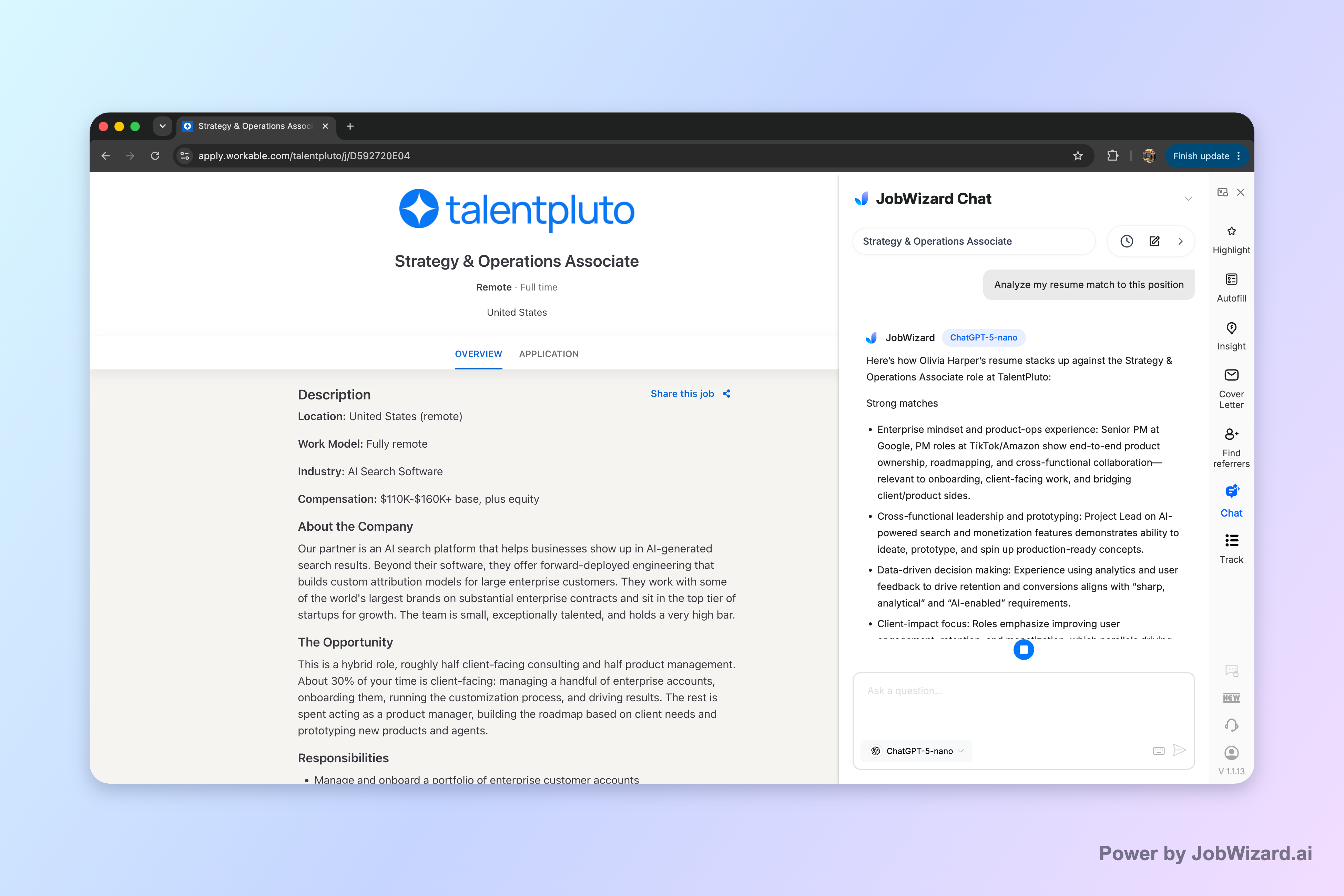
JobWizard Career Chat can support prep by keeping the current role in context so you can ask focused follow-up questions about resume fit and application strategy without pasting the job description again. Use the output to refine your prep, then review it against the job description before you rely on it. Also note that it does not present its analysis as a recruiter decision or a guarantee that you qualify.
Quick note: Career Chat is for sharpening your questions and tailoring your preparation—not for assuming an outcome. You’ll still review and finalize your interview story based on the actual job description.
Do this automatically with JobWizard
Skip the manual work — JobWizard's Smart Autofill handles this for you.
FAQ: performance based interview questions
What’s the difference between performance based interview questions and typical behavioral questions?
Performance based interview questions usually push for evidence of how you performed (constraints, decisions, and measurable outcomes). Typical behavioral questions may focus more broadly on “what you did,” while performance-focused prompts often require you to explain how you judged success, what changed, and what the result was.
How do I answer performance based interview questions when I don’t have exact numbers?
If you don’t have exact numbers, use defensible proxies (cycle time, defect rate, throughput, stakeholder satisfaction, cost drivers, or scope). Be explicit about estimates, timeframe, and what you controlled—then connect your actions to an outcome the interviewer can evaluate.
Should I use the STAR method for performance based interview questions?
Yes—STAR works well, but performance-based answers need an extra emphasis on results and your decision logic. Use Situation/Task briefly, then spend more time on Action (what you changed and why) and finish with Results (what improved, by how much, and what you’d do differently).
What questions should I ask the interviewer for a performance based interview?
Ask about how success is measured in the role (KPIs, quality bars, and what “good” looks like early on). You can also ask about decision criteria and constraints (timeline, stakeholders, systems). This helps you tailor your examples to what they actually evaluate.
Can Career Chat help me prepare for performance based interview questions?
Yes. JobWizard’s Career Chat keeps the current role in context, so you can ask follow-up questions about resume fit and application strategy without pasting the job description again. Invite a focused follow-up question about the current role, then review the answer against the job description before you use it in your interview prep.
Ready to prep smarter for your next interview? Use JobWizard to support your application workflow with autofill + review-before-submit, then use Career Chat to generate focused follow-up questions tailored to the role—so your performance based interview questions answers match what the team will actually evaluate.
Frequently Asked Questions
Autofill your next job application
JobWizard is a free Chrome extension that fills applications, tracks statuses, and optimizes your resume.