Behavioral Interview Questions That Actually Predict Your Performance—And How to Craft Strong Answers
Learn how to answer behavioral interview questions with real examples, a repeatable structure, and practical review steps. You’ll also see how JobWizard’s Career Chat can help you sharpen follow-ups.

Free Chrome extension
Autofill your next job application
JobWizard is a free Chrome extension that fills applications, tracks statuses, and optimizes your resume.
If you’re searching for behavioral interview questions, you’re probably trying to predict what hiring managers are really listening for—because “tell me about a time…” can feel vague until you know the pattern. The good news: behavioral interviews are rarely about your title; they’re about your decisions, communication, and follow-through in realistic situations.
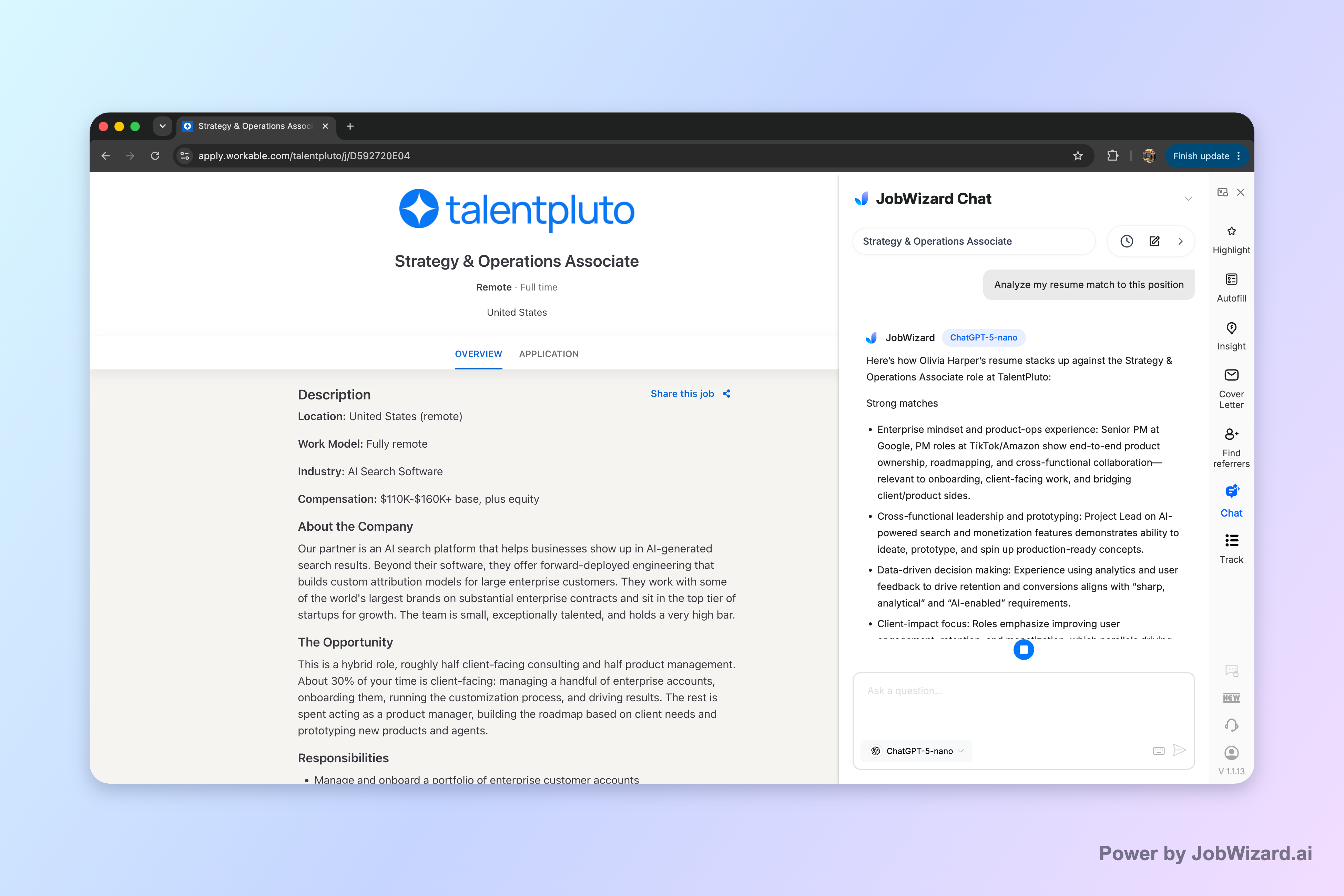
For role-focused prep and better follow-up questions, JobWizard’s Career Chat keeps the current role in context so you can ask follow-ups about resume fit and application strategy without pasting the job description again.
What behavioral interview questions are testing (and how to answer them)
Behavioral interview questions are testing how you behave when the stakes are real—especially your judgment, ownership, and communication.
Most behavioral prompts map to a handful of competencies. Instead of memorizing responses, build your answers around “what I did and why it worked,” then connect that to the role’s needs. If your story doesn’t clearly show your decision-making or the reason you chose your approach, it can sound like you’re reciting tasks rather than demonstrating impact.
- Ownership: Did you act without waiting for perfect information?
- Collaboration: How did you align with others—especially when priorities conflicted?
- Conflict & communication: What did you say, what did you listen to, and what changed afterward?
- Failure & learning: What did you do differently next time, and how did you prevent repeats?
- Execution & tradeoffs: How did you handle constraints (time, scope, quality, stakeholders)?
To keep your answers credible, avoid exaggeration or vague claims like “I improved performance.” Instead, anchor your story in observable actions: what you measured, what you changed, and what outcome followed.
The fastest way to prepare: build an “example bank” you can reuse
The simplest prep workflow is to build a bank of stories that cover themes, then tailor them to each company.
Think of your example bank as reusable building blocks. You should be able to pull the same core experience into multiple answers by swapping the lens: conflict becomes communication, ownership becomes execution, and learning becomes risk management.
Step-by-step: creating a story bank that matches most prompts
- Pick 6–10 situations: choose examples that show your best behaviors, not your longest resume.
- Label each one by theme: ownership, collaboration, failure/learning, process improvement, leadership.
- Write your STAR+Plan bullets: focus on Situation, Task, Action, Result—plus a short “why it worked.”
- Add 1 constraint detail: a tight deadline, limited data, competing stakeholders, or unclear requirements.
- Choose a “pivot moment”: the point where you changed direction or made a key decision.
- Collect your lesson: what you’d repeat, what you’d improve, and what you learned about working with others.
When you customize, don’t rewrite the entire story. Adjust the framing so the hiring manager can immediately see the relevance to the role.
Quick example: Suppose you have a conflict story about two teams disagreeing on requirements. In one interview, frame it as communication and alignment. In another, frame it as execution under ambiguity. Your “core actions” stay consistent; your emphasis shifts.
If you want a structure you can reuse across many prompts, use this guide as a parallel resource: How to Answer Behavioral Interview Questions and Answers: The STAR+Plan That Wins Interviews.
Write answers with STAR+Plan, then validate them against the role
STAR+Plan helps you deliver behavioral interview answers that are specific, organized, and easy to trust.
Behavioral questions reward clarity: hiring teams want to understand the situation, what you were responsible for, what you did, and the results. STAR gives you the skeleton; STAR+Plan adds the connective tissue—how your approach fits the role.
Use this template (and keep it to one tight flow)
- S (Situation): 1–2 sentences that set the context.
- T (Task): what you owned or influenced.
- A (Action): 3–5 sentences on your decisions, communications, and steps.
- R (Result): the measurable or observable outcome.
- Plan check: what you’d repeat and how this approach maps to the role’s priorities.
If you’re practicing across different question types (including “application question” prompts), pair your interview prep with How to Answer Job Application Questions: A Field-Tested Method for Confident, Consistent Responses. The same principle applies: concrete examples beat generic statements.
Validate before you answer: what to double-check
Before you rehearse “final” versions, validate your story details so you can defend them in follow-ups. This matters because behavioral interviews often include second-order questions like “What did you do first?” or “How did you handle pushback?”
- Decision logic: why your approach made sense at the time (not in hindsight).
- Boundaries: what you personally controlled vs. what others owned.
- Tradeoffs: what you chose not to do, and why.
- Learning: what changed in your process afterward.
Then, if you’re using JobWizard’s Career Chat, ask follow-up questions that keep your answer aligned to the role—without re-pasting the job description. For example, you can ask how your example bank should be weighted toward the role’s priorities, or what clarification hiring managers might look for in your specific scenario.
Pro tip: behavioral answers land best when they make it easy for the interviewer to picture you doing the work.
If your background is in software engineering, tailor your prep approach using Behavioral Interview Questions for Software Engineers: How to Use a Tool to Practice, Not Guess. The themes are similar, but the “proof points” often look different.
Common behavioral interview question types (with answer angles you can reuse)
Behavioral interview questions repeat patterns, so knowing the “answer angle” saves you from writing from scratch each time.
Here are high-frequency prompt types and the angles that typically make your response feel job-relevant. Use them to decide which story to pull from your bank and what emphasis to add.
| Prompt type | What they’re looking for | Answer angle to emphasize |
|---|---|---|
| Conflict / disagreement | Communication and resolution approach | How you aligned priorities, listened, and reached a decision |
| Failure / mistake | Accountability and learning | What you owned, what you changed, and how you prevented recurrence |
| Ownership with ambiguity | Judgment under uncertainty | Your decision-making process when data was incomplete |
| Leadership / influence | How you guided outcomes without formal authority | How you motivated, clarified roles, and removed blockers |
| Process improvement | Execution discipline | What you measured, what you changed, and how adoption happened |
| Time pressure / tradeoffs | Prioritization and communication | How you negotiated scope/quality and updated stakeholders |
Example angle shift: For a “time pressure” question, your core story might stay the same, but you highlight different parts: in one answer you focus on stakeholder communication; in another you focus on your prioritization framework.
If you’re also aiming to strengthen your general interview delivery, use How to Answer Interview Questions Like a Pro: Your Repeatable Framework for Clear, Confident Replies to keep your transitions and structure consistent across both behavioral and technical prompts.
Rehearse like a professional: deliver naturally and handle follow-ups
Practice for follow-ups, not just for the first answer—behavioral interviews often probe the “why” behind your actions.
Instead of memorizing paragraphs, rehearse bullet-level prompts for each STAR step. That keeps you flexible and prevents sounding scripted. If you notice you’re drifting into long background, stop and re-anchor at your decision or your action.
Rehearsal routine (30–45 minutes per theme)
- Tell the story in 60 seconds: a clean STAR run with one strong result detail.
- Tell it again in 90 seconds: add the pivot moment and 1 constraint.
- Answer 3 likely follow-ups: “Why did you choose that approach?” “What would you do differently?” “How did you involve others?”
- Trim one section: cut background so your action stays centered.
When you handle follow-ups, keep your structure loose but disciplined. If you’re asked about a specific step, respond with the step you took, what you considered, and what the immediate outcome was. You don’t need to “restart” your whole story.
And because behavioral interviews can become role-specific quickly, leverage JobWizard’s Career Chat to ask focused follow-up questions about the current role so you can validate what to emphasize—without manually copying the job description into a new message.
Do this automatically with JobWizard
Skip the manual work — JobWizard's Smart Autofill handles this for you.
FAQ: behavioral interview questions
What are behavioral interview questions actually testing?
They’re usually testing how you think and act under real conditions—how you handle ambiguity, conflict, ownership, and tradeoffs. Your goal is to show a repeatable pattern, not a one-time heroic story.
How many behavioral stories should I prepare before interviews?
Aim for an “example bank” that covers the most common themes (ownership, conflict, failure/learning, teamwork, process improvements). Then customize each story slightly so it matches the role’s priorities you’re applying for.
Should I rehearse with STAR or should I write full scripts?
Use STAR as your structure, not as a full-script requirement. Rehearse bullet-level prompts for each step (Situation, Task, Action, Result) so your delivery sounds natural and you can adjust wording in the moment.
How do I make my answers specific without sounding over-rehearsed?
Add specificity through concrete details you can defend: what you noticed, what constraints you had, the decision you made, and what you learned. Keep the story moving, and let 1–2 vivid details carry the credibility.
How can JobWizard help with behavioral interview prep?
JobWizard’s Career Chat helps you keep the current role in context so you can ask follow-up questions about resume fit and application strategy without pasting the job description again. Use it to tighten your story choices and validate your answer focus against what the role emphasizes.
Ready to sharpen your behavioral stories for a specific role? Use JobWizard’s Career Chat to ask a focused follow-up question about the role you’re interviewing for, then validate your answer focus against what the job emphasizes before you walk into the conversation.
Frequently Asked Questions
Autofill your next job application
JobWizard is a free Chrome extension that fills applications, tracks statuses, and optimizes your resume.