Interview Questions About Behavior: 37 Prompts and Answer Patterns That Actually Get Noticed
Master interview questions about behavior with proven prompt categories, decision frameworks, and example answers you can adapt. Build sharper stories fast.

Free Chrome extension
Autofill your next job application
JobWizard is a free Chrome extension that fills applications, tracks statuses, and optimizes your resume.
Interview questions about behavior are designed to test how you think and act under real constraints—not whether you can recite the “right” answer. If you walk in with vague examples, you’ll sound generic. If you walk in with a tight set of adaptable stories, you’ll sound like the person who can do the job.
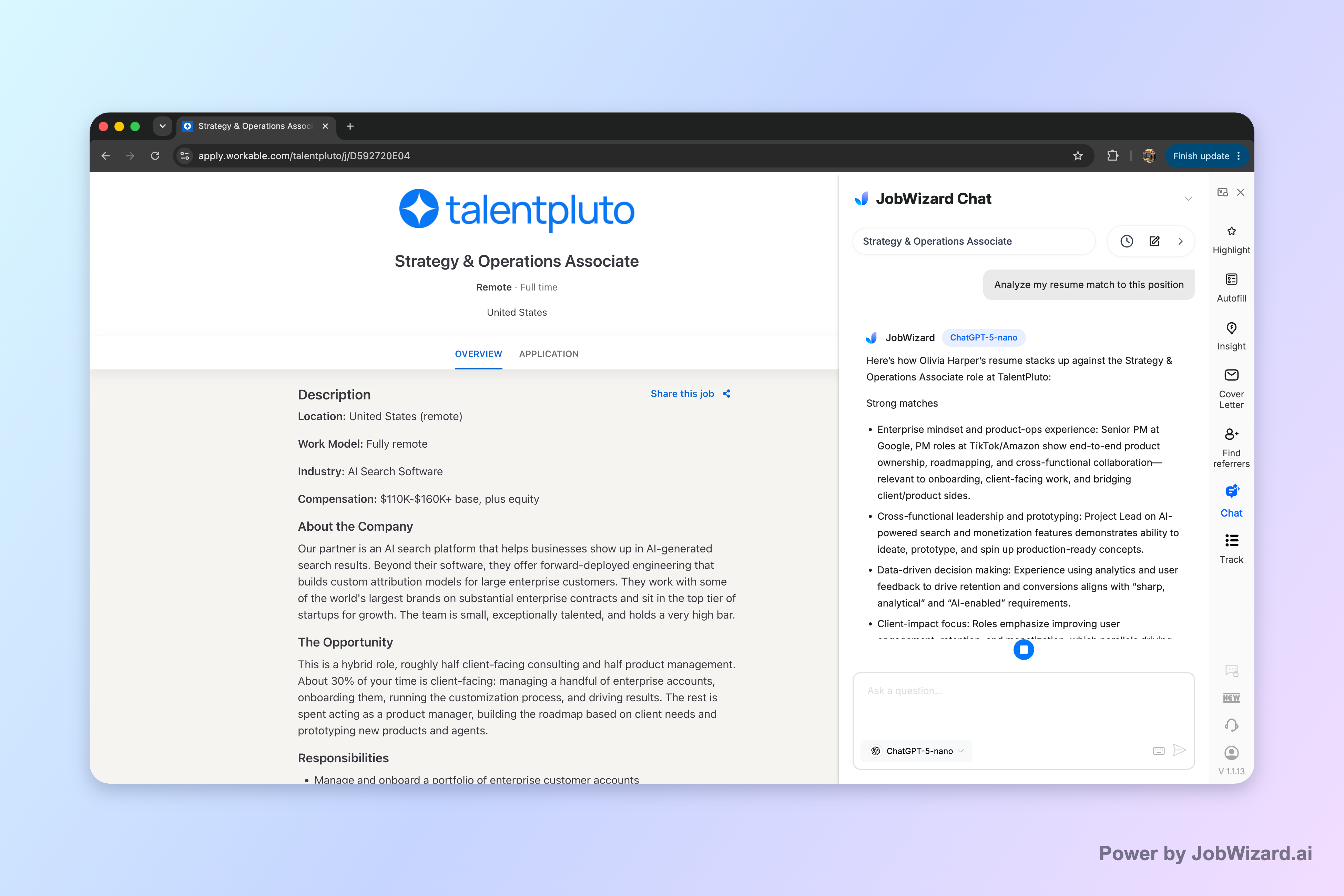
One fast way to sharpen your responses is to use Career Chat to keep your target role in context while you refine follow-up answers and your alignment to the job description.
If you want a structured approach to answering, start here: Behavioral Interview Questions That Actually Predict Your Performance—And How to Craft Strong Answers and then use the question bank in this guide to build your own “story library.”
How to structure interview questions about behavior so you sound specific, not rehearsed
The easiest way to win is to answer with a behavior story that proves your judgment: what you faced, what mattered, what you did, and what changed because of it.
Behavioral interviews often follow a pattern: “Tell me about a time…” Then the interviewer is listening for three signals—clarity, decision-making, and learning. Your job is to make those signals obvious in 60–120 seconds.
Use a STAR+Plan rhythm (but don’t get stuck in acronyms)
STAR gives you a clean structure, while “Plan” helps you finish with meaning.
- Situation: 1–2 sentences to set context (avoid a history lecture).
- Task: what you owned or what problem needed solving.
- Action: 3–5 concrete steps you personally took.
- Result: outcome (quantitative if you have it; credible qualitative if you don’t).
- So what / Plan: what you’d repeat and what you’d improve next time.
For a deeper breakdown of how to use this format, see How to Answer Behavioral Interview Questions and Answers: The STAR+Plan That Wins Interviews.
Choose answers that show “behavior” (not just achievements)
Good interview questions about behavior answers show what you did when things weren’t ideal: priorities shifted, someone disagreed, timelines tightened, or information was incomplete.
When your story is strong but outcomes are hard to measure, shift to what improved: stakeholder trust, reduced rework, faster cycle time, smoother handoffs, fewer escalations, or better follow-through. The interviewer still learns your patterns.
37 interview questions about behavior (plus what they’re really testing)
Use this prompt list to build a set of reusable story templates for the competencies most interviewers probe.
Below, each question includes the underlying behavior being evaluated. Pick 1–2 prompts per competency and turn them into your own story bullets.
Ownership, accountability, and follow-through
- Tell me about a time you took ownership of a problem. (Testing: initiative + responsibility)
- Describe a time you handled an urgent issue with incomplete information. (Testing: decision-making under uncertainty)
- Give an example of a commitment you made that you had to deliver on. (Testing: reliability)
- Tell me about a time you followed up when no one was pushing you. (Testing: follow-through)
- Describe a situation where you had to get something unstuck. (Testing: execution + problem solving)
Conflict, influence, and collaboration
- Tell me about a time you had a disagreement at work. (Testing: conflict navigation)
- Describe a time you influenced someone without authority. (Testing: stakeholder management)
- Give an example of how you handled competing priorities between teams. (Testing: alignment + prioritization)
- Tell me about a time you gave tough feedback. (Testing: communication + tact)
- Describe a time you worked effectively with a difficult teammate. (Testing: professionalism + adaptability)
Learning, growth, and adapting to feedback
- Tell me about a time you received critical feedback. (Testing: receptiveness + growth)
- Describe a situation where you had to learn something quickly. (Testing: learning agility)
- Give an example of a time you changed your approach after new information. (Testing: flexibility + judgment)
- Tell me about a time you made a mistake. (Testing: accountability + improvement)
- Describe a time your first attempt didn’t work. (Testing: iteration + resilience)
Planning, prioritization, and execution
- Tell me about a time you managed multiple deadlines. (Testing: prioritization)
- Describe a time priorities changed mid-project. (Testing: adaptability)
- Give an example of how you planned a project end-to-end. (Testing: structured execution)
- Tell me about a time you reduced risk. (Testing: proactive thinking)
- Describe a time you improved a process. (Testing: continuous improvement)
Decision-making and judgment under constraints
- Tell me about a time you had to make a tradeoff. (Testing: balanced judgment)
- Describe a time you made a decision with limited data. (Testing: smart uncertainty)
- Give an example of a time you said “no” or pushed back. (Testing: boundaries + reasoning)
- Tell me about a time you escalated a concern. (Testing: risk awareness + communication)
- Describe a time you managed scope creep. (Testing: control + clarity)
Customer, quality, and performance standards
- Tell me about a time you improved customer experience. (Testing: service mindset)
- Describe a situation where you had to balance speed and quality. (Testing: quality ownership)
- Give an example of how you handled a customer escalation. (Testing: calm problem solving)
- Tell me about a time you maintained quality under pressure. (Testing: discipline + consistency)
- Describe a time you set measurable standards for output. (Testing: performance management)
If you’re targeting a technical role, these categories often show up with different vocabulary. See Behavioral Interview Questions for Software Engineers: How to Use a Tool to Practice, Not Guess for a role-specific practice angle.
Turn your stories into answer templates (with examples you can adapt)
Templates make you faster because you only rewrite the “Situation” details while keeping your Action logic consistent.
Below are reusable templates. Replace bracketed text with your specifics.
Template 1: conflict → alignment
Use this when you disagreed but maintained momentum.
- Situation/Task: “We had [goal]. I disagreed with [person/team] about [decision]. I owned aligning the path forward.”
- Action: “I asked [clarifying questions], summarized tradeoffs, and proposed [two options] with risks. Then I negotiated success criteria and deadlines.”
- Result: “We shipped [deliverable] by [date], and stakeholders reported [qualitative improvement].”
- Plan: “Next time, I’ll surface decision criteria earlier to prevent rework.”
Template 2: missed goal → accountability + learning
Use this when the interviewer wants maturity.
- Situation/Task: “I planned [initiative], but we fell short of [metric/expectation]. I was responsible for [scope].”
- Action: “I reviewed the timeline, identified the failure points (e.g., dependencies, assumptions), and rebuilt the plan with earlier checkpoints. I also changed how I communicated risk.”
- Result: “We regained control and improved [outcome—time saved, fewer escalations, better throughput].”
- Plan: “I now confirm dependencies sooner and create a contingency plan at the start.”
Template 3: priorities changed → decision-making clarity
Use this when the job requires adaptability.
- Situation/Task: “Midway through [project], priorities shifted to [new direction]. My task was to protect impact while adjusting execution.”
- Action: “I re-ranked work using criteria like [customer impact, urgency, effort], updated stakeholders with a clear timeline, and adjusted scope. I also set a next review point to prevent churn.”
- Result: “We delivered [what you kept] and met the new deadline for [deliverable].”
- Plan: “I’ll propose a ‘change control’ step earlier when roadmaps are likely to shift.”
Template 4: influence without authority → stakeholder strategy
Use this when you collaborated across teams.
- Situation/Task: “I needed [outcome], but I didn’t directly manage [team]. I was responsible for coordinating alignment.”
- Action: “I mapped stakeholders by incentives, listened to concerns, and aligned on a shared goal. Then I offered a concrete plan with owners and milestones.”
- Result: “Their team adopted [approach], and we achieved [measurable or credible outcome].”
- Plan: “Next time, I’ll confirm decision owners upfront so we move faster.”
Quick credibility move: In your last sentence, add your “Plan” (what you’d repeat + what you’d improve). That’s often what separates memorized stories from strong behavioral answers.
Practice plan: rehearse interview questions about behavior without sounding scripted
Practice should feel like testing your logic, not reciting lines. Use a repeatable rehearsal workflow so every story becomes interview-ready.
Step-by-step rehearsal workflow
- Pick 5 competencies: ownership, conflict, learning, prioritization, and decision-making.
- Choose 1–2 prompts per competency from the list above.
- Write 6–10 story bullets (Situation, Task, Action steps, Result, Plan).
- Rehearse out loud twice: first for clarity, second for pacing.
- Swap the “Situation” details while keeping the Action logic constant.
- Record and tighten anything that takes longer than ~2 minutes.
This approach matches how behavioral interviews actually operate: the interviewer will vary the prompt, but they’ll still probe the same behaviors.
If you want broader context on other application-stage questions that can surface similar themes, use How to Answer Job Application Questions: A Field-Tested Method for Confident, Consistent Responses to keep your answers aligned across resume, application, and interview.
How to use Career Chat to refine your follow-ups
Career Chat is useful when you want to ask follow-up questions about fit and application strategy without repeatedly pasting the job description—because it keeps the current role in context for your question.
- Ask follow-ups: “What behavior example best proves [competency] for this role?”
- Test your framing: “Can you suggest a stronger Action step for clarity?”
- Verify alignment: Use your own judgment to confirm what’s consistent with the job description.
Limitation to remember: Career Chat does not present its analysis as a recruiter decision or a guarantee you qualify—so treat outputs as drafting support, not a hiring verdict.
Do this automatically with JobWizard
Skip the manual work — JobWizard's Smart Autofill handles this for you.
Interview questions about behavior FAQ: quick answers to the stuff you’re nervous about
Here are direct answers to the most common questions job seekers ask before behavioral interviews.
What are some common interview questions about behavior I’m likely to be asked?
Expect prompts like “Tell me about a time you handled conflict,” “Describe a time you missed a goal,” “Tell me about a time you influenced without authority,” “Give an example of a time you improved a process,” and “Describe a situation where priorities changed.”
How do I answer interview questions about behavior if I don’t have the “perfect” example?
Pick the closest real situation you can defend: focus on what you controlled, what changed because of your actions, and what you learned. If your original context was messy, frame it around your decision-making under constraints and the measurable outcome (even if it’s qualitative: reduced rework, faster turnaround, fewer escalations).
Should I use the STAR method for interview questions about behavior every time?
Use STAR as the backbone (Situation, Task, Action, Result), then layer a quick “So what” for credibility: what you’d do the same again and what you’d improve next time. That brief reflection helps your interviewer understand your judgment, not just your story.
What should I ask at the end after answering behavioral interview questions about behavior?
Ask role-anchored follow-ups like: “Based on my example about handling competing priorities, what would you want to see me do in the first 30–60 days?” or “Which behaviors matter most for success in this role—especially for collaboration and decision-making?”
How can I practice interview questions about behavior without sounding scripted?
Write 6–10 reusable story bullets (one per competency: conflict, ownership, learning, influence, planning, adaptability). During practice, swap the Situation details while keeping your Action steps consistent. Then rehearse out loud until the phrasing is natural, but the logic remains the same.
Next step: If you want to get better fast, ask a focused follow-up question about the current role and verify your framing against the job description. Start with JobWizard’s Career Chat by telling us the role title and the one competency you want to prove—then refine your behavioral interview story from there.
Frequently Asked Questions
Autofill your next job application
JobWizard is a free Chrome extension that fills applications, tracks statuses, and optimizes your resume.