Amazon Behavioral Interview Questions: A STAR Plan for “Ownership” Answers That Land
Learn how to answer amazon behavioral interview questions with a STAR structure that matches Amazon’s “ownership” style—plus what to ask in follow-ups so you sound prepared and specific.
Free Chrome extension
Autofill your next job application
JobWizard is a free Chrome extension that fills applications, tracks statuses, and optimizes your resume.
Amazon behavioral interviews reward ownership-style stories. If you’re searching for amazon behavioral interview questions, you don’t just need “what happened”—you need a repeatable way to show judgment, tradeoffs, and impact in the exact format interviewers can evaluate.
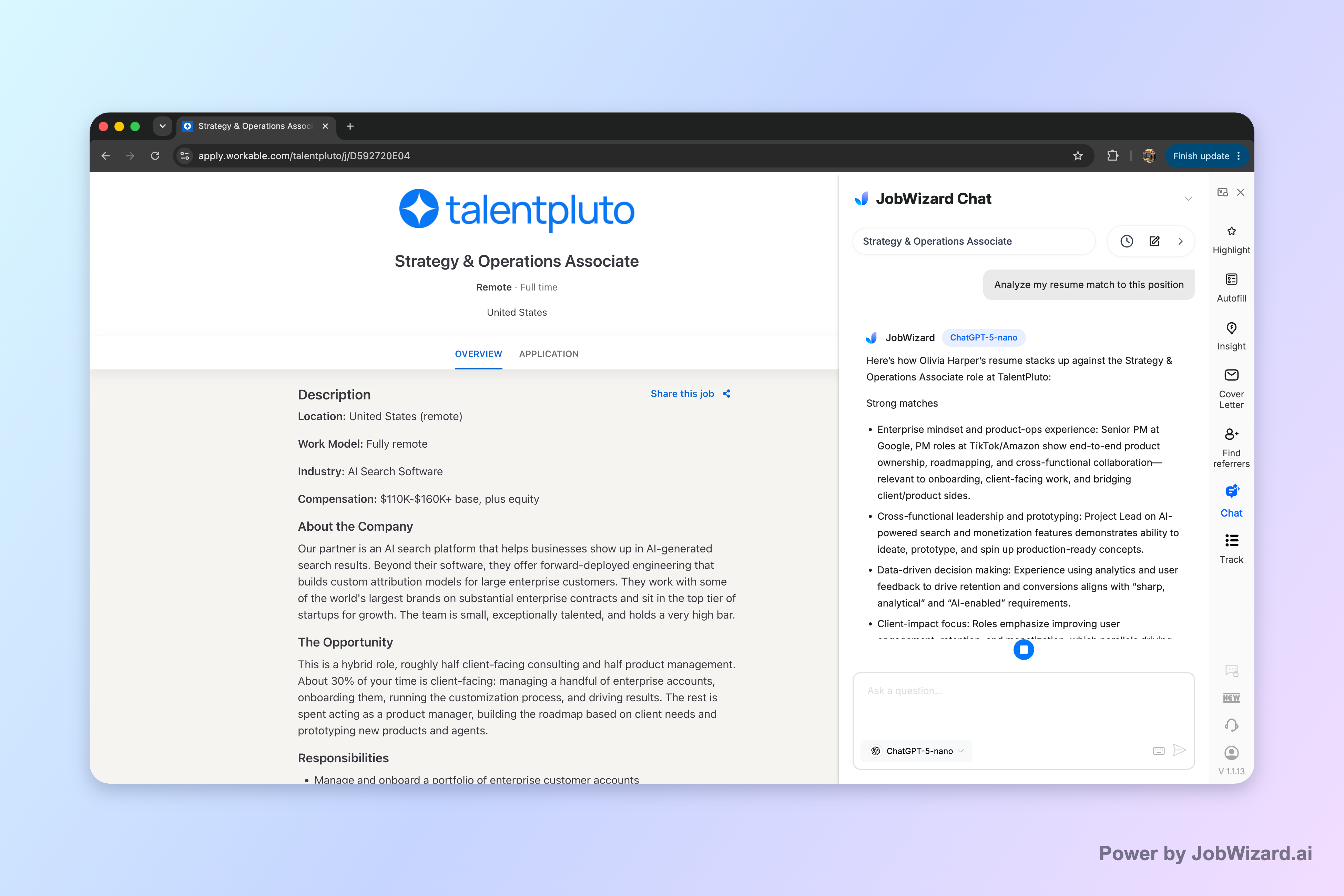
JobWizard’s Career Chat helps you keep the role in context while you refine how you answer—so you can ask follow-up questions about fit and strategy without repeatedly pasting the job description. That’s especially useful when you’re turning a great story into an answer that matches what this specific role is likely evaluating.
What interviewers mean by “amazon behavioral interview questions”
They’re testing how you think under real constraints. Amazon behavioral questions typically aim to learn how you handled ambiguity, made decisions, influenced others, and delivered results—not whether you can recite a textbook answer.
As you prepare, treat every question as a prompt to demonstrate four things: (1) your role in the situation, (2) the decision you made (or championed), (3) how you managed tradeoffs and risk, and (4) the outcome and learning. If your story is strong but the evaluator can’t quickly identify those four elements, your answer will feel “good” instead of “hireable.”
Translate any question into an ownership narrative
Even when the wording changes, the goal stays consistent. You can often reframe common prompts into an ownership theme: you took responsibility for progress, clarified what mattered, and drove execution.
- “Tell me about a time you took ownership”: Focus on how you identified the problem, chose an approach, and pushed the work forward without waiting.
- “Tell me about a time you improved a process”: Emphasize what you changed, how you persuaded stakeholders, and how you validated results.
- “Tell me about a time you disagreed with someone”: Show how you handled conflict, the reasoning you used, and how you preserved alignment.
- “Tell me about a time you worked with ambiguity”: Describe how you reduced uncertainty, got feedback early, and iterated.
If you want the “core mechanics” of building evidence-based behavioral answers, you’ll get a useful baseline from behavioral interview questions that actually predict your performance—and how to craft strong answers.
Turn “ownership” into a STAR answer (with examples you can reuse)
STAR keeps your answer structured and evaluator-friendly. For amazon behavioral interview questions, use STAR—but bias your wording toward Action and ownership.
Here’s a STAR template that works across most Amazon-style behavioral prompts. Keep it tight, then plug in one of your real stories.
STAR template optimized for Amazon-style evaluation
- Situation (1–2 sentences): Set context: where you were, what was happening, and what made it urgent or difficult.
- Task (1 sentence): Define what you were responsible for—your scope, the constraint, or the specific goal.
- Action (3–5 sentences): Explain your decision-making: what you did, what you asked, how you handled tradeoffs, and who you influenced.
- Result (1–2 sentences): Share the outcome and (when possible) the measurable impact or the learning you’d apply again.
Example: “Tell me about a time you took ownership”
Situation: “We had a customer-impacting issue and unclear ownership across teams.”
Task: “I was responsible for coordinating resolution and reducing repeat incidents.”
Action: “I mapped the failure points, identified where the signal was getting lost, and proposed a prioritized plan. I aligned stakeholders by focusing on user impact and risk, not blame. I set a short feedback loop, documented decisions as we learned, and made sure the next steps were explicit.”
Result: “We reduced repeat occurrences and improved response quality. More importantly, I created a lightweight process we still use to prevent similar ambiguity from slowing us down.”
Example: “Tell me about a time you worked with ambiguity”
Situation: “The requirements were incomplete and the timeline was tight.”
Task: “I needed to deliver something useful while we clarified the actual needs.”
Action: “I ran a discovery pass, asked structured questions to identify the constraints, and proposed a ‘learning-first’ plan. I chose an initial scope that let us validate assumptions quickly. Then I communicated progress in small checkpoints so stakeholders stayed aligned while we adjusted based on feedback.”
Result: “We launched an approach that met the real need and avoided rework. I learned that early ambiguity is best handled by narrowing the problem quickly and creating a shared definition of success.”
If you’re preparing for tech roles specifically, use behavioral interview questions for software engineers: how to use a tool to practice, not guess to help you practice these stories without turning them into memorized scripts.
Common amazon behavioral interview questions (and what to emphasize)
Use these question prompts as pattern-matching cues. You’ll likely see Amazon behavioral questions in different words, but the evaluation criteria stays similar.
| Behavioral prompt (example) | What interviewers are really evaluating | What to emphasize in your STAR |
|---|---|---|
| “Tell me about a time you took ownership.” | Initiative, accountability, and follow-through | Your decision, your coordination, and what you drove to completion |
| “Tell me about a time you disagreed with a teammate or stakeholder.” | Judgment, communication, and conflict handling | How you argued your reasoning and preserved alignment toward the outcome |
| “Tell me about a time you handled ambiguity.” | Ability to learn fast and reduce uncertainty | How you validated assumptions and built feedback loops early |
| “Tell me about a time you improved a process.” | Continuous improvement and measurable impact | The change you made, adoption strategy, and the results (even qualitative) |
| “Tell me about a time you failed or made a mistake.” | Accountability and learning | What you owned, how you corrected course, and what changed afterward |
| “Tell me about a time you delivered results under pressure.” | Execution under constraints | Your prioritization and how you protected quality while moving fast |
Pro tip: If you’re unsure what emphasis to use, listen for the interviewer’s framing (“how did you decide?” vs. “how did you collaborate?”). Then reflect that framing in your Action section with the matching details.
Practice method: rehearse transitions, not speeches
The fastest way to sound natural is to practice structure plus key details. When you prepare for amazon behavioral interview questions, your goal is clarity—so the interviewer can follow your thinking without feeling like you’re reading.
Build a story bank (and keep it flexible)
Start with 6–10 stories you’ve lived. Label each one with a “core action,” not a leadership-principle buzzword. Then you can reuse the same story for different prompts by swapping the task framing and result emphasis.
- Ownership: you led the next step when nobody owned it
- High ambiguity: you created a learning plan and iterated quickly
- Challenging stakeholder: you found alignment or managed conflict
- Process improvement: you changed behavior and reduced friction
- Failure / course correction: you owned the issue and improved how you work
Use a “3-detail” outline to prevent rambling
For each story, write down only these three anchors. During the interview, they become your guardrails:
- Constraint: what was limiting you (time, risk, incomplete requirements, resource gaps)
- Decision: what you chose and why (including the tradeoff)
- Impact: the result or the learning (measurable if you can, but specific either way)
Ask one smart follow-up to confirm what they want
Good follow-ups make your answer more targeted. If you can ask, ask one question that confirms evaluation criteria. For example: “For that example, are you looking more for how I made the decision or how I influenced stakeholders to execute?”
This also lines up with how Career Chat is designed to be helpful: keep the role context while you ask focused follow-up questions about job fit and strategy, without re-pasting the whole posting. (As always, use what you learn to refine your own answer—not to assume you’re guaranteed to qualify.)
If you’re currently mapping behavioral preparation to job applications and role-fit questions, see how to answer job application questions: a field-tested method for confident, consistent responses so your interview stories and written responses don’t contradict each other.
Do this automatically with JobWizard
Skip the manual work — JobWizard's Smart Autofill handles this for you.
Frequently asked questions about amazon behavioral interview questions
Here are direct answers to the most common prep questions. Use these to tighten your approach and avoid common mistakes.
What’s the best structure for amazon behavioral interview questions?
Use STAR—Situation, Task, Action, Result—and keep the emphasis on the Action you took and what you learned. For Amazon-style answers, translate your story into a clear “ownership” narrative: what you personally drove, how you made tradeoffs, and how you improved the outcome.
How do I handle questions that feel vague, like “Tell me about a time you took ownership”?
Ask one clarifying follow-up in your head, then pick the most relevant story you already have. Choose an example where you led without being formally in charge, faced ambiguity, and can name the decision you made and the metric or user impact you improved—even if it’s qualitative.
What should I prepare before answering, so my behavioral stories sound specific instead of rehearsed?
Before you speak, map your story to 2–3 anchor details: (1) the constraint (time, resources, risk, stakeholders), (2) the decision you made, and (3) the measurable impact or learning. Then rehearse only the transitions (“Here’s the situation…”) rather than memorizing every sentence.
Is it okay to ask follow-up questions during the interview when they ask about my experience?
Yes. If you’re invited to discuss your experience, you can ask one focused follow-up to confirm what they’re evaluating (for example, “Are you looking for the decision-making part or the collaboration part in that example?”). Aim for questions that help you tailor your answer to what matters for the role.
How can I practice answers for amazon behavioral interview questions without overfitting to one job posting?
Practice with a reusable story bank (ownership, high-ambiguity, challenging stakeholder, measurable improvement) and then adjust only the job-relevant framing. Keep the core actions the same, but swap in the role’s context: the team’s goals, the user/customer impact, and the specific type of tradeoff the role would face.
Ready to make your answers role-specific? Use JobWizard to refine your interview prep with Career Chat: ask a focused follow-up question about the current role and verify your answer against the job description—so your amazon behavioral interview questions responses sound specific, evidence-based, and aligned to what they’re hiring for.
Frequently Asked Questions
Autofill your next job application
JobWizard is a free Chrome extension that fills applications, tracks statuses, and optimizes your resume.