Behavioral Interview Questions for Software Engineers: How to Use a Tool to Practice, Not Guess
Learn how to answer behavioral interview questions software engineer roles with a repeatable STAR approach—plus how to use JobWizard’s Career Chat to tighten your answers based on the actual job description you’re targeting.
Free Chrome extension
Autofill your next job application
JobWizard is a free Chrome extension that fills applications, tracks statuses, and optimizes your resume.
Behavioral interview questions software engineer candidates get asked are designed to test how you think under real constraints—ambiguity, tradeoffs, conflict, and learning. Instead of memorizing lines, you’ll get farther by practicing a small set of STAR-ready stories and verifying that your “why it matters” matches the job you’re targeting.
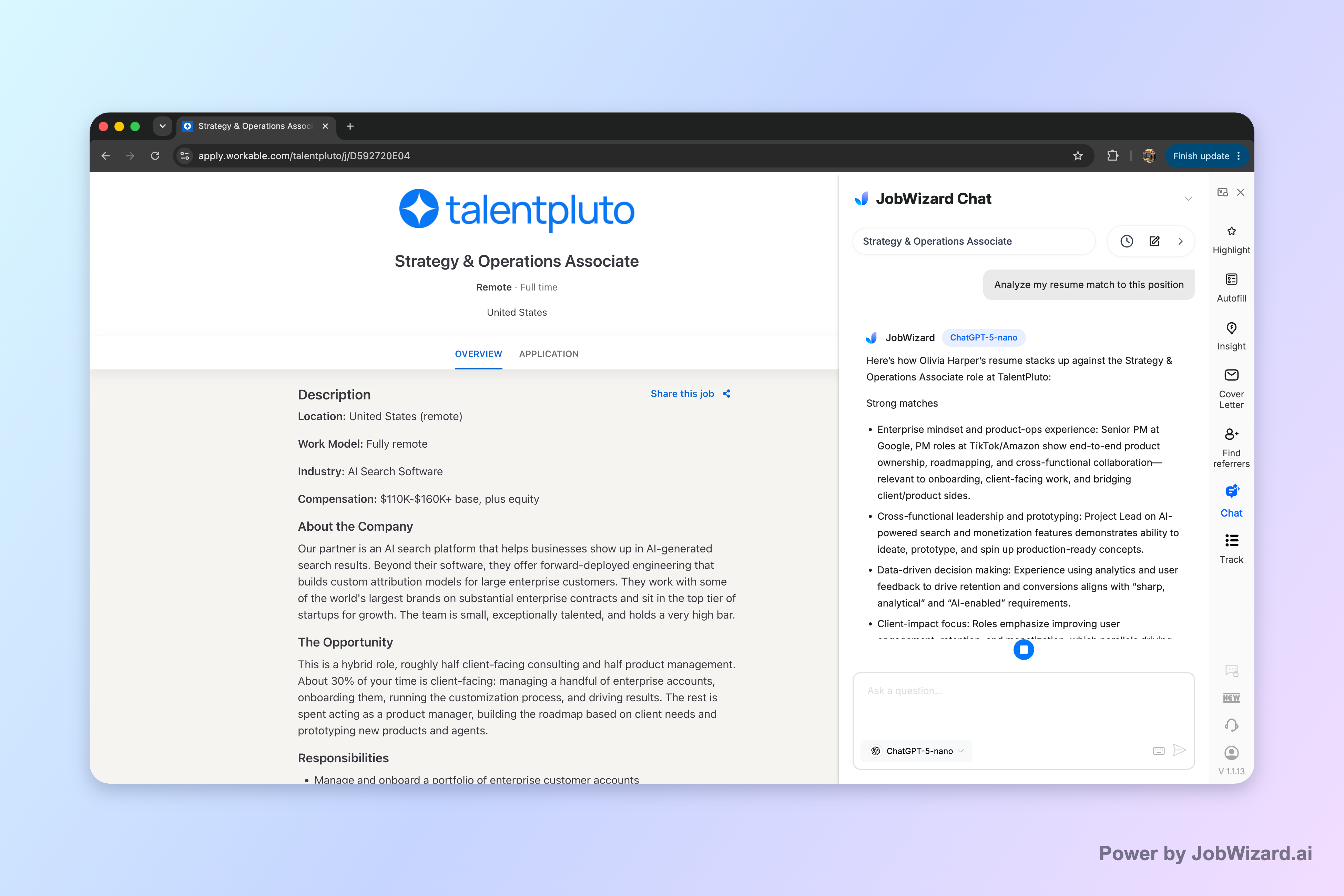
That’s where JobWizard’s Career Chat can help: it keeps the current role in context so you can ask follow-up questions about resume fit and application strategy without pasting the job description again.
What interviewers really look for in behavioral interview questions (software engineer edition)
Behavioral questions software engineer interviews usually probe repeatable behaviors—how you operate—not just whether you “can code.” Interviewers want evidence of judgment, communication, and delivery in messy, human situations.
Most software engineering behavioral prompts fall into a few competency buckets. If you prepare stories that hit these buckets clearly, you can answer a wide range of questions without starting from scratch each time.
- Ownership: You identified a problem, took responsibility, and drove the work to completion.
- Collaboration: You worked with others, aligned stakeholders, and made progress without being “the loudest voice.”
- Tradeoffs: You explained why you chose one approach over another (cost, time, risk, maintainability, performance).
- Learning speed: You recovered from mistakes, improved after feedback, and used lessons to prevent repeats.
- Impact: Your actions changed outcomes—reliability, performance, customer experience, developer productivity, or delivery predictability.
If you want a faster path to stronger answers, start from the STAR structure—but build each story around a specific “decision moment” you can explain in plain language. For more on the behavioral format, see How to Answer Behavioral Interview Questions and Answers: The STAR+Plan That Wins Interviews.
Behavioral interview questions software engineer candidates actually hear (with story ideas)
Behavioral interview questions software engineer roles often reuse the same themes with different wording. Below are high-frequency prompts plus the kind of story elements that satisfy them.
| Behavioral prompt you may hear | What it’s really testing | Story ingredients to include |
|---|---|---|
| “Tell me about a time you handled ambiguity.” | Clarity-building and decision-making under uncertainty | What was unclear, how you reduced uncertainty, what you decided, how you communicated the plan |
| “Describe a conflict with a teammate or stakeholder.” | Collaboration, diplomacy, and influence | What each person wanted, how you found shared goals, the compromise/tradeoff, and the outcome |
| “Tell me about a failure and what you learned.” | Accountability and learning speed | What went wrong (no blame), what you changed in process/quality checks, and how it prevented recurrence |
| “Give an example of improving performance, reliability, or quality.” | Impact and engineering judgment | Baseline vs. goal, what you measured, the approach, risks you considered, and results/evidence |
| “Describe a time you influenced a decision without authority.” | Communication and persuasion | Constraints, your analysis, how you presented tradeoffs, how you earned buy-in, what shipped |
| “Tell me about a time you changed your approach after feedback.” | Coachability and iteration | What the feedback was, your revised plan, why the change mattered, and what improved |
| “Describe a time you delivered under a tight deadline.” | Prioritization and execution | Scope decisions, how you managed risk/quality, what you delivered first, and how you handled follow-through |
When you practice, don’t just write the story—write the “lesson learned” in one sentence. That sentence becomes your closing line, and it helps you sound confident without overclaiming.
Use STAR (and a prep loop) to answer without rambling
STAR method gives you structure, but the prep loop ensures you deliver it clearly: you refine the story once, then tighten the way you explain your decisions.
- Select 5 stories that match the competency buckets you’ll likely face (ownership, conflict, failure, impact, influence).
- Write Situation + Task in 20–30 seconds so the interviewer understands context quickly.
- Define your Action as a “decision chain” (what you chose, why, and how you involved others).
- Make Result specific—either measurable (preferred) or clearly described in terms of impact and follow-on effects.
- Finish with the learning and connect it to what the role needs.
If you’re looking for a repeatable way to keep all job-related answers consistent, you can also blend your behavioral prep with the broader interview approach in How to Answer Interview Questions Like a Pro: Your Repeatable Framework for Clear, Confident Replies.
Remember: “structured” doesn’t mean “scripted.” The best answers sound natural because they’re grounded in real decisions you can explain from multiple angles (constraints, tradeoffs, communication, and outcomes).
How JobWizard’s Career Chat supports behavioral prep (without pretending it decides)
Career Chat can help you validate how your story maps to the role so your behavioral answers don’t drift away from what the team actually needs.
Instead of pasting the job description repeatedly, you can ask follow-up questions while keeping the current role in context. The approved use here is to refine your story and practice framing—especially for things like “what to emphasize,” “what’s missing,” and “how to align your experience to the role.”
Important limitation: Career Chat does not present its analysis as a recruiter decision or a guarantee that you qualify. Treat it as a support tool; review and use your own judgment before you apply or interview.
To make it concrete, try asking targeted follow-ups like:
- “For this role, which behavioral theme should my conflict-resolution story emphasize?”
- “How can I frame my ownership story so it matches what they likely care about most?”
- “What follow-up question might they ask after I describe my debugging/reliability work?”
- “What should I clarify in my story so it aligns with the role’s priorities?”
And when you’re ready to broaden the prep beyond behavioral answers, pair this with How to Answer Job Application Questions: A Field-Tested Method for Confident, Consistent Responses so your application narrative and your interview stories reinforce each other.
Do this automatically with JobWizard
Skip the manual work — JobWizard's Smart Autofill handles this for you.
FAQ: Behavioral interview questions software engineer candidates ask most often
Behavioral interview questions software engineer prep gets easier when you answer common concerns up front—structure, story selection, and how to validate your messaging.
What are the most common behavioral interview questions for software engineers?
Common prompts include: “Tell me about a time you handled ambiguity,” “Describe a conflict with a teammate,” “Tell me about a failure and what you changed,” “Give an example of improving performance/reliability,” and “Describe a time you influenced a decision without authority.” Your goal is to map each story to a job-relevant competency (ownership, collaboration, learning speed, impact), then answer in STAR so the interviewer can follow the cause-and-effect.
How should a software engineer structure behavioral answers (STAR) without sounding robotic?
Use STAR to stay organized—Situation (context), Task (your responsibility), Action (what you did), Result (measurable or clearly explained outcome). To avoid sounding robotic, vary sentence length and focus on one “decision moment” in your Action. Keep the Result tied to learning and impact: what changed in your process, reliability, code quality, stakeholder alignment, or delivery. Then connect the lesson back to the role you’re interviewing for.
Can behavioral interview questions software engineer candidates be answered with past projects instead of work experience?
Yes. If you’re early in your career—or transitioning—projects, internships, open-source contributions, hackathons, coursework, and even side work can work well. The key is to select stories that show the same competencies the role needs (collaboration, tradeoffs, debugging under pressure, ownership, communication). Treat each project story the same way: clarify your specific Task, the Actions you owned, and what outcomes you drove or learned from.
How does JobWizard’s Career Chat help you prepare for behavioral questions?
Career Chat keeps the current role in context so you can ask follow-up questions about resume fit and application strategy without re-pasting the job description. You can also use it to refine how your story maps to what the role emphasizes (for example, how to frame conflict resolution or ownership). Just remember: Career Chat doesn’t present its analysis as a recruiter decision or a guarantee you qualify—review and adjust before using anything in an interview.
What should I practice if I only have one hour before my behavioral interviews?
Pick your 2 strongest stories and rewrite them into tight STAR answers (Situation/Task in ~20–30 seconds, Action as a clear decision chain, Result with one impact takeaway). Then rehearse 3 likely follow-ups: “Why did you choose that approach?”, “What would you do differently now?”, and “How did you communicate with others?” Finally, sanity-check your alignment to the role using Career Chat so your emphasis matches what the job posting values.
Ready to sharpen your behavioral stories for the role you want?
Behavioral interview questions software engineer preparation becomes simpler when your answers stay aligned to the actual job requirements. Use JobWizard’s Career Chat to ask a focused follow-up about the role (for example, how to frame your ownership or conflict story), then review your final wording before you interview.
JobWizard CTA: Try Career Chat now—ask a single, specific question about how your story should map to the role you’re targeting, and verify your answer against the job description before you submit or speak to the interviewer.
Frequently Asked Questions
Autofill your next job application
JobWizard is a free Chrome extension that fills applications, tracks statuses, and optimizes your resume.