Google Behavioral Interview Questions: The STAR Playbook to Prove You Can Do the Job
Nail “google behavioral interview questions” with a STAR structure, evidence-based examples, and smart follow-ups. Learn a repeatable method to answer clearly—and what to ask after.
Free Chrome extension
Autofill your next job application
JobWizard is a free Chrome extension that fills applications, tracks statuses, and optimizes your resume.
Google behavioral interview questions often reward evidence-based stories and clear decision-making
If you’re searching “google behavioral interview questions,” you’re probably trying to figure out what the interviewer is really testing: how you think under real constraints, how you collaborate, and whether your past actions match the role. The fastest way to stand out is to prepare a small set of strong STAR stories and then refine each one so your Action explains your choices—not just what happened.
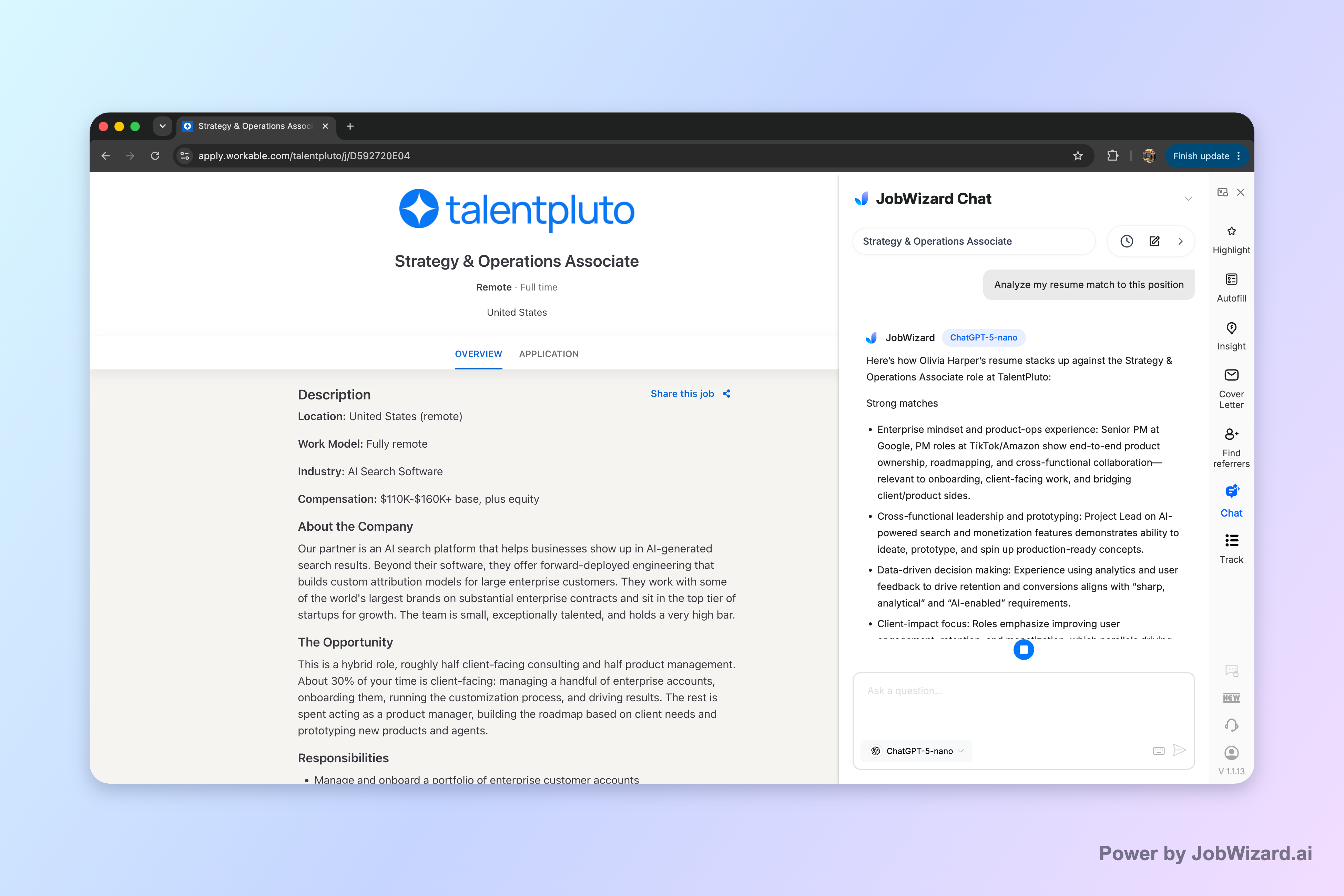
JobWizard’s Career Chat can help you prep by keeping the current role in context, so you can ask follow-up questions about resume fit and application strategy without pasting the job description again. Use it to pressure-test your STAR story themes, then review your wording and make sure it matches the role you’re targeting.
Map your stories to the themes behind common prompts
Google behavioral interview questions tend to fall into repeatable themes. You don’t need a different story for every prompt—you need stories that you can flex so the interviewer sees the same strengths in different situations.
Before you start practicing, write down 4–6 “anchor stories” from your experience (projects, cross-team work, conflict resolution, leadership moments, and moments you learned fast). Then tag each story with one or two behavioral themes you can defend with specifics.
Common categories you can expect
- Ambiguity & learning: times you didn’t have full requirements, had to investigate, and still moved decisions forward.
- Influence & collaboration: times you changed minds or aligned stakeholders without formal authority.
- Tradeoffs & prioritization: times you made a decision with constraints (time, cost, quality, risk) and explained why.
- Conflict & accountability: times you handled disagreement, clarified ownership, or improved outcomes after a miss.
- Customer/user focus: times you used feedback or real-world impact to adjust plans.
How to translate a “tell me about a time” prompt into a STAR outline
When you’re given a prompt, don’t just start narrating. First, decide what competency the interviewer is likely checking, then build your STAR outline around that competency.
- Pick the theme: identify which category the prompt is aiming at (ambiguity, influence, tradeoffs, conflict, etc.).
- Choose the cleanest story: select the example where your role is clear and your decisions are describable.
- Write your Action as decisions: list what you chose, what you considered, and what you stopped doing.
- Make Results explainable: include outcomes you can confidently describe and connect back to your actions.
For reference, if you need a consistent framework for other behavioral prompts, use your STAR stories the same way you’d map responses to structured hiring signals—this approach is similar to how candidates prepare for roles across major companies. For example, you can see a STAR-focused method in Amazon Behavioral Interview Questions: A STAR Plan for “Ownership” Answers That Land and adapt the same logic for your Google stories.
Answer with STAR but make the “A” do the heavy lifting
STAR gets you organized, but Google-style behavioral interviews often look for how you think. That means your Action section needs to show reasoning, collaboration, and iteration—not just activity.
Use this STAR formula for Google behavioral interview questions
Keep each part short, then add detail where it matters:
- Situation: 1–2 sentences that set context (team, constraints, stakes).
- Task: what you were responsible for (or what success required).
- Action: 4–7 bullets answering: What did you do first? Why? How did you verify? Who did you align with? What tradeoffs did you accept?
- Result: outcomes plus what you learned (and how it improved later work).
What “good” looks like in the Action section
In many google behavioral interview questions, interviewers aren’t only asking what you did—they’re assessing whether you can explain your decision process. That’s why your Action should include at least two of the following:
- How you reduced uncertainty (research, prototypes, experiments, measurement).
- How you aligned stakeholders (what you communicated and when).
- How you handled constraints (scope, timelines, risk, dependencies).
- How you iterated after feedback or unexpected outcomes.
- How you delegated or coached if the moment involved others.
If you want a quick reference for building stronger behavioral narratives, you can also compare how other interview formats map to STAR in Cisco Behavioral Interview Questions for Data Analysts: STAR Answers That Map to Cisco’s Hiring Signals. Use the same structure, then tailor the competency emphasis to the prompt you’re answering.
Practice “prompt-to-story” alignment so your answers stay on target
The biggest behavioral interview mistake is delivering a great story that doesn’t answer the prompt. For google behavioral interview questions, practice matching the question’s intent to your story’s “most relevant slice.”
Here’s a practical method: write a one-sentence “answer thesis” for each anchor story—then rewrite that thesis so it explicitly addresses the prompt you’re practicing.
A “prompt-to-story” rewrite template
Fill in this template each time you practice:
- Thesis: “I demonstrated [theme] by [your key action] under [constraint].”
- Proof: “The strongest part of my story is [specific decision/verification/alignment].”
- Outcome: “As a result, [measurable or clearly explainable outcome], and I learned [lesson you applied later].”
Include the iteration, not just the win
Even when your original outcome was strong, Google behavioral interviews often reward humility and learning. If you faced friction or uncertainty, explain what you changed—how you adjusted your plan, clarified ownership, or improved communication.
That “evidence over rehearsal” mindset is also useful for other sectors. For example, Behavioral Interview Questions for Healthcare Professionals: How to Answer With Evidence, Not Rehearsal highlights how to ground your story in evidence. You can borrow the same idea: name the evidence you relied on (signals, feedback, metrics, observations), then connect it back to your decision.
Use Career Chat for focused follow-ups and verify before you use anything externally
Behavioral interviews are about fit, clarity, and specificity. Career Chat helps you prep in a role-aware way, so you can ask follow-up questions about resume fit and application strategy without re-pasting the job description.
Important: Career Chat is for preparation and iteration. Do not present its analysis as a recruiter decision or a guarantee that you qualify.
What to ask Career Chat so it actually improves your google behavioral interview questions answers
- “Turn my experience into a STAR story for this role.” Provide the specific project and ask for a tight Situation/Task/Action/Result outline.
- “Which part of my story should I emphasize for influence/tradeoffs?” Ask it to highlight which decisions align best with the behavioral theme.
- “Give me follow-up questions I should ask the interviewer.” Use the role context to keep your questions specific.
Then, review-before-you-use: behavioral answers should be in your voice, match the job description, and stay truthful to what you actually did. You control the final wording and submission.
Do this automatically with JobWizard
Skip the manual work — JobWizard's Smart Autofill handles this for you.
FAQ: fast answers to the questions behind google behavioral interview questions
What are common google behavioral interview questions categories?
You’ll most often see questions that probe how you handle ambiguity, influence others without authority, learn fast, lead through conflict, and make tradeoffs. Many prompts also translate to themes like “tell me about a time…” and “what was your approach?” rather than asking about the job specifically.
How do I structure answers for google behavioral interview questions using STAR?
Use STAR like this: Situation (1–2 lines of context), Task (what you needed to accomplish), Action (the specific steps you took), and Result (outcomes you can explain clearly). For Google-style behavioral questions, make sure your Action section includes your decision process and how you collaborated or navigated constraints—not just what tools you used.
What should I do if I don’t have a perfect example for google behavioral interview questions?
Choose the closest “best-fit” story and be transparent about the context. If the original result wasn’t what you hoped, focus on what you changed after learning—what you tried next, what you’d do differently, and what you documented or shared with others to prevent the same issue.
How can I use Career Chat to prep for google behavioral interview questions without pasting the job description?
Career Chat keeps the current role in context so you can ask follow-up questions about your resume fit and application strategy without pasting the job description again. Ask for help turning a role-relevant experience into a STAR story, then review the draft before you submit anything.
What questions should I ask the interviewer after answering google behavioral interview questions?
Ask questions that confirm fit and clarify expectations, such as how the team measures success for your scope, what “good” looks like in the first months, and how decisions get made when requirements change. Keep them grounded in the role and your answers so the conversation stays specific.
CTA: Want to make your answers more specific to the role you’re targeting? Ask JobWizard’s Career Chat a focused question like: “Help me turn this experience into a STAR answer for influence/tradeoffs for this role,” then review the draft and adjust the final wording to match what you truly did.
Frequently Asked Questions
Autofill your next job application
JobWizard is a free Chrome extension that fills applications, tracks statuses, and optimizes your resume.