How to Answer Behavioral Interview Questions: A STAR+Plan With Evidence You Can Actually Defend
Learn how to answer behavioral interview questions using a STAR+Plan that emphasizes evidence, not rehearsed stories—plus examples you can tailor fast.
Free Chrome extension
Let AI answer these questions for you
JobWizard fills sponsorship, work-auth, and availability answers correctly on every application — free.
Behavioral interviews are designed to test how you think and act under real conditions—so if you’re wondering how to answer behavioral interview questions without rambling or sounding rehearsed, you’re not alone. The goal isn’t to “perform” your past; it’s to prove you can repeat good judgment when it matters.
This guide gives you a practical STAR+Plan (with evidence-based phrasing), plus ready-to-use example templates you can tailor to almost any prompt. You’ll also learn how to sanity-check your story against the job so your answers match what they’re actually hiring for.
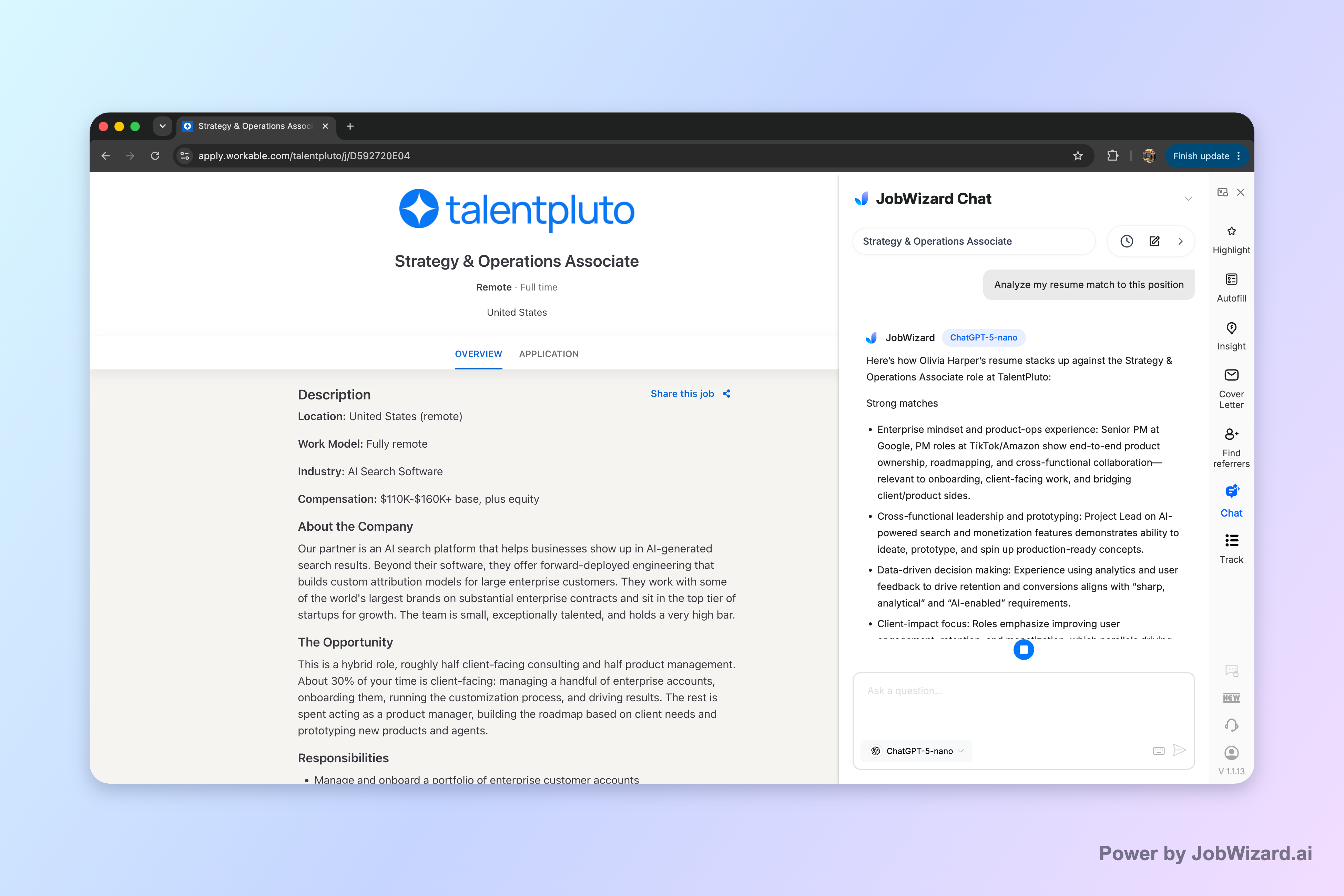
Career Chat can keep the current role in context, so you can ask follow-up questions about resume fit and application strategy without pasting the job description again.
How to answer behavioral interview questions: use STAR+Plan that includes evidence
Use a STAR+Plan so your answer stays structured and credible, not vague or overly “nice.” The “+” is what makes your response defensible: you add evidence (what you did, what changed, and why it worked) and a quick reflection on what you’d do similarly again.
Many candidates memorize STAR, then forget the recruiter’s real question: “Can this person do the job, based on what they actually did?” Your answer should make it easy to see your role in the outcome—especially the decisions you made, the tradeoffs you accepted, and the constraints you worked within.
If you want more on building answers that match specific role expectations, start with:
- Behavioral Interview Questions That Actually Predict Your Performance—And How to Craft Strong Answers
- How to Answer Behavioral Interview Questions and Answers: The STAR+Plan That Wins Interviews
STAR (the baseline) — keep each part tight
- Situation: One sentence to set context (where/when, and what was at stake).
- Task: What you personally owned or needed to accomplish.
- Action: The steps you took and the judgment calls you made.
- Result: What happened because of your actions—ideally with a measurable outcome.
The “+” (the part most people skip) — evidence + repeatability
After Result, add a short evidence-and-repeatability line. This is where you differentiate a believable answer from a “story.” Aim for:
- Evidence you can point to: scope, timeline, stakeholders, what you produced, or before/after behavior.
- Why it worked: the principle behind your choice (e.g., alignment, prioritization, testing, stakeholder buy-in).
- Repeatability: what you’d do again in similar situations.
Rule of thumb: your answer should sound like something you could defend if they asked, “How exactly did you do that?”
Turn any behavioral prompt into a reusable answer workflow
Build a repeatable workflow for turning prompts into answers in minutes, not hours. Instead of memorizing paragraphs, you’ll assemble clean building blocks you can remix.
Here’s a simple process you can use for any behavioral question: conflict, leadership, failure, time pressure, learning, ownership, collaboration, or adaptability.
- Pick the closest real story: Choose an experience where you made meaningful decisions.
- Label your exact role: Write what you did personally (not what the team did “in general”).
- Extract 2–4 key actions: Keep only the steps that show competence and judgment.
- Add credible evidence: Use metrics if you can defend them; otherwise use scope, constraints, or before/after descriptions.
- Close with what you’d repeat: One sentence that explains your principle or learning.
To tighten clarity, use language that’s easy to verify: “I led…,” “I decided…,” “I coordinated…,” “I changed…,” “We reduced…,” “I tested…,” “I re-prioritized…” Avoid “I helped” unless you can explain what you owned.
Examples: how to answer common behavioral prompts (with evidence)
Below are example answer stems you can adapt. Each shows the STAR core plus the evidence-based “+” ending.
- “Tell me about a time you handled conflict.” Situation: “Two stakeholders disagreed on scope during…” Task: “I owned aligning priorities.” Action: “I mapped requirements, clarified success metrics, and proposed tradeoffs.” Result: “We shipped on time with fewer rework cycles.” +: “The principle: align on measurable outcomes before debating preferences.”
- “Tell me about a time you failed.” Situation: “We launched a plan that didn’t meet…” Task: “I owned the rollout plan.” Action: “I gathered feedback quickly, identified the root cause, and updated the approach.” Result: “We improved outcomes in the next iteration.” +: “I still use the same loop: measure, learn fast, and communicate tradeoffs.”
- “Describe a time you influenced without authority.” Situation: “Different teams needed to cooperate on…” Task: “I had to get buy-in without direct authority.” Action: “I built a shared decision framework and offered options with pros/cons.” Result: “We reached agreement and delivered…” +: “Evidence: I documented decision points and ensured feedback was incorporated.”
If you’re aiming at specific industries or role contexts (for example, healthcare settings where evidence and process matter), review:
Make your behavioral answers match the job (without overfitting)
Match their priorities by aligning your evidence to what the job description signals—while keeping your story honest and complete.
A common failure mode is answering “the question they wanted,” not the experience you actually have. Another is overfitting: adding details that don’t belong to your story. Instead, aim for alignment at the level of decisions, values, and outcomes.
Use a fit-check loop before you finalize your answers
Before you submit your final version of each behavioral answer, run a quick fit-check against the role you’re targeting. Career Chat can help keep the role in context so you can ask follow-up questions about resume fit and application strategy without re-pasting the job description again.
Here are fit-check prompts you can ask yourself (and then refine into what you say in interviews):
- “What skills does this role treat as non-negotiable?” Map them to your actions, not just your claims.
- “What constraints does the role emphasize?” Ensure your story includes the right kind of pressure (time, quality, compliance, stakeholder needs).
- “What outcomes are they most likely to reward?” Use your best defensible evidence that tracks to those outcomes.
To connect behavioral questions to broader job-application preparation, also see:
How to handle “Tell me about yourself” vs. behavioral questions
“Tell me about yourself” is a positioning question; behavioral questions are proof. Keep “about yourself” more overview, then treat behavioral prompts as specific evidence of how you behave in practice.
If you try to cram your whole background into each behavioral answer, you’ll lose the thread. For behavioral questions, your best friend is focus: one story, four parts, evidence in the “+,” then stop.
Common behavioral interview mistakes (and how to fix them fast)
Avoid these mistakes and you’ll sound clearer, more confident, and easier to trust.
Mistake 1: being too general in Action
“I collaborated with the team” doesn’t answer what you did. Replace it with actions that show decision-making: what you asked, what you chose, and how you drove progress.
- Fix: Name 2–4 actions you personally took (e.g., prioritized, re-scoped, tested, documented, escalated).
Mistake 2: results without evidence
If you claim impact, you need evidence you can defend: metrics, scope, or before/after changes you can explain.
- Fix: If you can’t share numbers, describe what changed in process, behavior, or deliverables.
Mistake 3: saying you “learned” but not showing what changed
Interviewers want to know whether the failure or challenge changed your behavior. A vague “I learned to communicate better” is weaker than a concrete example of what you changed.
- Fix: Add a “+” line: the principle you adopted and how it shows up in your work today.
Mistake 4: forgetting the + (evidence and repeatability)
STAR alone can still sound like a résumé summary if you don’t add the credibility layer. Your “+” is your proof that you can repeat the right decisions.
- Fix: After the Result, add one sentence: evidence you can point to + the principle you’d repeat.
Do this automatically with JobWizard
Skip the manual work — JobWizard's Smart Autofill handles this for you.
FAQ: how to answer behavioral interview questions
What’s the best structure for how to answer behavioral interview questions?
Use a STAR+Plan: Situation, Task, Action, Result—then add the “+” part (evidence you can point to and what you’d do again).
How do I turn a real experience into a strong behavioral answer without sounding scripted?
Draft it from outcomes you actually own, name the tradeoffs you faced, then close with one specific result and one lesson you still apply.
What if I don’t have direct experience for the role—how should I answer behavioral questions?
Choose the closest transferable situation, highlight your responsibility and decision-making, and make the result about the skills you demonstrated (not the exact job title).
How can I prepare follow-up answers after my first behavioral response?
Ask a focused follow-up question to check fit and accuracy, then be ready to expand on metrics, constraints, or the exact choices you made.
Should I include numbers or measurable impact in my behavioral answers?
Only if you can defend them. If you don’t have hard numbers, use credible evidence like scope, duration, frequency, stakeholders, or before/after descriptions you can explain.
Get your behavioral stories ready for the next interview
Answering behavioral questions gets easier when your stories are built on evidence you can defend. Use STAR+Plan to draft 6–10 core stories, then run a quick job-fit check so your Action and Result match what the role actually values.
If you’re tailoring for a specific role right now, use JobWizard to keep the role in context and help you generate follow-up questions to verify your story’s alignment before you walk into the interview.
Frequently Asked Questions
Let AI answer these questions for you
JobWizard fills sponsorship, work-auth, and availability answers correctly on every application — free.