Behavioral Interview Questions for Healthcare Professionals: How to Answer With Evidence, Not Rehearsal
Learn behavioral interview questions for healthcare professionals and how to answer them using STAR-style evidence—plus what to ask back to confirm role fit. Practice a review-first approach so your answers stay accurate to the job.
Free Chrome extension
Autofill your next job application
JobWizard is a free Chrome extension that fills applications, tracks statuses, and optimizes your resume.
If you’re preparing for behavioral interview questions for healthcare professionals, the goal isn’t to sound confident—it’s to show you can make safe, patient-centered decisions under real conditions. Hiring teams often look for communication habits, escalation judgment, documentation discipline, and teamwork under pressure.
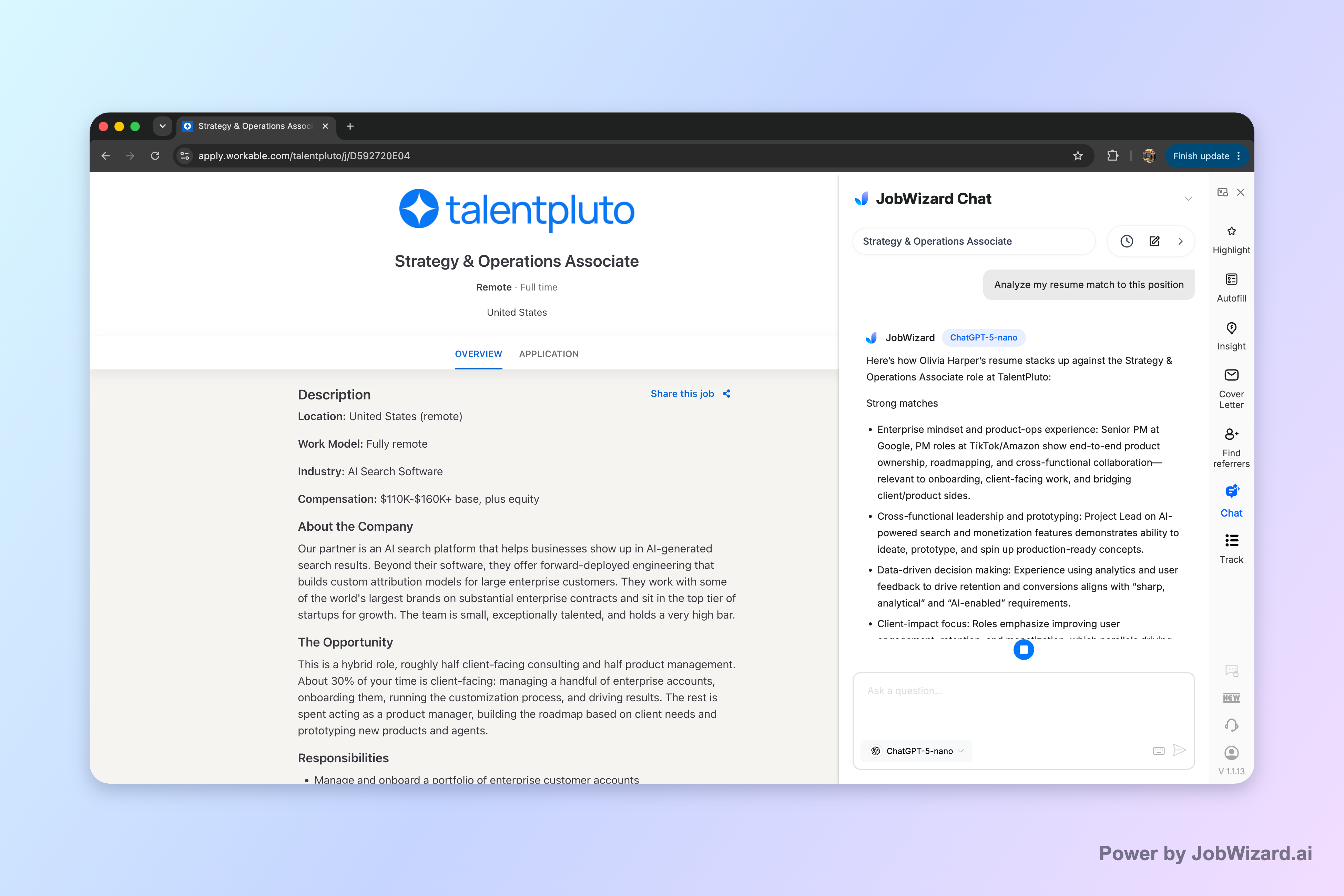
JobWizard’s Career Chat keeps the current role in context, so you can ask follow-up questions about resume fit and application strategy without pasting the job description again. Use it to sanity-check how your “story evidence” aligns with what the role is actually asking for—then tailor your answers so you don’t just repeat a generic script.
What interviewers are really testing in healthcare behavioral questions
Healthcare behavioral interview questions for healthcare professionals are designed to surface repeatable behaviors, not one-off hero moments. In practice, interviewers look for how you think and act when the stakes are high.
Think of behavioral prompts as clues to your clinical judgment and workflow habits. They usually test four areas: patient safety, communication, teamwork, and quality improvement.
- Patient safety under stress: Do you escalate appropriately? Do you document accurately? Can you keep your head when things change?
- Communication that reduces risk: Do you clarify expectations, confirm understanding, and close the loop with teams and patients?
- Collaboration across roles: How do you handle handoffs, differing opinions, and time pressure?
- Learning mindset: Do you use feedback to adjust your process?
To build strong answers, start each story with what you controlled. Even when other people caused the problem, interviewers want your specific actions: what you said, what you checked, what you documented, and how you followed through.
The most common behavioral interview questions for healthcare professionals (with what to include)
Behavioral interview questions for healthcare professionals typically fall into a few predictable categories. Use these prompts to choose which stories you’ll reuse and how you’ll tailor them to the job.
Difficult patients, families, or conflict
Prompt examples you may hear: “Tell me about a time you handled a difficult patient or family member,” and “Describe a situation where communication broke down.”
- Include: how you de-escalated, what you clarified (goals, expectations, next steps), and how you protected patient dignity.
- Show judgment: when you brought in additional support and how you ensured the patient still received timely care.
- Close the loop: what changed after the interaction (e.g., improved compliance, clearer follow-up).
Teamwork during high volume or time pressure
Common prompts: “Tell me about a time you worked effectively on a team during a high-pressure situation,” or “Describe a time you coordinated care across disciplines.”
- Include: how you handled handoffs, updated relevant parties, and prevented errors.
- Make actions concrete: what you checked, what you confirmed, and how you ensured everyone was aligned.
- Quantify when possible: use simple measurable outcomes when you have them (turnaround times, reduced repeats, completed tasks).
Safety, errors, and feedback
Prompts often sound like: “Tell me about a time you made a mistake or received feedback,” or “Describe a time you caught a potential problem before it became a patient safety issue.”
- Include: your detection process and what you did next (reporting, correcting, notifying, documenting).
- Demonstrate accountability: what you owned, what you fixed, and what you changed afterward.
- Emphasize prevention: how your action improved the system or your future routine.
Prioritization and care planning
Look for prompts like “Describe a time you managed competing priorities,” “Tell me about a time your plan changed,” or “How do you prioritize when you’re overloaded?”
- Include: how you triaged, what criteria you used, and how you communicated the plan.
- Show reliability: what you tracked so nothing fell through the cracks.
- Demonstrate adaptability: what you changed when new information arrived.
Ethics, compliance, and privacy (without rambling)
Some interviews ask indirectly: “Tell me about a time you handled sensitive information appropriately,” or “Describe a time you followed protocol even when it was inconvenient.”
- Include: the minimum necessary information sharing and your documentation habits.
- Show boundaries: how you protected patient privacy and escalated when needed.
- Keep it practical: one example of a decision you made and why.
How to answer: a healthcare STAR framework that stays specific
The best answers to behavioral interview questions for healthcare professionals follow a predictable structure—so the interviewer can see your thinking, not just hear your conclusion.
You can use STAR, but make it healthcare-specific. Your “Action” step should read like a clinician workflow: communicate, verify, document, escalate if needed, and then follow up.
STAR, healthcare version (what each piece should sound like)
- Situation: One sentence on context (unit/role-level, time pressure, what was at stake).
- Task: What you owned (assessment, coordination, documentation, escalation, patient education).
- Action: 3–5 concrete moves (what you said, what you checked, how you involved others, how you documented).
- Result: What changed and why it mattered for safety, quality, or patient experience.
- Reflection: One sentence on what you learned or the process you improved.
When you draft your answers, avoid two common pitfalls: (1) staying too general (“I was compassionate”) and (2) over-sharing details that aren’t necessary. Instead, specify the exact behaviors that show competence—especially the safety and communication steps.
Quick example (conflict + resolution + safety)
Example story flow: You’re dealing with a frustrated family member in a busy setting. You acknowledge concerns, clarify what they need next, and confirm understanding. You escalate appropriately, document the conversation accurately, and coordinate follow-up with the responsible clinician.
In your “Result,” focus on what improved: reduced escalation loops, clearer expectations, timely next steps, and safer coordination.
Make your answers match the job description (without copying it)
Behavioral interview questions for healthcare professionals are evaluated against the role’s real priorities—so your stories should align with what the organization emphasizes.
A fast way to do this is to map each story to the job’s key competencies (examples: safety mindset, collaboration style, documentation expectations, patient communication). Then you tailor only the Action and Result sentences to match those priorities.
How to use Career Chat to sharpen role-fit follow-ups
Career Chat is most helpful when you’re turning “my experience” into “their expectations.” Because it keeps the current role in context, you can ask targeted follow-up questions (like how they define teamwork or escalation) without re-pasting the job description repeatedly.
What to ask it before your interview:
- Role fit check: “What parts of my experience should I emphasize for this role’s priorities?”
- Answer refinement: “How should I frame my behavioral example so it matches what they’re likely looking for?”
- Follow-up questions: “What questions should I ask to confirm expectations during a second interview?”
Use Career Chat as an assistant to help you verify fit—not as a guarantee that you qualify. The user reviews any output and submits themselves.
Autofill doesn’t replace review-before-submit
If you’re also applying broadly, remember that tools that help fill repetitive application fields are meant to speed up the mechanical parts—not to replace your judgment on custom questions. In our database, JobWizard is used for autofill + review-before-submit workflows: it fills repetitive fields quickly while sponsorship / salary / EEO / custom questions are left for you to review before submitting. That same mindset works for interview prep: draft fast, then verify accuracy and specificity.
Verified usage overview from 2026-07 (aggregate): JobWizard is associated with 720,000+ applications submitted and 600,000+ autofill sessions. It autofills an average of ~18 repetitive fields per application (typically 11–23). About ~65% of applications are on Workday, ~19% on Greenhouse, ~12% on Ashby, and ~4% on Lever—Workday is where it saves the most time.
Do this automatically with JobWizard
Skip the manual work — JobWizard's Smart Autofill handles this for you.
FAQ: Behavioral interview questions for healthcare professionals
What are the most common behavioral interview questions for healthcare professionals?
Common examples include, “Tell me about a time you handled a difficult patient or family member,” “Describe a time you worked effectively on a team during a high-pressure situation,” and “Tell me about a time you made a mistake or received feedback—what did you do next?” Aim for specific actions and measurable outcomes, even when the numbers are simple (e.g., reduced repeat calls, clarified handoffs, documented accurately).
How should healthcare professionals structure answers for behavioral questions (STAR or something else)?
Use STAR as a practical checklist: Situation (brief context), Task (what you owned), Action (what you did), and Result (what changed). Keep it healthcare-relevant: mention communication steps, documentation, escalation when needed, and how you ensured patient safety—then close with what you learned and how you’d handle it again.
What questions should I ask the interviewer in a healthcare role after answering behavioral questions?
Ask role-fit questions that clarify expectations and decision-making. Examples: “When you say ‘high-volume,’ what does that look like day-to-day?” “How do you want clinicians to escalate safety concerns?” and “What does strong collaboration look like across shifts?” These help you confirm your evidence matches their workflow.
Do I need to mention patient privacy or compliance in my behavioral answers?
Yes—at least briefly. You don’t need to quote policies, but you should show you understand boundaries: share only the minimum necessary information, follow documentation standards, and escalate appropriately. If your story involved sensitive data or compliance concerns, describe the action you took to protect patients and maintain quality.
How can I practice behavioral interview questions for healthcare professionals without sounding memorized?
Practice by rewriting your STAR evidence in your own words, not by memorizing scripts. Start with 3–5 “story cards” (conflict, teamwork, safety/quality, feedback, prioritization), then adapt the same evidence to each prompt. After you draft, review for accuracy against the job description and tighten for clarity and safety-focused details.
Next step: turn your best stories into role-fit answers
Behavioral interview questions for healthcare professionals get easier when your answers are evidence-based and tailored to the role. If you want to make your next draft more accurate, ask JobWizard’s Career Chat one focused question about the current role—then refine your STAR “Action” and “Result” to match what the job description is actually emphasizing.
JobWizard CTA: Ask Career Chat a follow-up question about the role you’re interviewing for (for example, “Which of my experiences best demonstrates safety escalation and collaboration for this position?”) and use the guidance to tighten your behavioral answers before you walk into the interview.
Frequently Asked Questions
Autofill your next job application
JobWizard is a free Chrome extension that fills applications, tracks statuses, and optimizes your resume.