Cisco Behavioral Interview Questions for Data Analysts: STAR Answers That Map to Cisco’s Hiring Signals
Get ready for cisco behavioral interview questions data analyst interviews with evidence-first STAR answers, tough follow-ups, and a review-first approach to application prep.
Free Chrome extension
Autofill your next job application
JobWizard is a free Chrome extension that fills applications, tracks statuses, and optimizes your resume.
Answer Cisco behavioral questions with data-analyst evidence: use STAR, then pressure-test the “why.”
If you’re preparing for cisco behavioral interview questions data analyst, your goal isn’t to sound impressive—it’s to prove you can handle ambiguity, collaborate with stakeholders, and make analysis decisions you can defend. Cisco behavioral prompts often steer toward how you think under pressure: what you did first, how you validated your data, and how you communicated clearly when others needed answers fast.
In practice, the fastest way to improve is to stop collecting “random stories” and start building a small set of STAR narratives that map to the same recurring evaluation signals: ownership, data quality, stakeholder alignment, and learning when things go wrong.
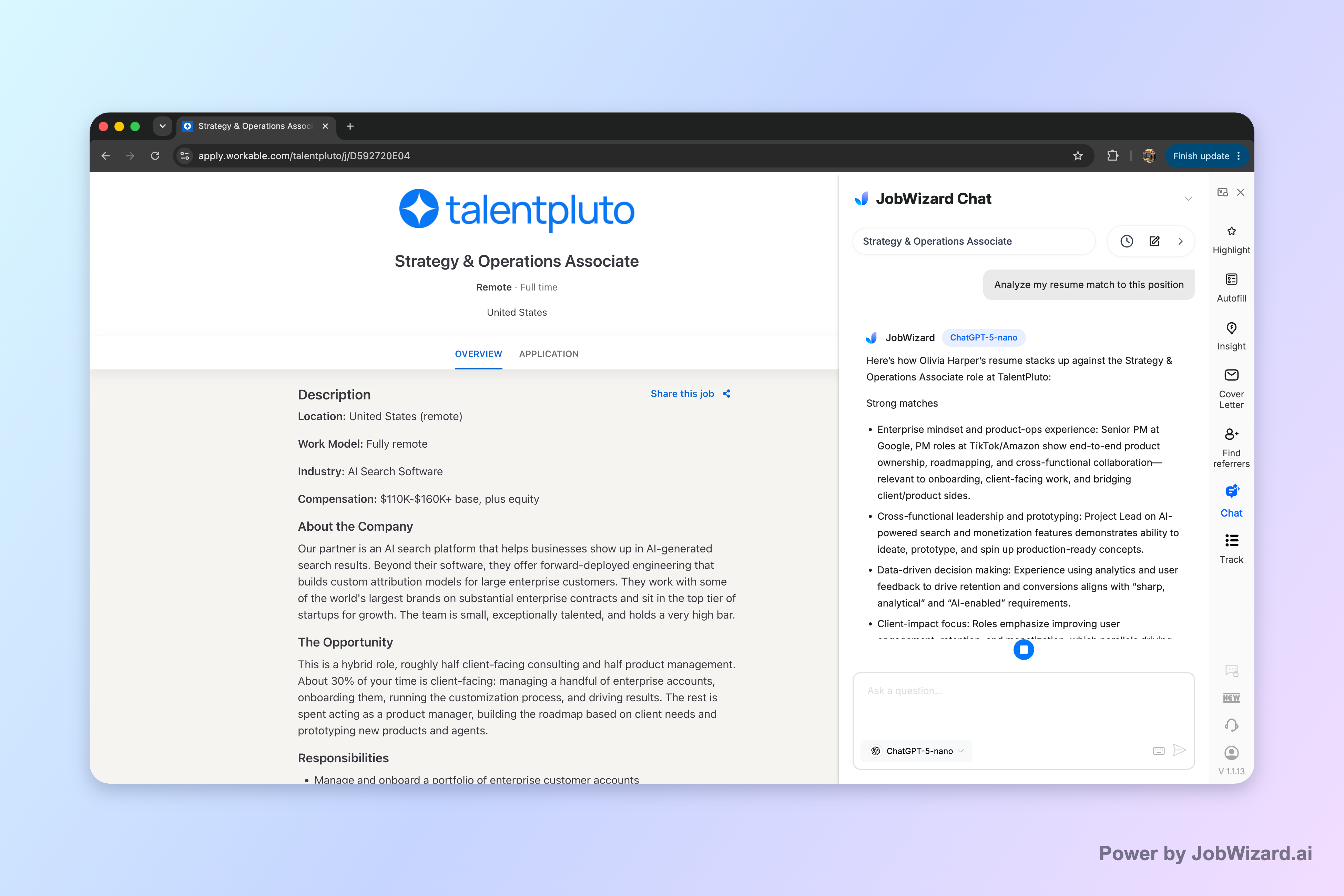
Career Chat can support this prep by keeping the current role in context—so you can ask focused follow-up questions about resume fit and application strategy without pasting the job description repeatedly. It’s guidance for aligning your answers; you still review and tailor your own final responses before you submit or interview.
What Cisco behavioral interviewers test for (and how to reflect it in your STAR stories)
Cisco behavioral interviews for data analyst roles usually reward candidates who can show structure, judgment, and communication—not just technical skill. When you build STAR answers, aim your actions (A) toward specific “signals” that interviewers can map to day-to-day responsibilities.
Use this checklist as you draft (or rewrite) each story. You’ll notice the patterns repeat across questions.
- Ownership under ambiguity: You identify what’s missing, propose a plan, and move the work forward while clarifying requirements.
- Data trustworthiness: You validate assumptions, check data quality, and explain how you know the analysis is reliable enough to make a decision.
- Cross-team collaboration: You translate between technical details and business meaning, and you align on definitions before conclusions.
- Tradeoffs and prioritization: You choose what to do now vs. later, justify the decision, and document the reasoning.
- Learning + course correction: You change approach when results or stakeholders signal the plan isn’t working.
Now translate those signals into interview-ready STAR components.
Build STAR stories that “show your work” (without drowning the interviewer in details)
A strong STAR answer for a data analyst role usually follows a simple rhythm: short context, clear goal, concrete actions, evidence-based outcome. The interviewer shouldn’t have to infer your thinking—they should feel it.
- S (Situation): One or two sentences that set the stakes and constraints (time, data limitations, stakeholder urgency).
- T (Task): What you owned and what success meant (a metric, a decision, a deliverable, or a risk to reduce).
- A (Action): Your method—how you cleaned/validated data, defined metrics, aligned with stakeholders, and iterated.
- R (Result): The impact you can defend (even if it’s “we avoided a bad decision” or “we improved accuracy/coverage”).
To keep it natural, avoid narrating every step like a lab report. Instead, describe the critical checkpoints: validation rules, decision criteria, and how you communicated uncertainty.
Cisco behavioral interview questions for data analysts: high-probability prompts + what a strong answer sounds like
Below are common cisco behavioral interview questions data analyst prompts you’re likely to see, plus the “direction” that makes a response land well. Use them to map your own stories to the right evaluation criteria.
1) “Tell me about a time you owned an ambiguous problem.”
What they want: evidence you can define the problem, ask the right questions, and drive progress without waiting for perfect clarity.
- S/T: The business was unclear, data sources weren’t fully defined, and stakeholders disagreed on what “good” looked like.
- A: You gathered requirements, created a working definition, built a first-pass analysis, then iterated after stakeholder feedback.
- R: You delivered a decision-ready output and documented what changed when you learned more.
Tip: In the “A,” name the artifacts you used (requirements doc, metric definition, validation approach) so it’s credible.
2) “Describe a time your analysis changed someone’s mind—or corrected a misconception.”
What they want: you can challenge assumptions respectfully using evidence, not ego.
- S/T: A stakeholder had a hypothesis; your job was to test it with data.
- A: You validated the dataset, compared expected vs. observed patterns, and explained uncertainty and limitations.
- R: The team aligned on the updated conclusion and acted on it (or avoided a costly misstep).
Tip: Make your “R” about the decision, not just the chart.
3) “Tell me about a time you had data quality issues.”
What they want: how you protect decision-making when the input isn’t clean.
- S/T: Missing fields, inconsistent definitions, or duplicated records affected your analysis goal.
- A: You performed specific checks (e.g., completeness, duplicates, outliers), corrected what you could, and flagged what you couldn’t.
- R: You either improved accuracy or adjusted the scope so the final recommendation was still trustworthy.
Tip: If you can’t quantify the improvement, describe the risk you reduced (e.g., “prevented a false trend” or “avoided reporting the wrong metric”).
4) “How do you handle competing priorities or tight deadlines?”
What they want: prioritization, communication, and decision tradeoffs.
- S/T: Multiple requests landed at once with overlapping needs.
- A: You triaged by impact and dependencies, aligned on what “good enough” meant, and communicated timelines early.
- R: You met the highest-impact deadline and delivered remaining work with clear expectations.
Tip: Add the exact criteria you used for tradeoffs (business impact, risk, data readiness).
5) “Tell me about a time you disagreed with a stakeholder.”
What they want: collaboration under friction and your ability to reach alignment.
- S/T: Stakeholder interpretation didn’t match your initial findings.
- A: You rechecked assumptions, aligned on metric definitions, and used a shared comparison to resolve differences.
- R: You converged on a single approach and clarified how future decisions should be made.
Tip: Keep it human—focus on your process for de-escalation and alignment.
How to craft answers that fit Cisco’s “signal”: communication, rigor, and a learning loop
Your best advantage in cisco behavioral interview questions data analyst isn’t a perfect script—it’s a repeatable framework for communicating your thinking. Cisco hiring signals tend to reward crisp explanations, defensible logic, and accountability.
Use the “evidence-first” approach: lead with what you decided, then backfill your how. That prevents your answer from becoming a technical dump.
A simple structure you can reuse across almost any behavioral prompt
- Decision: What you chose and what problem you were solving.
- Evidence: The validation checks, comparisons, or criteria you used.
- Collaboration: How you aligned with stakeholders (definitions, expectations, review points).
- Outcome: The impact, plus any measurable improvements or risk reduction.
- Learning: What you changed next time to avoid repeating the issue.
What to say when you don’t have perfect metrics
Some candidates wait until they have “hard numbers” before speaking—then freeze. Instead, describe the quality of the evidence you did have, and how you protected the decision.
- Use language like “we validated X sources,” “we used Y definition for the metric,” or “we flagged Z limitation and scoped recommendations accordingly.”
- If you improved something indirectly, say so: “the team stopped using an unreliable proxy,” “we prevented a misleading conclusion,” or “we clarified the definition and reduced rework.”
Practice fast: turn one story into 3 variants for likely question angles
Pick one real experience and create variants so you can answer different question flavors without starting over.
- Ownership angle: Emphasize your requirement discovery and plan under uncertainty.
- Data rigor angle: Emphasize validation steps and how you measured trust.
- Collaboration angle: Emphasize how you aligned definitions, managed disagreement, and communicated tradeoffs.
This practice method is how you sound consistent while still being responsive to the interviewer’s phrasing.
Prep workflow for Cisco behavioral interviews: align your stories to the posting, then rehearse the “follow-up layer”
A strong prep workflow turns “good stories” into interview-ready answers for cisco behavioral interview questions data analyst. It’s not about memorization—it’s about alignment and pressure-testing.
Step-by-step: your 45–60 minute prep session
- Select 4 core stories: One for ambiguity, one for data quality, one for stakeholder disagreement, one for prioritization.
- Write your STAR once: Keep S and T brief, and make A include validation + collaboration checkpoints.
- Extract job-aligned phrases: Mirror the job’s responsibilities in your T (task) and your R (what changed).
- Plan 2 follow-ups per story: “What data did you use?”, “What did you validate?”, “What tradeoff did you make?”
- Rehearse answers in 90-second form: Then practice extending to 2–3 minutes if they ask for details.
Use Career Chat to refine fit (without rewriting everything from scratch)
Career Chat keeps the current role in context so you can ask follow-up questions about resume fit and application strategy without pasting the job description again. That’s especially useful when you’re trying to verify that your behavioral stories line up with what the team actually needs.
Important: Career Chat helps you think through alignment, but don’t treat it like a recruiter decision or guarantee you qualify. You’re the one who reviews and tailors the final story details.
Invite a focused follow-up question about the current role, then update your STAR “Task” and “Evidence” accordingly. (For example: “Which metric definition or data validation approach should I emphasize for this role?”)
Quick resources to strengthen your behavioral answering
- Behavioral Interview Questions That Actually Predict Your Performance—And How to Craft Strong Answers
- Behavioral Interview Questions for Healthcare Professionals: How to Answer With Evidence, Not Rehearsal
- Behavioral Interview Questions for Software Engineers: How to Use a Tool to Practice, Not Guess
- How to Answer Job Application Questions: A Field-Tested Method for Confident, Consistent Responses
Do this automatically with JobWizard
Skip the manual work — JobWizard's Smart Autofill handles this for you.
FAQ: Cisco behavioral interview questions for data analysts
What Cisco behavioral interview questions should data analyst candidates expect?
Expect prompts that test ownership, cross-team collaboration, data quality, ambiguity handling, and how you communicate insights. Common phrasing looks like “Tell me about a time…,” followed by situations involving stakeholders, tradeoffs, and measurable outcomes you can defend.
How do I answer Cisco behavioral interview questions for a data analyst role using STAR without sounding rehearsed?
Use STAR, but keep the “S” and “T” brief and specific, then spend most of the time on your actions (A) and the evidence you used (metrics, validation checks, or decision criteria). Finish with an honest result plus what you’d do differently, so it sounds practiced—not memorized.
What follow-up questions can Cisco interviewers ask after my behavioral answer?
Be ready for clarifiers like: “What data did you have vs. what you needed?”, “How did you ensure the analysis was trustworthy?”, “What tradeoff did you make and why?”, and “How did you handle disagreement with a stakeholder?”. If you can, end your answer by offering the key artifact (e.g., dashboard logic, data validation steps, or documentation) you used.
How can I practice answers for Cisco behavioral interviews so they match the job description?
Practice by rewriting your STAR stories to directly mirror the job’s responsibilities and keywords. Then run a focused check: ask follow-up “job fit” questions tied to that role so your stories line up with what the team actually needs.
Should I use Career Chat to refine my behavioral interview prep for a specific Cisco posting?
Yes—Career Chat keeps the current role in context so you can ask follow-up questions about resume fit and application strategy without pasting the job description again. Just treat its help as guidance: you review the output and use it to tailor your own STAR stories and talking points before the interview.
Ready to sharpen your Cisco behavioral answers? Use JobWizard’s Career Chat to ask role-specific follow-up questions about your fit, then tailor your STAR stories around the job’s real priorities before your interview.
Frequently Asked Questions
Autofill your next job application
JobWizard is a free Chrome extension that fills applications, tracks statuses, and optimizes your resume.