Interview Questions to Prepare for: How to Build Answers That Sound Like a Fit, Not a Guess
Use these interview questions to prepare for—then turn your notes into clear, confident answers using the STAR method and job-fit follow-ups. Includes a practical question bank and how to review your responses.
Free Chrome extension
Autofill your next job application
JobWizard is a free Chrome extension that fills applications, tracks statuses, and optimizes your resume.
Interview questions to prepare for—start by planning answers that match the role’s priorities
If you’re searching for interview questions to prepare for, you don’t just need a list—you need a way to turn questions into answers that sound specific, credible, and relevant. Most candidates fail because their stories don’t connect to what the hiring team actually needs.
This guide gives you a targeted question bank, a simple preparation workflow, and a final “job-fit verification” step so you can walk in with clarity—not guesswork.
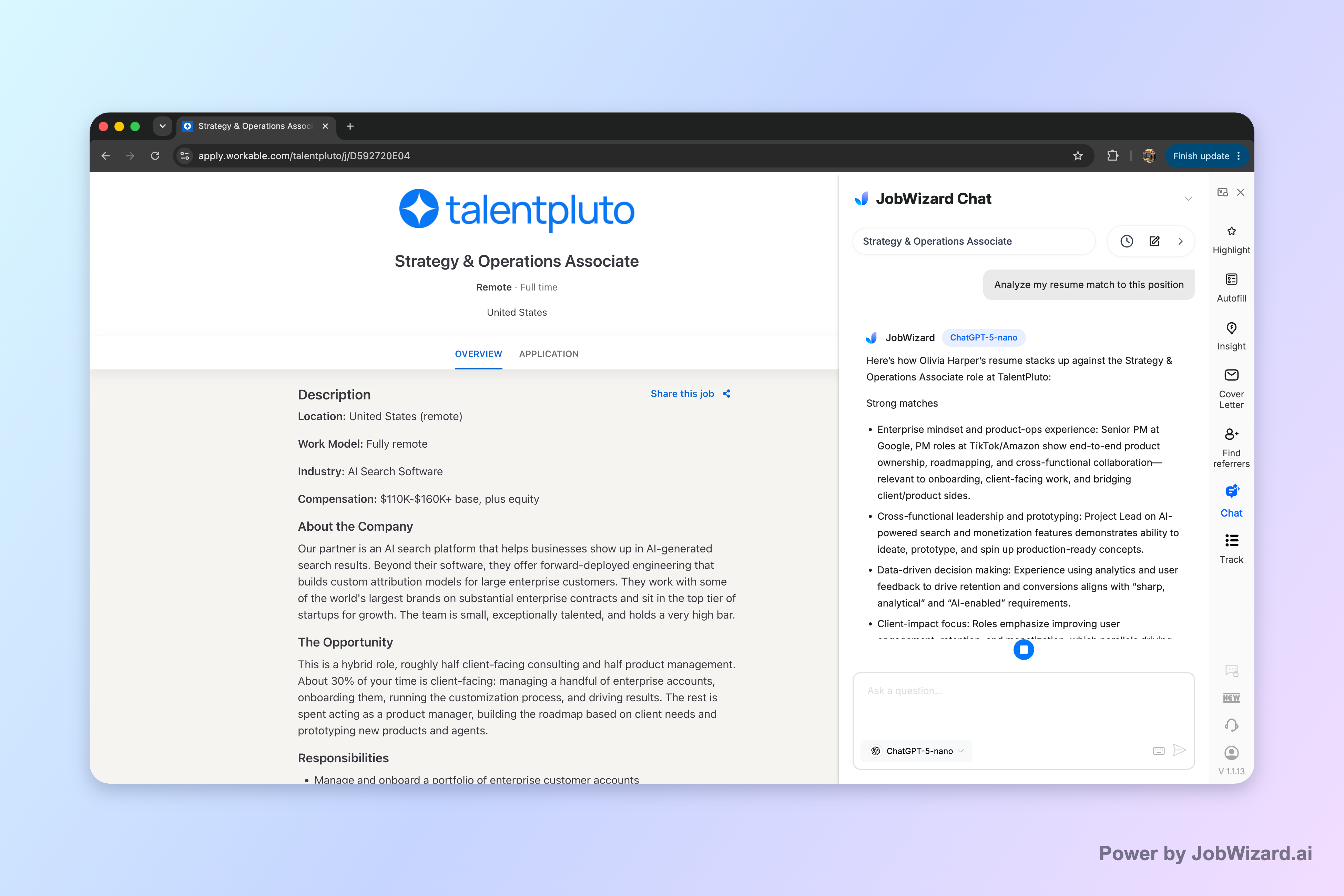
JobWizard’s Career Chat keeps the current role in context, so you can ask follow-up questions about resume fit and your interview strategy without pasting the job description again.
Behavioral interview questions to prepare for—use STAR so your stories land
For behavioral prompts, the goal is consistency: what you did, why you did it, and what changed. The fastest way to do that is STAR—Situation, Task, Action, Result.
If you want a deeper set of prompts and templates, use this companion guide: Behavioral Interview Questions That Actually Predict Your Performance—And How to Craft Strong Answers.
Behavioral questions (high frequency)
- Tell me about a time you handled a difficult stakeholder or customer.
- Describe a situation where you disagreed with a decision and what you did next.
- Give an example of a goal you didn’t hit—what you learned and how you changed.
- Tell me about a time you improved a process or made work faster/cleaner.
- Describe a moment you led without direct authority.
- Tell me about a time you worked with ambiguous requirements.
- Give an example of how you handled competing priorities.
Turn any behavioral answer into a STAR-ready outline
Before you write full paragraphs, create a one-page “story bank” with 6–8 examples. Then connect each to the skills the job emphasizes (communication, ownership, execution, judgment, collaboration).
- Situation: 1–2 sentences to set the scene and constraints.
- Task: what you were responsible for (not the team in general).
- Action: 2–4 bullets on what you personally did.
- Result: outcomes and impact (use metrics only if you have them; otherwise quantify in plain terms).
For a tighter set of answer patterns, also review: STAR Method Interview Questions for Hiring Managers: Answers That Show Impact (Not Just Stories).
Standard “tell me about yourself” and fit questions—answer like you belong in the room
These questions often decide whether the interviewer believes you can do the job before they hear your evidence. Your job is to lead with relevance.
Start with a short arc: current focus → proven strengths → why this role now. If you need a script approach, read: Common Interview Questions and How to Answer Them: A Script-First Playbook for Confident Hiring Discussions.
High-impact fit questions
- Tell me about yourself.
- Why do you want this role?
- Why should we hire you?
- What interests you about our company?
- What are your strengths?
- What’s a weakness you’re working on?
- How would you describe your work style?
- Where do you see yourself in 2–3 years?
A simple structure that works for “Why should we hire you?”
The best answers don’t list generic traits. They connect your strengths to what the team needs and then back it up with evidence.
- Strength #1 + one example (what you did, why it mattered).
- Strength #2 + one example.
- Relevance: one sentence tying your strengths to their likely priorities.
If you’re unsure whether your examples match the role, ask JobWizard Career Chat follow-up questions using the role context so your talking points stay aligned. (And remember: Career Chat is for helping you draft and refine your approach—don’t treat any analysis as a recruiter decision or guarantee that you qualify.)
Questions to ask the interviewer—turn curiosity into job-fit signals
Asking great questions shows you can think like the role and handle real-world constraints. Aim for clarity and relevance, not trivia.
Most job seekers under-plan this section. Build a short set you can reuse, then personalize on the fly.
A strong question mix (3–5 questions)
- Success metrics: “How do you measure success in the first 90 days?”
- Day-to-day: “What does a typical week look like for this role?”
- Top challenge: “What’s the hardest problem the person in this role will tackle first?”
- Team collaboration: “How does this role work with cross-functional partners?”
- Decision-making: “How do important decisions get made here?”
Second interview and “strategy” follow-ups
If you get a second interview, your questions should become more operational and specific. Use what they already emphasized in the first round.
- Follow-up: “You mentioned X—what does that look like in practice?”
- Tradeoffs: “What constraints usually affect decisions in this area?”
- Stakeholders: “Who are the key stakeholders this role relies on most?”
- Process: “What does the intake or planning process look like?”
Career Chat can help you generate role-specific follow-up question ideas without you re-pasting the job description every time. Again, use the output to sharpen your thinking and your questions—not as an authority that decides fit for you.
Interview questions to prepare for—salary, scenarios, and “what if” prompts
These are the questions where candidates either freeze or improvise without a plan. Prepare short scripts so you can answer quickly and professionally.
Below are common categories and what to practice.
Compensation and negotiation questions
- What are your salary expectations?
- Are you flexible?
- How do you view compensation in relation to scope?
Prepare a range anchored to the role and your experience, then confirm scope first if needed. Your goal is to keep the conversation anchored to responsibilities and level.
Scenario and judgment questions
- What would you do if priorities changed mid-quarter?
- How would you handle a disagreement on approach?
- What’s your process for tackling an ambiguous project?
- How would you prioritize multiple urgent requests?
For scenarios, structure your answer like a mini-plan: clarify goals, identify constraints, propose options, choose one, then define how you’ll communicate and measure progress.
Fast preparation checklist (use 60 minutes)
- Select your top examples: choose 6–8 stories you can reuse.
- Write one-line answers for fit questions (why you, why this role).
- Draft 3–5 questions for the interviewer (personalize one).
- Rehearse with transitions: what happened → what you did → why it mattered.
- Job-fit verification: use Career Chat to ask follow-up questions about resume fit and interview strategy in the role context.
Do this automatically with JobWizard
Skip the manual work — JobWizard's Smart Autofill handles this for you.
FAQ—interview questions to prepare for, answered
How do I prepare for interview questions to prepare for fast without sounding rehearsed?
Pick 8–12 high-frequency questions, write 2–3 bullet points for each, and rehearse the transitions (what happened → what you did → what changed). Then use a job-fit follow-up check to confirm your examples still match the role’s priorities before you finalize your wording.
What’s the best way to answer “Why should we hire you?” in an interview?
Map your top strengths to what the interviewer needs, then support each strength with one concrete example. If you’re unsure what they want most, use JobWizard Career Chat to keep the current role in context while you draft follow-up questions about resume fit and interview priorities.
How many questions should I ask the interviewer?
Aim for 3–5 thoughtful questions: one about success metrics, one about the team’s day-to-day, one about obstacles the role will handle, and one about how decisions are made. Leave time for a final follow-up that ties back to something they just mentioned.
Should I use the STAR method for every question?
Use STAR for behavioral prompts (“Tell me about a time…”, conflict, failure, leadership, process improvement). For why-you/fit questions, use a shorter structure—strength → evidence → relevance—then reference STAR examples when the interviewer asks for details.
How can I prepare for salary or compensation questions?
Prepare a range anchored to the role and your experience, plus a short script for how you’ll confirm expectations (e.g., “I want to understand the scope and level first”). Then review your final answers by checking that your reasoning aligns with the role’s responsibilities and requirements.
Ready to tighten your interview answers? Try JobWizard’s Career Chat: ask a focused follow-up about the role you’re interviewing for, then use the job context to validate your talking points before you finalize your response.
Frequently Asked Questions
Autofill your next job application
JobWizard is a free Chrome extension that fills applications, tracks statuses, and optimizes your resume.