STAR Method Interview Questions for Hiring Managers: Answers That Show Impact (Not Just Stories)
Learn how to handle star method interview questions with a repeatable structure, ready-to-use answer prompts, and a fast way to verify your story against the role—without guessing.
Free Chrome extension
Autofill your next job application
JobWizard is a free Chrome extension that fills applications, tracks statuses, and optimizes your resume.
Use STAR method interview questions to show impact, not just describe what happened
If you’re stuck staring at a list of star method interview questions, it usually isn’t because you lack experience—it’s because you don’t have a repeatable way to turn that experience into hiring-manager clarity. The STAR method helps you do that by organizing your answer into a tight narrative: Situation, Task, Action, and Result.
When you’re prepared, you can answer faster, sound more confident, and make it easier for the interviewer to connect your story to the role. And importantly: you still control what to share, what to omit, and what details to emphasize.
Build a STAR answer that maps directly to the job
The goal of a STAR response is alignment: your Situation and Task should set context, your Action should show behaviors, and your Result should prove value that fits the job. Before you rehearse, read the job description (or interview notes) and identify the skills they keep emphasizing.
Then, for each STAR story you plan to use, write a one-line “fit sentence” that answers: why your actions are relevant to this role. That one line becomes your anchor when you adjust the story for different prompts.
Start with Situation + Task (make the question easy to follow)
Keep the Situation brief. You’re not writing a novel—you’re giving just enough context for the interviewer to understand constraints and stakes. Your Task should state what you personally owned or were responsible for.
- Situation: where/when, what was happening, and why it mattered.
- Task: your responsibility and the specific challenge or objective.
Make Action concrete (use “what I did” behaviors)
Most STAR answers go wrong in the Action section. Don’t describe intentions—describe your actual decisions and work. Use multiple action verbs and include the strategy you used (how you approached it) plus the behaviors you demonstrated (how you collaborated, communicated, and executed).
- Explain what you decided and why.
- Share how you worked with others (or what you changed when collaboration broke down).
- Mention tools, process changes, or experiments if they were part of the work.
Turn Result into evidence (show the outcome clearly)
The Result should be specific. Even when you don’t have perfect metrics, you can still provide outcomes like performance improvements, reduced risk, faster cycles, clearer communication, or a lesson that changed how you work going forward.
If you don’t have numbers, aim for outcomes the interviewer can evaluate: what improved, what became easier, what you prevented, or what changed after your intervention. Your Result should close the loop on the Task.
Top star method interview questions (with “what they’re really testing”)
Here are high-frequency star method interview questions and what each one is usually designed to uncover. Use them as a rehearsal checklist and plug in your best-matching experiences.
| Star method interview question (example) | What the interviewer is testing | How to shape your STAR |
|---|---|---|
| Tell me about a time you handled a difficult situation. | Composure, problem-solving, and judgment | Situation: constraints. Task: what was at stake. Action: decisions + communication. Result: what changed. |
| Describe a project where you had to influence others. | Stakeholder management and persuasion | Task: your goal without direct authority. Action: alignment steps + tradeoffs. Result: buy-in or measurable progress. |
| Share an example of a time you improved a process. | Ownership and continuous improvement | Situation: the existing friction. Task: what you aimed to improve. Action: experiment/iteration. Result: outcome and impact. |
| Tell me about a time you worked under pressure. | Execution under constraints | Situation: time/risk. Task: deliverable or reliability. Action: prioritization and risk control. Result: outcome achieved. |
| Describe a time you made a mistake and what you did next. | Learning, accountability, and follow-through | Situation: what went wrong. Task: what you were responsible for. Action: correction plan. Result: prevention + learning applied. |
| Give an example of when you had to learn something quickly. | Adaptability and ramp-up ability | Situation: unfamiliar territory. Task: deliverable timeline. Action: how you learned + applied. Result: what you delivered and how you scaled. |
How to rehearse without sounding scripted
Rehearsal should feel natural, not memorized word-for-word. Practice by mapping each answer to bullet points you can swap in. A simple approach: write one bullet each for Situation and Task, three for Action, and one for Result.
Then practice delivering the answer as a short narrative, using the bullets as scaffolding. The goal is that you can explain the “why” behind your actions quickly—without rambling.
Career Chat can help you verify fit before you answer—without pasting the job
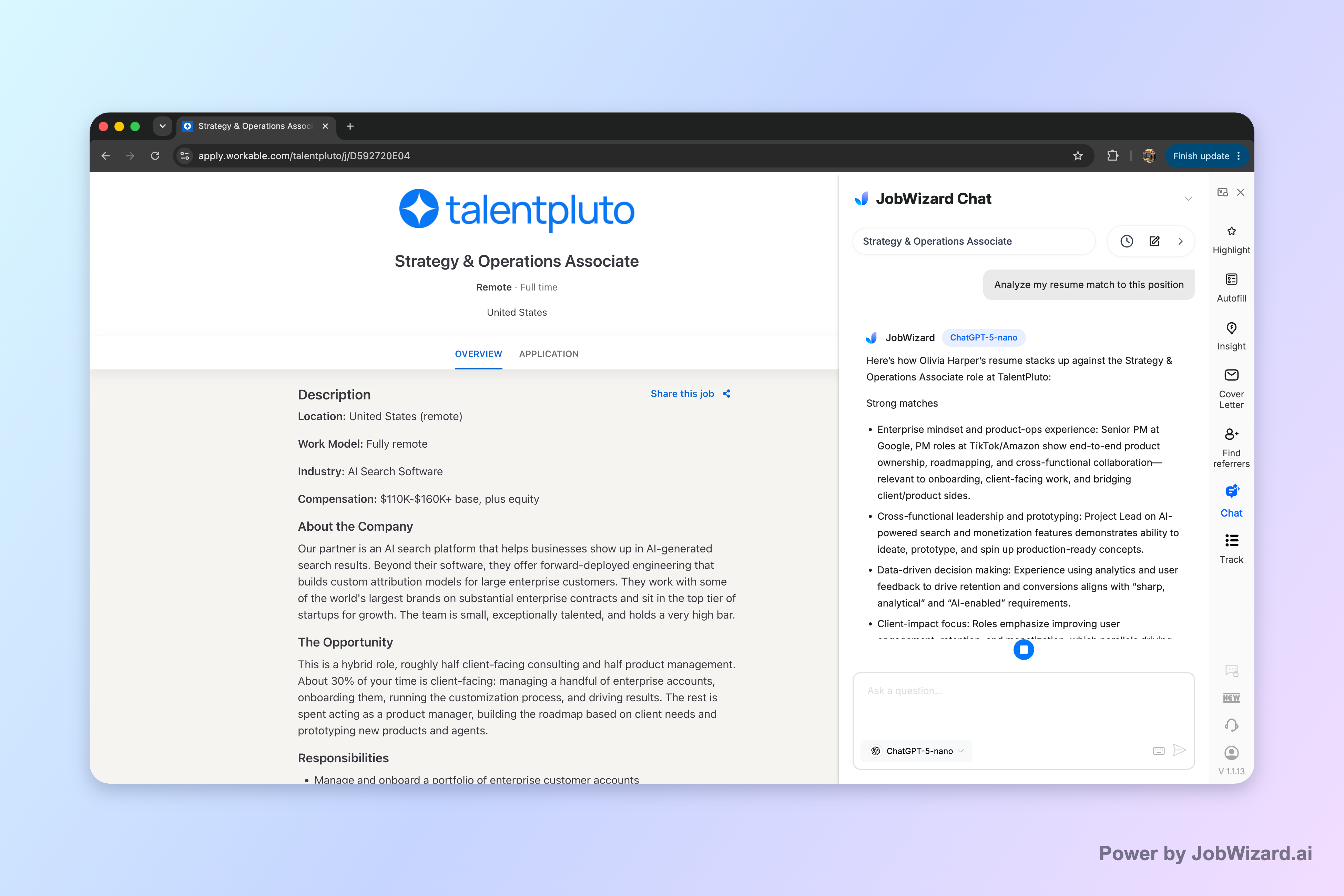
If you’re preparing for star method interview questions, it’s easy to build great stories that accidentally miss the role’s emphasis. JobWizard’s Career Chat helps keep the current role in context so you can ask follow-up questions about resume fit and application strategy without pasting the job description again.
Because it keeps the role context, you can use it to sanity-check what details matter most as you craft your STAR answers. For example, you can ask career question prompts like: “Which of my experiences best demonstrates the core competency they likely care about?” or “What follow-up questions might they ask next based on this role?”
Limitation to keep in mind: Career Chat shouldn’t be treated as a recruiter decision or a guarantee that you qualify—it’s a support tool for thinking and preparation, not an evaluation of your candidacy.
Use it like a pre-interview checklist
- Ask about fit: which parts of your background connect most clearly to what the role emphasizes.
- Ask follow-ups: what the interviewer might probe after your STAR answer.
- Verify your angle: confirm you’re emphasizing the actions and outcomes that best match the job description.
And you stay in control: you review any drafted content and decide what to submit or share.
Do this automatically with JobWizard
Skip the manual work — JobWizard's Smart Autofill handles this for you.
FAQ: quick answers to star method interview questions
What are the most common star method interview questions I should prepare for?
Most common star method interview questions ask about results from past situations—examples include “Tell me about a time you handled a difficult situation,” “Describe a project where you had to influence others,” “Share an example of a time you improved a process,” and “Tell me about a time you worked under pressure.” Use the STAR framework to translate each story into a Situation, Task, Action, and Result that matches the role you’re interviewing for.
How long should my STAR method interview answer be?
Aim for a tight narrative that covers all four parts (S, T, A, R) without repeating background. A practical target is about 2 minutes per answer: enough to explain your actions clearly, but short enough that the interviewer doesn’t have to work to find your impact.
Should I use the same STAR story for different interview questions?
Yes—when the underlying experience fits. Start by matching the story to what the question is really testing (leadership, problem-solving, conflict resolution, ownership, learning). Then reshape the emphasis: adjust the “Task” to match the new prompt and rewrite the “Action” bullets to highlight the behaviors the interviewer is asking for.
What follow-up questions can I ask after answering a STAR prompt?
Good follow-up questions help you confirm fit and clarify expectations. Examples: “Based on what you described, how are you measuring success in the first 30–60 days?” and “What would you like to see more of from someone in this role—ownership, collaboration, or operational execution?” If you’re using Career Chat, you can keep the role context and ask follow-up questions about how your experience maps to the job description—so you don’t need to paste it again.
What’s the biggest mistake when answering star method interview questions?
The biggest mistake is treating STAR as a storytelling template instead of an impact explanation. If your answer spends most of its time on setup or vague intentions (“I tried to…”) and not enough on specific actions and measurable outcomes (“I did X, which led to Y”), the interviewer won’t clearly see why you’re a strong match.
Next step: ask JobWizard to help you tailor your STAR stories to this role
Want your star method interview questions answers to feel tightly matched to the role—and avoid guessing what they’ll care about most? Use JobWizard’s Career Chat to ask a focused follow-up question about the current role, then verify your answer angle against the job description details.
For deeper practice, also review:
- How to Answer Job Application Questions: A Field-Tested Method for Confident, Consistent Responses
- How to Answer Behavioral Interview Questions and Answers: The STAR+Plan That Wins Interviews
- Behavioral Interview Questions That Actually Predict Your Performance—And How to Craft Strong Answers
- Behavioral Interview Questions for Software Engineers: How to Use a Tool to Practice, Not Guess
CTA: Ask Career Chat a follow-up question about the role you’re interviewing for (for example, “Which of my experiences should I lead with for this competency?”), then refine your STAR story so your Situation, Action, and Result map cleanly to the job.
Frequently Asked Questions
Autofill your next job application
JobWizard is a free Chrome extension that fills applications, tracks statuses, and optimizes your resume.