Tell Me About a Time Interview Questions: A STAR Answer Script That Sounds Like You
Learn how to answer tell me about a time interview questions with a realistic STAR story, tight follow-ups, and a strategy for what to say next. Use JobWizard Career Chat to sanity-check role fit as you practice.
Free Chrome extension
Autofill your next job application
JobWizard is a free Chrome extension that fills applications, tracks statuses, and optimizes your resume.
When an interviewer asks tell me about a time interview questions, they’re not looking for a dramatic life story—they want proof you can handle work problems with clear thinking and ownership. The quickest path to a strong answer is a repeatable story framework that you can personalize in under a minute.
Below you’ll get a practical STAR script, example angles you can adapt, and a way to ask sharper follow-up questions so your interview answers stay tightly connected to the role.
How to answer “tell me about a time” questions with STAR (without sounding rehearsed)
Use STAR so each answer has a beginning, a decision point, and a payoff—while you stay focused on what you did instead of what happened around you.
Here’s a reliable template you can say out loud. Keep it simple, then swap in your real details.
- Situation: One sentence that sets the context (team, constraint, timing).
- Task: The specific responsibility you owned.
- Action: 2–3 concrete moves you made (not everything you tried).
- Result: The outcome (measurable if you can), plus what you learned.
STAR should feel like a story, not a worksheet. If you’re tempted to list tools, processes, and every stakeholder name, cut 30–40% and keep the part that shows judgment.
What “good” sounds like (a script you can adapt)
Try this pattern for the Action section: “I did X to solve Y, then I verified Z, and I communicated A to B.” That keeps your answer grounded and easy to follow.
Mini-script: “In [Situation], I was responsible for [Task]. I [Action 1] to address [problem], then I [Action 2] to confirm [impact]. As a result, [Result]. What I’d repeat next time is [lesson tied to the role].”
Common mistakes that weaken “tell me about a time” answers
- Sharing vague action: “We collaborated” is weaker than “I aligned two teams on a single success metric and tracked weekly progress.”
- Over-crediting others: If the question is about your behavior, name your decision and your follow-through.
- Stopping at the result: Add one sentence on what you learned or how you’d apply it again.
- Answering the wrong skill: Sometimes a question is really about communication, prioritization, or stakeholder management—even if the surface topic is “project” or “deadline.”
35 “tell me about a time” prompt angles—and what they’re really testing
Interviewers ask tell me about a time interview questions in different disguises, but the underlying goal is consistent: evaluate how you think, decide, and execute under real constraints.
Use the list below to quickly identify which skill the interviewer wants, then plug in an example you already know you can defend.
| Tell me about a time prompt angle | What they’re testing | Your best STAR focus |
|---|---|---|
| …when you missed a deadline | Accountability + recovery | Action: what you changed, how you communicated risk, how you prevented repeats |
| …when priorities shifted | Decision-making under uncertainty | Action: trade-offs, re-planning, aligning stakeholders |
| …when you disagreed with a teammate | Professional conflict handling | Action: how you framed the problem, how you reached a workable conclusion |
| …when you had to learn something fast | Learning agility | Action: how you found the fastest path to competence + applied it immediately |
| …when you influenced without authority | Stakeholder management | Action: persuasion approach, shared goals, proof you created |
| …when you handled a tough customer/client | Composure + problem-solving | Action: de-escalation, constraints, a clear next step |
| …when you improved a process | Ownership + continuous improvement | Action: the before/after change, how you measured it, what you documented |
| …when you found a better way to do something | Pragmatism + execution | Action: pilot/iteration steps and adoption strategy |
Turn any angle into a defensible result
If you don’t have hard numbers, you can still produce a convincing result. Choose one of these “result types” and make it specific:
- Quality outcome: Fewer rework cycles, fewer escalations, or clearer approvals.
- Speed outcome: Reduced time-to-resolution or faster turnaround after a change.
- Risk outcome: Prevented a failure mode by catching issues early.
- Alignment outcome: Stakeholders moved from disagreement to a shared plan.
Keep your result tied to your action. Don’t write a “result” sentence you can’t connect back to a behavior you described.
Use role fit to sharpen your STAR: practice with Career Chat (and still own the story)
To make tell me about a time interview questions land, your story needs to match the role’s priorities—not just be impressive in general.
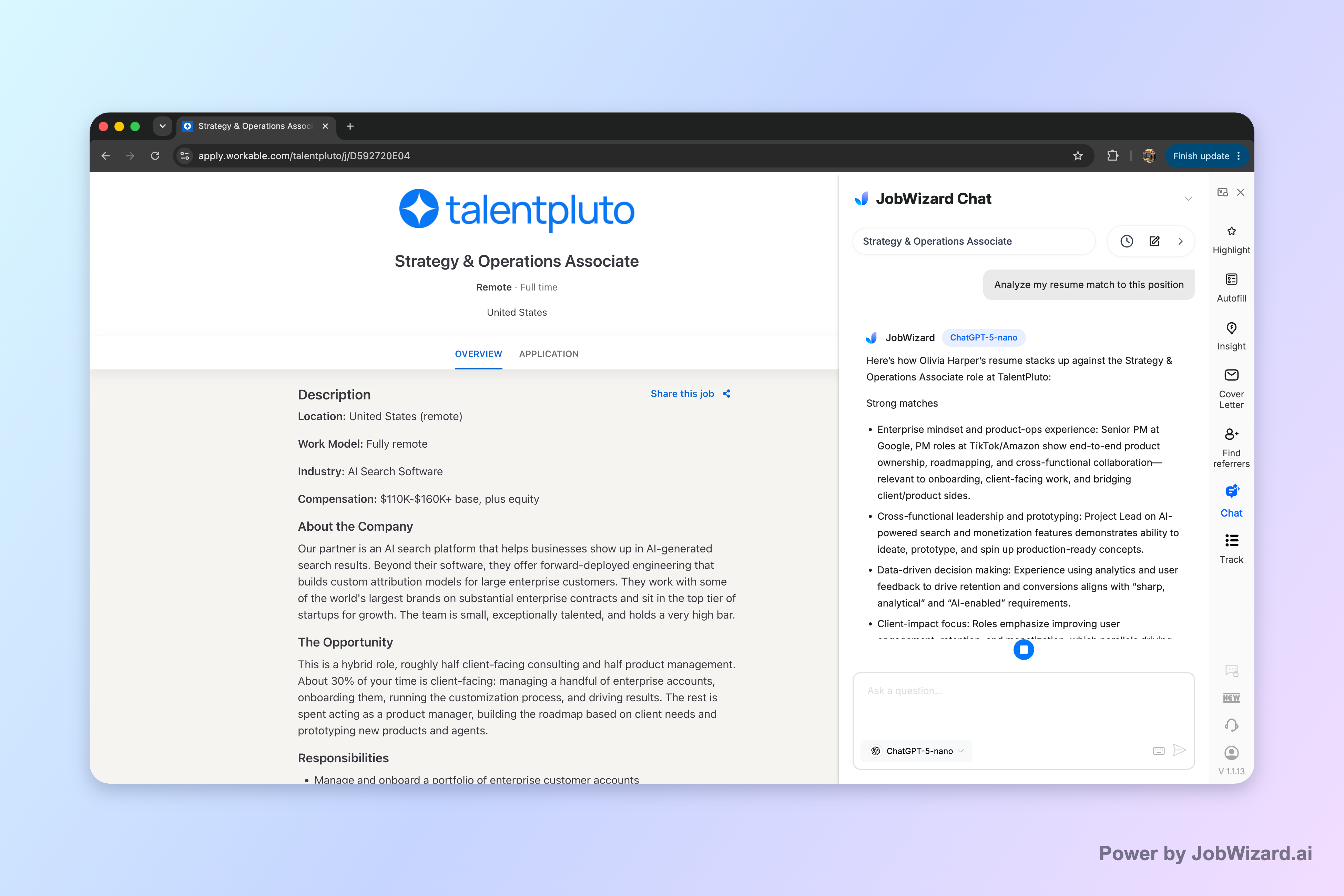
JobWizard’s Career Chat keeps the current role in context so you can ask follow-up questions about how your resume experience and application strategy connect to what the job wants, without repeatedly pasting the job description.
When you practice, treat Career Chat as a reviewer for alignment—not as a recruiter decision or a guarantee that you qualify. You remain responsible for what you say.
How to practice (5-minute workflow)
- Paste your rough STAR: Situation + Task + Action + Result in a few lines.
- Ask a targeted fit check: “Which part of this story best supports the role’s responsibilities?”
- Request missing hooks: “What should I emphasize to show [skill] clearly?”
- Verify against the job description: Cross-check that your emphasis matches the posted needs.
- Rehearse and refine: Adjust your wording so it sounds like you, not like a template.
Invite follow-up that stays specific to the role. JobWizard’s CTA approach is to ask a focused follow-up question about the current role and verify the answer against the job description before you use it in the interview.
Follow-up questions that turn one answer into a stronger conversation
After you answer a tell me about a time interview questions prompt, the interviewer often decides whether to probe deeper based on clarity and relevance—so your follow-ups should keep the momentum in the right direction.
Use one follow-up from each category below. Pick the one that matches what the interviewer seemed to care about most.
- Success definition: “How do you measure success for this responsibility in the first few months?”
- Common failure modes: “What usually causes projects to slip or get stuck here?”
- Team collaboration: “Who do I partner with most closely, and what does alignment look like day-to-day?”
- Decision-making: “When trade-offs happen, how do you decide what to prioritize?”
- Interview-to-reality bridge: “Which part of my background would you want to see expanded in more detail?”
Don’t ask for generic info you could have found on the job post. Good follow-ups sound like they’re continuing a thread from your STAR story.
Related prep: answers for the “classic” behavioral set
If you want more example phrasing, use these focused guides to build your practice bank:
- Interview Questions About Behavior: 37 Prompts and Answer Patterns That Actually Get Noticed
- How to Answer Job Application Questions: A Field-Tested Method for Confident, Consistent Responses
Tell me about a time answers also pair well with your “self-introduction” message—so you can smoothly transition from your story to how you’d perform in the role.
- How to Answer “Tell Me About Yourself” in an Interview: A 4-Part Answer That Sounds Credible
- How to Answer “Tell Me About Yourself” on a Job Application: A Job-Seeker Framework That Lands Interviews
Do this automatically with JobWizard
Skip the manual work — JobWizard's Smart Autofill handles this for you.
FAQ: tell me about a time interview questions
What is the best way to structure tell me about a time interview questions?
Use STAR: Situation, Task, Action, Result. Pick a moment where you owned the outcome, then end with a concrete result plus one lesson you’d repeat in a similar role.
How long should my answer be for a “tell me about a time” question?
Aim for about 60–90 seconds for your full STAR story. If the interviewer wants more, be ready with a brief “extra detail” add-on for the hardest part or the decision you made.
What if I don’t have experience exactly like the question?
Choose the closest transferable example—especially one that shows the same skill (prioritization, conflict handling, learning fast). In your wrap-up, explicitly connect the transferable piece back to the role’s needs.
What questions should I ask at the end of this kind of interview?
Ask role-specific follow-ups like: “What would success look like in the first 60–90 days?” and “How do you evaluate this responsibility in practice?” Keep the questions grounded in the job description so your answers and questions align.
How can JobWizard help me practice answers for tell me about a time interview questions?
Use JobWizard Career Chat to keep the current role in context while you practice. Ask focused follow-ups about how your story matches the job description, then review the output yourself before you use it in the interview.
Ready to practice your best story? Open JobWizard Career Chat, ask a focused follow-up question about the role you’re interviewing for, and verify the guidance against the job description—then rehearse your final STAR answer so it’s ready when they ask.
Frequently Asked Questions
Autofill your next job application
JobWizard is a free Chrome extension that fills applications, tracks statuses, and optimizes your resume.