Common Interview Questions and How to Answer Them: A Script-First Playbook for Confident Hiring Discussions
Learn how to handle common interview questions and how to answer them with clear, role-specific scripts. Plus, get a practical prep workflow you can reuse.
Free Chrome extension
Let AI answer these questions for you
JobWizard fills sponsorship, work-auth, and availability answers correctly on every application — free.
Common interview questions and how to answer them shouldn’t feel like a guessing game. If you prepare a few reusable “scripts,” you can respond with confidence, stay on topic, and connect your experience to what the interviewer actually needs.
Below is a practical, script-first playbook for the most frequent prompts—plus a prep workflow you can run before every interview so your answers stay consistent and role-relevant.
Start with a script-first prep system (so your answers sound consistent)
Write 1–2 sentence “headline” answers for each major question category, then attach 2–3 proof points. This prevents rambling and makes your delivery easy to follow—even under pressure.
Before your interview, collect the job’s key needs and translate them into simple categories you can map to your experience (examples: execution, collaboration, problem-solving, stakeholder management, or technical ownership). Then build a small set of stories you can reuse across multiple prompts.
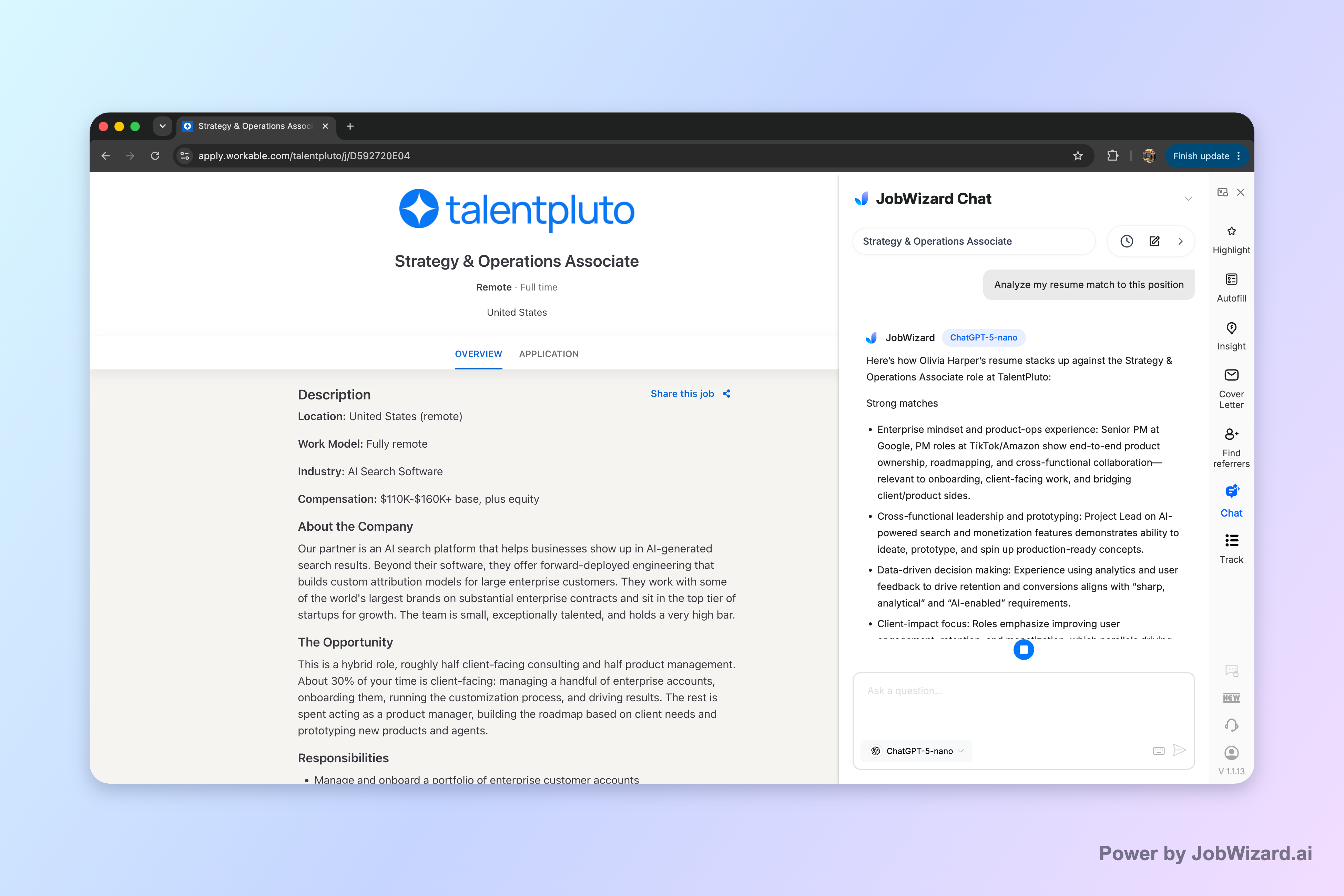
When you’re preparing, it’s also helpful to keep your target role in view so you can answer in the right direction. JobWizard’s Career Chat is designed to keep the current role in context, so you can ask follow-up questions about resume fit and application strategy without pasting the job description again.
Run this 10–15 minute “answer rehearsal” before every interview
- Headline: Draft the first sentence you’ll say out loud (keep it direct).
- Proof: Add 2–3 specifics (what you did, with what, and what changed).
- Tie-back: End with how it maps to the team’s priorities in this role.
- Question-ready: Prepare one follow-up question you can ask the interviewer to confirm context.
If you do this once per interview, you’ll spend less time “figuring out your answer” mid-conversation—and more time sounding like the person who can do the work.
Common interview questions and how to answer them: the high-frequency set
These are the prompts you’ll hear most often, and you can answer them with the same repeatable structure: headline → proof → tie-back.
Use these templates to speed up prep. Customize the details to match your real experience (and the specific role) rather than trying to memorize generic lines.
1) “Tell me about yourself.”
Keep it focused and forward-looking: one sentence on your current focus, 1–2 relevant past experiences, then why you want this role. Aim for roughly a minute.
Example structure: Current role/focus → one achievement that proves fit → why you’re interested now.
Common mistake: repeating your whole resume in order.
2) “Why do you want this job?”
Answer the “why” behind the job, not just the job title. Reference the specific problems you want to solve and the environment you want to be in.
Example structure: What you’re seeking → what the role offers → why your background makes you effective there.
Common mistake: sounding like you’re applying to “any role with growth.”
3) “Why should we hire you?”
Match your strongest evidence to the top needs. Choose 2–3 competencies the role emphasizes, then connect them to proof from your experience.
Example structure: Top needs (2–3) → evidence you’ve delivered → how you’ll approach the role early on.
Common mistake: listing responsibilities you had instead of outcomes you drove.
For a related preparation angle, see: How to Answer Job Application Questions: A Field-Tested Method for Confident, Consistent Responses.
4) “What are your strengths?”
Select strengths that show up as job impact. Pick 2–3 strengths, then add one mini-story or concrete example for each.
Example structure: Strength → evidence → how it helps this role.
Common mistake: generic adjectives with no proof.
5) “What is your biggest weakness?”
Choose something real—and show improvement. The goal isn’t perfection; it’s growth and self-awareness.
Example structure: weakness (framed safely) → what you do to manage it → measurable improvement or learning.
Common mistake: turning weakness into a hidden requirement (e.g., “I’m too much of a perfectionist” with no real context).
6) “Where do you see yourself in 3–5 years?”
Make it credible, not overly specific. Connect your target direction to how this role builds the skills you need.
Example structure: skills you’re building → the next level you want → why this role is a bridge.
Common mistake: only talking about titles and ignoring skill-building.
7) “Describe a time you handled a challenge.”
Use a behavioral story format so your answer stays structured and easy to evaluate.
Prepare several stories for recurring themes like conflict, failure, high pressure, stakeholder disagreement, or process improvement.
If you want a deeper behavioral focus, use these guides next: Behavioral Interview Questions That Actually Predict Your Performance—And How to Craft Strong Answers and How to Answer Behavioral Interview Questions and Answers: The STAR+Plan That Wins Interviews.
Behavioral questions: turn “stories” into scored answers with STAR
Behavioral interviews reward clarity and outcomes, not long narratives. STAR gives you a clean path: Situation → Task → Action → Result.
Before your interview, pick 2–3 stories per common theme so you aren’t scrambling to generate examples while the interviewer waits.
Use STAR+ as your default checklist
Plan your stories like reusable modules: each story should include a few flexible details you can emphasize depending on the question.
- Situation: One sentence setting context.
- Task: Your responsibility or goal.
- Action: What you did—tools, collaboration style, and decision-making.
- Result: The outcome and what improved.
- Learning (if relevant): What you’d do again or how it changed your process.
For a prompt-by-prompt approach, start with: STAR Method Interview Questions for Hiring Managers: Answers That Show Impact (Not Just Stories).
Quick story selection trick (so you pick the right example fast)
Choose the story that best matches what they’re trying to evaluate. If they ask about teamwork, prioritize collaboration-heavy actions and outcomes. If they ask about ownership, prioritize decision-making and follow-through.
Then, rehearse your first 10 seconds out loud. The opening line often determines whether your answer feels confident and coherent.
Questions to ask the interviewer (and why they matter)
The best questions confirm fit and reduce risk for both sides. Your goal isn’t to interrogate—it’s to understand priorities and signal how you think.
Prepare 3–5 questions and adapt them to the conversation. If you can, ask at least one question that touches success metrics or early priorities.
High-impact question options
- Success early on: “What would success look like in the first 60–90 days?”
- Measurement: “How does the team measure impact for this role?”
- Collaboration: “Who will I work with most closely, and how do decisions get made?”
- Current challenges: “What are the biggest challenges the team is focused on right now?”
- Growth: “What skills does someone need to grow into the next level here?”
Common mistake: asking questions that have obvious answers from the job posting without adding anything new.
If you’re preparing multiple rounds, keep a short “question bank” and reuse the questions that align with what you learned after each conversation.
Do this automatically with JobWizard
Skip the manual work — JobWizard's Smart Autofill handles this for you.
FAQ: common interview questions and how to answer them
Use these direct answers to tighten your prep before you walk into the room.
What are the most common interview questions and how should I structure my answers?
Use a repeatable structure: a direct 1–2 sentence headline answer first, then 2–3 proof points (specific results, tools, or metrics) and close with how it ties to the role.
How do I answer “Tell me about yourself” without rambling?
Start with your current focus in one line, add 1–2 relevant past experiences, and end with why you’re interested in this role. Keep it to about a minute and avoid repeating your entire resume.
What’s the best way to answer “Why should we hire you?”
Match your strongest experience to the job’s top needs, then add how you’ll approach the work in the first months. Keep it grounded in the role description and your demonstrated track record.
How should I prepare for behavioral interview questions (and STAR)?
For each common theme (leadership, conflict, failure, impact), prep 2–3 STAR-ready stories. Use STAR to stay organized, but speak in plain language and highlight the outcome and what you’d do again.
What questions should I ask the interviewer at the end?
Ask questions that show you understand priorities and context, like what success looks like in the first 60–90 days, how the team measures impact, or what challenges the role is most focused on.
Ready to make your answers more role-specific? Use JobWizard’s Career Chat to ask a focused follow-up question about the current role (based on what you plan to say in the interview), then verify your answer lines up with the job description before you submit.
Frequently Asked Questions
Let AI answer these questions for you
JobWizard fills sponsorship, work-auth, and availability answers correctly on every application — free.