Best Interview Questions to Ask Employer: Get Clarity, Prove Fit, and Negotiate with Confidence
Learn the best interview questions to ask employer to uncover priorities, team fit, and growth—and to guide smart follow-ups. Includes ready-to-use question templates.
Free Chrome extension
Autofill your next job application
JobWizard is a free Chrome extension that fills applications, tracks statuses, and optimizes your resume.
If you want to stand out, you don’t just answer interview questions—you ask the best interview questions to ask employer. The goal is simple: walk away with clarity, show informed interest, and create openings for smart follow-ups on priorities, success, and growth.
Before you go in, pick questions that match the stage of the process and the level of specificity you’re comfortable with. Then keep your tone curious and collaborative—so your questions sound like you’re preparing to contribute, not testing the company.
How to choose the right best interview questions to ask employer (without sounding generic)
Choose questions based on what you need to decide—then ask for the level of detail that proves you’re thinking ahead.
Most “good questions” fail because they’re either too broad (“What’s your culture like?”) or too late (“So what are the next steps?” right as you’re leaving). A strong set of interview questions to ask employer is anchored to the role’s realities: priorities, success measures, decision-making, and constraints.
Use this quick selection logic:
- Role clarity first: ask what “good” looks like (outcomes, metrics, or scope) so you can confirm alignment.
- Workflow next: ask how decisions happen and how the team collaborates—because culture lives in the process.
- Impact and ramp: ask about the first 60–90 days to understand onboarding and early expectations.
- Growth and constraints: ask what’s likely to change and what resources the role will have.
Finally, tailor follow-ups. If they mention a challenge, ask a “how” question. If they mention a metric, ask how it’s tracked. That’s how your questions become evidence that you’ll deliver.
Best interview questions to ask employer about priorities, success, and the first 90 days
When you ask about priorities and success criteria, you signal readiness to execute—not just interest.
These questions work in both recruiter screens and hiring-manager interviews. They’re also ideal if you’re trying to understand whether the role is replacing someone, expanding scope, or solving an ongoing gap.
- “What are the top priorities for this role over the next 60–90 days?” This forces specificity and reveals urgency.
- “How do you define success for the person in this position?” Listen for measurable outcomes or clear expectations.
- “What are the most important problems the team needs help solving right now?” This gives you a window into strategy.
- “What would make you say, ‘We made the right hire’ after the initial ramp?” Great for translating their needs into your value.
- “How does this role interface with other teams or stakeholders?” You’ll learn what collaboration actually means.
- “If I’m starting soon, what should I understand on day one to be effective?” You’ll uncover onboarding realities.
If you want a high-signal follow-up, use this pattern: repeat a key phrase from their answer and ask for the next layer. For example: “You mentioned X being the top priority—how is that typically measured or tracked?”
Tip: The best interview questions to ask employer don’t just collect information—they help you confirm you can deliver in their environment.
Best interview questions to ask employer about team dynamics, decision-making, and communication
Culture and teamwork show up in decisions and communication—ask about those instead of asking for generic “vibes.”
Employers often describe culture broadly. Your job is to bring it down to the day-to-day: how disagreements are resolved, how priorities shift, and how people communicate when deadlines tighten.
- “How does the team handle tradeoffs when priorities conflict?” This reveals how work gets scheduled and re-scoped.
- “What does collaboration look like for this role day-to-day?” You’ll learn the cadence and expectations.
- “How are decisions made—who owns final calls?” This helps you understand your autonomy and influence.
- “Can you describe the communication rhythm on the team (meetings, updates, reporting)?” Great for figuring out stakeholder management.
- “What’s a recent example of a project that changed direction—what drove the change?” Ask for reality, not theory.
- “How do you give feedback and measure progress over time?” You’ll learn performance expectations.
If the interviewer mentions a tool, process, or workflow, ask how it impacts outcomes: “How does that process help the team get to decisions faster?” This keeps your questions grounded in outcomes.
Best interview questions to ask employer about growth, compensation, and next steps
Use these questions to clarify expectations, reduce surprises later, and set yourself up for an informed offer conversation.
Compensation and growth can feel awkward if you approach them indirectly. Aim for clarity and alignment, not pressure. The questions below help you understand the framework without demanding a contract on the spot.
- “What does career growth look like for someone in this role?” Ask how people advance and what skills matter.
- “What skills or experiences would differentiate someone who exceeds expectations here?” This tells you where to invest.
- “How do you structure compensation for this role, and what factors influence the range?” Salary negotiation question that stays collaborative.
- “What’s the timeline for decisions after this stage?” Helps you manage next steps.
- “What are the next steps in the process, and who will be involved?” Reduces ambiguity.
- “Is there anything that would prevent you from moving forward with my candidacy?” Use thoughtfully; it invites specific concerns.
If you’re unsure how to word compensation questions, search your own notes for a sentence the interviewer used about outcomes, then connect it: “Given what you said about X priorities, how do you think about compensation for this scope?”
Also, if the interview includes application questions, remember that employers may ask eligibility items on job applications. If you want context for that, see Why Employers Ask “Are You Over 18” on Job Applications: What It Means and How to Answer.
Using Career Chat to craft sharper follow-up questions (and avoid mismatch)
You get better answers—and a better impression—when your follow-ups stay grounded in the specific role you’re interviewing for.
JobWizard’s Career Chat keeps the current role in context so you can ask follow-up questions about fit and application strategy without pasting the job description again. That’s helpful when you want your next question to reflect exactly what they’re hiring for—not what you assume the role means.
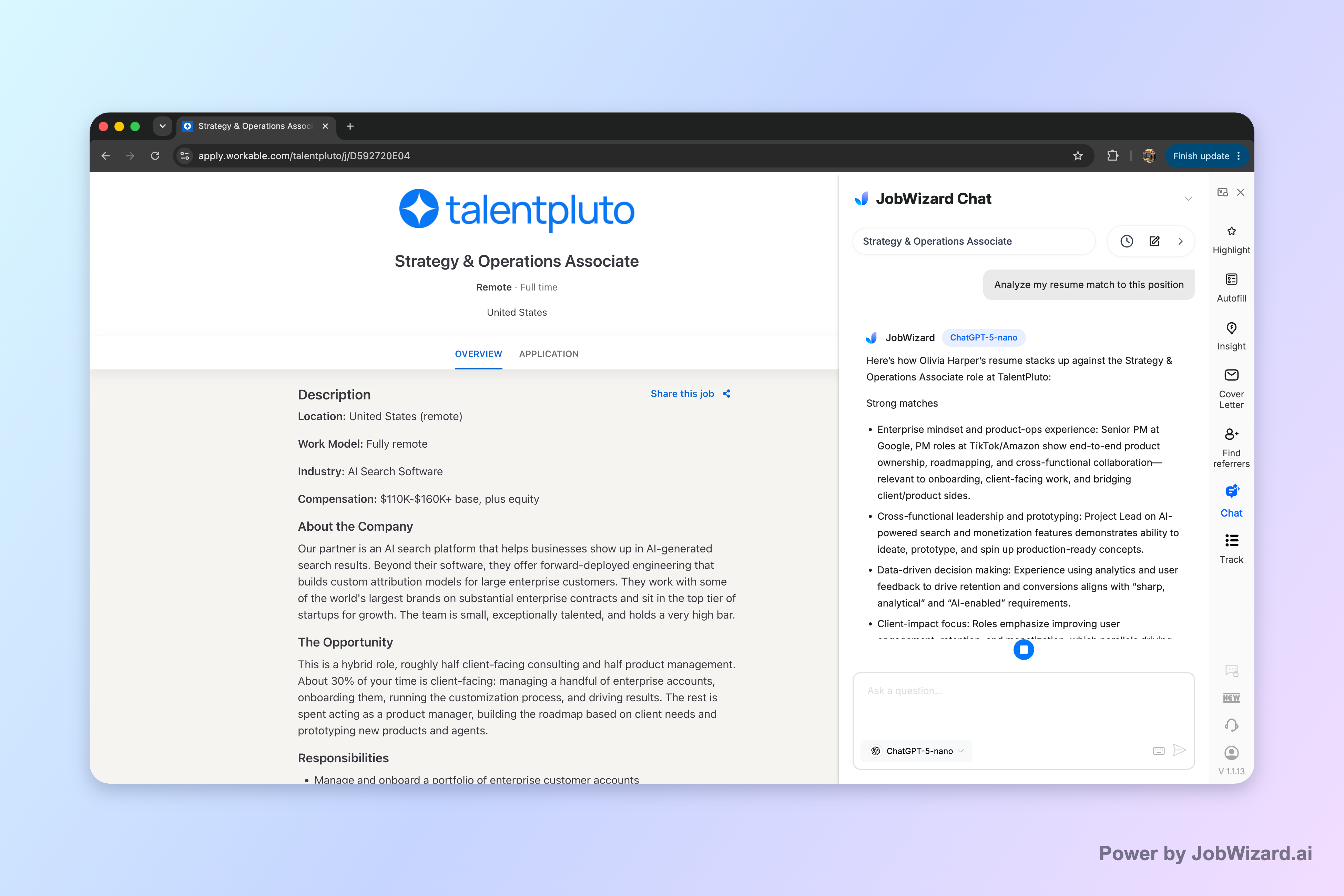
As you prepare, use Career Chat to generate or refine follow-ups that connect your experience to their priorities. For example, if the role description emphasizes ownership, you can ask how success is evaluated and what ownership looks like in day-to-day work. Then you can practice turning those insights into a short, natural question for the interviewer.
Reality check: Career Chat can help you frame questions and think through fit, but it shouldn’t be presented as a recruiter decision or a guarantee that you qualify.
If you want a targeted practice loop: ask a focused follow-up question about the current role, then verify the answer against the role details you were given (and your own experience). Finally, bring the most specific question you’re ready to ask—typically one about priorities, success metrics, or first-90-day expectations.
To round out your interview prep, you can also review related guidance on how to respond to common application and interview formats: How to Answer Job Application Questions: A Field-Tested Method for Confident, Consistent Responses and How to Answer Interview Questions Like a Pro: Your Repeatable Framework for Clear, Confident Replies. If your interview includes structured storytelling prompts, use How to Answer Behavioral Interview Questions and Answers: The STAR+Plan That Wins Interviews to keep your examples crisp.
Do this automatically with JobWizard
Skip the manual work — JobWizard's Smart Autofill handles this for you.
FAQ: best interview questions to ask employer
What are the best interview questions to ask an employer early in the process?
Ask about near-term priorities and what success looks like for the first 60–90 days—then follow up with how the role is evaluated (e.g., “What outcomes matter most in the first 1–3 months?”).
How do I ask about salary without sounding aggressive?
Frame it around alignment: “How do you typically structure compensation for this role, and what factors influence the range?” If salary wasn’t discussed, ask what the next step looks like for compensation review (without pushing the interviewer to negotiate on the spot).
What questions should I ask to confirm team fit and culture?
Ask how the team collaborates and handles tradeoffs: “How do you work through conflicting priorities?” or “What does strong teamwork look like here?” This helps you evaluate day-to-day reality, not slogans.
Which questions make the best impression in a second interview?
In a second interview, go deeper: “What are the biggest gaps this role will address?” and “How will you measure impact after the initial ramp period?” If relevant, ask who the role partners with most and how decisions get made.
Should I bring up my resume or experience during the interview questions I ask?
Yes—use your questions to connect your experience to their needs. For example: “Based on what you shared about X, how would you expect someone with my background in Y to contribute?” Then listen for specifics you can reference in follow-up emails.
Ready to walk into your next interview with sharper, role-specific questions? Use JobWizard to get support from Career Chat while you prep follow-ups, then confirm the details against the job description before you ask—so your questions land with confidence.
Frequently Asked Questions
Autofill your next job application
JobWizard is a free Chrome extension that fills applications, tracks statuses, and optimizes your resume.