Paralegal Cover Letter That Wins Interviews: a Smart Template + AI Draft Workflow
A strong paralegal cover letter helps you match the job’s legal focus and sound human. Use this workflow to draft faster, then edit with confidence.
Free Chrome extension
Generate this cover letter automatically
JobWizard drafts a tailored letter from your resume and the job description in seconds — free.
Paralegal cover letter—it’s the difference between “submitted” and “interview.” Hiring managers for legal roles want proof you can handle detail, discretion, and legal support work, not just a generic intro.
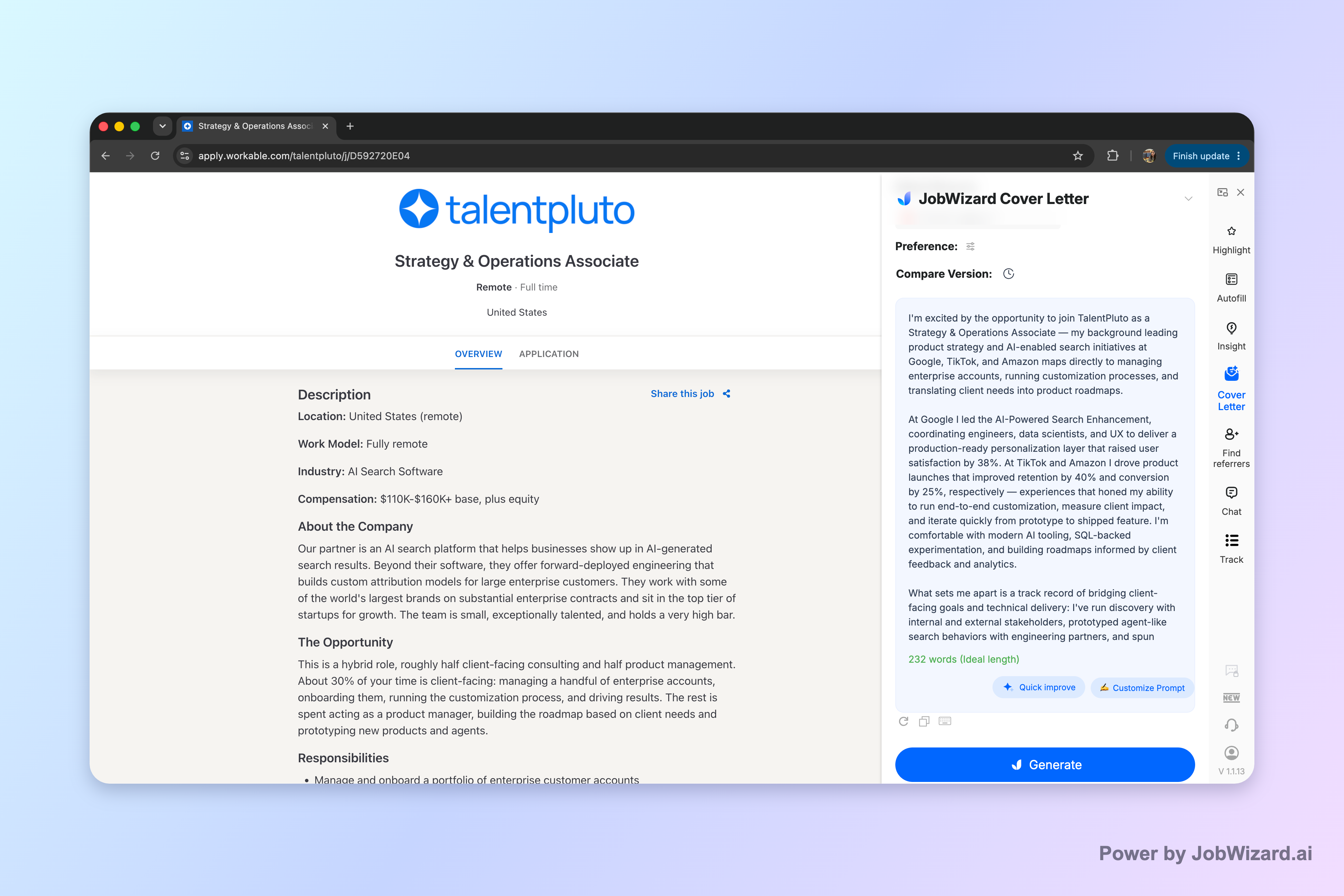
JobWizard can help you create an editable first draft using your selected resume and the current job description, then you review and edit before submitting. That means faster drafting—without skipping the personal tailoring a paralegal recruiter expects.
What a Hiring Team Expects in a Paralegal Cover Letter
Lead with credibility and role-fit—your letter should quickly show you understand legal support work and can be trusted with accuracy and confidentiality.
Most paralegal searches are high-signal: the firm is hiring for specific case support needs (research, document prep, drafting assistance, intake, scheduling, case management, and more). Your cover letter should map your experience to those responsibilities and make it easy for the reader to answer, “Would I trust this person with the details?”
Think of your letter as a short case narrative:
- Intent: why you’re applying to this role and why now.
- Evidence: 2–3 concrete examples from your background (including internships/classwork if you’re early-career).
- Behavior: how you work (proofreading, organization, confidentiality, follow-through).
- Fit: how those skills support the firm’s workflow and priorities.
If you’re worried about “legal-sounding” language, don’t overdo it. Clarity beats jargon. A recruiter should be able to skim your letter and immediately understand what you’ve done and how you’ll help.
Use This Paralegal Cover Letter Structure (Fill It In Like a Template)
Follow a tight one-page structure that mirrors the job description and gives you space for concrete proof.
Below is a practical structure you can fill in. Use it for both entry-level and experienced candidates—then adjust the emphasis depending on the role.
- Opening (3–4 lines): name the role, show your specific interest, and include one “fit hook” tied to their needs.
- Core paragraph (skills + proof): choose 2–3 relevant responsibilities from the posting and back each with a real example.
- Core paragraph (legal support habits): describe how you work—accuracy, confidentiality, organization, and timelines.
- Closing (next step): confirm your interest and invite an interview.
Here’s a simple example you can adapt (bracketed parts are placeholders):
Opening example: “Dear Hiring Manager, I’m writing to apply for the Paralegal position at [Firm Name]. I’m particularly interested in this role because [specific detail from the job posting]. My background in [research/document work/admin support] has prepared me to support attorneys with detail-focused case tasks and reliable follow-through.”
Skills + proof example: “In recent work/experience, I supported legal teams by [responsibility #1], [responsibility #2], and [responsibility #3]. For example, I [specific action] to help ensure [impact tied to accuracy, organization, speed, or client readiness].”
Workflow habits example: “I approach legal support work with a checklist mindset—verifying citations and document details, maintaining confidentiality, and tracking deadlines in a way that reduces errors. I’m comfortable coordinating across calendars, intake, and document workflows while keeping communication clear for attorneys and clients.”
Closing example: “I’d welcome the opportunity to discuss how my research, organization, and attention to detail can support your team’s casework. Thank you for your time and consideration.”
Note: keep the examples truthful. If your experience is limited, your “proof” can come from school projects, internships, or closely related work where you demonstrated the same transferable behaviors.
Match the Job Description Without Sounding Generic
Mirror the listing, then prove it—use job language as a starting point, but your examples should be specific and real.
When candidates write generic cover letters, recruiters feel it immediately. A fast way to fix that is to pull 3–5 keywords or responsibilities from the posting and build your paragraphs around them.
Try this mini-process:
- Step 1: Highlight responsibilities (e.g., legal research, document drafting support, cite checking, scheduling, ECF/firms’ systems, intake organization).
- Step 2: Choose matching proof from your resume (or internship/classwork) that shows you actually did that work.
- Step 3: Add 1–2 “how” details (accuracy checks, organization method, how you prioritize deadlines, how you handle confidential info).
- Step 4: Trim anything that doesn’t prove fit—leave room on one page for your best evidence.
Example of “good mirroring” vs “copying”:
- Good: “The job mentions legal research; I included a real example of how I conducted research and summarized findings for an attorney/review workflow.”
- Not great: repeating the same phrases without evidence (it reads like filler, not experience).
If you’re preparing multiple applications, use one consistent structure but update the “fit hook” and the 2–3 proof points each time. That’s where your paralegal cover letter earns interviews.
Draft Faster With an AI-Generated Cover Letter—Then Edit Like a Pro
Use AI for your first draft, then take control—JobWizard generates an editable cover letter draft from your resume and the current job description, but you’re responsible for reviewing and personalizing before you use it.
Here’s a workflow that keeps your letter authentic and role-specific:
- Select your resume + the job description: JobWizard uses the selected resume and current job description to generate your editable draft.
- Choose your length, format, tone, and style: you can set what the draft focuses on (before generating).
- Generate the draft: you’ll get a first draft you can click into and edit directly.
- Edit for truth and specificity: confirm every fact is correct, add genuine personal details, and adjust any legal-specific claims to match your real experience.
- Proofread for tone: make sure it sounds like you—confident, clear, and professional.
This approach is especially helpful if you’re applying to multiple paralegal openings and you’re juggling different practice areas (litigation, corporate, family law, compliance, immigration support, etc.). You still do the key tailoring—AI simply speeds up the first pass.
Important limitation: don’t assume AI automatically creates “perfect personalization.” Your job is to review facts and add personal details before using the draft.
If you want to expand your toolkit, these related guides can help you adapt tone and structure across roles: How to Write a Cover Letter with AI (Step-by-Step That Still Sounds Like You and Teaching Cover Letter That Gets Interviews: Use an AI Draft, Then Make It Yours.
Quick Paralegal Cover Letter Examples (By Situation)
Choose the example that matches your situation, then tailor the details and evidence.
Example 1: Entry-level paralegal / career switch Opening: Mention the role and your interest in legal support work, then pivot to transferable evidence (writing quality, research habits, document organization, confidentiality, customer or internal coordination). Core paragraphs should emphasize how you learn quickly and how you’d support attorneys with accurate, organized work.
Example 2: Experienced paralegal moving to a new practice area Opening: Highlight your practice-area connection to the job posting. Core paragraphs should show comparable experience (even if the subject matter differs) and include one example of how you ramped up—researching new procedures, building familiarity with documentation, and maintaining accuracy.
Example 3: Internal transfer to a paralegal role Opening: Focus on continuity—your current knowledge of the team’s workflow and the reason your skills translate. You can also emphasize readiness and growth. If you want guidance on internal positioning, use A standout cover letter for internal position: prove you’re ready for the next step as a model for your closing and “why me” framing.
Example 4: If your background includes client-facing support Opening: Connect your communication skills to the role’s intake and coordination needs. Core paragraphs should still prioritize legal support behaviors (document handling, accuracy, timelines), not only “customer service” language. For related phrasing, see Cover Letter for Customer Service: a Template That Sounds Human (Plus AI Draft Steps—then translate it into legal support outcomes.
Key rule: every paragraph should either (1) explain fit or (2) prove fit with a specific example. If it doesn’t do either, cut it.
Do this automatically with JobWizard
Skip the manual work — JobWizard's AI Cover Letters handles this for you.
FAQ About Writing a paralegal cover letter
What should I include in a paralegal cover letter if I’m new to the field?
Focus on transferable experience (research, writing, document organization, confidentiality), highlight how you learn fast, and connect your skills to the specific role. You can also reference coursework, internships, or any exposure to legal documentation—then explain how you’d apply that to the firm’s needs.
How long should a paralegal cover letter be?
In most cases, keep it to about one page. Use short paragraphs, match the job description with 2–3 concrete examples, and save deeper detail for your resume—your goal is to earn the interview, not list everything you’ve ever done.
Should I mention my legal skills (research, drafting, case management) verbatim from the job posting?
Yes—carefully. Mirror key skills or responsibilities from the listing, but back each one up with a real example (even if it was in school, an internship, or a related admin role). Avoid copying phrases without substance; specificity sounds more credible.
Can I use AI to write my paralegal cover letter?
You can use AI to generate an editable first draft, but you must review the facts and add genuine personal details before using it. A good approach is: generate with your selected resume + the current job description, then edit tone, proofread, and tailor any legal-specific claims to match your actual experience.
What’s a strong closing line for a paralegal cover letter?
Close with a clear next step: express interest in an interview and tie your fit to the firm’s priorities (e.g., case support, legal research, document accuracy). Example: “I’d welcome the opportunity to discuss how my research, organization, and attention to detail can support your team’s casework.”
Ready to move faster without losing your voice? Use JobWizard to generate a draft paralegal cover letter for the current job description, then edit it directly so your examples and legal-specific details are accurate and personal before you submit.
Frequently Asked Questions
Generate this cover letter automatically
JobWizard drafts a tailored letter from your resume and the job description in seconds — free.