A standout cover letter for internal position: prove you’re ready for the next step
A strong cover letter for internal position roles focuses on fit, impact, and continuity—showing you understand the team and the gap you’ll close.

Free Chrome extension
Generate this cover letter automatically
JobWizard drafts a tailored letter from your resume and the job description in seconds — free.
What a cover letter for internal position should accomplish (and why most fail)
A cover letter for internal position isn’t a reworded resume—it’s your argument that you understand the role and that your current work already proves you can do it.
Most internal applicants either (a) sound generic (“I’m hardworking and reliable”) or (b) overshare (“please let me switch ASAP”). Instead, make one clear case: you’re already delivering value, and the new role expands that value in a specific, logical way.
Use a draft to get started, then personalize with proof
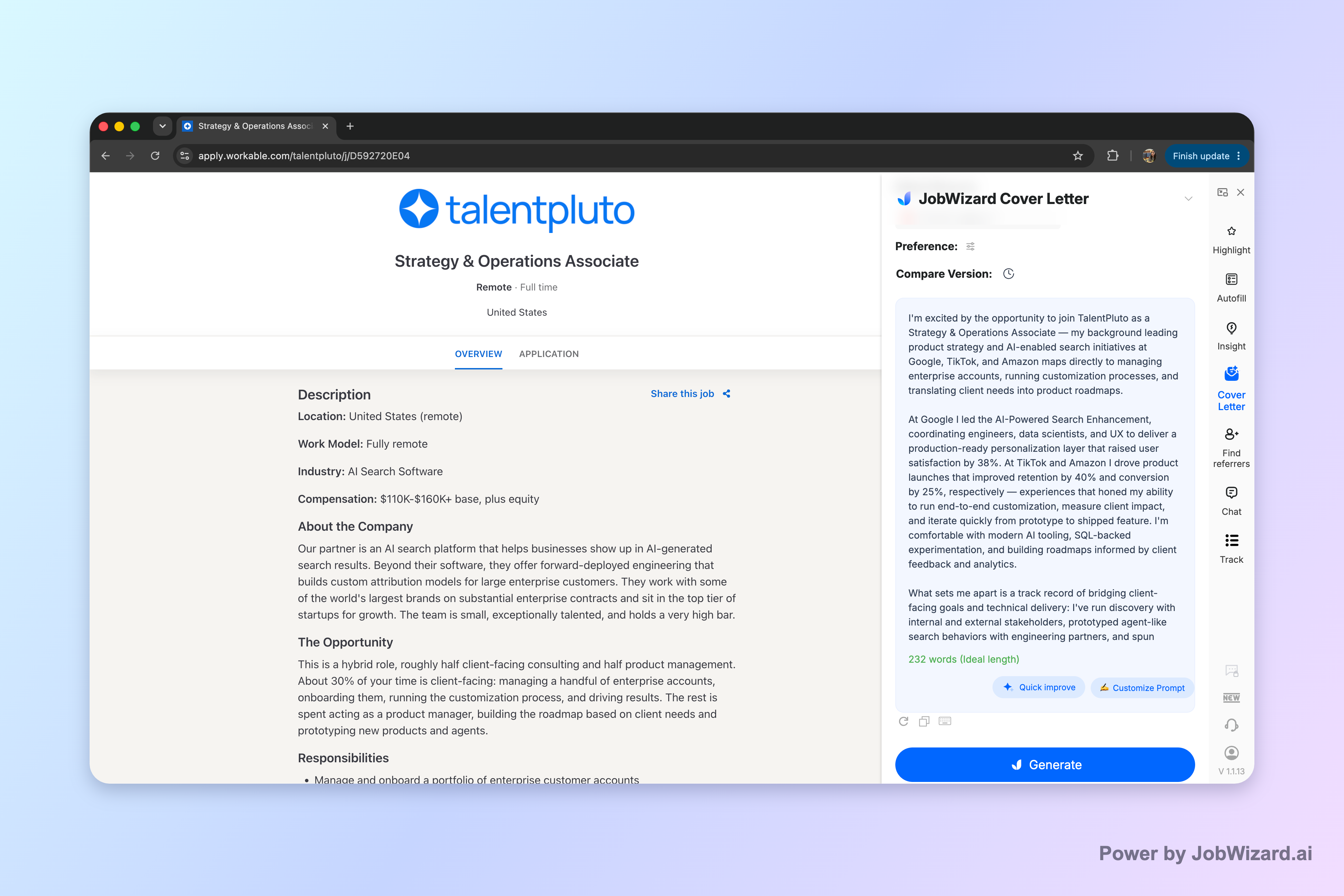
JobWizard can generate an editable first draft using your selected resume and the current job description, and you can edit it directly before you submit anything.
That workflow matters: you get momentum fast, but you still own the final content—especially the details a hiring manager expects from an internal candidate (what you’ve done, what you learned, and what you’ll take on next).
Internal promotion cover letter structure that hiring managers actually skim
To write a cover letter format that matches internal hiring realities, keep it tight, specific, and proof-forward.
Paragraph-by-paragraph outline (copy this)
- Intro (3–4 lines): Name the internal role and state why you’re applying now—tie it to what the posting needs.
- Fit through your current impact (1 paragraph): Describe what you do today and one–two outcomes that map directly to the new scope.
- Fit through relevant proof (1 paragraph): Address the posting’s key requirements with specific examples (a project, cross-team collaboration, process improvement, customer/stakeholder results).
- Forward-looking close (3–4 lines): Confirm you understand the role’s priorities and ask for an interview.
What to emphasize for internal moves
- Continuity: You already know the company’s systems, stakeholders, and “how work really gets done.”
- Translation: Show how your current responsibilities directly transfer to the new role (not just that you “could learn it”).
- Gaps you’re closing: If the posting mentions a capability you’ve only partially had, acknowledge it and show the adjacent work you’ve already started.
- Credible collaboration: Internal roles often depend on cross-functional trust—mention who you’ve partnered with.
Cover letter for internal position examples you can adapt
A strong cover letter for internal position reads like a short narrative of readiness: what you’ve done, what the role needs, and what you’ll deliver next.
Example 1: Internal promotion to a team lead (operations)
Intro: “I’m applying for the Internal Operations Lead role. Based on the posting’s focus on improving turnaround times and coordinating cross-team workflows, I’m confident my current work in [team/process] is the right foundation for the next scope.”
Impact: “In my current role, I’ve led [initiative], which reduced [pain point] by [result] and improved handoffs between [teams]. I also built a repeatable workflow for [process], so onboarding and execution are consistent across projects.”
Translation to the new role: “The posting highlights stakeholder alignment and measurable operational improvements. I’ve already partnered with [stakeholders] to define priorities, surface blockers earlier, and adjust execution based on feedback—work that directly supports the leadership responsibilities in this position.”
Close: “I’d welcome the opportunity to discuss how I would approach the first 30–60 days, particularly around [priority from the posting]. Thank you for your time and consideration.”
Example 2: Internal move to a different function (e.g., from analyst to product)
Intro: “I’m excited to apply for the Product role internally. The job description’s emphasis on customer-centered decision-making and turning insights into execution strongly matches the work I’ve been doing as an [current role].”
Proof: “Over the past [timeframe], I’ve translated customer feedback and internal data into actionable recommendations for [teams], including [example]. I’ve also collaborated with design/engineering to refine scope and measure outcomes.”
Address the transition directly: “I understand product execution requires ownership of tradeoffs across stakeholders. In addition to my analytics work, I’ve taken the lead on [adjacent responsibility], and I’m prepared to deepen my product planning by applying the same structured approach to [specific posting requirement].”
Close: “I’d love to discuss how my existing customer insights and cross-team execution can help the product team deliver [goal mentioned in the posting]. Thank you for considering my application.”
Quick checklist: do these before you send
- Match the job description language: mirror the role’s key requirements using your own words and examples.
- Add at least two specifics: named projects, measurable outcomes, or clear before/after results (even if approximate—just be honest).
- Remove generic claims: “hardworking,” “team player,” “fast learner” without proof doesn’t help.
- Confirm facts: if you used AI to draft, verify titles, dates, metrics, and stakeholder names.
- Keep the “why now” clear: internal roles are often time-sensitive—explain what changed (your readiness, the team’s needs, your interest).
How to draft a cover letter for internal position with AI (without losing your voice)
You can use AI to speed up your first pass, as long as you treat it as a starting draft—not a final submission.
Step-by-step workflow (simple and effective)
- Start with your resume + the exact job description: JobWizard uses these inputs to generate an editable cover letter draft.
- Choose your settings deliberately: pick the length, format, tone, and focus so the draft aligns with how you want to sound.
- Read like a hiring manager: scan for missing requirements, vague statements, or any claims you can’t fully support.
- Edit with your real story: replace placeholders with specific projects, outcomes, and the “why this role” connection.
- Make it internal: add details that show you understand internal stakeholders, processes, and how priorities shift.
What AI should do vs. what you should do
- AI can help with: drafting a coherent cover letter tone and format based on your inputs.
- You must own: the facts, personal details, and the genuine “translation” from your current work to the new responsibilities.
Related drafts you may also want
- How to Write a Cover Letter with AI (Step-by-Step That Still Sounds Like You)
- Engineering Cover Letter That Gets Read: a Draft + Editing Checklist for Real Proof
- AI Cover Letter for No Experience: A Realistic Draft You Can Edit Fast
- Cover Letter for Teaching Position: A Confident Template That Sounds Like You (Plus AI Draft Steps)
Internal hiring strategy: what to do after you submit the cover letter for internal position
Once your cover letter for internal position is ready, your job shifts from “write perfectly” to “increase credibility through follow-through.”
Internal candidates can benefit from showing professionalism and momentum. Make it easy for the hiring team to understand your readiness without forcing extra work.
Practical next steps (that don’t feel pushy)
- Align with timing: if the posting mentions a timeline, reference your availability for interviews or discussions.
- Offer a short working session: propose a brief conversation to clarify priorities—especially if you already coordinate with the team.
- Stay accurate: do not claim you’ve already done responsibilities that the posting clearly assigns to the new role.
- Re-check your messaging: ensure your resume summary and cover letter intro reinforce the same “why you now” story.
One final truth about internal roles
Hiring managers typically know your baseline performance. Your cover letter’s job is to help them see the next level: which parts of the new job you’ll own first, and how your current work proves you’ll succeed.
If you want to move faster, generate an editable draft for the role you’re applying to, then review-before-submit so your final version is accurate, specific, and unmistakably yours.
Do this automatically with JobWizard
Skip the manual work — JobWizard's AI Cover Letters handles this for you.
FAQ: Cover letter for internal position
What should I include in a cover letter for internal position applications?
Include (1) a clear “why this move” tied to your current impact, (2) the specific skills the new role needs (mapped to real examples), (3) credibility signals like cross-functional work or measurable results, and (4) a brief close that asks for an interview and shows you understand the team’s priorities.
How do I keep an internal cover letter from sounding too informal or entitled?
Keep the tone professional and appreciative: thank the manager/company for the opportunity, emphasize your readiness and learning mindset, and use concrete achievements instead of broad claims. Avoid “I deserve it” language—replace it with “here’s what I’ve delivered that translates to the new scope.”
Should I mention my current job in a cover letter for internal position roles?
Yes—mention it to connect your track record to the new role. Briefly reference what you do today, then pivot to what the internal job needs and how your existing work shows you can handle it (especially the gaps the role is meant to solve).
Can I use AI to draft a cover letter for internal position and still sound like me?
Yes. Use AI to generate an editable first draft based on your resume and the specific job description, then revise: swap in your real examples, confirm accuracy, and tailor the tone to how you normally communicate. The goal is a draft you actively own, not a one-click submission.
What’s the best cover letter format for internal positions?
Use a standard business cover letter format: header/contact info, a concise intro, 1–2 body sections with proof tied to the posting, and a short closing. Keep paragraphs tight, avoid fluff, and make it easy for the hiring manager to see (quickly) your readiness for the next scope.
Ready to write your cover letter for internal position faster? Generate an editable first draft for the current job description in JobWizard, then review it and add your real achievements before you submit.
Frequently Asked Questions
Generate this cover letter automatically
JobWizard drafts a tailored letter from your resume and the job description in seconds — free.