Engineering Cover Letter That Gets Read: a Draft + Editing Checklist for Real Proof
Learn how to write an engineering cover letter that matches the job description, sounds like you, and avoids generic filler. Includes a draft workflow and an editing checklist.
Free Chrome extension
Generate this cover letter automatically
JobWizard drafts a tailored letter from your resume and the job description in seconds — free.
Engineering cover letter basics: make it job-specific, not generic
Your engineering cover letter should read like a focused technical conversation: you understand the role, you can prove fit, and you know what tradeoffs matter. Most engineering cover letters fail because they summarize a resume or reuse templates that could apply to anyone.
To write one that gets read, anchor every paragraph to the job description: the team’s priorities, the product domain, the stack (when relevant), and the kind of problems you’ve already solved. Then show proof—briefly—so the hiring manager can trust your claims.
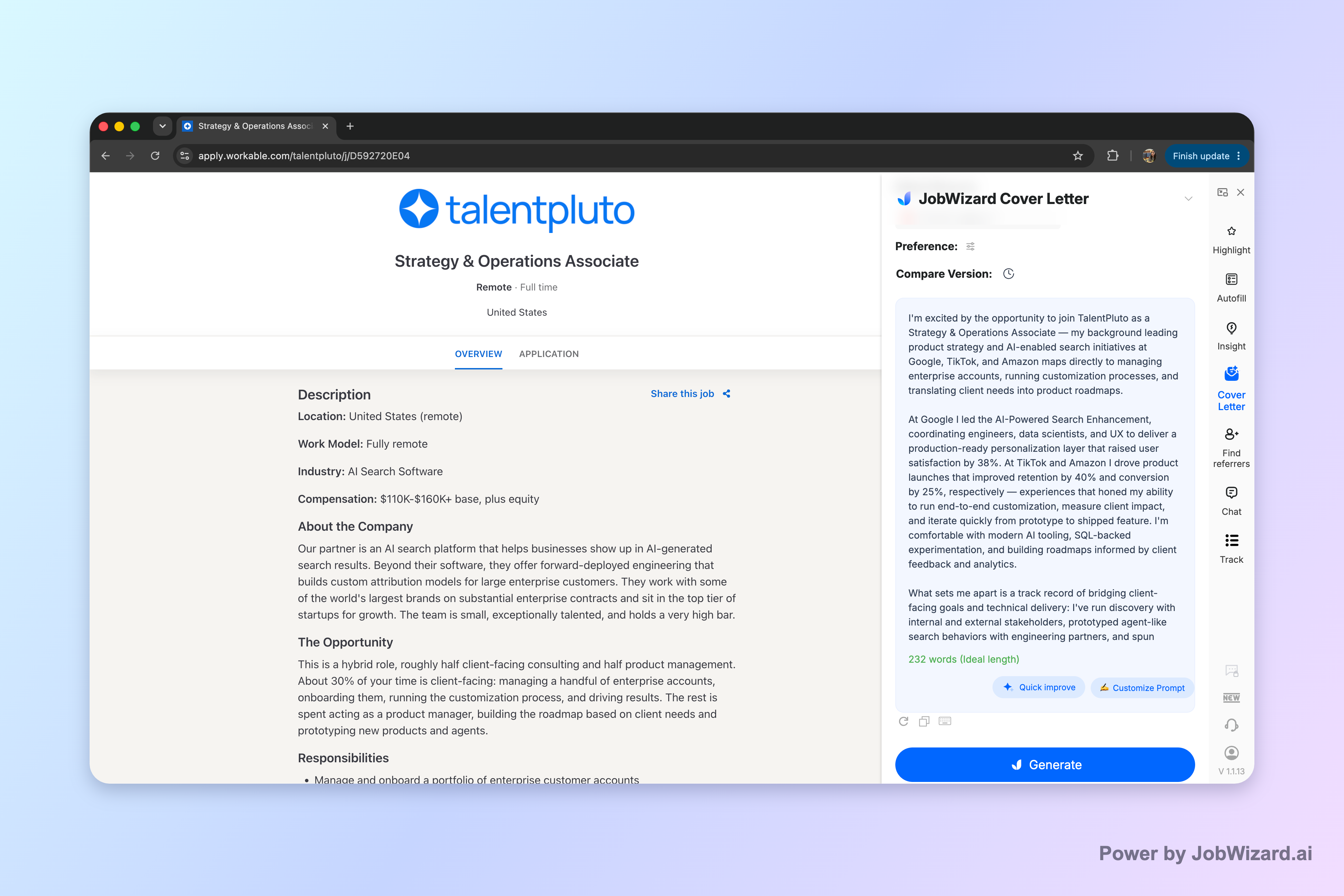
Use an editable AI draft as a starting point (then make it yours)
If you want to move faster without sounding robotic, generate an editable first draft using your resume and the current job description. JobWizard lets you choose length, format, tone, and focus before you generate, and you can click into the draft to edit it directly.
That workflow matters: the draft gives you structure and role alignment, but you still review every detail, add genuine personal information, and remove anything that isn’t true for your background.
What “job-specific” looks like in engineering terms
Job-specific doesn’t mean repeating the exact job posting line-by-line. It means you translate the role requirements into engineering realities you’ve lived through.
- Turn requirements into constraints: If they want reliability, mention how you handled incidents, observability, and failure modes.
- Match collaboration style: If they emphasize cross-functional delivery, describe how you partnered with product/design/ops (briefly and concretely).
- Connect your work to the system: Name the kind of components you built (APIs, pipelines, data stores, services) and why those decisions mattered.
Engineering cover letter structure: a proof-first template you can customize
A strong engineering cover letter usually follows a simple structure: hook → proof → proof → close. Keep it concise, skim-friendly, and tightly linked to what the team is hiring for.
1) Opening: name the role and earn attention in 2–3 sentences
Start with the role title and a specific reason you’re interested. Then add one “credibility hook”—a short proof line that shows you’re not just enthusiastic, you’re relevant.
Example opening (software engineering): “I’m excited to apply for the Backend Engineer role. In my recent work, I redesigned critical request paths to reduce tail latency and improved reliability through better observability and incident response.”
2) Proof point #1: show impact tied to the job description
Pick the most job-relevant accomplishment. Keep it readable: what you built or changed, what constraints you handled, and what result you delivered (metrics if you can).
- Use action + tradeoff: “Implemented caching to cut repeated reads, balancing freshness with correctness.”
- Include one tangible outcome: “Cut latency,” “improved error rate,” “reduced manual work,” or “shortened deployment time” (only if accurate).
- Make it verifiable: If you can’t defend a metric, describe the change clearly instead of guessing.
3) Proof point #2: demonstrate how you work with others
Engineering roles are collaborative. Use your second proof point to show code quality habits, review culture, or cross-team delivery.
Example proof point (collaboration): “I regularly worked from product requirements to define API contracts and rollout plans, aligning with QA and operations to ensure safe deployments. I also use reviews to catch edge cases early and keep the system maintainable.”
4) Closing: invite the next step—cleanly and confidently
End with a simple close: thank them for their time, express interest in a conversation, and offer to discuss the role and your experience.
Example close: “I’d welcome the opportunity to discuss how my engineering approach can help your team deliver reliable features. Thank you for your time and consideration.”
How to write an engineering cover letter from a job post (step-by-step workflow)
The fastest way to get a strong result is to build your letter directly from the job posting—then generate and edit. Here’s a workflow you can repeat for every application.
- Extract the “must-haves”: Copy the top 4–7 requirements from the job description (skills, responsibilities, and outcomes).
- Map each must-have to a proof: For each requirement, write one 1–2 sentence story from your experience.
- Decide what to emphasize: Choose 2–3 themes (e.g., reliability, distributed systems, mentorship, performance, security).
- Generate a draft with the right tone: Use JobWizard to generate an editable first draft, selecting length, format, tone, and focus.
- Edit for accuracy and “you-ness”: Replace vague lines with your specifics, verify facts, and remove anything that feels generic.
- Final scan: proof, clarity, and alignment: Ensure every paragraph supports the role and doesn’t contradict your resume.
What to do when your experience doesn’t perfectly match
Engineering hiring is about capability and evidence of judgment. If a requirement isn’t an exact match, write about close analogs and transferable engineering skills.
- Reframe the story: “While I didn’t work with the exact framework, I built analogous systems emphasizing reliability, testing, and performance.”
- Show the learning loop: Describe how you ramped—what you learned, how you validated correctness, and how you de-risked deployment.
- Keep it honest: Don’t overclaim; the draft must be reviewed and corrected by you before you use it.
Engineering cover letter examples by situation (pick the closest match and rewrite)
Use the examples below as patterns—then swap in your own proof points. The goal is to keep your tone and facts accurate while matching the role.
Example 1: Software engineer role with reliability emphasis
Opening: “I’m excited to apply for the Software Engineer role focused on reliability. I’ve spent the last year improving incident readiness and reducing production risk through better observability and safer rollouts.”
Proof #1: “I led work to instrument core services, defined SLO-driven alerts, and improved dashboards so on-call could diagnose faster. We also tightened deployment checks to prevent known failure modes from reaching production.”
Proof #2: “I collaborate closely with product and operations to translate reliability requirements into practical engineering plans—balancing speed, correctness, and maintainability.”
Example 2: Career change into engineering (make the engineering signal explicit)
Opening: “I’m applying for engineering roles where strong problem-solving and practical delivery matter. Through structured projects and iterative learning, I’ve built the foundations to contribute quickly—especially around testing, debugging, and clear system design.”
Proof #1: “In my recent project work, I focused on building dependable functionality: defining requirements, implementing core components, writing tests, and improving performance as we scaled usage.”
Proof #2: “I’m comfortable working from ambiguous goals and turning them into actionable plans—communicating tradeoffs early and collaborating through feedback loops.”
For career-changer phrasing that still sounds credible, see AI Cover Letter for Career Changers: How to Sound Credible While Switching Lanes.
Example 3: No experience yet—still write like an engineer
If you’re early-career, your letter should emphasize engineering behaviors: learning velocity, disciplined iteration, and quality habits.
Opening: “I’m excited to apply for entry-level engineering opportunities where I can contribute through careful implementation, testing, and collaboration. I’ve been building projects that reflect real engineering workflows—from requirements to iteration and verification.”
Proof #1: “I prioritize correctness by writing tests, using small incremental steps, and validating behavior under edge cases. I also document key decisions so teammates can understand the why, not just the what.”
Proof #2: “I welcome feedback and use it to improve quickly—whether that’s refactoring code, tightening interfaces, or clarifying requirements.”
For a realistic draft you can edit fast, start with AI Cover Letter for No Experience: A Realistic Draft You Can Edit Fast.
Example 4: Product-minded engineering roles (SaaS signals)
If the job blends engineering with product outcomes, connect your technical decisions to user value.
Opening: “I’m applying for the engineering role at your SaaS organization because I enjoy building systems that support real product workflows. My background centers on delivering features reliably while keeping performance and maintainability in focus.”
Proof #1: “I’ve worked on backend services supporting key user flows—improving throughput, reducing failure impact, and collaborating on rollouts with teams downstream.”
Proof #2: “I use instrumentation and clear metrics to understand what’s happening in production, then adjust engineering choices to improve customer experience.”
For SaaS-tailored wording, read AI Cover Letter for Product Manager Roles in SaaS Guide (even if you’re an engineer, the proof-focused product language can be adapted).
Do this automatically with JobWizard
Skip the manual work — JobWizard's AI Cover Letters handles this for you.
FAQs: Engineering cover letter questions hiring managers expect you to answer
What should an engineering cover letter include?
An engineering cover letter should include: (1) a specific opening that names the role and why you fit, (2) 2–3 proof points tied to the job description, (3) brief evidence of impact (metrics when you can), and (4) a clear closing that invites next steps. Keep it focused on the role’s real needs rather than your full resume.
How long should an engineering cover letter be?
Aim for a concise, scannable letter—typically one page. Use short paragraphs and bullets only if they help readability. If you’re using a draft, set the length and focus before you generate so the structure matches the role.
Can an engineering cover letter be AI-assisted without sounding fake?
Yes—generate an editable first draft, then replace any vague claims with your specific details. Before sending, verify facts, ensure the tone is truly yours, and add genuine personal details (projects, tradeoffs you made, what you learned, and how you collaborated).
What are good proof points for an engineering cover letter?
Good proof points are specific and job-relevant: the systems you built or improved, performance/reliability work you led, the constraints you handled (latency, cost, security, scale), and how you collaborated (reviews, cross-functional delivery). When possible, include outcomes with numbers you can stand behind; otherwise, describe the change clearly.
Common mistakes to avoid
- Vague claims without engineering context: “Improved performance” is weaker than “reduced tail latency by changing how requests were routed.”
- Mismatch with the job posting: If they want reliability, don’t lead with only feature work.
- Unverified details from drafts: AI can produce plausible-sounding text—review and correct everything you send.
Next step: generate your engineering cover letter draft and edit it for proof
If you’re ready to stop starting from a blank page, use JobWizard to generate an editable engineering cover letter draft from your resume and the current job description—then tailor the proof points so every claim is accurate and truly yours.
Start with your next job posting, generate your first draft, and spend your time on the part that matters most: replacing generic lines with your real engineering tradeoffs and outcomes.
Want a deeper walkthrough of the process? Use How to Write a Cover Letter with AI (Step-by-Step That Still Sounds Like You) to refine your workflow beyond engineering roles.
Frequently Asked Questions
Generate this cover letter automatically
JobWizard drafts a tailored letter from your resume and the job description in seconds — free.