Cover Letter for Teaching Position: A Confident Template That Sounds Like You (Plus AI Draft Steps)
Learn how to write a cover letter for teaching position roles that’s specific, credible, and easy to edit. Use an AI cover letter draft you can personalize fast.
Free Chrome extension
Generate this cover letter automatically
JobWizard drafts a tailored letter from your resume and the job description in seconds — free.
If you’re applying for schools or districts, a cover letter for teaching position has to do more than sound polite—it needs to prove you understand the role, support students, and can collaborate with staff. Hiring teams skim quickly, so your best chance is a letter that’s specific, easy to read, and tightly connected to the job description.
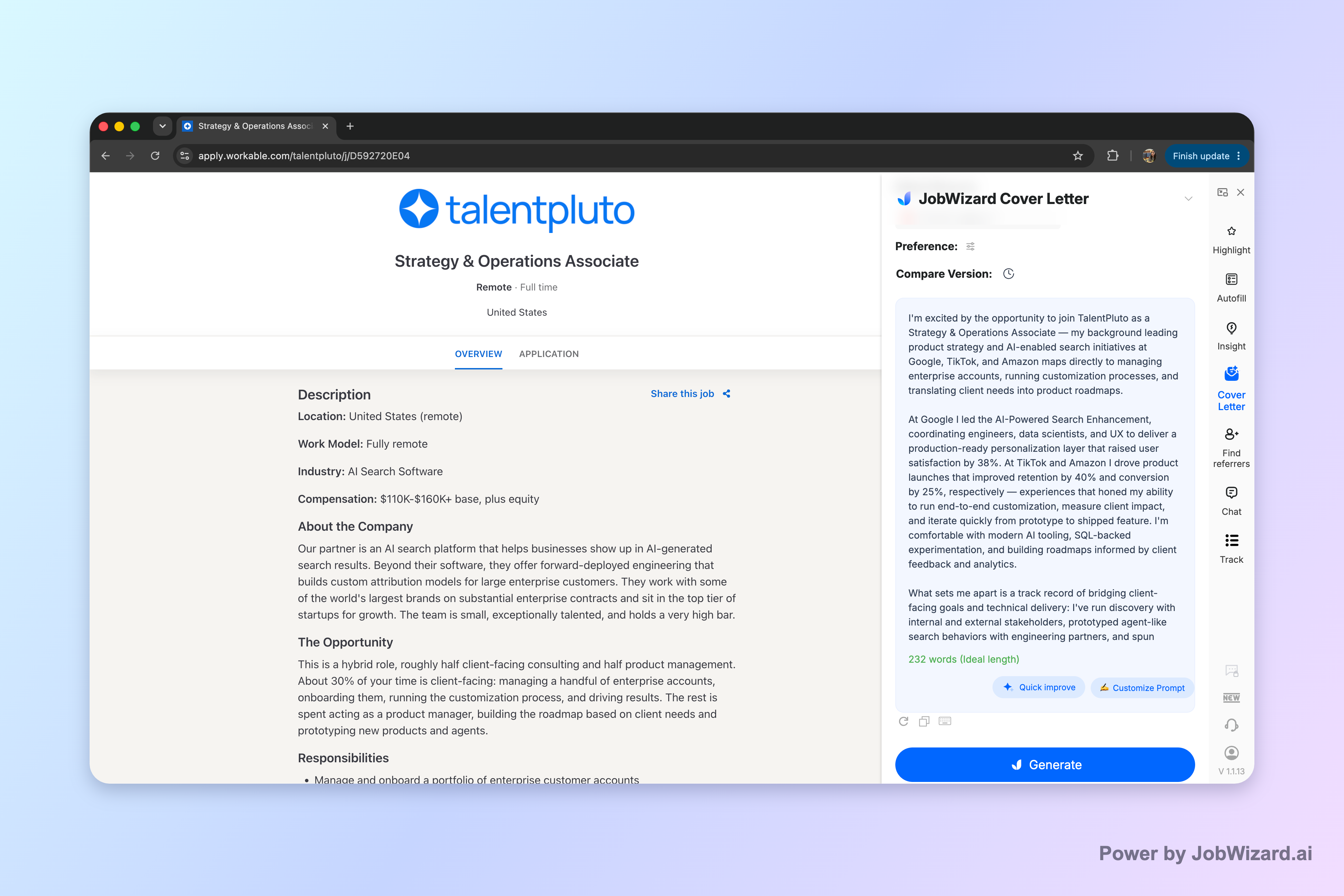
JobWizard can generate an editable first draft using the selected resume and the job description—then you can customize it before you apply. That gives you a strong starting point for your cover letter for teaching position while keeping the final version genuinely yours.
How to write a cover letter for teaching position roles that actually fits the job
The fastest way to write a strong teaching cover letter is to treat the job posting like an outline. When each paragraph maps to a requirement, your letter reads like evidence—not a generic introduction.
Start by extracting the key needs from the posting (examples: grade level, subject, classroom management approach, collaboration, instructional strategies, special populations). Then draft your letter so the hiring manager can quickly connect your experience to those needs in under a minute.
Use a simple teaching-cover-letter structure (and keep it skimmable)
Follow a standard cover letter format, but write each section with teaching goals in mind. This keeps the cover letter for teaching position aligned to education hiring expectations.
- Opening (3–4 lines): Name the role, the school/district (or program), and one reason you’re a match (tied to the job posting).
- Evidence paragraph #1: Your most relevant classroom/school achievement or experience.
- Evidence paragraph #2: Instructional approach (differentiation, assessment, literacy/math routines, etc.).
- Evidence paragraph #3 (optional): Collaboration and student support (IEPs/504s, SEL, MTSS, parent communication, team planning).
- Teaching philosophy (brief): A short, concrete “how I teach” statement.
- Closing: Thank them, restate interest, and invite next steps.
Choose a cover-letter tone that feels teacher-authentic
Teaching cover letters should be warm, professional, and confident—especially when the posting emphasizes student engagement, responsiveness, and collaboration. Use respectful language, but avoid sounding overly formal or vague.
Instead of “I’m passionate about education,” try “In my last placement, I…” and include one specific detail that shows how you work with students and families.
What to include (and what to avoid) in a cover letter for teaching position applications
A teaching cover letter should include clear specifics that match the posting, not broad claims. Think in terms of “teaching actions” and “student impact” rather than adjectives.
As you write, avoid common pitfalls: repeating the resume, using generic phrases, or listing responsibilities without showing how you carried them out.
Include these essentials
- Role alignment: Grade level, subject area, and any relevant certifications or training mentioned in the posting.
- Classroom reality: How you handle instruction and student needs (routines, differentiation, assessment, feedback).
- Collaboration: Evidence you work with colleagues (teams, PLCs, interdisciplinary planning) and communicate with families.
- Student-centered mindset: Examples of engagement, support, or behavior/SEL approach tied to your experience.
Avoid these issues
- Overpromising: Don’t claim outcomes you can’t support with your background.
- Fact dumping: If you must list tools or programs, keep it selective and tie it to instruction.
- Generic openings: “I am writing to apply…” without naming why you fit the role reads like a template.
Editable teaching cover letter examples you can customize fast
Below are plug-and-play teaching cover letter examples designed to match common requests in school job postings. Swap in your specifics and keep each paragraph tight.
Use these as drafts for your cover letter for teaching position — then edit to reflect your real classroom work and the exact needs in the posting.
Example 1: Entry-level teacher (student teaching / early career)
Opening: I’m excited to apply for the [Grade/Subject] Teacher position at [School/District]. During my [student teaching/placement] experience, I focused on building routines that help students understand expectations and participate confidently.
Evidence: In my classroom, I used [instructional approach, e.g., guided practice, small-group instruction, learning targets] to support students at different readiness levels. I frequently checked understanding through [quick assessments, exit tickets, conferencing] and adjusted instruction based on what students needed next.
Collaboration + support: I also partnered with [cooperating teacher/case manager/support staff] to ensure students received consistent support. I communicated with families by sharing progress and next steps in a way that felt clear, respectful, and actionable.
Closing: Thank you for your time and consideration. I would welcome the opportunity to discuss how my approach to instruction, feedback, and student support aligns with your program.
Example 2: Experienced teacher (instruction + student support)
Opening: I’m applying for the [Grade/Subject] Teacher role at [School/District] because your posting highlights [one specific need from the job ad—e.g., differentiation, literacy development, collaborative planning, SEL]. That aligns closely with how I teach and how I support students.
Evidence: Over the past [X years/placements], I’ve designed lessons that move from clear modeling to purposeful practice, then toward independent application. I track progress through [assessment method(s)] and use results to plan reteaching, enrichment, and small-group instruction.
Collaboration + culture: I collaborate with colleagues through [PLCs/grade teams] and contribute to schoolwide goals such as [mention one goal only if it’s in the posting]. I also prioritize student communication and feedback, helping students develop ownership of their learning.
Closing: I’d love to discuss how my classroom practice and collaboration style can support your students and team. Thank you for your consideration.
Example 3: Special education / support-focused role (if applicable)
Opening: I’m interested in the [Special Education/Intervention/Support] position at [School/District]. The role’s focus on [IEP/504 implementation, accommodations, intervention, collaboration] matches my experience supporting students to access instruction and make measurable progress.
Evidence: I’ve supported learners through [specific supports/accommodations/intervention approach], and I document progress using [progress monitoring approach]. I also ensure accommodations are implemented consistently and understood by students.
Teamwork: I collaborate closely with general education teachers, related service providers, and families to align strategies and maintain clear communication. My goal is to make support predictable, respectful, and effective.
Closing: Thank you for your time. I would welcome the opportunity to discuss how my approach can support your students and staff.
How to generate a first draft with JobWizard (then make it truly yours)
JobWizard helps you move from blank page to a strong cover letter for teaching position draft without sacrificing personalization. The key is using AI for drafting, then editing with your real experience.
Here’s the workflow.
- Select your resume + the current job description: JobWizard uses them to generate an editable cover letter draft.
- Choose the draft settings: Before generating, you can choose length, format, tone, style, and focus.
- Edit directly in the draft: Click into the draft and revise it so it reflects your actual classroom details.
- Review facts and add personal details: You must review any AI-generated content and add genuine personal details before you submit.
Make sure the final version matches the school’s needs
After you generate a draft, read it like a hiring manager. Then tighten the paragraphs so each one answers a question the district is likely asking: “Can you teach this content?” “Can you manage and support students?” “Can you collaborate?”
If you’re adjusting for a different teaching path or experience level, these guides can help you tailor your language before you finalize your letter:
- How to Write a Cover Letter with AI (Step-by-Step That Still Sounds Like You)
- AI Cover Letter for No Experience: A Realistic Draft You Can Edit Fast
- AI Cover Letter for Career Changers: How to Sound Credible While Switching Lanes
- AI Cover Letter for Product Manager Roles in SaaS Guide
Do this automatically with JobWizard
Skip the manual work — JobWizard's AI Cover Letters handles this for you.
Cover letter for teaching position FAQs (quick answers for busy applicants)
You probably have a few high-impact questions before you send your application. Here are clear answers to help you finalize a strong teaching letter with less guesswork.
What should a cover letter for a teaching position include?
A cover letter for teaching roles should include (1) a clear teaching-specific opening, (2) 2–3 concrete highlights tied to the job description (e.g., classroom outcomes, curriculum experience, student support), (3) a short paragraph on teaching philosophy or approach, and (4) a closing that confirms interest and invites an interview—without repeating your entire resume.
How do I make a cover letter for teaching positions sound personal (not generic)?
Use the job posting as your checklist and swap in real details: the grade level/subject, the program or standards you’ve used, one brief classroom story, your approach to feedback/behavior/communication, and the exact needs you noticed in the role. If you use an AI draft, you must review every fact and add genuine personal details before using it.
Can I use AI to write a cover letter for a teaching position?
Yes. JobWizard can generate an editable cover letter draft using the selected resume and the current job description. Before generating, you can choose length, format, tone, style, and focus. After it creates the draft, you can click into it and edit directly—but you should review facts and personalize details before submitting.
What tone should I use in a teaching cover letter?
Aim for warm, professional, and student-centered. Show clarity and confidence about teaching practice, then back it up with specific examples from your experience. Avoid overly casual language, and don’t overpromise outcomes—focus on what you’ve done and how you work with students.
How should I format a cover letter for teaching jobs?
Use a standard cover letter format: your contact info at the top, the school/employer address (if included), a brief greeting, 3–5 short paragraphs, and a closing with thanks and a call to action. Keep paragraphs tight so hiring teams can skim; make sure each paragraph supports the job description.
Next step: Generate an editable cover letter draft for the current teaching job you’re applying to in JobWizard—and then edit it to include your real classroom details before you submit.
Frequently Asked Questions
Generate this cover letter automatically
JobWizard drafts a tailored letter from your resume and the job description in seconds — free.