Cover Letter for Teaching Post: A Readable, Edit-Ready AI Draft You Can Tailor
A cover letter for teaching post should sound personal, not robotic. Use an AI draft workflow that generates an editable letter from your resume and the job description—then you tailor it.
Free Chrome extension
Generate this cover letter automatically
JobWizard drafts a tailored letter from your resume and the job description in seconds — free.
If you’re applying for a school role, a cover letter for teaching post has one job: convince the hiring team you’re a real teacher who matches their needs. The fastest way to get a strong first draft is to start from your resume and the exact job description, then edit it until it sounds like you.
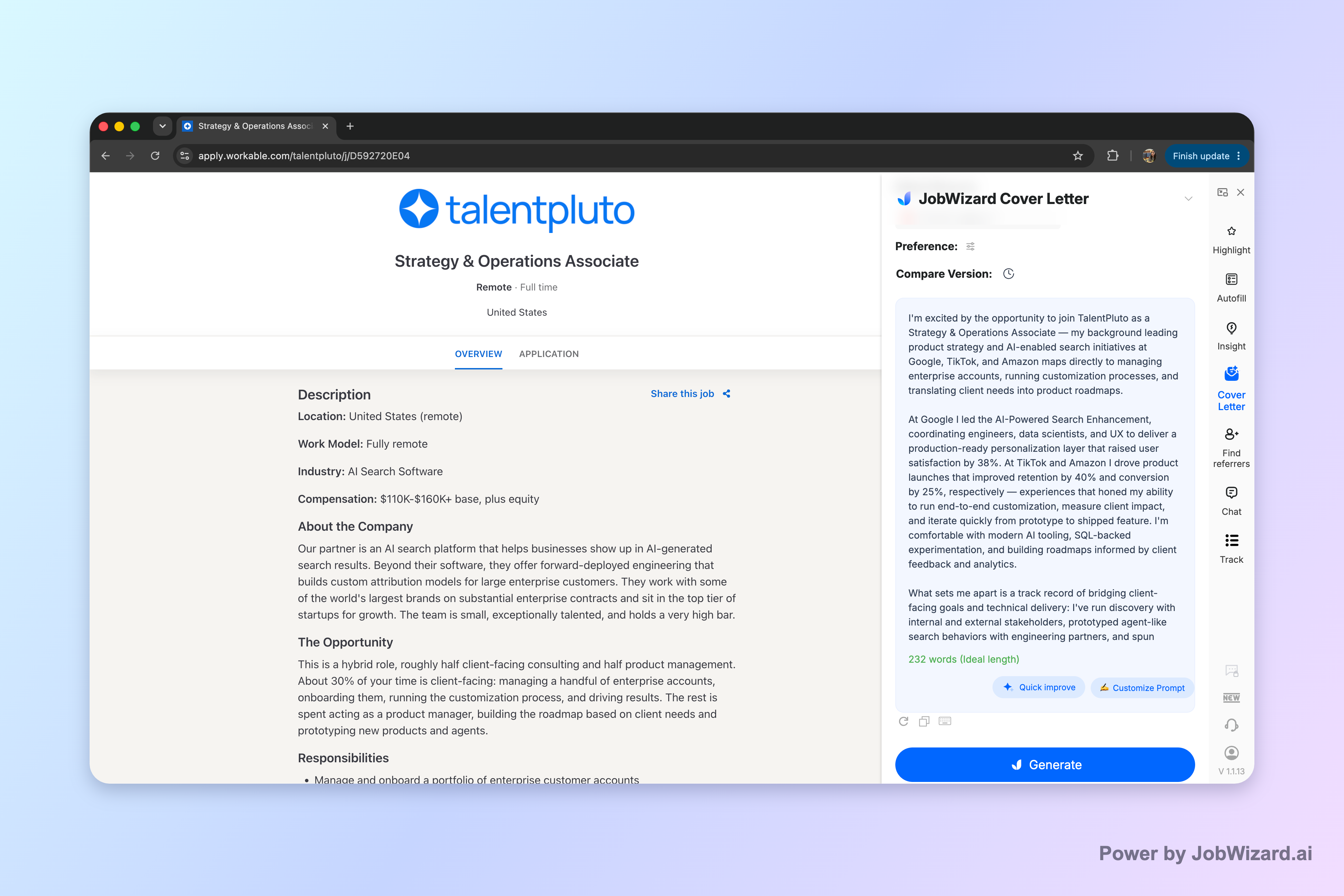
JobWizard creates an editable first draft using the resume and job description from the current application page—so you can focus on tailoring details instead of staring at a blank document.
Below you’ll find a clear structure, sentence-level tips, and a workflow for producing a teaching cover letter you can confidently customize for each opening.
How to structure a cover letter for teaching post (so it gets read)
A winning cover letter for a teaching post is easy to scan and clearly mapped to the posting. Use this structure to stay aligned with what schools actually evaluate.
Use a simple 1-page format
- Opening (2–3 sentences): Name the role and connect your experience to the school’s context.
- Teaching fit (2 short paragraphs): Pick 2–3 responsibilities from the job description and match them with your real examples.
- Collaboration + student support: Show how you work with families, special education, counselors, or grade-level teams.
- Closing: Thank them, restate interest, and invite an interview.
What to include (and what to leave out)
- Include: grade levels or subject areas, your instructional approach (practical, not buzzword-only), and at least one “how” proof point (what you did, not just what you believe).
- Leave out: vague phrases like “hard-working and passionate” with no classroom evidence.
- Avoid guarantees: don’t claim outcomes you can’t support. Schools want credibility, not certainty-sounding promises.
If you want a starting point that’s already formatted for a teaching role, use this guide alongside the steps below: Cover Letter for Teaching Position: A Confident Template That Sounds Like You (Plus AI Draft Steps).
Write the opening that earns trust (no hype, just relevance)
The opening of your cover letter for teaching post should quickly answer: “Why you, and why this role?” Keep it direct and school-specific.
Opening formulas you can customize
Choose one and replace the bracketed parts with details from the posting.
- Role + school mission: “I’m excited to apply for the [Job Title] role at [School/District]. With experience teaching [grade/subject] and building routines for [student needs highlighted in posting], I’m eager to support your students’ growth and consistent learning expectations.”
- Student-centered focus: “I’m applying for the [Job Title] position because it aligns with how I teach: [brief approach]. In my current/previous role teaching [grade/subject], I’ve focused on [instructional practice] to help students [practical result you can support].”
- Direct match to the posting: “The [Job Title] posting stood out to me—especially your emphasis on [two items from posting]. My background includes [relevant experience], and I’m prepared to bring that same focus to your classroom.”
A quick checklist for the first 3 sentences
- Name the role exactly as written.
- Reference 1–2 posting priorities (not generic “student success”).
- Add credibility with a specific grade/subject or responsibility.
Want more ideas for shaping your tone and keeping it human? Compare your draft against this related guide: How to Write a Cover Letter with AI (Step-by-Step That Still Sounds Like You).
Turn job requirements into proof points (the “fit” section)
The middle of a cover letter for teaching post is where most letters go wrong—either they’re too generic or they list responsibilities without showing your actual teaching work.
Map 3 requirements to 3 examples
Pick 2–3 responsibilities that appear in the job description and create one mini-story for each. Use this pattern:
- Requirement: What they say they need (e.g., differentiation, classroom management, literacy intervention, collaboration).
- Your method: The specific approach you use (the “how” you teach).
- Your evidence: A concrete moment or routine you used (keep it honest and supportable).
Concrete example ideas (adapt to your experience)
- Differentiation: Describe how you adjusted tasks, reading supports, or practice based on formative checks.
- Classroom culture: Explain a routine you used consistently (entry procedures, feedback cycles, behavior expectations).
- Literacy support: Share a strategy for decoding/fluency/comprehension or vocabulary practice tied to your students.
- Collaboration: Mention how you communicated progress with families and coordinated with support staff.
Example paragraph you can adapt (template style, not a claim of outcomes you can’t prove):
“In this role, you emphasize supporting students with diverse learning needs. In my classroom, I use brief, frequent checks during instruction and adjust practice based on what students demonstrate. For example, when learners need additional support, I provide targeted scaffolds and alternate practice formats so they can access grade-level content without losing momentum.”
Keep tone teaching-professional, not salesy
- Use specifics (“formative checks,” “feedback cycle,” “scaffolded practice”).
- Avoid guarantees (“I will ensure success”); stick to what you’ve done and how you work.
- Don’t copy the posting verbatim; paraphrase and then show how you’ve lived it.
If you’d like a quick cross-check for how tone should read across roles, here’s a similar workflow example: Cover Letter for Nursing Job: A Readable Template + Tone-Right AI Draft Workflow.
Use an AI cover letter draft workflow—then make it genuinely yours
You can speed up drafting without sacrificing authenticity by using an AI cover letter workflow that results in an editable draft you can review and customize.
How JobWizard helps with the first draft
JobWizard uses the selected resume and the current job description to generate an editable cover letter draft. Before generating, you can choose length, format, tone, style, and focus, and then you can click into the draft and edit it directly.
What you must do before using the draft
To keep your letter credible, you’ll want to do two things before submitting:
- Review facts: confirm that any school context, role expectations, and experience details are accurate for you.
- Add genuine personal details: insert your real classroom language, examples, and anything unique about your background that isn’t safely guessable.
Important note: don’t rely on the draft as a final product. A strong cover letter for teaching post is personal by design—schools can tell when language doesn’t match the way you actually talk about teaching.
A fast “edit pass” you can do in 10–15 minutes
- Highlight the teaching specifics: Replace generic statements with your grade level, subject, and routine or strategy.
- Mirror the posting priorities: Each paragraph should map to a responsibility they listed.
- Swap buzzwords for actions: “Student-centered” becomes “I built practice routines using…”
- Check tone consistency: Keep it warm, confident, and professional—never exaggerated.
- Final accuracy sweep: Verify dates, titles, and anything fact-based.
For a broader look at using AI while keeping your voice, return to the full process in How to Write a Cover Letter with AI (Step-by-Step That Still Sounds Like You).
Cover letter for teaching post examples you can adapt (by scenario)
Use these mini-patterns to tailor your cover letter for teaching post when your situation doesn’t fit a “perfect” template.
Example 1: New teacher (student teaching / early career)
- Opening: Mention student teaching and your focus (classroom routines, learning supports, collaboration).
- Fit: Use 2 examples from practice: one for instruction/differentiation and one for classroom culture.
- Collaboration: Emphasize how you sought feedback and worked with mentors and support staff.
What to avoid: don’t claim years of experience. Instead, show your readiness through specific training and what you implemented.
Example 2: Career changer (industry-to-teaching)
- Opening: Explain why teaching now in one sentence.
- Fit: Connect your previous work strengths to the classroom: communication, coaching, project-based thinking, or leading teams.
- Evidence: Use tutoring, workshops, volunteer work, or relevant coursework as proof points.
What to avoid: don’t over-index on “transferable skills” without connecting them to daily teaching practices.
Example 3: Applying to a specific instructional focus (literacy, special education support, enrichment)
- Opening: Name the instructional focus from the posting.
- Fit: Provide one strategy and one routine you used with students (or designed during training).
- Collaboration: Mention coordination with specialists, intervention teams, or grade-level partners.
What to avoid: don’t list programs you’ve only read about. If it’s not something you used, reframe around your training and approach.
One more resource (template + draft steps)
If you want a ready-to-edit teaching-specific structure, start here: Cover Letter for Teaching Position: A Confident Template That Sounds Like You (Plus AI Draft Steps).
Do this automatically with JobWizard
Skip the manual work — JobWizard's AI Cover Letters handles this for you.
FAQ about a cover letter for teaching post
What should a cover letter for a teaching post include?
A strong cover letter for a teaching post should include (1) a clear opening that names the role and school context, (2) 2–3 targeted teaching strengths tied to the job description, (3) a brief proof point from your experience (e.g., a classroom routine, student outcome, or intervention you led), (4) how you collaborate with families/colleagues, and (5) a concise closing that invites an interview. Keep it specific to the posting and avoid generic claims.
How do I keep my cover letter from sounding generic or AI-written?
To keep it sounding like you, treat any AI draft as a starting point: replace generic wording with your real classroom language, add specific details you can stand behind (courses/grade levels, your approach to behavior or differentiation, and what you actually did), and make sure each paragraph reflects the exact responsibilities in the posting. Before using the draft, review every factual detail and add genuine personal details.
Should I use an AI cover letter draft for teaching jobs?
An AI cover letter draft can help you move faster, especially if you start from your resume and the current job description. With JobWizard, you generate an editable draft by choosing length, format, tone, style, and focus; then you review and edit it directly before you submit anything. This is not a blind “auto-apply”—you remain responsible for personalization and accuracy.
What tone works best for a teaching cover letter?
For most teaching roles, aim for warm professionalism: confident, student-centered, and collaborative. Use respectful language for the school’s mission, explain your teaching approach in practical terms, and avoid exaggerated claims. If the posting emphasizes equity, inclusion, or literacy interventions, mirror those themes with concrete examples from your experience.
How long should a teaching cover letter be?
Keep it readable—typically about one page. Focus on 3–5 short paragraphs: opening, your fit (2–3 targeted points), collaboration/impact, and a closing that invites next steps. If the draft gets too long, tighten sentences and prioritize the details that most directly match the job description.
Ready to draft your next teaching application? Use JobWizard to generate an editable cover letter draft for the current job description—then review, personalize, and submit with confidence.
Frequently Asked Questions
Generate this cover letter automatically
JobWizard drafts a tailored letter from your resume and the job description in seconds — free.