Teacher Cover Letter That Gets Read: Use This AI-Helped Draft + Tone Checklist
A teacher cover letter should be specific, warm, and easy to scan. Use this AI-helped draft workflow, plus a tone checklist you can personalize fast.
Free Chrome extension
Generate this cover letter automatically
JobWizard drafts a tailored letter from your resume and the job description in seconds — free.
Teacher cover letter wins with specificity: here’s a workflow that produces a readable draft
A teacher cover letter should make it easy for a hiring manager to see “this person can teach our students” within the first few seconds. That means you need a clear opening, concrete teaching-facing proof, and a closing that feels confident—not generic.
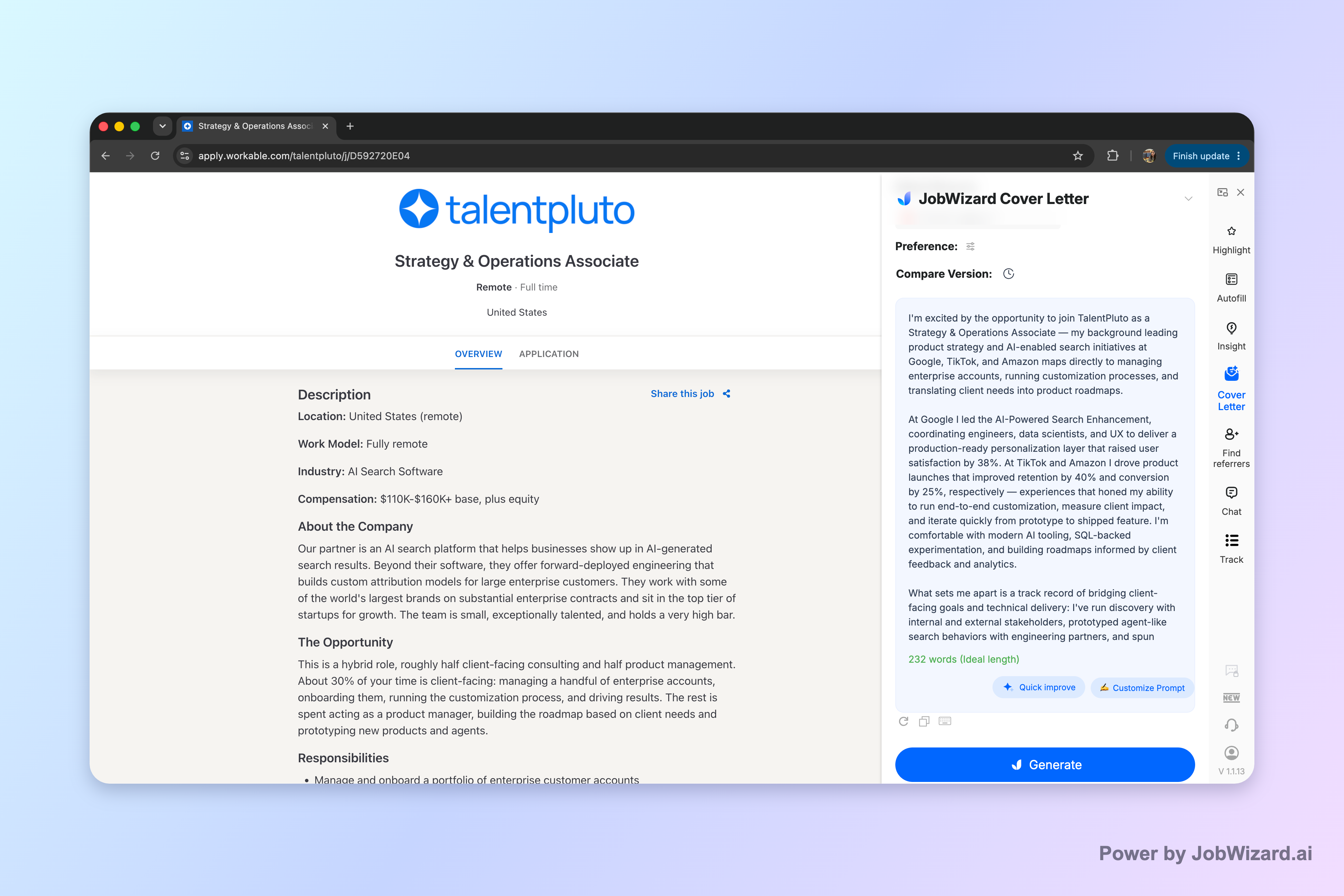
JobWizard can generate an editable first draft using your selected resume and the current job description. You can choose length, format, tone, and focus before you generate, then click into the draft to edit directly.
To get the best results, treat the draft as scaffolding: you’ll keep what’s strong (structure and tone) and replace anything that isn’t truly you. In particular, you should review and confirm any details—then add your own genuine personal information before using the letter.
Start with a “fit-first” structure (opening → proof → teaching approach → close)
The easiest way to write a compelling teacher cover letter is to follow a structure that mirrors how schools make decisions: role fit, evidence of impact, and classroom/teaming approach.
Use this four-part outline and fill it with your real examples:
- Role + reader-friendly fit: Name the position and reference one specific need from the posting.
- Proof points: Add 2–3 short paragraphs or bullets worth of evidence (achievement, improvement, or what students gained).
- Your teaching approach: Explain how you build routines, differentiate instruction, support engagement, or collaborate.
- Confident close: Ask for an interview and mention you’d like to discuss how you’ll contribute in this role.
Quick example (customizable opening):
“I’m excited to apply for the 5th Grade ELA Teacher position at [School]. Your posting highlights student reading growth and strong classroom routines—exactly where I’ve focused my work by building structured literacy blocks and data-informed small groups.”
If the job description includes keywords like “differentiation,” “IEPs,” “restorative practices,” or “collaboration,” weave them in naturally. Don’t copy-paste—match the meaning, then add proof.
Two proof points beat a list of duties
A common teacher cover letter mistake is listing responsibilities instead of outcomes. Hiring managers are scanning for the difference you made and the methods you used.
Here are “duty → proof” rewrites you can model:
- Instead of: “Responsible for classroom management.”
- Say: “Built consistent routines (entry/exit, transitions, and feedback loops) that reduced off-task behavior and improved time-on-task.”
- Instead of: “Taught reading and writing.”
- Say: “Used mini-lessons and leveled texts to move students toward independent reading goals, then adjusted small-group instruction based on weekly checks.”
Keep each proof point tight: what you did, who it helped (students broadly is fine), and what changed.
Use an AI-helped first draft, then make it authentically yours
A practical way to write faster without losing credibility is to generate a draft, then do a targeted “human editing pass” before you submit—especially for any claims that must be accurate.
With JobWizard, you can use your resume and the job description to generate an editable first draft. Before generating, you choose length, format, tone, and focus; after generating, you edit the draft directly.
Human editing pass (do these before you send):
- Confirm facts: Replace any general wording with specific details you can verify (courses, grade levels, tools, dates if needed).
- Make it personal: Add one “why this school” sentence tied to a real program, value, or community detail.
- Prove your impact: Swap any vague statements (e.g., “helped students”) for your measurable or clearly described outcomes.
- Check tone: Read aloud once to catch stiffness, repetition, or anything that sounds too templated.
- Match the posting: Ensure you address the requirements the school emphasizes (skills, experience areas, student support approach).
Reminder: AI can help you draft, but you should review the content and add genuine personal details before using the letter.
If you want a starting point tailored to different career situations, you can also adapt these guides:
- How to Write a Cover Letter with AI (Step-by-Step That Still Sounds Like You)
- AI Cover Letter for No Experience: A Realistic Draft You Can Edit Fast
Short, strong teacher cover letter body template (fill-in-the-blanks)
Copy this template structure and replace the bracketed areas with your details:
Paragraph 1 (opening): “I’m writing to apply for the [Teacher Title] role at [School]. I’m drawn to this position because [specific need from the posting], and my experience in [grade/subject or setting] aligns with your goals for [student outcome].”
Paragraph 2 (proof 1): “In my recent work at [Current/Previous Role], I [action you took] to support [students]. For example, [specific moment or program], which resulted in [clear outcome or improvement].”
Paragraph 3 (proof 2 + collaboration): “I also collaborate closely with [specialists/caregivers/admin/team] to [support systems—IEPs, interventions, planning, communication]. I bring [teaching strength: differentiation, feedback, engagement routines] to ensure students can participate and progress.”
Paragraph 4 (approach + close): “My teaching approach is grounded in [belief/routine: relationships, structured literacy, inquiry, classroom community]. I would welcome the opportunity to discuss how I can contribute to [School] and support your students and staff.”
Signature line: “Sincerely, [Your Name]”
Teacher cover letter tone checklist: sound confident, warm, and specific
Even a strong draft can fail if it sounds generic or reads like a template. This teacher cover letter tone checklist helps you refine the voice quickly.
Before submitting, score your letter with a yes/no pass:
- Warm but professional: Does it feel friendly and respectful without being casual?
- Specific evidence: Do you include 2–3 proof points that describe what you did and what changed?
- Clear teaching approach: Do you explain how you teach (routines, differentiation, engagement, feedback)?
- Collaboration is real: Do you mention working with families, specialists, or colleagues in a meaningful way?
- Reads well out loud: Any sentences you stumble over likely need rewording.
Fix these common tone issues:
- Too generic: Replace “passionate about education” with a concrete example (what you did and why it matters).
- Overly formal: Shorten long sentences and remove inflated phrases.
- Too self-focused: Balance your achievements with how they translate to student outcomes and team needs.
If you’re switching careers or repositioning your story, you may also find this helpful:
For teachers applying to nontraditional education or adjacent education-adjacent roles, tone still matters—but proof points matter even more. Your goal is always the same: show how your experience becomes value for students.
Comparing teacher cover letter examples: what changes by situation
The content of a teacher cover letter should adapt to your background and the role you’re targeting—especially whether you have direct classroom experience.
| Situation | What to emphasize | What to de-emphasize | Good supporting angle |
|---|---|---|---|
| Early career / new to teaching | Student teaching, tutoring, coursework outcomes, lesson planning process | Long claims you can’t back up | How you learn fast, build routines, and improve based on feedback |
| No direct teaching experience | Transferable experience tied to teaching goals (mentoring, coaching, facilitating) | Empty “I want to help” statements without evidence | Specific examples that show you can support learning and engagement |
| Experienced teacher | Student outcomes, differentiation, data-informed instruction, collaboration | Generic “I’m a team player” without detail | One story of improvement and one story of collaboration |
| Career change to education | Relevant skills that map to classroom work (communication, operations, coaching) | Focus on unrelated job duties | Clear narrative: why education, and how your skills translate |
If you want a realistic drafting approach for situations with less experience, use this resource as a starting point:
Then apply the human editing pass above—because schools hire people, not just wording.
Do this automatically with JobWizard
Skip the manual work — JobWizard's AI Cover Letters handles this for you.
FAQ: quick answers for writing your teacher cover letter
What should a teacher cover letter include?
Include (1) a strong opening that names the role and shows fit, (2) 2–3 proof points from your experience (not just duties), (3) how you support students and collaborate with adults, and (4) a confident close that invites an interview. If the posting mentions specific requirements, mirror the language—then add your own details so it’s true to you.
How do I write a teacher cover letter with no experience?
Focus on transferable experience: student teaching, tutoring, coaching, volunteering, tutoring, projects, coursework, or even responsibilities from other jobs. In the body, connect each example to a teaching-facing outcome (lesson support, feedback, engagement, classroom routines). Use an AI-generated first draft as a starting point, then replace any generic lines with concrete examples you can verify.
Should I use AI to write my teacher cover letter?
Using AI can help you generate an editable first draft based on your resume and the job description, and then you can tailor tone and details before you submit. The key is to review everything, add genuine personal information, and avoid any claims you can’t back up.
What tone works best for a teacher cover letter?
Aim for warm, professional, and specific. Avoid sounding overly formal or overly casual. Use confident language about your impact, but keep it grounded in examples (what you did, what changed, and what you learned). A simple tone checklist can help you catch overly generic phrasing before you send.
How long should a teacher cover letter be?
In most cases, keep it concise enough to scan quickly—typically one page. Prioritize a few high-quality proof points over long explanations, and format it so hiring managers can find key info (fit, evidence, collaboration, and next steps) fast.
Ready to draft faster for the teacher role you want? Generate a teacher cover letter first draft in JobWizard using the job description and your resume, then edit it with your real examples before you submit.
Frequently Asked Questions
Generate this cover letter automatically
JobWizard drafts a tailored letter from your resume and the job description in seconds — free.