Cover Letter for Nursing Job: A Readable Template + Tone-Right AI Draft Workflow
Learn how to write a strong cover letter for nursing job applications—then generate an editable draft using your resume and the job description so it still sounds like you.
Free Chrome extension
Generate this cover letter automatically
JobWizard drafts a tailored letter from your resume and the job description in seconds — free.
If you’ve been searching for a cover letter for nursing job that actually gets read, you’re not alone—most applicants write something too generic, too long, or not aligned with what the unit is hiring for. A great nursing cover letter does two things at once: it proves you’re qualified for this specific role, and it sounds like a real clinician, not a copy-paste template.
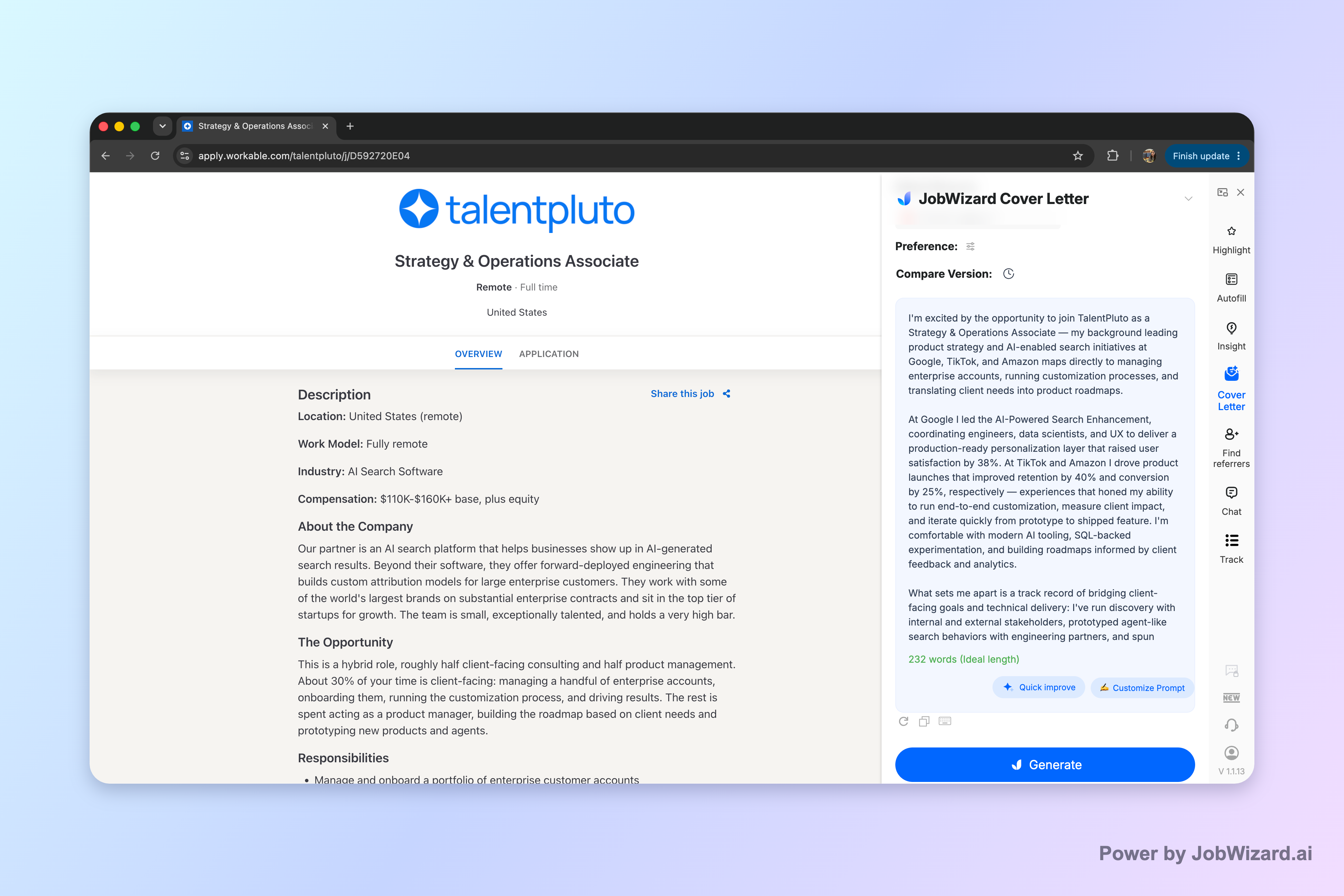
JobWizard helps by generating an editable first draft using the resume you select and the job description from the page—so you can customize tone, length, and focus before you submit. Then you review and add personal details so the final letter stays true to you.
What a “readable” cover letter for nursing jobs needs (in plain English)
A readable cover letter for nursing job is short, specific, and easy to skim—like a good handoff note.
Most hiring managers don’t need a biography. They want to quickly understand: your credentials, your relevant experience, how you work with patients and teams, and why you’re interested in their unit or setting.
Use this structure to keep it tight and credible:
- 1st paragraph: what role you’re applying for + 1 sentence linking your experience to their needs.
- 2nd paragraph: 2–3 strengths in action (patient care, teamwork, documentation, patient education, coordination—choose what matches the posting).
- 3rd paragraph: one short example that reflects the job’s priorities + why you’re drawn to their environment.
- Close: confident interest + a simple call to action (for an interview or to discuss fit).
For nursing roles specifically, keep the language patient-centered and team-aware. Words like “collaborate,” “communicate,” “follow evidence-based processes,” and “document accurately” signal you understand clinical reality.
Use this nursing cover letter template (then tailor it fast)
Start with this cover letter for nursing job template, then customize 5 key details so it matches the posting.
Template (copy + customize):
Subject/Opening: Dear Hiring Manager, I’m applying for the [Job Title] position at [Facility/Unit]. With my background in [brief nursing specialty or setting], I’m confident I can support your team’s goals—especially [1–2 priorities from the posting].
Body: In my recent work, I’ve focused on [patient care strength #1] and [patient care strength #2]. I’m intentional about clear communication with patients and families, accurate documentation, and coordinating with providers and fellow clinicians so care stays consistent from shift to shift. For example, in [one specific scenario], I [what you did] to [measurable or concrete outcome you can truthfully claim—keep it modest]. That experience reinforced how important it is to [connect to the posting: triage support/care coordination/patient education/etc.].
Closing: I’m particularly interested in [facility/unit detail] because [why it fits you]. I’d welcome the chance to discuss how my experience aligns with your needs for [shift/unit expectations]. Thank you for your time and consideration.
Sincerely, [Your Name] [RN/LPN/credential] • [Phone] • [Email]
What to tailor (5 details that change everything)
Tailor these items first, and the letter instantly looks “written for this role.”
- The unit’s priorities: pick 2 duties or values from the posting and mirror them in your opening and body.
- Your closest experience: choose one setting that matches (ED, med-surg, ICU, rehab, clinic, home health, etc.).
- Your patient-care style: decide on 2 strengths you can defend (education, calm escalation, documentation quality, coordination).
- One concrete example: describe a real situation where your actions supported safe, organized care.
- Your fit reason: mention something specific about the facility/unit—training, care model, patient population, or schedule alignment.
If you’re worried about sounding “too rehearsed,” keep the template but rewrite at least 70% of the wording. Hiring teams can feel when a letter is mechanically generated instead of thoughtfully written.
How to generate an editable first draft with AI (and keep it truly yours)
You can use AI to speed up drafting—as long as you treat it like a writing partner, not a replacement for your judgment.
JobWizard uses your selected resume and the current job description to generate an editable cover letter draft. Before generating, you can choose length, format, tone, style, and focus, and then click into the draft to edit it directly.
Best workflow for a nursing cover letter (draft → review → finalize)
Follow this workflow to avoid the most common mistakes:
- Select your resume + the job description: make sure the resume includes the credentials and experience you want emphasized.
- Set the tone and focus: aim for professional and warm. Choose a focus that matches the posting (for example: patient education, coordination, or documentation quality).
- Generate a short first draft: you want a starting point you can quickly edit—not a final product you hope is perfect.
- Review facts and add personal details: verify dates, roles, and any claims. Add genuine examples from your own experience.
- Match the posting’s language carefully: you can reuse key terms (from the duties list), but keep your sentences natural.
- Final pass for nursing-specific clarity: check patient-centered phrasing, teamwork language, and documentation/communication references.
Reminder: AI can draft—your review makes it trustworthy. JobWizard’s draft should be treated as editable text, and you should add genuine personal details before using it.
What not to do
Avoid these traps that can weaken a nursing cover letter:
- Don’t overpromise: don’t claim experience you don’t have, especially with patient populations, procedures, or certifications.
- Don’t skip tailoring: generic letters get filtered fast because they don’t prove fit.
- Don’t submit without editing: hiring teams can tell when the letter doesn’t match your actual background.
If you want more drafting speed for remote or tech-forward applications, see The Fastest Way for Remote Jobs to Write a Cover Letter and AI Cover Letter for Remote Jobs. These strategies translate well to nursing too—especially the “draft then edit” discipline.
Nursing cover letter examples by scenario (use the right “angle”)
Different nursing backgrounds need different angles—use the examples below to find your best fit.
Example angle: New graduate (confidence + learning mindset)
Opening idea: highlight your clinical education, preceptorship, and readiness to learn the unit’s workflow.
Try: “As a new graduate, I’m eager to bring strong foundational nursing skills from clinical rotations and a team-first attitude to [unit]. I’m especially interested in your focus on [posting priority] and want to contribute while continuing to develop under your precepting model.”
Example angle: Experienced RN (process + patient safety)
Opening idea: emphasize stability, communication, and safe, organized care.
Try: “With experience in [setting], I’m applying for the [role] because your team emphasizes [priority]. I’m known for clear handoffs, accurate charting, and patient-centered communication that supports continuity of care.”
Example angle: Career change within nursing (transferable care strengths)
Opening idea: connect your current skills to the new unit’s needs.
Try: “Even though my background is in [current area], my strengths in patient education, care coordination, and calm escalation translate directly to [new role]. I’m particularly interested in [unit/facility detail] because it aligns with how I approach patient-centered care.”
Example angle: Returning to nursing (re-entry confidence + refresher)
Opening idea: mention your plan to get current and your motivation to rejoin.
Try: “I’m returning to nursing with renewed energy and a commitment to staying current on best practices. In preparing for the role, I’ve focused on strengthening the fundamentals that matter most for safe care: documentation, patient communication, and collaborative teamwork.”
Do this automatically with JobWizard
Skip the manual work — JobWizard's AI Cover Letters handles this for you.
FAQ: cover letter for nursing job
Get quick answers to the questions that block most nursing applicants from finishing their cover letter.
What should I include in a cover letter for a nursing job if I’m not a perfect match?
Focus on what you can do for the team right now: your license/credentials, your most relevant patient-care strengths, and 1–2 concrete examples that mirror the posting’s needs (without exaggerating). Then close by asking a specific question about the unit’s patient population or training priorities so you sound engaged, not uncertain.
How long should my cover letter for a nursing job be?
Aim for about one page. Keep it scannable: 3 short paragraphs plus a closing line. If you’re sending email or uploading to an application portal, prioritize clarity over word count and make sure every sentence supports the job description.
Should my nursing cover letter be formal or more conversational?
Use a professional, warm tone—confident but never casual. Think “respectful and specific.” You can be slightly more human in your wording (especially when describing patient-centered care), but avoid jokes, slang, or anything that could feel like you’re not taking the role seriously.
Can I use AI to write my cover letter for a nursing job?
Yes—use AI to generate an editable first draft. JobWizard uses your selected resume and the current job description to create a draft you can click into and edit directly. Before using it, you should review all facts and add genuine personal details (your experience, achievements, and any specifics from the posting).
What’s the best way to tailor a nursing cover letter for each job posting?
Mirror the posting’s priorities in your opening and closing, then choose 2–3 keywords from the duties (for example: patient education, care coordination, charting, triage support, or particular patient populations). Add one short example for each—then double-check that your final letter matches the role’s requested schedule, shift expectations, or unit focus.
Ready to draft a nursing cover letter that’s aligned and still sounds like you?
Draft smarter with JobWizard—generate an editable cover letter for the current job description, then review and personalize it before you submit.
Start by selecting your resume in JobWizard and pasting the job description. Choose the tone and focus you want, generate a first draft, and edit it directly so your experience (and your voice) stays front and center.
If you’re also applying beyond nursing roles or dealing with remote application workflows, strengthen the same “tailor-first” habit with How to Write a Cover Letter with AI (Step-by-Step That Still Sounds Like You) and AI Cover Letter Examples for Remote Jobs.
Frequently Asked Questions
Generate this cover letter automatically
JobWizard drafts a tailored letter from your resume and the job description in seconds — free.