What Is a Cover Letter for Employment? Purpose, Format, and What to Write
What is a cover letter for employment? It’s your brief, targeted pitch that explains why you’re a strong match—along with the right cover letter tone and format.
Free Chrome extension
Generate this cover letter automatically
JobWizard drafts a tailored letter from your resume and the job description in seconds — free.
What is a cover letter for employment, and why hiring managers still read it?
A cover letter for employment is a short, role-specific message you send with your resume to explain why you’re a strong match. It helps the employer understand your fit quickly, especially when the posting asks for context that a resume can’t fully capture.
Think of it as a targeted “bridge” between what you’ve done and what the job needs. While your resume lists experience, your cover letter can explain why that experience matters for this specific role, and how you approach the work.
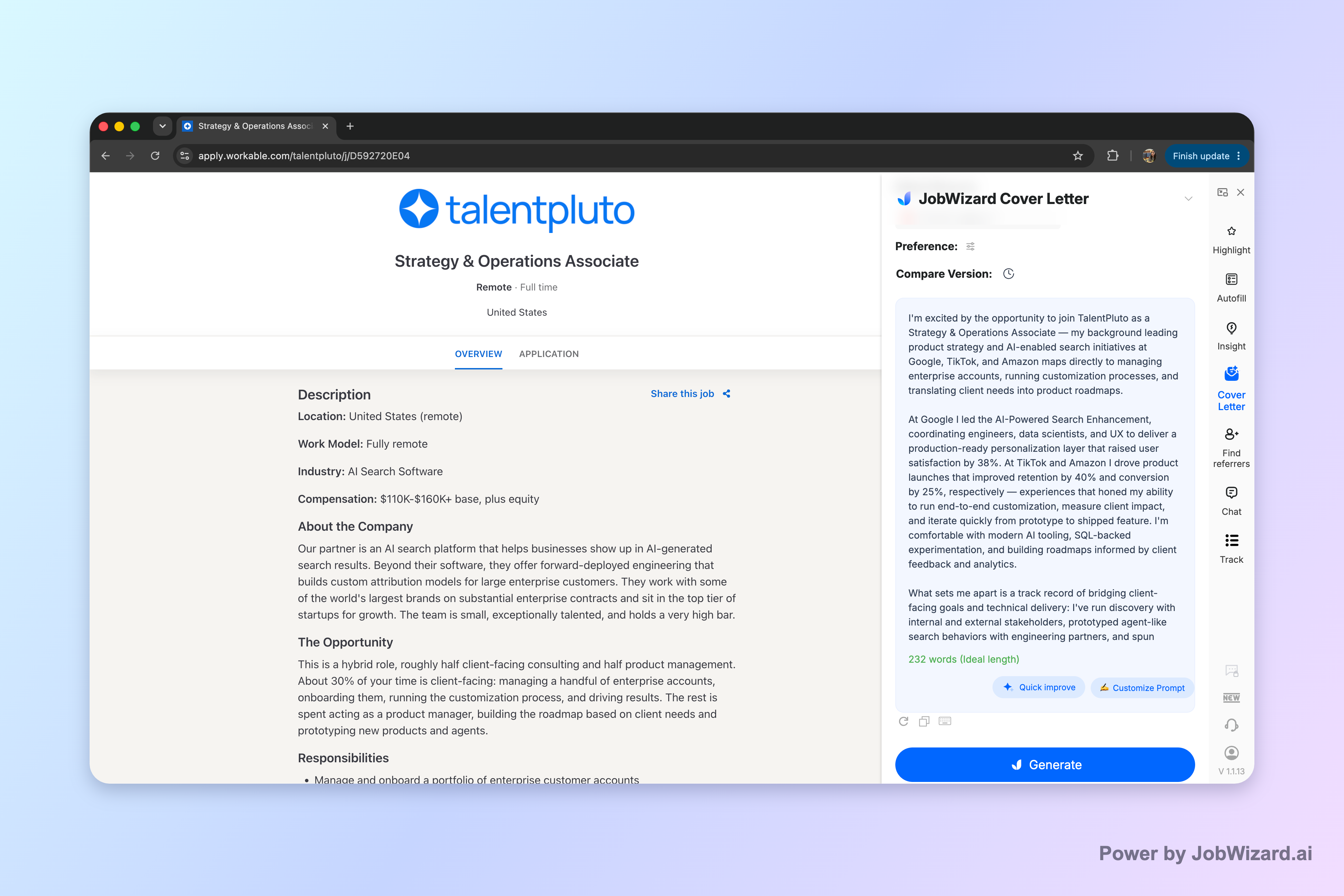
JobWizard creates an editable first draft using the selected resume and the job description on the page.
What a cover letter for employment should include (the winning sections)
A strong cover letter for employment follows a predictable structure—so recruiters can skim fast and still feel the message is personal. Use the sections below as your checklist.
- Purpose & role fit: One sentence that clarifies what role you want and why you’re applying.
- Proof from your experience: 2–3 examples that directly match the job’s requirements (not a full life story).
- How you’ll add value: A brief “so what” that ties your experience to the company’s goals or the team’s needs.
- Professional close: A clear, respectful ending that expresses interest and invites next steps.
It’s also the right place to address items resumes often leave implicit—like your motivation for switching domains, how you handle a specific responsibility, or why this company interests you.
Include the right details—without repeating your resume line-by-line
Recruiters already see your job titles and dates. Instead of repeating everything, pick the most relevant accomplishments and add clarity: what you did, how you did it, and what result or learning you gained.
For example, if the posting emphasizes customer handling, you can mention a situation where you resolved an issue, documented the outcome, or improved communication. If the role emphasizes administrative accuracy, you can focus on how you maintained records, scheduled efficiently, or reduced errors through process.
Cover letter tone and format: what to write so it’s easy to read
The fastest way to improve your odds is to get both cover letter tone and cover letter format right—because readability affects how far your message travels.
Cover letter tone: professional, specific, and human
A good cover letter for employment reads like a thoughtful professional wrote it: clear, confident, and respectful. Match the tone to the company and role—startup roles can tolerate more energy, while more formal industries benefit from a polished, steady style.
- Use clear statements over long explanations.
- Avoid buzzword stacking (it can make you sound generic).
- Be specific about responsibilities you’ve handled that match the posting.
Cover letter format: a simple structure recruiters can skim
Use a standard layout with clear spacing and short paragraphs. If your formatting is messy, recruiters may skip reading even if your content is strong.
- Header: Your name and contact info (and any employer contact info if you choose to include it).
- Greeting: “Dear Hiring Manager” or the appropriate person/department if known.
- Body: 2–4 concise paragraphs that cover fit, evidence, and value.
- Close: A respectful sign-off and your name.
For skimmability, keep paragraphs short and use specific phrases that mirror the job’s language (without copying full sentences). And always proofread—spelling and dates matter.
How to write a cover letter for employment step-by-step (with examples)
If you want your cover letter for employment to feel targeted (not templated), follow a repeatable workflow that turns the job posting into your message.
Step 1: Pull requirements from the job description
Underline the responsibilities and qualifications that show up repeatedly. Then write down what evidence you have for each one—tasks you’ve performed, systems you’ve used, or outcomes you supported.
Example: If the posting mentions “customer communication” and “issue resolution,” list a scenario where you handled a difficult request and how you documented the next steps.
Step 2: Choose a “fit story” you can explain in 3–5 sentences
Pick one or two experiences that best represent your match. Your goal isn’t to prove you’ve done everything—it’s to show you can do the core work the employer is hiring for.
Example for a customer-facing role: describe the problem, your approach, and what you improved (clarity, turnaround time, accuracy, customer experience).
Step 3: Write a first draft, then edit for specificity and tone
Draft quickly to get the ideas on the page. Then revise by asking: Did every paragraph earn its place? Does it sound like you? Did you connect your experience to what the employer is asking for?
Example edit checklist:
- Replace generic claims (“I’m a hard worker”) with role-specific proof (“I handled X and documented Y”).
- Make the “why us” real (something you noticed about the team, mission, or product).
- Adjust tone to the role (more formal or more conversational).
Step 4: Use an AI-assisted draft—then make it truly yours
If you’re short on time, you can use an AI cover letter draft workflow to accelerate drafting. JobWizard uses the selected resume and the current job description to generate an editable cover letter draft.
Before you generate, you can choose length, format, tone, style, and focus. Then you can click into the draft and edit it directly—so you stay in control of what’s said and what’s accurate.
Important: Don’t treat any draft as “ready to send.” Users must review facts and add genuine personal details before using the draft.
This approach keeps your cover letter for employment from sounding like a generic template while still saving time on the first pass.
Cover letter examples by job type + where to use AI templates effectively
The fastest way to write well is to use examples that match your job type—then customize them with your details. Below are targeted starting points and when to lean on AI.
When you’re applying externally vs. internally
External applications usually emphasize skills you bring. Internal moves often require extra focus on your impact in your current environment and readiness for the next scope. If you’re applying internally, use a cover letter that proves you’re already operating at the level required.
A standout cover letter for internal position: prove you’re ready for the next step
Customer service and people-facing roles
For customer service, your cover letter should highlight communication, de-escalation, and how you handle follow-through. Choose examples that show you can solve problems and still maintain a helpful tone.
Cover Letter for Customer Service: a Template That Sounds Human (Plus AI Draft Steps)
Administrative assistant roles
For administrative work, the strongest letters show reliability, organization, and accuracy—plus how you collaborate with teams and manage scheduling or documentation. Your resume lists your duties; your letter can explain your process and priorities.
Cover Letter for Administrative Assistant: A Results-Oriented Template + AI Draft Workflow
When you want an AI draft but still want it to sound like you
If you want the workflow details (what to prepare and how to edit), follow a step-by-step approach. Start with your resume and the job description, draft, then personalize and verify before submitting.
How to Write a Cover Letter with AI (Step-by-Step That Still Sounds Like You)
Quick “do and don’t” list before submitting
- Do: Keep it concise, tie claims to the job posting, and ensure every detail is accurate.
- Don’t: Submit a draft you haven’t reviewed—especially anything factual about your experience, responsibilities, or accomplishments.
Do this automatically with JobWizard
Skip the manual work — JobWizard's AI Cover Letters handles this for you.
FAQ: what is a cover letter for employment?
What is a cover letter for employment, and do I need one for every job?
A cover letter for employment is a short, targeted letter that explains why you’re a good fit for a specific role and company. Whether you “need” one depends on the application instructions—if the employer asks for it (or seems to expect one), you should submit it rather than skip it.
What should I include in a cover letter (besides my resume)?
Strong cover letters for employment typically include (1) a clear reason you’re applying, (2) a few specific examples that match the job’s requirements, and (3) a professional closing that shows interest and invites next steps. You should also keep the tone aligned with the role and the company.
What cover letter tone should I use?
Use professional, confident, and specific—then match the tone to the job and industry. Avoid sounding generic or overly formal; aim for a conversational-professional style that still reads clearly and respectfully.
How do I format a cover letter for employment so it’s easy to skim?
Use a standard structure: a header, a greeting, 2–4 concise body paragraphs that highlight relevant fit, and a close. Keep paragraphs short, use specific phrases tied to the posting, and check spacing and spelling so it’s easy to scan.
Can I use AI to draft a cover letter, and what do I have to do before submitting?
Yes—you can use AI to generate an editable first draft using your selected resume and the current job description. But you must review every detail and add genuine personal details (and any factual specifics) before using or submitting the draft.
Ready to write faster without losing your voice? Generate a cover letter draft for the current job description in JobWizard, then edit it directly so it’s accurate, specific, and ready to submit.
Frequently Asked Questions
Generate this cover letter automatically
JobWizard drafts a tailored letter from your resume and the job description in seconds — free.