lazyapply jobhunterbot autoapply.jobs user reviews experiences pros cons: what can go wrong—and the safer review-first way
lazyapply jobhunterbot autoapply.jobs user reviews experiences pros cons often point to one theme: bots can submit the wrong answers or trigger spam filtering. Use review-first autofill instead—fill the repetitive fields fast, then submit yourself.
Free Chrome extension
Autofill your next job application
JobWizard is a free Chrome extension that fills applications, tracks statuses, and optimizes your resume.
lazyapply jobhunterbot autoapply.jobs user reviews experiences pros cons—so why do “bot” apps go sideways?
If you’ve been reading lazyapply jobhunterbot autoapply.jobs user reviews experiences pros cons threads, you’ve probably noticed a pattern: people like the speed, but the problems show up after the submission—when it’s harder to fix. Auto-submit tools can quietly push the wrong answers, attach the wrong story, or create “looks automated” signals on the employer side.
Here’s the key distinction: review-first autofill helps you move faster while you’re still in control. Auto-apply bots aim to finish the job for you, which increases the chance you won’t catch mistakes before they’re sent.
What goes wrong with lazyapply jobhunterbot autoapply.jobs-style auto-submit bots (the real risks)
Auto-submit bots can backfire because they treat “fill the form” as “send the right application,” even though job posts often include nuanced questions and required fields that don’t transfer perfectly.
1) Wrong answers to screening questions
Screening fields aren’t always just “yes/no.” They can ask about eligibility, availability, compensation expectations, work authorization details, EEO-related prompts, or role-specific qualifications. If a bot uses the wrong assumption—or fills from an older profile—you may submit answers that don’t match the posting.
2) Mismatched resume-to-role details
Even when an app system accepts your resume upload, the content can still be mismatched. For example, your experience highlights might not align with the role’s requirements, or a prior version of your resume may be used when the posting calls for a different skill emphasis. With an auto-submit workflow, you may not catch that mismatch before it’s too late.
3) Employer-side filtering and “spammy” signals
Many companies use automated systems to detect low-quality or suspicious application patterns. When activity looks automated, your application can be reviewed less carefully, routed differently, or flagged—especially if you submit lots of similar forms with small inconsistencies. This doesn’t mean you’re “bad”; it means automation can reduce the perceived authenticity of your submissions.
4) Damaged reputation with companies you genuinely want
If you’ve ever applied to a dream employer and later wondered why you didn’t hear back, bot behavior can be part of the story. Submitting inaccurate answers, inconsistent text, or unclear qualifications can create a negative impression—particularly with competitive hiring teams who rely on screening signals.
The pros and cons people mention—what reviews usually get right (and what to watch)
In lazyapply jobhunterbot autoapply.jobs user reviews experiences pros cons discussions, the “pros” tend to focus on speed and reduced manual typing. The “cons” tend to involve errors you only notice after submission.
| What users like | Why it sounds good | Common downside to verify |
|---|---|---|
| Faster form filling | You spend less time typing repetitive fields | Does it still force review of screening questions and required prompts before submission? |
| Less copy/paste fatigue | Reduces mental load when applying often | Does it risk stale info (old resume version, wrong dates, outdated eligibility answers)? |
| “Auto” convenience | Frees you from repetitive work | If it submits for you, you lose control of accuracy and timing—your job is to confirm details. |
| Coverage across platforms | Some tools support multiple ATS-style experiences | Even with broad support, required fields and custom questions may still be missed or filled incorrectly. |
The most useful way to interpret reviews: treat them as warnings about what you might not catch. If a tool doesn’t make review mandatory, it shifts risk from the bot to your career.
A safer alternative: review-first autofill (fill fast, then submit yourself)
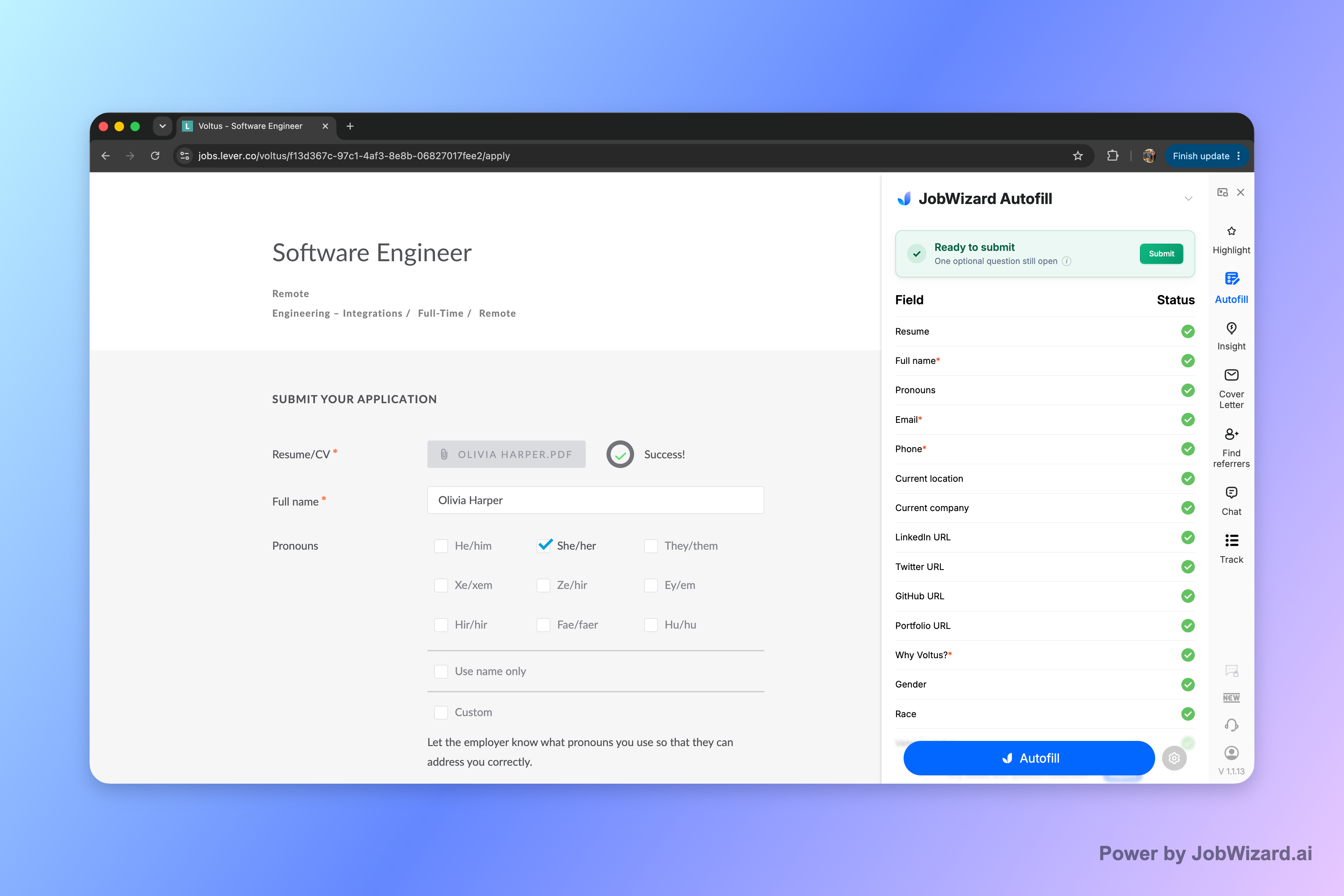
The safer pattern is simple: let software pre-fill the repetitive fields, then you read, correct, and submit. JobWizard is built around that review-first workflow.
What Smart Autofill does (and doesn’t)
- Smart Autofill uses saved profile and resume data to fill detected fields on supported application pages.
- You review the populated fields and submit the application yourself.
- If a required field still needs attention, JobWizard can identify it and help you jump to the matching question.
- It does not submit automatically, never mass-applies, and doesn’t apply while you’re away.
That last point matters: the goal is speed without surrendering control. Since ~65% of applications submitted through JobWizard are on Workday, this review-first approach is especially valuable when those forms include lots of detailed prompts you can’t afford to guess at.
Bottom line: review-first autofill accelerates repetitive fields, while you stay responsible for the final accuracy on sponsorship/salary/EEO/custom questions.
How to get the “bot-like speed” without the bot-like mistakes
- Start the application on the job page (you’re in control of the role context).
- Use autofill to populate repetitive fields so you don’t retype the same basics.
- Read every screening question and required prompt—don’t assume the prefill is correct.
- Confirm your resume alignment with the job’s stated requirements and keywords.
- Submit yourself once everything matches your real background.
If you want proof that this approach is working at scale, JobWizard data shows 720,000+ applications submitted and 600,000+ autofill sessions run through the platform—supported by an average of ~18 repetitive fields autofilled per application. The automation is the typing, not the decision.
Do this automatically with JobWizard
Skip the manual work — JobWizard's Smart Autofill handles this for you. On these platforms: JobWizard vs LazyApply.
lazyapply jobhunterbot autoapply.jobs user reviews experiences pros cons FAQ
What goes wrong when a bot auto-submits job applications for you?
It can enter wrong or outdated answers for screening questions, mismatch your resume to the role you’re applying for, and increase the chance an employer’s systems flag the activity as low-quality or spam—hurting your chances with companies you actually want. Review-first autofill avoids that by filling repetitive fields while you control the final answers and submission.
Are lazyapply jobhunterbot autoapply.jobs “autofill” tools the same as review-first autofill?
No. Some tools aim to submit on your behalf, which introduces errors you may not notice until it’s too late. A review-first workflow fills common fields quickly (like contact info and basic profile details), then forces you to read and correct screening questions, salary/EEO/custom prompts, and any required fields before you submit.
What should I check before I hit submit on an autofilled application?
Scan every screening question and any required field that’s specific to the posting, verify the correct resume/experience highlights for that job, confirm sponsorship/salary/EEO/custom questions are accurate, and double-check attachments and key text for consistency with your real background.
Is JobWizard “auto-submit” or mass-apply?
No. JobWizard autofills an application you’re already viewing, then you review and submit it yourself. It does not submit by itself, never mass-applies, and it doesn’t apply while you’re away.
How does review-first autofill help when the application is on Workday, Greenhouse, Lever, or Ashby?
JobWizard’s Smart Autofill fills repetitive fields on supported application pages and helps you jump to any required fields that still need attention. You keep control of the final review (including custom questions), so you can correct anything that doesn’t match the job before submitting.
Ready for the speed without the risk? Try JobWizard’s Autofill on your next application: it fills repetitive fields for you, then you review every answer and submit yourself.
Want more context on review-first workflows? Start with How to Autofill Job Applications (Step-by-Step with JobWizard), then compare bot behavior in Lazyapply Reviews: What Goes Wrong With Auto-Submission (and the Better Way to Apply). If you’re weighing “free bot” options, read Is There a Free Way to Automatically Apply for Jobs? Here’s What “Bot” Tools Get Wrong, and if you’re still unsure, see Is auto applying to jobs a good idea? The bot-submission pitfalls vs review-first autofill.
Frequently Asked Questions
Autofill your next job application
JobWizard is a free Chrome extension that fills applications, tracks statuses, and optimizes your resume.