Is There a Free Way to Automatically Apply for Jobs? Here’s What “Bot” Tools Get Wrong
Searching “is there a free way to automatically apply for jobs”? Many “bot apply” tools fill answers without your real review—leading to wrong screening answers, resume mismatches, and spam-filter risk. JobWizard offers review-first smart autofill so you can fill repetitive fields fast and submit yourself.

Free Chrome extension
Autofill your next job application
JobWizard is a free Chrome extension that fills applications, tracks statuses, and optimizes your resume.
Is there a free way to automatically apply for jobs? You might find “auto-apply” tools that claim they can apply on your behalf, sometimes with a free tier—but the catch is what happens when a bot submits without your real review.
For many job seekers, the goal isn’t just speed. It’s getting past screening reliably while still sending a resume and answers that match the role. In this guide, you’ll see where bot-based automation usually breaks down—and the review-first alternative that helps you apply fast without the “wrong answers got sent” problem.
Why “free auto-apply” bots often backfire on real applications
Bot submissions tend to fail on the exact parts employers care about: screening questions and fit details. The more automation you add, the more likely it is that something important gets defaulted, misread, or filled with the wrong data.
Here are the most common failure points when you use tools built around automatic application behavior:
- Wrong answers to screening questions: If a tool guesses instead of using your intentional wording, you can get filtered out—even if you’re qualified.
- Resume mismatches: If the wrong resume version is selected (or key details don’t align with the specific role), your application can look inconsistent.
- Employer-side “bad submission” friction: When applications repeatedly contain errors or missing info, it can increase the odds that a system flags them as low quality.
- Damaged reputation with a company you actually want: If you send inaccurate responses to an employer you’d be excited to work for, that first impression can be hard to undo.
And there’s a practical issue: screening questions and custom prompts aren’t standardized. Even if two job postings look similar, the wording can change. Automation that treats forms as “mostly the same” can be confidently wrong.
Job seekers often think the risk is “getting rejected.” The bigger issue is that bots can send preventable wrong answers—so the rejection is based on details that you could have fixed.
If you’re wondering “is there a free way to automatically apply for jobs,” the honest answer is: free tools may exist, but “automatic submission” isn’t the same as “applying accurately.” Speed without review can turn into wasted applications.
What a safer workflow looks like: autofill + review before you submit
The safer alternative is review-first autofill: fill repetitive fields fast, then submit only after you check everything. That’s the difference between sending a completed application and delegating your answers to a bot.
JobWizard’s Smart Autofill focuses on the parts that slow you down: repeated personal info and standard fields on application pages. You still review what it filled, and you submit yourself.
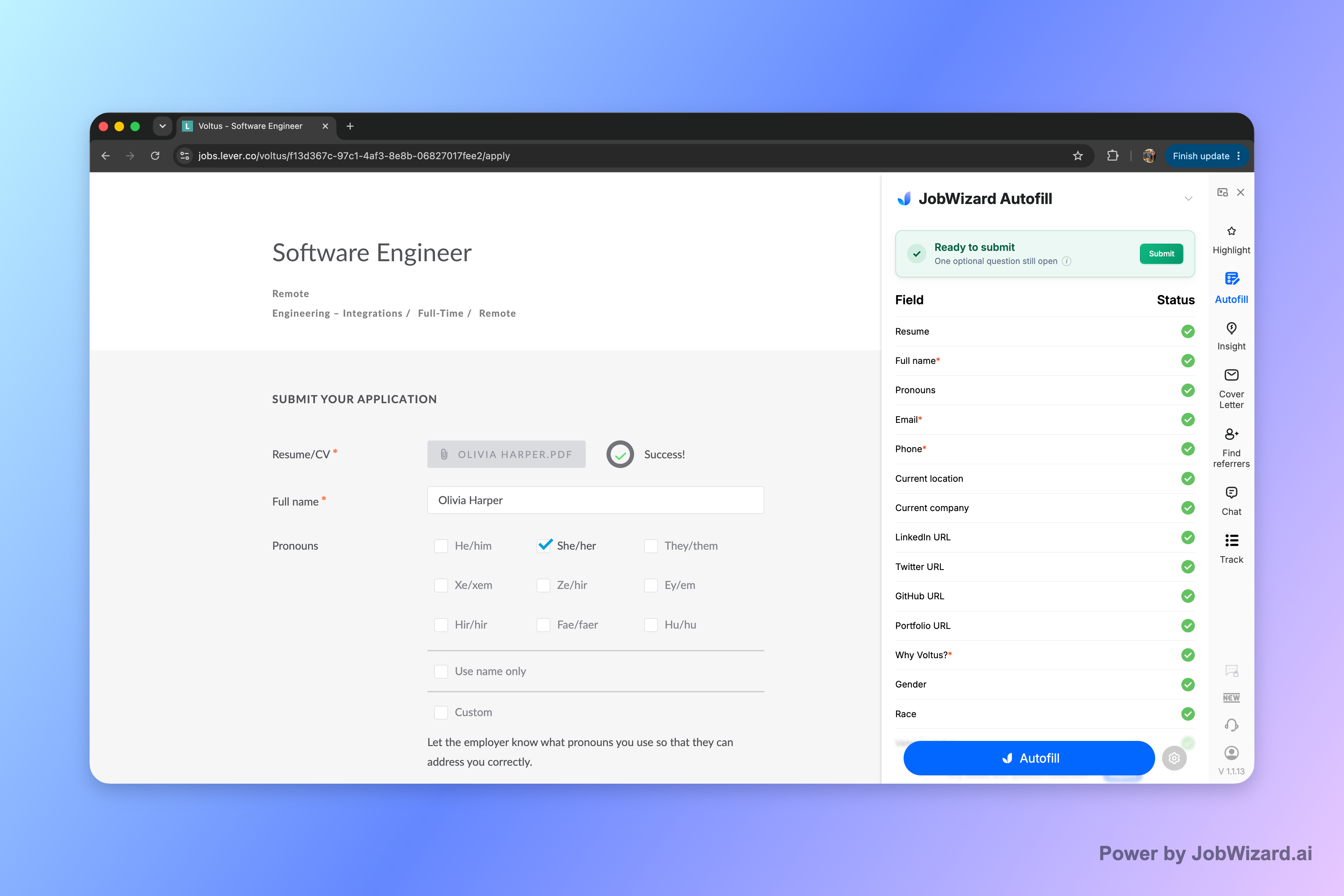
In practice, this workflow helps you avoid the most damaging bot errors (like wrong screening responses) while still reducing the busywork of repeatedly retyping information.
JobWizard also supports a key reality about job forms: required questions aren’t always fully predictable. When something still needs attention, JobWizard can identify it and let you jump to the matching question—so you’re not stuck hunting through the form wondering what’s missing.
How this compares to true “auto apply”
Review-first autofill preserves your control over the decisions that matter. Here’s the trade-off in plain terms.
| Approach | What it automates | What you still must do | Main risk |
|---|---|---|---|
| Bot-style auto-apply | Attempts to submit without you manually checking every answer | Often nothing immediately at submission time | Wrong screening answers / missing or mismatched details get sent |
| Review-first autofill (JobWizard) | Fills repetitive fields on the application page | Review the filled answers and submit yourself | You may still need to correct custom or required questions |
For the job seeker, that means the fastest path isn’t “set-and-forget.” It’s “fill in seconds, check, submit.”
Does “free” auto-apply mean you’ll waste less time?
Free auto-apply can feel efficient, but hidden rework time is common when submissions aren’t accurate. If your applications get filtered out due to wrong answers or missing details, you end up doing the same effort again—often across multiple roles and job boards.
Even if a tool helps you click “apply” faster, what matters is what ends up inside the form. Screening systems reward accuracy and consistency, and employers compare what you submit against the role’s criteria.
Here’s how that turns into real-world time cost:
- Submission happens faster, but errors slip through unchecked screening fields.
- Responses get rejected earlier because the content doesn’t match the employer’s requirements.
- You re-apply with corrected details, repeating manual effort that you thought automation eliminated.
JobWizard’s model is designed to reduce the repetitive typing burden while keeping you accountable for the final answers—so you’re less likely to burn cycles on applications that never had a fair shot.
How to apply faster without “bot” mistakes (a practical checklist)
You can keep the speed benefits of automation—without the risks—by using a review checklist every time. Before you submit, do a fast scan of the fields that most often determine whether you move forward.
- Screening questions: confirm each answer matches the role requirements and your real experience.
- Resume selection / version: make sure the document aligns with the job’s focus.
- Custom questions: rewrite anything that sounds generic or doesn’t reflect your actual story.
- Work authorization / location details: verify these are consistent with what you want to communicate.
- Missing or required fields: look for required prompts that may need your attention.
If you’re targeting platforms like Workday, Greenhouse, Lever, or Ashby, review-first autofill can especially help because the repetitive fields are frequent. Across JobWizard usage, autofill + review-before-submit is commonly used, with the workday experience where it tends to save the most time.
JobWizard users have submitted 720,000+ applications, and 600,000+ autofill sessions have been run—showing that “autofill + review” is a repeatable workflow for applicants.
And importantly: the tool is filling repetitive fields quickly while leaving sponsorship/salary/EEO/custom questions and any final judgments for you to review before submitting.
Where to start if you’re currently using bot-style auto-apply
Switch your goal from “automatic submission” to “faster completion with your review.” That mindset shift keeps you out of the “wrong answers were sent” loop.
If you want a step-by-step workflow, start with:
- How to Autofill Job Applications (Step-by-Step with JobWizard)
- auto apply for jobs: how bot-style submissions go wrong (and smart autofill fixes the damage)
And if you’re applying through specific workflows, these also help you keep control:
- Auto Applying for Jobs Is Risky—Here’s What to Do Instead (Autofill-Then-Review)
- How to mass apply for jobs on LinkedIn (without bot-submit mistakes)
Do this automatically with JobWizard
Skip the manual work — JobWizard's Smart Autofill handles this for you.
FAQ: is there a free way to automatically apply for jobs?
Is there a free way to automatically apply for jobs without taking time to fill forms?
There may be free tools that try to automate applications, but “automatic submission” usually means you’re delegating screening answers to something you may not control. The safer approach is review-first autofill: you still submit, but the tool fills repetitive fields so you can quickly verify every answer before sending it.
What goes wrong when a bot submits my application?
Bot submissions commonly fail on screening questions (wrong or default answers), resume mismatches (the wrong version or missing details), and employer-side friction (more errors can trigger spam/bad-quality filtering). If the company you genuinely want rejects you because of preventable mistakes, you lose time and credibility.
Does JobWizard automatically apply for jobs?
No. JobWizard is built for autofill + review-before-submit. It fills repetitive fields on the application page using your saved data, but you review what’s filled and submit the application yourself.
Will autofill handle every question perfectly for every employer?
No—autofill can miss or require attention on required fields (like custom questions). JobWizard is designed to help you spot what still needs your input so you can correct it before submitting.
How do I get the speed benefit of “auto apply” without the risks?
Use review-first workflows: let the tool autofill repetitive fields to save time, then actively check screening questions, custom responses, and document selection. When everything looks right, submit yourself so you keep control of the details.
Next step: autofill your next application, then review and submit yourself
Want faster applications without bot-style submission mistakes? Try JobWizard’s Smart Autofill on your next application—fill repetitive fields quickly, jump to any remaining required questions, then review every answer before you submit.
Learn the review-first autofill workflow with JobWizard and make every application count.
Frequently Asked Questions
Autofill your next job application
JobWizard is a free Chrome extension that fills applications, tracks statuses, and optimizes your resume.