Is auto applying to jobs a good idea? The bot-submission pitfalls vs review-first autofill
“Is auto applying to jobs a good idea?” Learn what goes wrong with bot submissions—wrong screening answers, mismatched resumes, and spam-filter fallout—then switch to review-first autofill with JobWizard.
Free Chrome extension
Autofill your next job application
JobWizard is a free Chrome extension that fills applications, tracks statuses, and optimizes your resume.
Is auto applying to jobs a good idea? Here’s the honest verdict
If you’re asking is auto applying to jobs a good idea, the short answer is: not as a bot that submits on your behalf. Auto-apply systems can fill the wrong information, ignore job-specific screening, and create “low-quality submission” signals for employers.
Job seekers often try bots to increase volume, but most of the real risk shows up at the final step—where accuracy matters. A single wrong response to a screening question, a mismatched resume, or inconsistent details can turn a strong candidate into a “no thanks.”
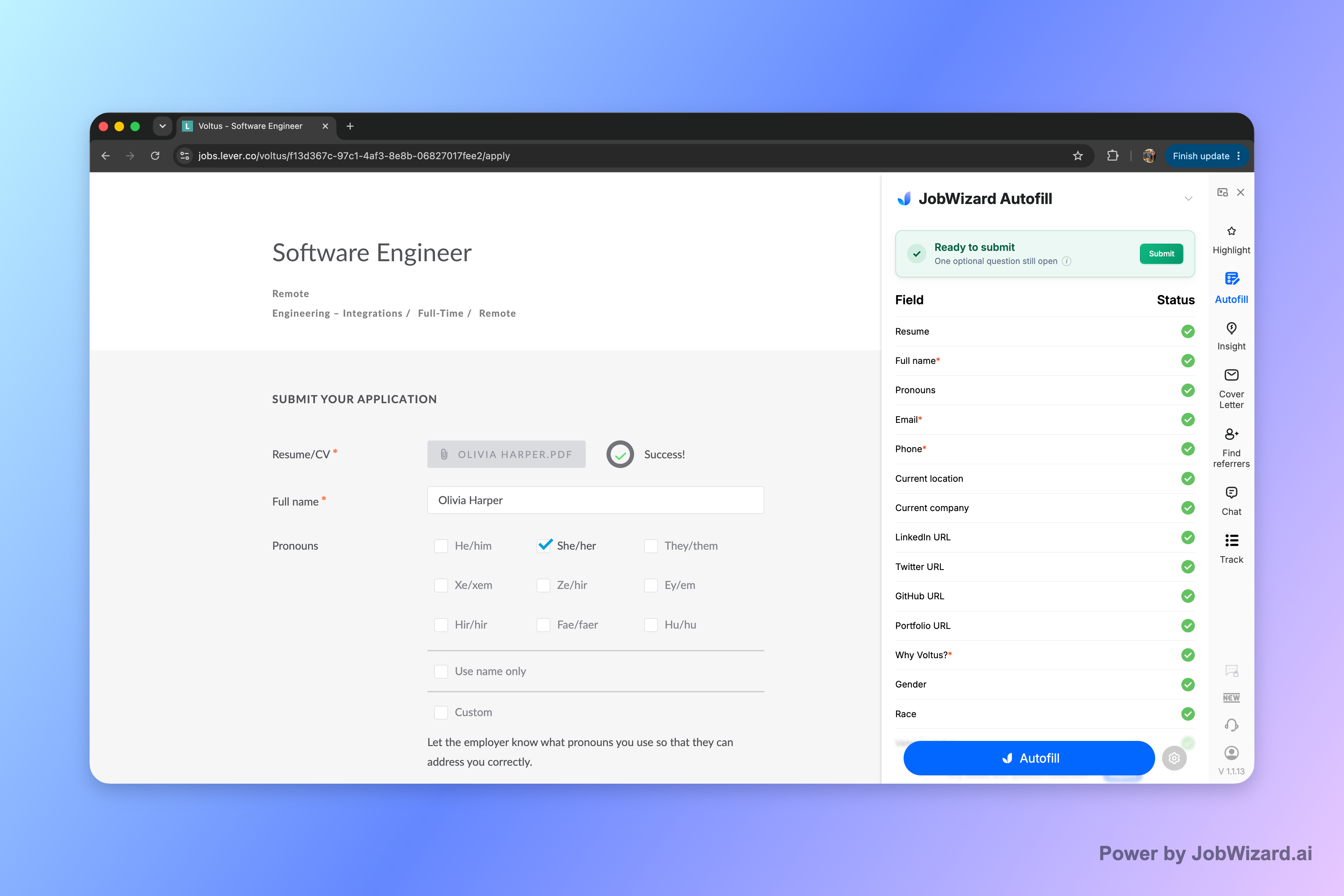
JobWizard takes a different approach: it fills the repetitive fields while keeping the final review and submission in your hands. That means you still control the answers that employers use to screen you.
What goes wrong when bots auto-apply for you
Bot-driven auto apply jobs can backfire because the application is more than a form—it’s a set of screening decisions. When your details aren’t perfectly aligned to the posting, the employer-side evaluation can be unforgiving.
- Wrong answers to screening questions: Many applications include role-specific filters (availability, eligibility, experience with a tool, work authorization, etc.). A bot can guess incorrectly or reuse stale responses.
- Mismatched resumes or versions: If the bot selects a generic resume or the “closest match” instead of the best-fit version for the specific job, you can look misaligned.
- Employer-side spam or quality filters: Repetitive, bot-like submissions can trigger anti-spam or low-quality heuristics. Even when the content is “technically filled,” it may not read like a tailored application.
- Damaged perception with companies you actually want: If you apply to the same employer with inconsistent details, it can reduce trust. Hiring teams remember patterns, especially for smaller or competitive funnels.
None of this requires “malice” from you—just automation that doesn’t guarantee that every job-specific answer is correct. And because you don’t review, those mistakes are harder to catch early.
Why “autofill + review-before-submit” is usually the smarter compromise
If your goal is speed, the key is separating repetitive form filling from final responsibility. With review-first autofill, you get the fastest part of the job—completing repeated fields—without surrendering control of the answers that matter.
JobWizard autofills fields on the application you’re already on, and you review before submitting. When a required field still needs attention, JobWizard can identify it and let you jump to the matching question, so you’re not hunting through the form.
Across JobWizard usage, users submit 720,000+ applications and run 600,000+ autofill sessions—so the workflow is built for “fill fast, then check before submit.”
In other words, you can still move quickly, but you’re not betting your candidacy on a bot getting every job-specific detail right.
Job application tools: what to choose instead of blind auto-applying
Not all “apply faster” tools work the same way. The right choice depends on whether you can keep a review step and ensure job-specific answers are accurate.
| Approach | What it typically does | Where risk appears | Best fit for |
|---|---|---|---|
| Auto-apply (submits for you) | Attempts to submit automatically | Wrong screening answers, mismatched resume, and quality/spam signals | Generally not recommended for jobs you really want |
| Review-first autofill (like JobWizard) | Fills detected fields, then you submit | Lower—because you can catch errors before submission | High-volume searching where accuracy still matters |
| Manual apply | You enter everything yourself | Lower screening mistakes, but higher time cost | When customization is high priority and you have time |
For many job seekers, the best workflow is: autofill the repetitive fields in seconds, then pause for a careful final pass. If you want more context on the autofill approach, see How to Autofill Job Applications (Step-by-Step with JobWizard).
If you’re specifically comparing different behaviors, this guide explains the difference between auto applying for jobs and an auto apply jobs review-first alternative.
And if you’re evaluating tool options, use a checklist mindset. For example, Simplify Jobs Pricing: a no-surprises checklist for application autofill tools can help you compare offerings based on what matters to your workflow—especially clarity on how the autofill experience works.
Do this automatically with JobWizard
Skip the manual work — JobWizard's Smart Autofill handles this for you.
FAQ: Is auto applying to jobs a good idea?
Is auto applying to jobs a good idea if it saves time?
It can feel faster, but bot submissions often fill the wrong details (especially screening answers) or mismatch your resume to the posting. A safer approach is autofill the repetitive fields quickly, then review every answer before you submit.
What are the most common problems caused by auto-apply bots?
Common issues include incorrect responses to screening questions, uploading or selecting the wrong resume/version for a specific job, and triggering employer-side anti-spam or quality filters. That can waste your chance with companies you actually want.
How is review-first autofill different from auto applying?
With review-first autofill, the tool fills detected fields on the application for speed, but you stay in control: you review the populated answers and submit yourself. If something required still needs attention, you can jump directly to the matching question.
Will auto apply bots hurt my reputation with employers?
They can. If your applications contain mismatched or inconsistent details, employers may associate you with low-quality submissions. Even if it’s “just one click,” repeated bot-like applications to a company you care about can make you look careless.
What should I check before submitting an autofilled application?
Before submitting, verify screening answers, confirm the resume is the correct version for the job, double-check work history dates/roles, and review any custom questions. Your goal is to keep speed for repetitive fields while making your final answers accurate.
Ready for a faster workflow that still keeps you in control? Try JobWizard autofill on your next application: let it complete the repetitive fields, then review every answer before you submit.
Frequently Asked Questions
Autofill your next job application
JobWizard is a free Chrome extension that fills applications, tracks statuses, and optimizes your resume.