How to Write a Consulting Cover Letter That Sounds Like You (and Gets Read)
Learn how to write a consulting cover letter with a clear story, sharp structure, and an AI-assisted first draft you edit to fit your experience—without sounding generic.
Free Chrome extension
Generate this cover letter automatically
JobWizard drafts a tailored letter from your resume and the job description in seconds — free.
If you’re applying to consulting roles, a consulting cover letter can be the difference between “received” and “read”—because it needs to show impact, judgment, and communication fast. The challenge: most letters become summaries of your resume, not persuasive case-style proof.
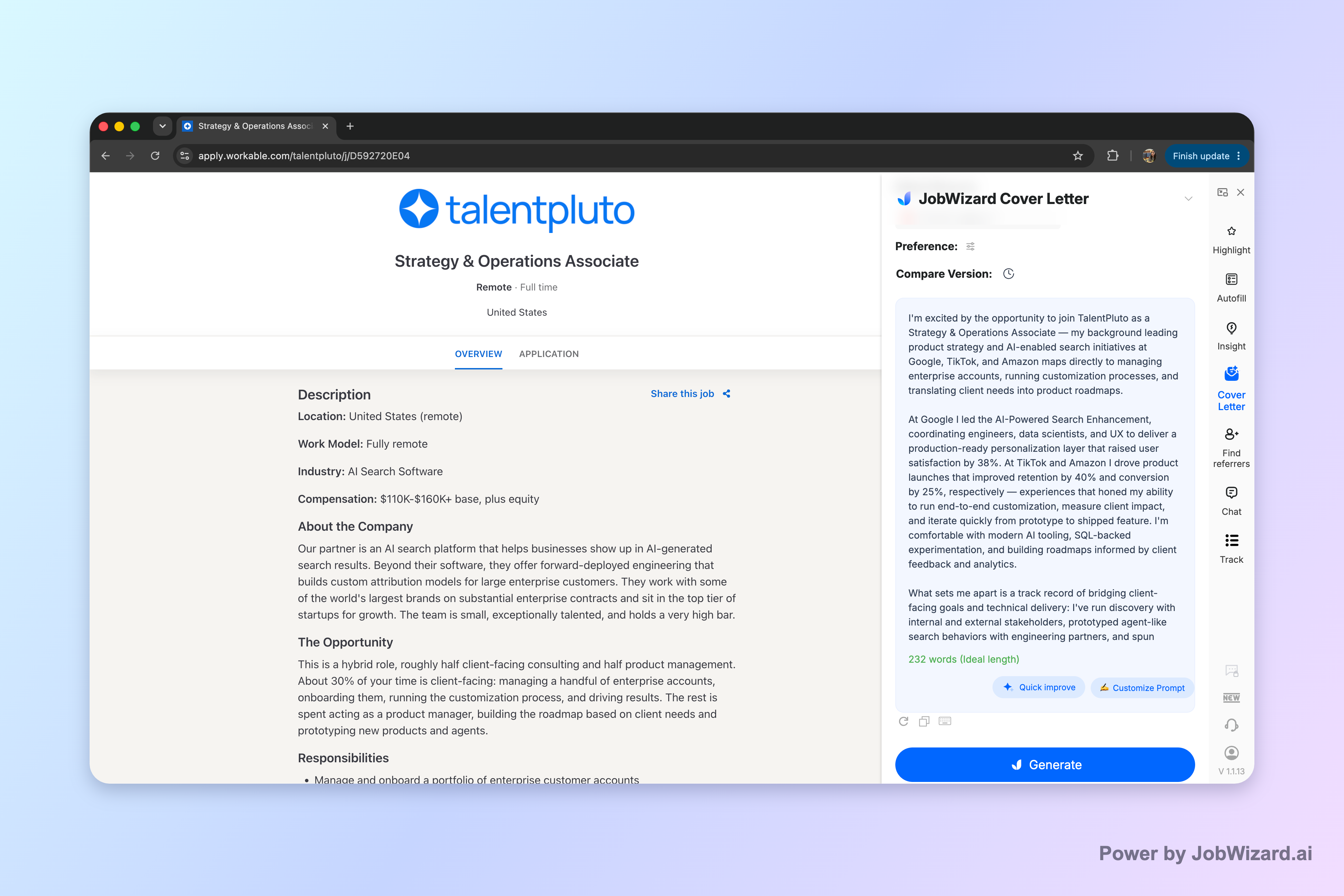
JobWizard can help you start with a first-draft consulting cover letter that’s editable. It generates the draft using your selected resume and the current job description, and you can choose length, format, tone, style, and focus—then you review and edit before using it.
What a consulting cover letter should prove (in under a page)
A consulting cover letter should quickly prove you can handle ambiguous problems, communicate clearly, and deliver measurable value. Hiring teams don’t just want “experience”—they want evidence that you can think like a consultant and operate with stakeholders.
That means your opening should sound like a pitch, not a bio. Instead of “I’m passionate about consulting,” aim for a sharper value story: what you’ve done, what changed because of it, and why you’re built for this role.
A simple target: “Value + Fit + Proof”
- Value: A crisp statement of what you deliver (speed, rigor, stakeholder management, turnaround, growth, cost reduction, etc.).
- Fit: Why this firm/team/role specifically—based on the job description priorities.
- Proof: Two to three examples with concrete details (what you did, how you approached it, what happened).
When your letter hits those three elements, it reads like a mini case—exactly what consulting hiring signals expect.
Consulting cover letter structure that hiring teams skim
You’ll rank higher with a consulting cover letter format that is scannable: short paragraphs, specific examples, and a confident close.
Use this structure (and keep it tight)
- Hook / value proposition: 2–3 sentences that name the kind of impact you’ve driven.
- Why this role: Bridge your background to the job’s top priorities.
- Proof point #1: A project that demonstrates analysis or problem-solving.
- Proof point #2: A project that demonstrates stakeholder communication or leadership.
- Proof point #3 (optional): A third example that matches a role requirement (e.g., research, transformation, go-to-market support).
- Close / next step: A confident final sentence that invites consideration and emphasizes fit.
Keep paragraphs to 1–3 sentences each. If your letter requires a “read twice” effort, it’s probably too dense.
Map examples to the job description (without copying it)
Take the role description and identify 2–3 recurring priorities (for example: “market analysis,” “client communication,” “strategy implementation,” “stakeholder management,” “data-driven recommendations”). Then mirror those priorities with your own story.
Tip: if a job posting says “cross-functional stakeholders,” don’t just claim you worked with stakeholders—name the groups (operations + finance + product, clients + internal teams, executives + analysts). Specificity is what prevents a generic letter.
What to write in each section (with consulting-ready examples)
The fastest way to improve a consulting cover letter is to write section drafts that sound like you, then tighten them into proof-based sentences.
1) Opening hook (2–3 sentences)
Bad: “I am a motivated professional with a strong interest in consulting.”
Better: “I helped a cross-functional team reduce cycle time by redesigning the workflow and rebuilding the metrics dashboard used in weekly leadership reviews. I’m applying that same mix of structured analysis and stakeholder communication to support the strategy and execution work described in your role.”
The best openings do two things: they summarize impact and signal how you work.
2) Why this role (bridge, not a biography)
Bad: “I’ve always wanted to work in consulting.”
Better: “Your focus on data-driven recommendations and client-ready deliverables matches my background in turning ambiguous inputs into clear options and next-step plans. In my most recent work, I translated research findings into decision-ready recommendations for stakeholders who needed a fast, defensible path forward.”
Notice the language: it points to priorities, then points to behavior.
3) Proof point #1 (analysis / problem-solving)
Use the “Situation → What you did → How → Result” pattern, but keep it short.
Example: “When our team faced inconsistent performance metrics, I led a cleanup and redefinition of the data model and built a repeatable reporting process. I ran gap analysis, aligned definitions with stakeholders, and created a standard template that reduced back-and-forth during reviews. The result was faster decision-making and fewer reporting errors across the cycle.”
4) Proof point #2 (stakeholders / communication)
Consulting isn’t only analysis—it’s communication under constraints.
Example: “I partnered with leadership and functional owners to present options and tradeoffs in a way that improved alignment. I created concise summaries for executives, documented assumptions and risks, and facilitated feedback loops so decisions moved forward without losing analytical rigor.”
5) Proof point #3 (optional, role-specific)
If the posting emphasizes something specific (e.g., transformation, growth strategy, operations improvement), include a third example that directly reflects it.
Example: “For a growth initiative, I supported go-to-market research by synthesizing customer and competitor information into a decision-ready narrative. I collaborated with product and marketing to turn findings into prioritized recommendations and tracked performance indicators after implementation.”
Closing (confident and specific)
Bad: “Thank you for your time. I look forward to hearing from you.”
Better: “I’d welcome the opportunity to discuss how my approach to structured analysis and stakeholder-ready communication can support your team’s work on strategy and execution. Thank you for your consideration.”
Draft faster with AI—then edit like a consultant
You can start quickly with an AI-assisted consulting cover letter draft, but the quality comes from your review. The goal is not blind submission—it’s faster iteration with your real details.
How to use an AI draft workflow (without losing authenticity)
- Choose the right starting inputs: Use your selected resume and the current job description.
- Select length, format, tone, style, and focus: Match the letter to the role and your voice.
- Generate an editable first draft: Use it as a structure and phrasing scaffold.
- Review-before-submit: Confirm facts, replace any vague claims, and add genuine personal details.
- Make it consulting-ready: Tighten proof points, remove filler, and ensure your examples map to the job’s priorities.
As you edit, double-check each statement: if it can’t be defended in an interview, it doesn’t belong in the letter. Consulting letters read like credibility tests—your job is to pass them.
Common “AI-like” problems to fix immediately
- Generic verbs: Replace “helped” / “worked on” with actions that show ownership (led, designed, rebuilt, evaluated, presented).
- Missing specifics: Name stakeholder types and what decision the project influenced.
- Too much summary: Cut down your resume recap; expand one or two proof points.
- Wrong tone: Ensure the tone is confident, clear, and professional—never overly casual or overly grand.
If you want a broader workflow for cover letters with AI, see How to Write a Cover Letter with AI (Step-by-Step That Still Sounds Like You). And if you’re applying for a role with heavy technical communication, you may find useful ideas in Engineering Cover Letter That Gets Read: a Draft + Editing Checklist for Real Proof.
For education-adjacent roles (where consulting-like communication and tone matter), this checklist can also help with voice: Teacher Cover Letter That Gets Read: Use This AI-Helped Draft + Tone Checklist. If you’re refining your overall application package, review CV vs Cover Letter: What Recruiters Expect—and How to Use Both to keep your narrative consistent across documents.
Do this automatically with JobWizard
Skip the manual work — JobWizard's AI Cover Letters handles this for you.
FAQ about writing a consulting cover letter
What makes a consulting cover letter different from other cover letters?
Consulting cover letters usually lead with a crisp value story (impact + how you think), then prove fit with 2–3 specific examples that show analytical work, stakeholder communication, and problem-solving. Keep it concise, confident, and structured—hiring teams expect clarity over long narratives.
How should I structure a consulting cover letter for top firms?
A strong structure is: 1) hook/value proposition in the first 2–3 sentences, 2) a short “why you / why them” bridge, 3) 2–3 proof points mapped to the role’s priorities, 4) a closing that signals next steps. Use clean cover letter format with short paragraphs and no fluff.
Can I use AI to draft a consulting cover letter?
Yes—use AI to generate an editable first draft based on your selected resume and the current job description. Before sending, review every claim, add genuine personal details, and adjust tone and emphasis so the letter still sounds like you and matches the exact role.
Should I mention metrics in my consulting cover letter?
Whenever you can, include measurable outcomes (even if you only have partial numbers) to demonstrate impact. If you don’t have metrics, describe scope and results qualitatively—what changed, how you contributed, and what evidence you can point to during an interview.
How do I avoid sounding generic in a consulting cover letter?
Avoid generic lines by mirroring the job’s priorities in your own words, using specific projects, naming the kinds of stakeholders you worked with, and tailoring your “problem-solving” story to the firm’s work. Read it out loud and replace any sentences that feel interchangeable across roles.
Quick reminder: An AI draft is a starting point. The user reviews and edits so the final consulting cover letter matches your real experience and the specific role.
Ready to draft your consulting cover letter in minutes?
If you want a faster starting point that still ends with a letter that sounds like you, generate an editable draft for the current job description in JobWizard—then review-before-submit to confirm facts and add genuine personal details.
Start with JobWizard now and build a consulting cover letter you can confidently tailor for each application.
Frequently Asked Questions
Generate this cover letter automatically
JobWizard drafts a tailored letter from your resume and the job description in seconds — free.