Architecture Cover Letter That Gets Interviews: A Concrete Draft + Editing Workflow
Learn how to write an architecture cover letter that fits the role and sounds like you. Use a workflow to draft, edit, and tailor quickly—without faking details.
Free Chrome extension
Generate this cover letter automatically
JobWizard drafts a tailored letter from your resume and the job description in seconds — free.
If you’re applying to architecture roles, your architecture cover letter has one job: translate your experience into exactly what that firm needs—fast. The best drafts don’t sound like templates; they read like a real person who understands the project type, the collaboration style, and the technical focus in the posting.
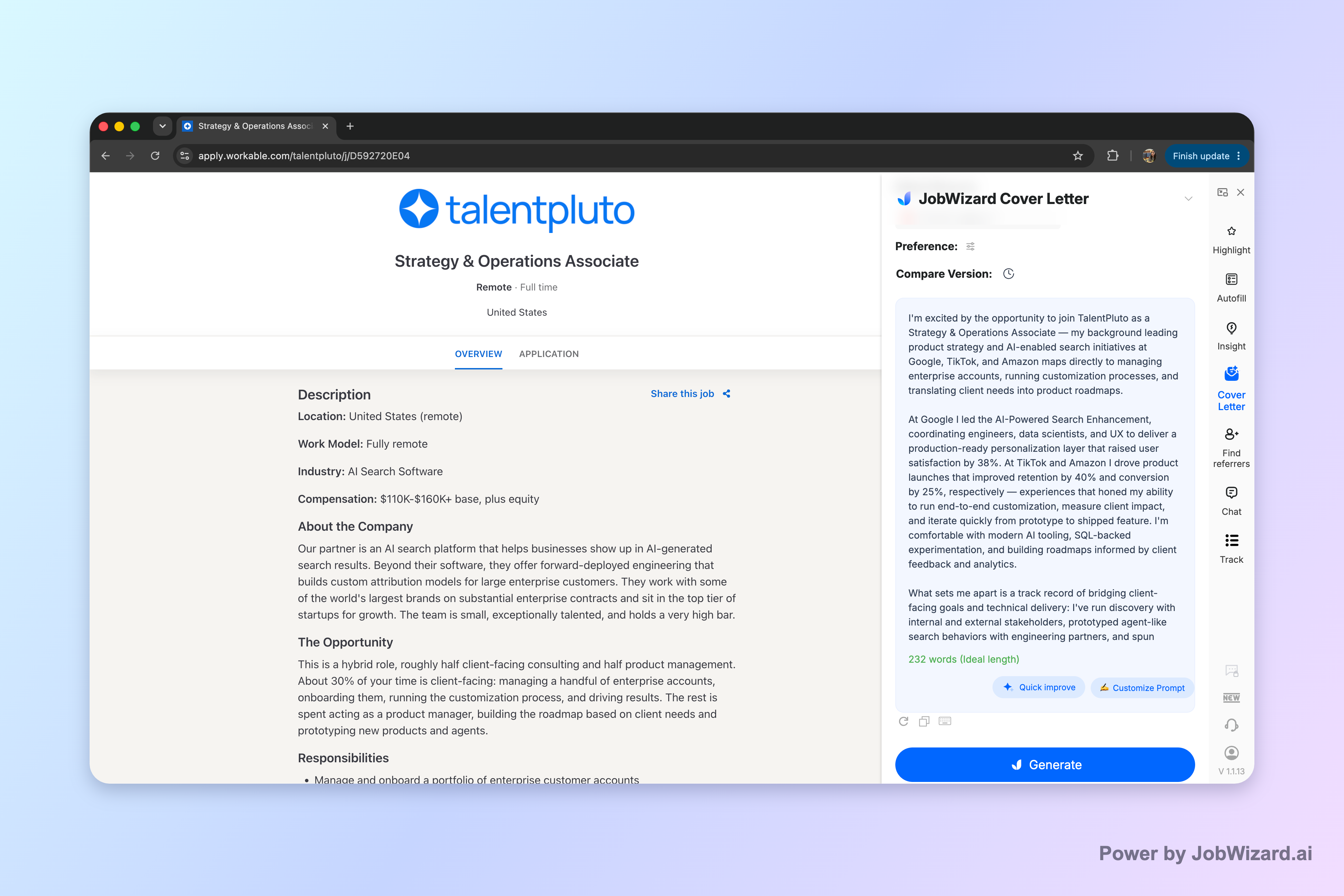
JobWizard can help you start from your materials and the job posting by generating an editable first draft you can tailor before you submit—so you’re not staring at a blank page or rewriting the same paragraphs every time.
What an architecture cover letter should accomplish (and how to structure it)
Your architecture cover letter should prove fit in three steps: show relevance, give role-specific proof, and close with a next action. Don’t try to “cover everything”—choose the details that match the job description most closely.
Use this structure to keep your letter skimmable and targeted.
- Opening (3–4 lines): Name the role and firm, then state why this opportunity matches your experience (design, technical delivery, client coordination, research, etc.).
- Proof (6–10 lines total): Add 2–3 specific evidence points tied to the posting—tools (e.g., Revit/BIM), project phase (schematic/design development), team contribution (coordination, documentation, design iterations), and collaboration.
- Fit (2–4 lines): Explain how your working style aligns with the firm’s work (creative problem-solving, rigorous documentation, sustainable design approach, fast iterations, QA discipline).
- Close (2–3 lines): Invite review of your portfolio or availability for an interview, and thank them for their time.
Quick check: if a recruiter could remove your resume and still understand why you’re a match, you did it right. If they can only find your dates and job titles, you need tighter proof and more job-specific language.
Architecture cover letter example: a draft you can adapt
Use this architecture cover letter draft as a base, then customize the bracketed parts with real project details and the exact focus from the posting.
Subject line (optional): Application for [Role Title] — [Your Name]
Opening paragraph: Hello [Hiring Manager Name/Team], I’m writing to apply for the [Role Title] position at [Firm Name]. My experience in [design/technical delivery/project type] and my approach to [collaboration/design process/coordination] align closely with what you’re seeking, especially around [specific requirement from posting].
Proof point #1 (project + phase): In my recent work on [Project Name or Type] during [phase—e.g., design development/CD/DD], I contributed to [what you actually did: schematic studies, design iterations, documentation support, BIM coordination, detail refinement]. I focused on [detail: coordination accuracy, constructability, design intent, stakeholder alignment], and we used [tool/process] to keep iterations moving.
Proof point #2 (tools/technical scope): I’m comfortable working with [Revit/BIM/AutoCAD/SketchUp/Rhino/others as applicable] and supporting deliverables across [deliverable types: plans/elevations/details/render-ready sets/permit documents]. When teams needed clarity, I helped by [example: organizing families, resolving model clashes, producing detail sheets, standardizing layers/specs] so the design stayed consistent from concept through documentation.
Proof point #3 (collaboration + outcomes you can defend): Beyond technical work, I enjoy partnering with [architects/engineers/clients/project managers] to translate feedback into usable next steps. For example, after [feedback moment—client request/coordination issue/internal review], I [your action], which resulted in [keep this grounded—e.g., a revised set ready for review, fewer coordination loops, clearer documentation—no “guaranteed” claims].
Fit paragraph (your voice + their priorities): I’m drawn to [Firm Name] because your work on [their project type/values] reflects the kind of design process I value: [specific trait—detail discipline, thoughtful iteration, sustainable thinking, rigorous review]. I’d welcome the chance to bring my strengths in [2 skills from posting] to your team.
Close: Thank you for your time and consideration. I’d love to discuss how my experience in [role-relevant area] matches your needs. Please find my portfolio at [link if applicable], and I’m available for an interview at your convenience.
If you want to speed up tailoring, treat the bracketed items like a checklist—swap them quickly, then read once out loud to make sure it sounds like you. That one pass catches the most common “AI-ish” wording and tense drift.
How to tailor an architecture cover letter to the job posting (fast, but real)
Tailoring is where the architecture cover letter wins—because it connects your background to their exact workflow and priorities. The goal isn’t to use every keyword; it’s to use the most meaningful ones, with evidence.
Try this repeatable editing workflow for each application.
- Extract the “must-have” clues: Identify 3–5 requirements in the posting (tools, project phase, collaboration needs, deliverable types, sustainability focus).
- Pick 2 proof points you can verify: Choose examples from your resume/portfolio that directly match those clues.
- Rewrite the “proof” sentences, not your whole letter: Keep your structure, swap the details, and adjust the verbs to match what you actually did.
- Match their tone with your natural language: If they emphasize precision, tighten your phrasing. If they emphasize ideation, keep it creative but specific.
- Do a “name + phase” final scan: Ensure you used the correct role title, firm name, and project phase (common mismatch: design development vs. documentation).
Use the job posting as your editing map. For architecture roles, the most persuasive letters usually include one sentence that answers: “What will you be doing in the first 30–60 days?” (e.g., supporting documentation sets, coordinating model updates, producing design development drawings, preparing details for review).
For broader guidance on cover letter style and length, you may also want to review How to Write a Cover Letter with AI (Step-by-Step That Still Sounds Like You) and Should a Cover Letter Be One Page? Use This Length Rule (and When to Break It).
Using AI to draft your architecture cover letter—without losing your voice
AI can speed up your first draft, but your review is what turns it into a credible architecture cover letter that reads like you.
JobWizard generates an editable cover letter draft using your selected resume and the current job description. Before generating, you can choose length, format, tone, style, and focus. Then you can click into the draft and edit it directly—so you can validate claims, add genuine personal details, and make sure the examples align with your portfolio.
What to edit right away (before you send):
- Facts: Confirm project names, tools, and phases match your real experience.
- Specifics: Add 1–2 concrete moments (a coordination challenge, a design iteration, a stakeholder request) that you can explain confidently.
- Your voice: Replace any overly formal or generic lines with phrasing you’d actually say in a conversation.
- Role alignment: Mirror the posting’s work type (documentation vs. ideation vs. coordination) in your proof points.
If you’re writing multiple letters, keep a simple “customization checklist” at the top of your draft document. It prevents “almost tailored” letters that miss the most important requirements.
For a different letter style you can learn from, you might also compare against templates like Sales Cover Letter That Gets Read: A Personal Template + AI Draft Workflow—then adapt the structure to architecture evidence (projects, tools, and collaboration, not revenue claims).
Architecture cover letter mistakes that quietly cost interviews
A strong architecture cover letter avoids the errors that make readers stop halfway: vague claims, mismatched details, and resume repetition.
Common issues to watch for:
- Generic openings: “I’m passionate about architecture” without immediate proof of fit.
- Resume recap instead of narrative: Listing job titles and responsibilities without connecting them to the role’s requirements.
- Unverifiable project bragging: Claims you can’t explain or measure in your portfolio.
- Tool mismatch: Mentioning software you didn’t use on relevant deliverables—or skipping the tool the firm emphasizes.
- Wrong phase vocabulary: Using “concept” language for a documentation-focused role (or vice versa).
Before you submit, do a “portfolio alignment pass.” Every major proof point should correspond to something you can show or describe in your portfolio. If it can’t, rewrite it to reflect what you can actually present.
If you want examples for different roles and industries, you can also review Retail Cover Letter Examples That Match the Job (With a Draft Plan You Can Edit in Minutes and reuse the editing mindset—then bring it back to architecture specifics.)
Do this automatically with JobWizard
Skip the manual work — JobWizard's AI Cover Letters handles this for you.
FAQ
What should an architecture cover letter include besides my resume?
Include a brief “why this firm/role” opening, 2–3 proof points tied to the job description (projects, tools, specialties), and a clear close that matches the hiring context (review meeting, portfolio follow-up, timeline). End with genuine specifics you can stand behind—your voice matters more than broad claims.
How long should an architecture cover letter be?
Aim for one page unless the posting asks otherwise. If you’re short on space, prioritize the most job-relevant project evidence and keep the rest to concise, outcome-free details.
What tone works best for an architecture cover letter?
Professional, confident, and specific. Use a direct, human tone—avoid generic phrases like “I am passionate about architecture” unless you immediately back it up with the project or collaboration that proves it.
Should I use AI to draft my architecture cover letter?
Yes—if you use AI to generate an editable first draft and then review it carefully. JobWizard generates a draft using your selected resume and the current job description, and you can choose length, format, tone, style, and focus. Before you use the draft, you should verify facts and add genuine personal details.
What are common mistakes to avoid in an architecture cover letter?
Don’t repeat your resume line-by-line, don’t make unverifiable claims, and don’t ignore the posting’s keywords (e.g., Revit/BIM coordination, design development, client-facing work). Also, avoid generic “everyone says” statements—replace them with 2–3 concrete, role-relevant examples from your experience.
Ready to write your next architecture cover letter faster? Generate an editable draft for the current job description in JobWizard, then tailor the proof points and details using your portfolio—so you submit something specific, accurate, and unmistakably you.
Frequently Asked Questions
Generate this cover letter automatically
JobWizard drafts a tailored letter from your resume and the job description in seconds — free.