Should a Cover Letter Be One Page? Use This Length Rule (and When to Break It)
Wondering should a cover letter be one page? Here’s the practical rule recruiters expect, plus examples of when 3/4 to 1.5 pages is a better fit.
Free Chrome extension
Generate this cover letter automatically
JobWizard drafts a tailored letter from your resume and the job description in seconds — free.
Should a cover letter be one page? In most US hiring situations, yes—one page is the safest length because it’s easy to skim and hard to over-explain. But the better question is: will your letter stay focused, specific, and readable within that space?
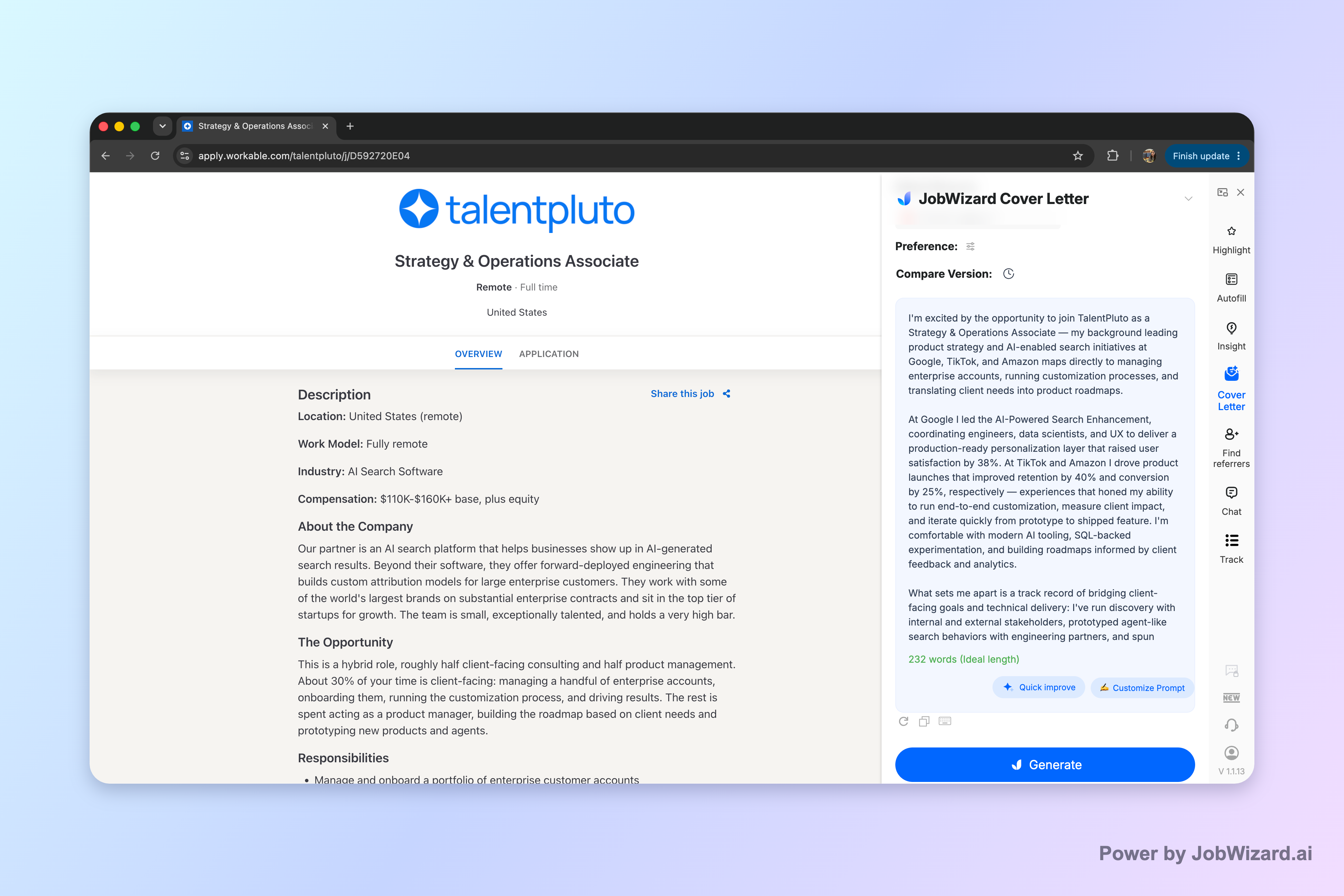
With JobWizard, you can generate an editable cover letter draft using your selected resume and the current job description. You can also choose the length, format, tone, style, and focus before you edit it into your final version.
The best default answer: should a cover letter be one page?
For most applicants, the practical rule is one page: about 250–400 words, depending on formatting. That length forces you to prioritize the most relevant story—your fit—without turning your cover letter into a second résumé.
Recruiters and hiring managers often scan quickly, especially early in screening. A one-page cover letter tends to signal that you can communicate clearly and respect the reader’s time—while still giving you room for personality and context.
What “one page” really means in practice
“One page” isn’t a magic number—it’s a readability target. If your font, margins, and spacing expand, your word count capacity changes. Aim for a letter that looks intentional and breathable, not cramped.
- Write to the job, not to your entire career.
- Keep the structure simple: opener, fit + evidence, closing.
- Use bullets sparingly if you include them at all (many prefer paragraphs).
Fast checklist for a one-page outcome
Before you decide your final length, run this quick test:
- Does every paragraph answer “why this job, why you”?
- Do you include 1–2 concrete examples (a result, a project, a measurable outcome, a specific task you did well)?
- Can a skimmer grasp your value in 15–20 seconds?
How to structure a one-page cover letter (so it doesn’t feel rushed)
The easiest way to stay at one page is to use a predictable structure with strict paragraph goals: opener + evidence + close. You’ll still sound personal, but you won’t drift into unrelated details.
Paragraph-by-paragraph blueprint (works for almost any role)
Here’s a reliable template you can adapt to your experience:
- Opener (2–3 sentences) — the job you’re applying for and the specific reason you’re interested.
- Fit (3–5 sentences) — your relevant skill/strength, phrased as value, not just credentials.
- Evidence (4–6 sentences) — one or two examples connected to the job’s needs (tasks, outcomes, or systems you used).
- Close (2–3 sentences) — what you’d bring on day one and an invitation to discuss next steps.
Example: one-page tone that feels confident (not generic)
Instead of “I am passionate about helping people and I have strong communication skills,”
Try: “In my current role, I’ve consistently improved client follow-through by simplifying next steps into clear, action-focused guidance. For this position, I’m excited by how your team focuses on fast, accurate support—because I’m comfortable owning communication end-to-end and escalating issues before they become delays.”
The goal: show the reader that you’ve done the work—not just that you want the job.
What to include for one page (and what to avoid)
| Include | Why it helps one-page letters | Avoid | Why it breaks the “one page” rule |
|---|---|---|---|
| 1–2 job-specific examples | Evidence replaces fluff | Every job title you’ve ever held | Turns the letter into a résumé recap |
| Skills tied to outcomes | Shows impact quickly | Lists of responsibilities without context | No proof = more words to “explain” |
| A clear reason for applying | Builds relevance in the first lines | Overly broad mission statements | Sounds copy-pasted and wastes space |
| Direct closing + next step | Ends strong without a novel | Long summaries of your entire career goal | Pulls the letter away from the job |
When a cover letter shouldn’t be strictly one page
Sometimes the most honest answer is: don’t force one page if the posting asks for specific context that you can’t compress without losing meaning.
That said, “longer” doesn’t mean “unlimited.” The difference is substance vs. noise. If you need to add one additional paragraph to explain a major transition or a required project, you can—provided it stays readable.
Scenarios where going beyond one page can be reasonable
- The employer explicitly requests more detail (e.g., a specialized application process, a role that expects deep background, or instructions that signal what they want to read).
- You’re making a complex career shift and the connection genuinely needs a short explanation to prevent confusion.
- The role calls for a specific project or domain context and you only have space for the “headline” in one page—you may need one extra paragraph for the full story.
How to go longer without losing the reader
If you choose more than one page, protect scannability:
- Keep examples tight: what you did, what changed, what you learned.
- Remove duplicate ideas (many letters become longer because they repeat the same claim in different words).
- Use headings only if the format fits—otherwise, stick to short paragraphs.
A useful rule: if your second page feels like it repeats your first page, cut it. If your second page adds new, job-specific value, keep it—then polish it until it reads clean.
How to decide your exact length before you hit “submit”
To determine whether your cover letter should be one page, use a simple decision process: read it as a skimmer, then as a reviewer.
Step 1: Do the skimmer test (10 seconds)
Ask: if someone skimmed only the first line, the middle evidence, and the close—would they understand your fit?
- If the opener is vague, the letter will likely need more space to “explain,” which usually backfires.
- If evidence is missing, you’ll try to compensate with more text (again causing length creep).
Step 2: Do the reviewer test (1 careful read)
Ask: do you stay specific to the job description? Does anything feel like it belongs on your résumé instead?
- Replace claims with proof (a tool you used, a process you improved, a result you delivered).
- Delete filler phrases that don’t add information (especially repeated enthusiasm lines).
Step 3: Use AI responsibly to manage length (and keep your voice)
AI can help you draft faster, but it’s best used as a writing partner, not an autopilot. JobWizard uses your selected resume and the current job description to generate an editable cover letter draft, and you can choose length/format/tone/style/focus before editing. You still need to review facts and add genuine personal details before using it.
If you’re unsure where to start, these role-focused guides can help you draft with the right tone:
- How to Write a Cover Letter with AI (Step-by-Step That Still Sounds Like You)
- Should I Use AI for My Cover Letter? A Practical Guide for Faster, Stronger Applications
Cover letter length examples by job type (so you know what “right” looks like)
Because roles differ, your “one page” target should still match what the reader needs—here are examples that stay concise while covering the essentials.
Example A: Office support / admin roles
Typical one-page target: one opener, one paragraph about reliability and systems, one evidence paragraph, one close.
Evidence you can use: scheduling volume, inbox management, process improvement, reducing errors, or handling prioritization under deadlines.
Example B: Healthcare support roles
Typical one-page target: emphasize patient interaction, accuracy, and coordination. Keep it human but concrete.
If you want a template-style approach, start with a role-specific workflow like this:
Example C: Teaching roles
Typical one-page target: show classroom approach and outcomes with brief examples—avoid long background summaries.
If you want help balancing warmth with specificity, use this guidance as a model:
Example D: “More than one page” case (keep it substance-only)
When it fits: you’re transitioning careers and need one extra paragraph that connects the dots with proof (a project, training, or relevant experience) rather than repeating job-history.
If you add a second page, treat it like a focused add-on: one more evidence block max, then cut anything redundant.
Do this automatically with JobWizard
Skip the manual work — JobWizard's AI Cover Letters handles this for you.
FAQ: should a cover letter be one page?
Should a cover letter be one page for every job?
Not always. For most roles, one page is the safest default, but you can go slightly longer if the posting calls out requirements that genuinely need context (e.g., a project, certification, or measurable accomplishment) and you can still keep it readable.
What should I cut to make a cover letter fit one page?
Cut summaries of your resume, repeated job-history details, and filler phrases. Keep only: (1) why you’re a fit, (2) 1–2 strong examples tied to the job, and (3) a specific closing that invites the next step.
Is it okay if my cover letter is shorter than one page?
Yes—if it’s complete and tailored. A 1/2–3/4 page cover letter can work when every paragraph earns its space and doesn’t sound like you skipped the key connection between your background and the role.
When should a cover letter be more than one page?
Consider more than one page when the employer asks for detailed context (for example: teaching materials, specialized experience, or a complex career shift) and you can add substance without turning it into a mini résumé.
How can AI help me keep my cover letter at the right length?
Use AI to generate an editable first draft based on your selected resume and the current job description, then choose the length/format/tone and edit it. The key is to review facts and add genuine personal details before using it.
Ready to get your cover letter length right (without overthinking)? Generate an editable first draft in JobWizard for the current job description, set the length and tone you want, and then review/edit so every paragraph stays specific to the role.
Frequently Asked Questions
Generate this cover letter automatically
JobWizard drafts a tailored letter from your resume and the job description in seconds — free.