Can a Cover Letter Be Two Pages? When to Go Longer (and How to Keep It Strong)
Can a cover letter be two pages? Yes—sometimes. Here’s how to decide the right length, structure it for impact, and edit like a hiring manager.
Free Chrome extension
Generate this cover letter automatically
JobWizard drafts a tailored letter from your resume and the job description in seconds — free.
Can a cover letter be two pages? Yes—sometimes. But the real question is whether your second page earns its space with new, role-relevant proof instead of repeating your resume.
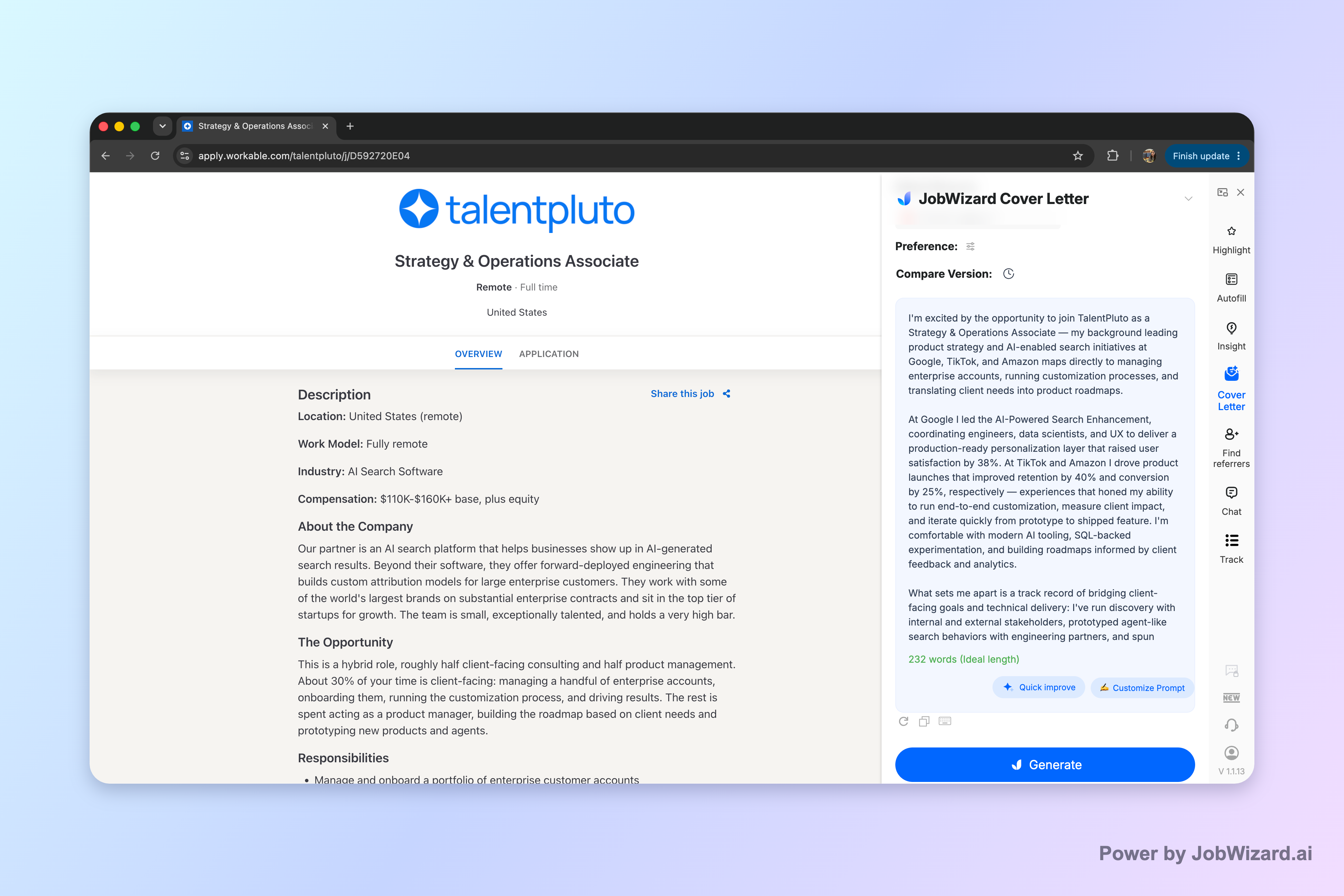
JobWizard can help you draft a tailored cover letter by using your selected resume and the current job description, then letting you choose length and edit the result directly—so you can build a two-page version only when it actually improves clarity and impact.
When “two pages” is a smart choice (and when it’s a risk)
Two pages is worth it when you’re adding new evidence. A longer cover letter can work when you have multiple highly relevant accomplishments, a short context story that directly explains your fit, or specialized skills that need careful explanation.
Two pages can be a risk when page two becomes a “second recap” of your resume. Hiring managers typically skim, and the longer you go without adding fresh information, the more likely your letter loses momentum.
Green lights for going to page two
- You have 2–3 distinct wins that match different responsibilities from the job posting (not just the same win described twice).
- The role requires context (e.g., leadership change, transitioning into a new function, complex domain knowledge where one achievement needs 4–6 sentences of explanation).
- You’re targeting a specific narrative (for example, “how I built X,” “how I improved Y,” or “how I scaled Z”), where the story is too long to fit cleanly in a single page.
- Your resume is strong but dense and a cover letter can translate that density into “here’s why this role is my best match.”
Red flags that usually mean “keep it one page”
- Page two repeats page one (same theme, different wording).
- You’re using generic filler like “I’m passionate” without tying it to job requirements.
- Your examples aren’t selective—you include every project instead of the top ones that prove fit.
- Your second page starts weak (e.g., “Additionally…” followed by non-essential history).
How to structure a two-page cover letter that stays persuasive
Your structure determines whether two pages feel confident or padded. If you’re going to two pages, you need a deliberate split: page one should hook and align, and page two should deepen proof.
A practical two-page outline (that won’t feel like a novel)
Use this as a checklist while editing:
- Opening paragraph: Name the role, explain why this company/team, and summarize the kind of impact you bring.
- Fit paragraph 1: Tie your most relevant experience to the first major responsibility in the job description.
- Fit paragraph 2: Tie your second major experience to the next responsibility; include one concrete result.
- Fit paragraph 3 (start page two): Address a “how” question—your method, tools, approach, or leadership style as it relates to the role.
- Example paragraph (close page two): Provide one more targeted accomplishment or a short narrative that completes the story.
- Closing: Reconfirm interest and make a clear next-step request (interview, conversation, or review of your application).
What to put on page one vs. page two (specific guidance)
Page one should answer: “Why you, why this role, and why now?” That usually means you use your best match early—your strongest story first—so the reader knows you’re not “making your way” to the point.
Page two should answer: “Okay—how exactly will you perform here?” That means focused proof: the experience, metric (if you can truthfully share one), or concrete example that supports each requirement. If you can’t name what you’d do differently in this role, cut the paragraph or compress it.
Concrete example: what changes when you go from 1 page to 2
Example of “good” two-page expansion: On page one, you mention you led cross-functional projects and improved a process. On page two, you add what you actually did—how you gathered requirements, what tradeoffs you made, and one outcome relevant to the job’s responsibilities.
Example of “bad” two-page expansion: On page one, you list three bullet-style achievements. On page two, you restate those same three achievements with synonyms and a new intro sentence—no new details, no additional proof, and no clearer tie to the job.
AI can help you draft a two-page letter—but you still need to edit for “you”
AI is best for drafting and editing speed, not for autopilot writing. JobWizard generates an editable cover letter draft using your selected resume and the current job description, and you can choose length, format, tone, style, and focus before you generate.
What to do before you generate (so page two earns its keep)
- Pick the right focus: If the job emphasizes leadership and stakeholder communication, make that the letter’s theme—not generic “hard work.”
- Select a length that matches your intent: If two pages is truly needed for your best proof, choose it; otherwise, use one page to force prioritization.
- Decide what evidence belongs on page two: Usually one deeper story, one “how I work” paragraph, or one additional targeted accomplishment.
What to do after you generate (so it doesn’t sound generic)
Review-before-you-submit is non-negotiable. JobWizard’s limitation is straightforward: don’t assume AI personalization is “done.” You must review facts and add genuine personal details before using any draft.
As you edit, ask: “Is this paragraph directly responding to a requirement in the posting?” If the answer is no, rewrite or cut. Also remove any claims that you can’t support with your real experience.
Use this quick edit workflow for a two-page draft
- Requirement map: Highlight the top 3–5 responsibilities in the posting.
- Paragraph ownership: Assign one requirement to each paragraph (no duplicates).
- Upgrade claims: Replace vague statements with one concrete example per paragraph (what you did + what changed).
- Eliminate repetition: Scan for the same concept appearing on both pages.
- Read like a skimmer: If your eye can’t “find the point” in under 10 seconds per paragraph, tighten.
Two-page cover letter examples you can adapt (by goal)
Your two pages should serve a specific hiring goal. Here are adaptable formats based on what you’re trying to prove, with the kind of content that typically fits best on page two.
Goal 1: You’re switching into a new function
On page one, focus on your strongest transferable experience. On page two, add a short narrative explaining the transition and one concrete example showing you can do the new work.
- Page two element to add: “Evidence of doing it before” (a project, course, collaboration, or initiative).
- Keep it tight: 1–2 paragraphs total, no long backstory detours.
Goal 2: You’re applying to a role with heavy stakeholder work
On page one, state your leadership/communication fit and summarize impact. On page two, explain your approach to alignment: how you gather input, manage tradeoffs, and reduce confusion.
- Page two element to add: “How I communicate under pressure,” with one real scenario and outcome.
- Avoid overlap: Don’t repeat the same accomplishment introduced on page one—use it as a launching point for method.
Goal 3: You’re senior or specialized and need room for proof
On page one, present your headline capability. On page two, include two targeted proof points that match two responsibilities the job cares about.
- Page two element to add: A deeper explanation of your role in one major achievement (what you owned, what you influenced, what you delivered).
- Make it measurable if you can truthfully share a metric.
Cover letter length checklist: decide now, then write to win
Use this checklist to decide whether two pages is justified. If you can answer “yes” to most items, a two-page cover letter is more likely to land well.
Two-page readiness checklist
- Each page has a different purpose: page one hooks; page two deepens proof.
- No paragraph repeats the same idea: scanning for duplication is part of editing.
- You include role-specific details: you mirror the job’s focus without copying phrasing.
- Every example is selective: you chose the best evidence, not the most memories.
- The second page doesn’t start generic: it begins with value, not filler.
Where to start (templates + role-specific drafts)
If you want structure fast, use a role-focused draft as a baseline and then tailor. These guides can help you build a strong voice and layout before you decide whether you truly need two pages:
- How to Write a Cover Letter with AI (Step-by-Step That Still Sounds Like You)
- Cover Letter Template Data Analyst: a plug-and-play draft you can customize fast (and still sound like you)
- Deloitte Cover Letter: A High-Impact Structure + AI Draft You Can Edit
- Cover Letter for Teaching Post: A Readable, Edit-Ready AI Draft You Can Tailor
Do this automatically with JobWizard
Skip the manual work — JobWizard's AI Cover Letters handles this for you.
FAQ: Can a cover letter be two pages?
Can a cover letter be two pages without hurting my chances?
Yes, it can—if the extra space adds new, role-relevant value. A two-page cover letter works best when you use the first page to hook with fit, and the second page to deepen proof (specific accomplishments, skills in action, or a short narrative that directly matches the job). If page two repeats your resume or doesn’t add new information, it will usually dilute your impact.
What’s the best structure if my cover letter goes to two pages?
Use page one for a strong opening + clear alignment, then use page two to expand with targeted evidence. A practical split is: Page 1 (interest + overview of fit), then 1–2 paragraphs showing the most relevant achievements; Page 2 (more proof + how you’ll contribute to this specific role). Keep paragraphs tight, avoid repeating the same points in different words, and ensure every section ties back to the job description.
How do I know whether a hiring manager expects one page or two?
Start with the job posting. If it explicitly requests a specific length, follow it. If it doesn’t, assume many teams prefer concise letters and only go longer when you genuinely need the extra space to show fit. If your experience is broad, consider prioritizing the top 2–3 most relevant stories and cutting everything else before deciding on two pages.
Should I use AI to write a two-page cover letter, or will it sound generic?
You can use AI to create an editable draft, then tailor it so it sounds like you. JobWizard generates a first draft using your selected resume and the current job description, and you can choose length, format, tone, and focus before editing in your own details. The key is to review and replace any facts or specifics that should reflect your real experience, plus add genuine personalization for the company and role.
What’s the fastest way to edit a two-page cover letter so it still feels “tight”?
Treat it like a proof-and-polish pass: (1) highlight the job’s top requirements, (2) ensure each paragraph maps to one requirement, (3) remove any duplicated ideas from page one to page two, (4) swap vague claims for one concrete example per paragraph, and (5) read for momentum—if a sentence doesn’t help you win the job, cut it or compress it.
Ready to make your “can a cover letter be two pages” decision easier? Generate an editable cover letter draft in JobWizard for the current job description, set the length and tone you want, and then review-before-submit to add your real details—especially the extra proof you plan to place on page two.
Frequently Asked Questions
Generate this cover letter automatically
JobWizard drafts a tailored letter from your resume and the job description in seconds — free.