“What Does Not Retained Mean” After Applying? How to Check Status and Next Steps
Trying to understand what does not retained mean after applying? This guide explains the likely reasons, what to check in your portal, and what follow-up to send next.
Free Chrome extension
Track all your applications in one place
JobWizard auto-tracks status changes across Workday, Greenhouse, and every major job site — free.
You applied, you waited, and then you saw an update that reads: “not retained.” It’s unsettling—because it sounds final, but it’s not always clear what it means or what you should do next.
This article answers what does not retained mean in job application status messages, shows how to confirm what system you’re looking at, and gives you a practical plan (including a follow-up template) to keep moving after the update.
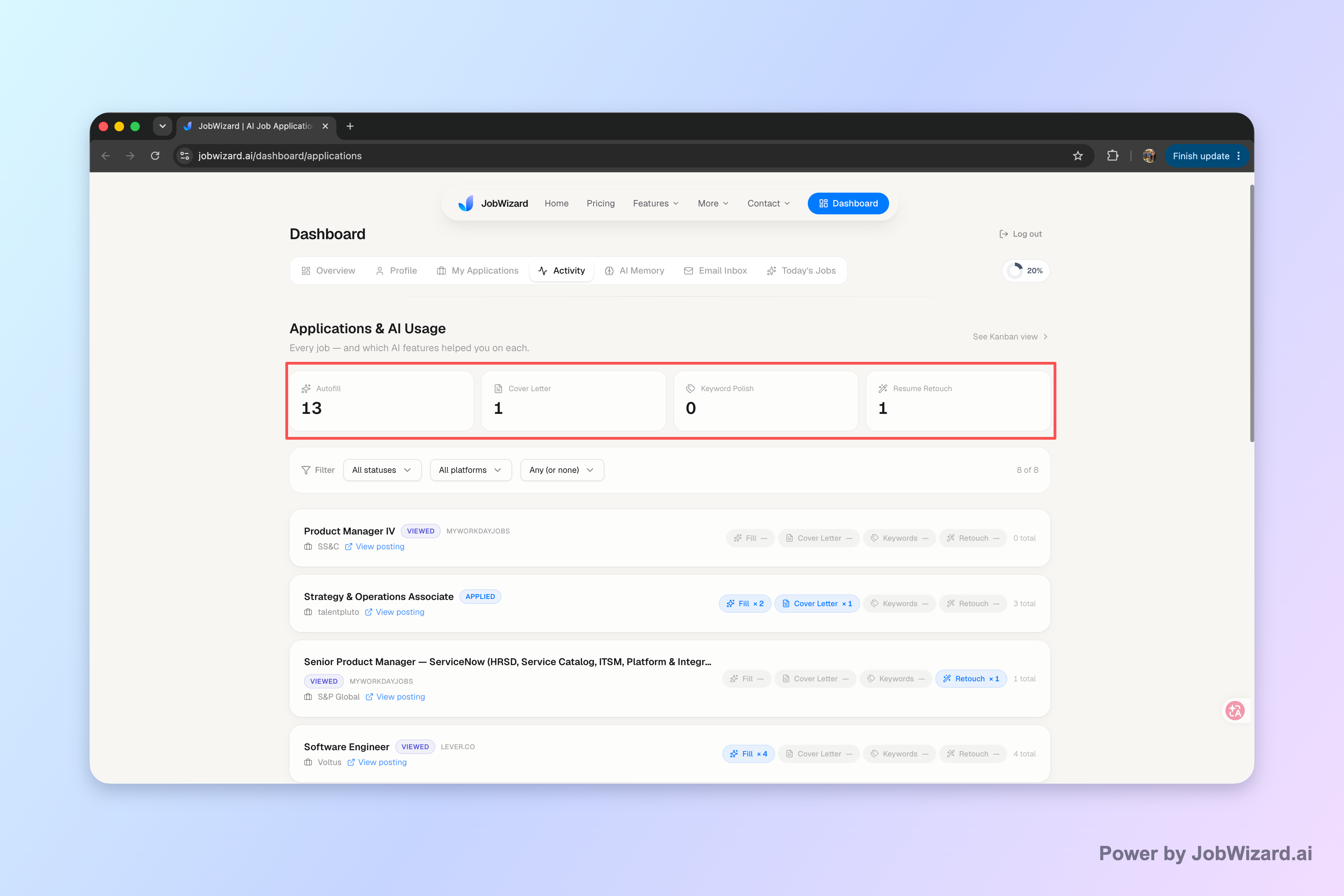
If you’re tracking multiple applications, a single place to see status changes and where you left off can help you avoid guessing. JobWizard’s Activity view shows your application status and which JobWizard tools were used for each role.
What does “not retained” mean after I apply for a job?
“Not retained” usually means your application was not kept for further consideration in that specific hiring process.
In many applicant tracking systems, “retained” is used to describe applications that remain in an active review pool. When your status becomes “not retained,” it typically indicates the process moved on without keeping your application on the active shortlist.
Important nuance: this wording focuses on the disposition of that application in that process—it doesn’t necessarily predict what will happen with you in future roles at the same company. Recruiters may reuse wording differently, and some portals update statuses for administrative reasons as well.
Key takeaway: Treat “not retained” as “not advanced in this posting’s process,” then shift to the next best action—verify details, improve fit, and follow up appropriately (if it makes sense).
What does “not retained” mean in Workday applications?
In Workday-style workflows, “not retained” commonly indicates a disposition decision tied to that job’s candidate review stage.
Workday-based processes often present application outcomes as statuses or dispositions. When you see “not retained,” you’re typically looking at an update that tells you where your application ended up relative to that role’s hiring steps.
Because Workday implementations can vary by company, don’t assume the exact internal logic. Instead, focus on what the portal is communicating: your application did not remain in the active consideration set for that opening.
If you want more context for other Workday phrasing, you may also find this useful: What Does No Longer Under Consideration Mean in Workday? (Fix It Fast).
Key takeaway: When the portal says “not retained,” prioritize next-step planning for that job rather than trying to “interpret” the hidden logic.
What does “not retained” mean compared to “dispositioned” or “rejected”?
“Not retained” is often a softer label than “rejected,” but it still usually signals the application didn’t move forward for that posting.
Different systems use different terms. You may see:
- “Not retained” — your application wasn’t kept for further consideration in that process.
- “Dispositioned” — your application reached a final outcome category (the details vary by employer).
- “Rejected” — the employer or system explicitly labeled it as not moving forward.
From a job seeker perspective, the operational meaning is similar: the job likely won’t be progressing with your candidacy. However, phrasing can change how you approach follow-up—neutral curiosity tends to work better than accusatory “why” questions.
Key takeaway: Don’t get stuck on the exact label—use it to guide your follow-up timing and your application strategy.
What does “not retained” mean versus “in process” or “in progress”?
“In process/in progress” signals active workflow, while “not retained” signals the workflow moved on without keeping you in the active pool.
These are the kinds of status switches that make applicants feel like they missed something. Generally:
- “In process / In progress” — your application is still within review steps.
- “Not retained” — your application was not kept for additional consideration.
- Next action changes — you pivot from waiting to improving, tracking, and planning new outreach.
If you’re comparing other statuses, this guide can help: What Does Application Status In Progress Mean? Here’s How to Check Updates and Next Steps.
Key takeaway: Treat “not retained” as the end of waiting for that posting and the start of your next move.
How can I confirm whether “not retained” is final?
You can reduce uncertainty by checking the portal timestamp, verifying the job posting, and checking for later status changes.
Before reacting emotionally or sending a follow-up too quickly, do three quick checks:
- Confirm the job posting — make sure the status belongs to the correct title/location.
- Look for a “last updated” time — if the portal shows when it changed, that’s your reference point.
- Check again later — some systems can update dispositions if internal decisions shift, but don’t expect it.
If you’re juggling many applications, it’s easy to lose track of what changed when. Consider using a tracker to keep context—then you only follow up when it’s genuinely time to do so.
Key takeaway: Verify the status applies to the right posting and note the update time before you decide what to send next.
What should I do next after I see “not retained”?
The best next step is to shift from waiting to improving your materials and creating a clear plan for your next applications.
Here’s a practical sequence you can follow after you see “not retained”:
- Update your resume for the exact role — mirror the job’s responsibilities and required skills in your experience bullets.
- Adjust your cover letter (if used) — focus on 2–3 proof points that match the role’s goals.
- Apply to similar, newer postings — if the job is closed to further consideration, a new posting is usually your best entry point.
- Decide whether to follow up — follow-up can be appropriate, but it should be short, polite, and not demand an outcome.
- Track everything in one system — so you don’t re-email the same recruiter repeatedly or miss a later change.
For a broader system approach, use this as your reference: How to Track Job Applications: A Practical System (JobWizard + Beyond).
Key takeaway: “Not retained” is information, not a verdict on your overall career—use it to iterate and re-target quickly.
Should I reapply to the same job after “not retained”?
In most cases, reapplying to the exact same posting won’t change the outcome because the process has already dispositioned your candidacy.
What you can do instead:
- Reapply only if the employer reopens the posting or explicitly invites updated applications.
- Apply to new roles that match your improved materials (even if they’re close variants of the same job).
- Take the “not retained” lesson forward — revise the resume for the missing skills or keywords you see emphasized in the posting.
If your application status messages are showing other “stop” signals, you may also want to review: What Does No Longer Under Consideration Mean in Workday? (Fix It Fast).
Key takeaway: Re-target with updated materials rather than reapplying to the same dispositioned posting.
How do I follow up after “not retained” without sounding pushy?
Follow up by being brief, appreciative, and improvement-focused—not by demanding a decision.
Use follow-up when you can add something helpful: a clarification, updated resume, or a short note on a relevant match. Avoid “Did I get rejected?” language. Instead, ask whether there’s anything they need from you to consider future opportunities.
Follow-up email template (copy/paste)
Subject: Follow-up on [Job Title] — [Your Name]
Hi [Hiring Manager/Recruiter Name],
I hope you’re doing well. I wanted to follow up regarding my application for the [Job Title] position on [Date Applied].
If it’s still useful, I’d be glad to share any additional information that would help your team evaluate my fit—especially around [1–2 relevant strengths from the job posting].
Thank you for your time and consideration. I appreciate any guidance on whether there’s a better way to be considered for future roles at [Company].
Best regards,
[Your Name]
[Phone] | [LinkedIn] | [Portfolio/GitHub, if applicable]
If you’re also trying to understand other application signals, don’t confuse “viewed” indicators with disposition outcomes. For example, some platforms use color-coded “viewed” updates—here’s a relevant reference: indeed application viewed blue vs green: what the colors mean and what to do next.
Key takeaway: A good “not retained” follow-up asks how to improve fit for future consideration—without pressuring for a reversal.
How can tracking help after “not retained,” especially if you apply often?
Tracking gives you context—so when “not retained” appears, you know exactly what you submitted and what you should do next.
The biggest mistake after a status update is responding without context. Did you apply yesterday or two months ago? Did you submit one version of your resume or updated it? Was there a recruiter you already emailed?
Job tracking helps you keep the timeline straight. JobWizard’s Activity view is designed to show application status and which JobWizard tools were used for each role—so you can review your workflow and make deliberate next steps rather than guessing.
Key takeaway: After “not retained,” use tracking to pivot efficiently: revise, re-target, and follow up only when it’s the right moment.
What if “not retained” is showing for multiple applications—does it mean something about me?
Not necessarily—multiple “not retained” updates often reflect process timing, role fit, and how postings are structured.
When several applications show “not retained,” common non-personal reasons include:
- Mismatch to the job’s immediate requirements — e.g., the posting emphasizes a specific tool or domain.
- High applicant volume — some roles move quickly from early screening.
- Different selection criteria per role — “close” profiles can still miss the exact keyword or experience emphasis.
What to do instead of spiraling: compare each job’s requirements and audit your resume bullets for direct alignment. If you’re using a job tracker, also review whether you followed up on the right roles at the right time.
Key takeaway: Use “not retained” as feedback loops—tighten relevance per posting and keep applying strategically.
Do this automatically with JobWizard
Skip the manual work — JobWizard's Application Tracker handles this for you.
FAQ about “not retained” application status
What does “not retained” mean after I apply for a job?
“Not retained” typically means your application wasn’t kept for further consideration in that hiring process. It doesn’t always mean you were rejected for every future role, but it usually indicates that specific application didn’t move forward.
Does “not retained” mean I was rejected?
Often, yes—at least for that particular posting. Some systems use “not retained” as a disposition when the recruiter’s review window closes or when your profile doesn’t match what they’re seeking at the moment.
Where can I find the “not retained” status (Workday or another portal)?
You’ll usually see it inside the job’s candidate portal (for example, Workday-based applications) under application status or disposition. If you used a tracking workflow, you may also see it reflected in your application tracker view.
What should I do after I see “not retained”?
First, confirm you’re looking at the correct job posting and that the status is final. Then update your resume/cover letter for that role, apply strategically to similar postings, and consider a polite follow-up email to ask whether anything else could improve your fit.
Should I reapply to the same job after “not retained”?
In many cases, reapplying to the same posting won’t help because the system has already dispositioned your application. A better move is to apply to new, similar openings or adjust your materials and wait for a new posting.
How do I follow up after “not retained” without sounding pushy?
Keep it short, neutral, and professional: thank them for their time, mention the role you applied for, and ask if there’s anything you should update or if they expect to consider candidates again. Avoid pressuring for a decision or asking for confidential feedback.
Can an application status change after showing “not retained”?
It can, but it’s not something you should assume. Some systems show a final disposition; others can be updated if a recruiter reconsiders. If you’re unsure, check the portal again later and track your applications so you don’t miss changes.
How can I track job statuses so I don’t lose context after applying?
Use one consistent job tracker or activity view to record each application and its current status, plus any notes you add (like interview stage, submission date, and follow-up dates). This helps you respond to updates quickly and avoid duplicate outreach.
Take control of every “not retained” update with JobWizard
Turn confusion into a system by tracking each application’s status and next step in JobWizard’s Activity view.
When you understand what does not retained mean for a specific posting, the next challenge is staying organized while you apply and iterate. JobWizard helps you keep your applications and your follow-ups aligned—so you don’t lose context when statuses change.
Start using JobWizard to keep each role’s application status and your next action in one place, and move faster from “not retained” to your next best opportunity.
Frequently Asked Questions
Track all your applications in one place
JobWizard auto-tracks status changes across Workday, Greenhouse, and every major job site — free.