What Does Application Status In Progress Mean? Here’s How to Check Updates and Next Steps
If you’re asking “what does application status in progress mean,” this guide breaks down what it usually indicates, how to confirm updates, and what to do next.
Free Chrome extension
Track all your applications in one place
JobWizard auto-tracks status changes across Workday, Greenhouse, and every major job site — free.
You applied for a role and now you’re seeing application status in progress, but you’re not sure whether that’s good news or just a holding pattern. If your status hasn’t moved in days, it’s normal to wonder: what does application status in progress mean, and what should you do next?
This guide explains what “in progress” typically signals, how to verify whether anything changed, and how to follow up in a way that helps—not distracts.
Quick takeaway: Treat “in progress” as “active, not closed,” then verify details (notes, updates, and dates) and follow up on a reasonable cadence.
What does application status in progress mean?
“In progress” usually means your application is still active—it hasn’t been rejected, withdrawn, or marked as completed from the employer’s perspective. In most hiring pipelines, that means your application is still being reviewed, routed internally, or waiting for a recruiter step.
Important nuance: “in progress” is not a universal step name. Different employers and ATS platforms use different labels, and some show only a high-level stage. So the right approach is to focus on two things: is the application still alive? and is there evidence of movement?
What “in progress” typically does not mean
- It doesn’t automatically mean “interview”. It indicates activity somewhere in the process, not a guaranteed outcome.
- It doesn’t always mean the recruiter has opened your resume. The label can reflect routing, queue position, or a general “processing” bucket.
- It doesn’t always change promptly. Some systems update infrequently, even while work is happening behind the scenes.
Key takeaway: When you see “in progress,” your best next move is to check for additional signals (portal notes, email confirmations, or status changes) and plan a follow-up.
What does “in progress” mean when you used an application tracker?
An application tracker helps you interpret “in progress” more clearly by tying the status label to a specific job, date, and what you did next. Instead of wondering when to re-check, you can keep everything in one place.
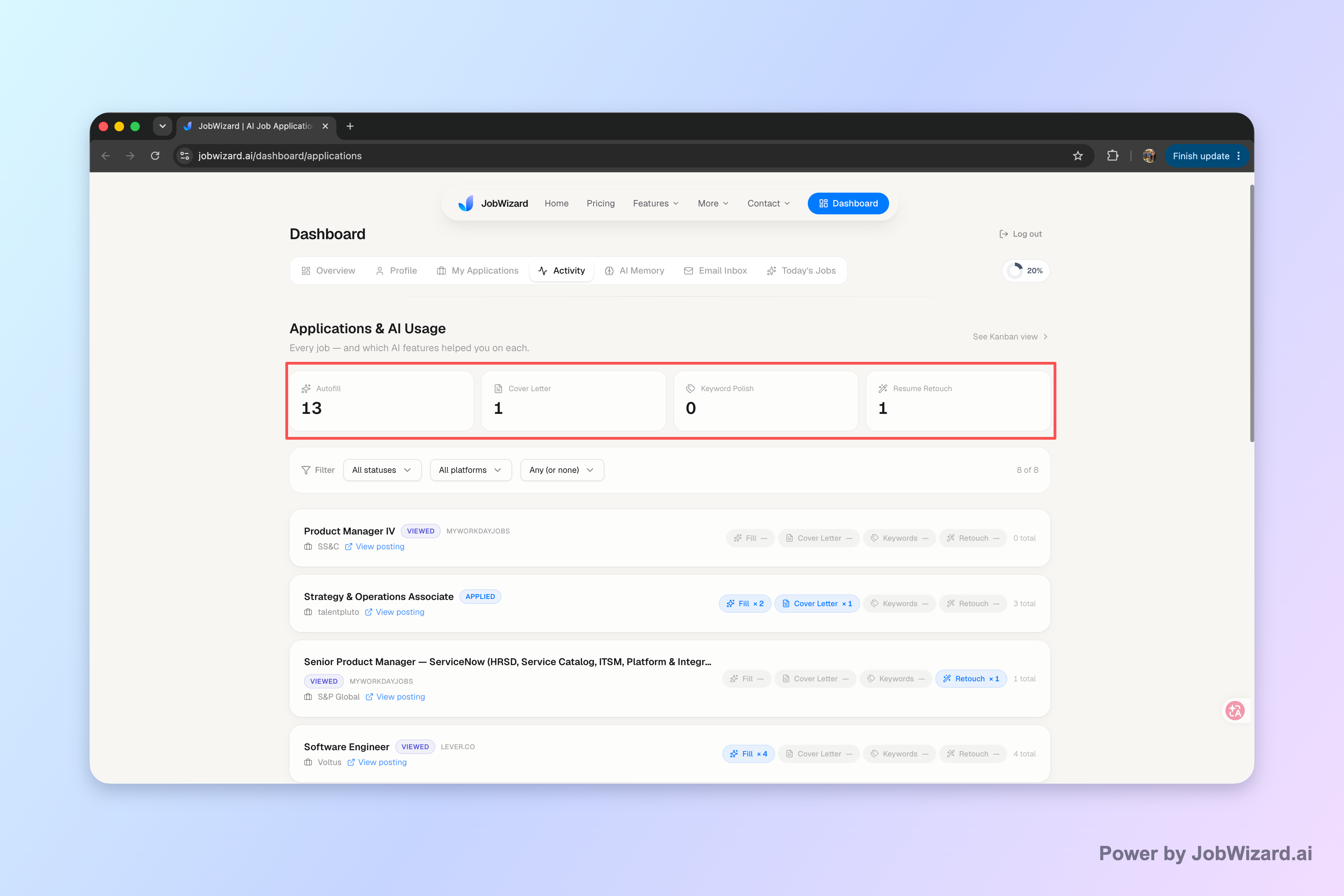
For example, JobWizard’s Activity view shows the application status and which JobWizard tools were used for each role, so you can see what stage you’re in and what actions you took along the way. (And you still review sponsorship/salary/EEO/custom questions before submitting.)
That matters because “in progress” becomes more actionable when you track timing and follow-up dates consistently—without relying on memory.
- Track the dates you applied and checked status.
- Record what changed (new status label, new portal note, recruiter message).
- Decide follow-up timing based on patterns, not anxiety.
Key takeaway: Use “in progress” as an input, not a decision—your tracker turns it into a workflow.
What does “in progress” application status mean on Workday?
On Workday, “in progress” generally indicates an active stage—your application is received and is moving through the employer’s process rather than being rejected or closed.
Because Workday can display multiple candidate/job stages, the label you see may be a high-level bucket. That’s why you should look for changes over time and any additional information on the job application portal (and in any email you receive).
How to confirm you’re seeing the latest Workday status
- Re-check the portal tab where the application status appears.
- Look for timestamped updates or any “last updated” details.
- Compare against your last screenshot/record (even notes in a tracker work).
- Watch for recruiter email that doesn’t always match portal wording.
Key takeaway: Workday labels are helpful, but the strongest confirmation comes from noticing what changed and when—not the label alone.
What does “in progress” application status mean in Workday vs other ATS?
Different ATS platforms show “in progress” differently, so the safest interpretation is to treat it as “not final” while verifying the specific job’s stage.
While some systems expose more detailed sub-stages, others consolidate many steps into a single label. Your goal isn’t to memorize every internal stage name—it’s to use “in progress” to decide what to do next: check updates and follow up appropriately.
How to compare meaning across ATS labels
- Look for status history (if the portal shows it).
- Check for consistent signals like “under review,” “screening,” or a “recruiter message.”
- Use timing as context: if the employer posts timelines, align your follow-ups to them.
For deeper coverage of platform-specific labeling, see Workday Meaning for Job Seekers: Application Statuses, Timeframes & What to Do Next.
Key takeaway: “In progress” is a starting point; the ATS label differences are why you should confirm movement.
What does “application status in progress” mean vs “application received”?
“Application received” usually means the employer confirmed submission, while “in progress” generally suggests the application has entered a broader processing/review workflow.
If you only see “application received,” you may be waiting for the initial routing or screening step. If you see “in progress,” the workflow is typically farther along—though still not at a decision point.
Recommended action when you see “application received”
- Don’t overreact immediately. Use a short wait window, then re-check.
- Confirm your application details (role title, location, and submission date).
- Prepare follow-up text so you’re ready if it flips to “in progress” and then stalls.
Key takeaway: “Application received” is confirmation; “in progress” is activity. Either way, systematic checking beats guessing.
What does “application status in progress” mean vs “under review”?
“Under review” usually indicates active evaluation (human review and/or resume screening), while “in progress” is broader and can include routing and queue processing.
If your status changes from “in progress” to “under review,” that’s usually a clearer positive signal. If it stays at “in progress,” you can still take action—just keep your follow-up respectful and informational.
| Application status label (example) | Most likely meaning | What you should do next |
|---|---|---|
| In progress | Application is active in the process (review/routing), not closed. | Check for changes, confirm dates, and plan a short follow-up after a reasonable period. |
| Application received | Submission confirmed; may still be pending routing. | Re-check later, save confirmation details, and be ready if the status advances. |
| Under review | Recruiter/screening is actively evaluating the application. | Stay patient but professional; follow up if it stalls beyond the employer’s stated window. |
| In process | Often similar to “in progress,” indicating movement through stages. | Treat it as active; focus on update checks and follow-up cadence. |
| Completed / Closed | Process ended for that application (not a live stage). | Don’t keep chasing that role; pivot to new applications and refine targeting. |
If you want a status-by-status walkthrough with next steps, read Application Status in Process: What It Means, How Long It Takes, and What to Do Next.
Key takeaway: Use the label to estimate “how alive” the application is, then use evidence (changes + dates) to decide follow-up timing.
What to do next when your application status is in progress (step-by-step)
You can respond to “in progress” with a clear workflow that keeps you proactive without spamming the employer.
- Confirm your last update date so you know when you last checked the portal.
- Re-check the portal for any new status wording or added notes.
- Scan your email for recruiter outreach (including spam/promotions folders).
- Compare against your job tracker to avoid missing other roles’ deadlines.
- Send one follow-up if it’s time—short, relevant, and not demanding.
Follow-up email template for “in progress”
Subject: Follow-up on [Job Title] application — [Your Name]
Hi [Recruiter Name/Team],
I hope you’re doing well. I’m following up on my application for the [Job Title] role submitted on [Date]. My application status shows in progress, and I remain very interested in the position.
If there’s anything else I can provide to support the review process, I’d be happy to share. Thank you for your time and consideration.
Best regards,[Your Full Name][Phone] | [LinkedIn] | [Email]
To build your own system for checking and following up consistently, use How to Track Job Applications: A Practical System (JobWizard + Beyond).
Key takeaway: Be structured: verify updates, then follow up once with a tailored, respectful message.
What does “in progress” mean if your application stays the same for weeks?
Staying “in progress” for weeks usually means the employer hasn’t updated the public status (even if internal work continues). It’s not automatically a rejection, but it does mean you should shift from waiting to verifying.
Your best move is to send a polite follow-up and consider broadening your search and outreach. If you’re tracking multiple applications, this is also where a job tracker prevents you from forgetting when you last checked.
How to respond (without chasing)
- Follow up once with the template above (or a variation).
- Keep the message value-focused (restate interest, offer materials if helpful).
- Do not send repeated “any updates?” emails. One well-timed note is better than frequent pings.
Key takeaway: If the status doesn’t move, act once to check—and then keep your pipeline moving with new applications and follow-ups on other roles.
What does “in progress” mean for an application activity tracker view?
In an activity view, “in progress” is often tied to timestamps and tooling, letting you see where you are in your personal application workflow.
For example, JobWizard’s Activity view shows the application status and which JobWizard tools were used for each role—so you can verify what you did and when, then decide your next step accordingly.
How to use an activity view effectively
- Treat every status change as a trigger to update your record and adjust follow-up timing.
- Don’t confuse speed with certainty: tracking helps you stay organized; it doesn’t replace recruiter decisions.
- Review before submit so any custom questions and critical details remain accurate.
Key takeaway: A tracker turns “in progress” into a decision point—check, plan, and move forward.
What does “in progress” mean next to other status labels?
When “in progress” appears alongside other wording, interpret it as a stage plus context (for example, screening vs routing vs review).
In practice, you’ll often see multiple signals: a high-level label (“in progress”) plus other clues like a job feed note, a candidate portal detail, or recruiter correspondence. Prioritize the most specific evidence you can find.
Quick sanity checks
- If you see a new label, that’s progress—save it with your check date.
- If you see no label change, focus on a follow-up cadence rather than guessing.
- If you receive a recruiter email, follow their direction even if the portal stays unchanged.
Key takeaway: Combine labels + dates + messages to understand what’s happening.
Do this automatically with JobWizard
Skip the manual work — JobWizard's Application Tracker handles this for you.
FAQs
What does application status in progress mean?
“In progress” usually means the employer has your application in an active stage (it hasn’t been rejected or closed), and the team is still reviewing or routing it. The exact step varies by company and system, so the best next move is to check for any additional notes and look for status changes after a few business days.
Does “in progress” mean I’ll get an interview?
Not automatically. “In progress” indicates the process is still moving, but it doesn’t guarantee an interview—recruiting schedules, internal approvals, and role priorities can change the timeline.
How long does it take for “in progress” to change?
There’s no universal timeline because each ATS and recruiter workflow differs. Treat “in progress” as an active stage and re-check based on the company’s stated hiring window (if provided) and a reasonable follow-up cadence.
Should I follow up if my status says “in progress”?
Yes, if you don’t see any movement after a reasonable period. Keep your follow-up short, reference the role and date you applied, and focus on showing continued interest while asking whether they need anything else.
What if my application status stays “in progress” for weeks?
If it stays unchanged for a long time, it typically means the employer hasn’t updated the public status yet. You can still follow up politely, and consider reaching out to the recruiter (if listed) or using an application tracker to ensure you don’t miss other roles’ update windows.
What does “in progress” mean in Workday specifically?
In Workday-based workflows, “in progress” generally indicates your application is active in the process—often that it’s been received and is in review or routed to the next step. Because Workday can show multiple job- and candidate-specific stages, confirming what changed (and when) is key.
Where can I check application status updates beyond the portal?
Check the job portal itself first, but also confirm your email for recruiter messages, and save any confirmation emails or application reference IDs. Using a job tracker can help you record dates, status changes, and follow-up reminders so you review systematically rather than guessing.
How do I write a follow-up email for an “in progress” status?
Use a clear subject line, mention the role, include your application submission date, briefly restate interest, and ask if they need any additional information. Keep it professional and concise, and avoid sounding impatient—your goal is to prompt an update or confirm next steps.
Ready to stop guessing? Keep every application and its next step in one place with JobWizard’s Activity view—so when you see application status in progress, you know exactly when to check and when to follow up.
If you want to learn more about tracking and timing, start with How to Track Job Applications: A Practical System (JobWizard + Beyond) and then review the platform notes in Workday Meaning for Job Seekers: Application Statuses, Timeframes & What to Do Next.
Frequently Asked Questions
Track all your applications in one place
JobWizard auto-tracks status changes across Workday, Greenhouse, and every major job site — free.