Application Status in Process: What It Means, How Long It Takes, and What to Do Next
“In process” often means your application is moving—just not finalized. Learn what “application status in process” typically indicates and the exact follow-up steps to take next.
Free Chrome extension
Track all your applications in one place
JobWizard auto-tracks status changes across Workday, Greenhouse, and every major job site — free.
You applied for a role, and the portal still shows application status in process. Three days later nothing changed—so you refresh again, unsure whether you should email, wait, or keep applying somewhere else.
This guide turns “in process” from a vague label into a clear set of actions: what it usually means, what “in progress” variants can imply, how to time follow-ups, and how to keep every update organized so you don’t lose track of anything.
How to Track Job Applications: A Practical System (JobWizard + Beyond)
Application status in process becomes manageable when you can see (1) what system the employer is using and (2) which stage you’re currently in. That’s why a tracking workflow matters as much as the label itself.
What does “in process” mean for an application?
In process typically means your application hasn’t been closed out yet and is currently being reviewed or processed by the employer’s hiring system.
In many applicant tracking systems (ATS), “in process” functions as a “not finished” bucket. That can include initial screening, internal routing, or waiting for a decision-maker to review. The key is to treat it as “active enough to matter,” not “final decision already made.”
Key takeaway: “In process” is a live stage. Don’t assume silence means rejection—assume your application is somewhere in the workflow until you see a definitive change.
What to look for alongside “in process”
Even when the status text is vague, the employer may provide clues elsewhere in the portal or email confirmations. Check for:
- Assessment links (if you have to complete a test, the status will often stay non-final until results are reviewed).
- Scheduling prompts (some employers keep a candidate listed as “in process” while interview logistics are arranged).
- Recruiter contact attempts (emails, tasks, or requests for updated info).
- Job-specific instructions in the application confirmation or the posting page.
What does “application status in process” mean on Workday?
On Workday, “in process” commonly signals that your application has moved past receipt but isn’t at a final disposition yet.
Workday-style status names often vary by employer and by the exact stage they chose to display. That’s why your best move is to interpret “in process” within the Workday label set you’re seeing—not by comparing it to what a different company uses.
For deeper Workday-specific interpretation (including how “timeframes” can affect what you see), use Workday Meaning for Job Seekers: Application Statuses, Timeframes & What to Do Next.
Key takeaway: Workday can show stage-level detail, but employers control what “in process” represents. Match your next step to the most specific stage name you can find.
How to respond when Workday stays “in process”
When the label doesn’t change, your follow-up should still add value:
- Be role-specific (mention the exact job title and the date you applied).
- Ask about next steps rather than demanding an update.
- Offer responsiveness (e.g., “I’m happy to provide any additional materials” if that’s true for you).
What does “in progress” mean compared to “in process”?
In progress and in process can overlap, but they don’t always indicate the same exact hiring stage.
Some systems use “in progress” as a more direct “currently being worked on” message, while “in process” can be broader—still active, but possibly covering multiple sub-steps. The practical difference for you: “in progress” can feel more “instant,” but either way you should confirm there’s no next-step action required on your end.
Key takeaway: Treat them as “active screening” until you see a clearer next action (assessment, interview scheduling, or a final disposition).
How to interpret “stuck” statuses
If you see “in progress” or “in process” and it stays there, consider these common explanations:
- Batch review: teams review candidates in groups, so your status doesn’t update daily.
- Team coordination: interviewers may not be available immediately.
- Portal delays: some systems update on a schedule rather than instantly.
- Parallel tracks: your application may be evaluated alongside others for multiple requirements.
Is “application status in process” a good sign or bad sign?
Generally, “in process” is a good sign because it indicates your application hasn’t been closed out yet.
However, “good sign” doesn’t mean “guaranteed.” Hiring teams can keep candidates in active states while they consider options, collect approvals, or finalize decision-makers. Your best strategy is to keep your momentum: continue applying while staying ready for a follow-up request.
Key takeaway: Use “in process” to justify follow-up planning—not to stop applying or assuming the outcome.
How long should you wait when the status is “in process”?
There’s no universal wait time for “application status in process,” because employers vary widely in how quickly they update ATS stages.
Some employers post a hiring timeline in the job listing; others don’t. Instead of waiting for a perfect number of days, use a simple decision rule: if no next step is required and the job listing doesn’t mention a timeline, choose a reasonable window for a polite check-in, then follow up at most once more if appropriate.
Key takeaway: Don’t wait until the last second. Use a reasonable follow-up window, then move on with your job search plan.
A practical follow-up timing workflow
- Note your applied date so you know when the ATS status first appeared.
- Check for next-step instructions (assessment, recruiter outreach, scheduling link).
- Send one short follow-up after a reasonable window if nothing changed.
- Stay consistent across roles so you don’t over-message the same employer.
What should you do next if the application status remains “in process”?
When “in process” doesn’t change, your next step is to confirm your records and send a targeted check-in, not to panic or spam.
Start by verifying the role and submission details. Then update your materials if you have a strong, legitimate reason (for example, you completed a relevant project or earned a credential). Your follow-up should reflect that you’re organized and genuinely interested.
- Confirm submission: same job title, same location/team, and same posting link.
- Review your submission: resume version, portfolio links, and answers to any application questions.
- Prepare a one-paragraph update you can mention if asked.
- Follow company norms (if there’s an internal contact method, use it).
Key takeaway: A calm, role-specific follow-up is the best response to a status that stays “in process.”
Copy-paste follow-up email template
Subject: Follow-up on [Job Title] — [Your Name]
Hi [Hiring Manager/Recruiter Name],
I’m following up on my application for the [Job Title] role submitted on [Applied Date]. My background in [1 relevant strength] aligns closely with what your team is looking for.
If there are any next steps or additional information I can provide, I’d be glad to share. Thank you for your time and consideration.
Best regards,[Your Full Name][Phone] | [Email] | [LinkedIn/Portfolio]
Why does my application status say “in process” but I don’t hear anything?
“In process” doesn’t automatically mean you’ll hear back immediately, even if your application is actively being reviewed.
Many employers run hiring in stages: screening, shortlisting, interviewer coordination, and approvals. During those steps, the portal may keep the same label for everyone in a category. Additionally, some systems update in batches or only when the employer pushes a status change.
Key takeaway: Silence often reflects workflow timing—not your likelihood of success. Your job is to track, prepare, and follow up once.
How can you track application status in process across multiple jobs?
You track “Application status in process” best by centralizing updates into one activity system, so you never wonder which role you already followed up on.
Tracking also helps you maintain your job search strategy. When you can see what’s waiting, what’s next, and what you’ve already messaged, you reduce repeated effort and keep your outreach respectful.
For a complete approach, start with How to Track Job Applications: A Practical System (JobWizard + Beyond) and adjust based on your preferences and number of roles.
Key takeaway: Use one system to track status, dates, and next steps—then review before you submit any follow-ups.
What to capture in your tracker
- Job details: title, company, link, and location (remote/on-site).
- Date applied and any confirmation number/email.
- ATS status label (e.g., “in process” / “in progress” / “under review”).
- Follow-up date and the message you sent.
- Any next-step requirements (assessment deadlines, scheduling instructions).
Should you use an application status tracker or a spreadsheet?
A tracker is usually easier than a spreadsheet for staying on top of multiple roles and remembering what changed and when.
Spreadsheets work well when you’re comfortable maintaining them—but they can become messy when statuses change irregularly. If you prefer the spreadsheet path, build it with the right columns and a follow-up plan from the start.
If you’re considering a spreadsheet system, see Job Tracker Spreadsheet: Build a Simple System to Track Applications and Follow Up. If you want a cleaner approach without spreadsheet overload, read How To Track Job Applications Without a Messy Spreadsheet (A Cleaner System).
Key takeaway: Choose the tool that makes it easiest to act on “in process” when the time comes.
Verified use of JobWizard’s Activity view (how it helps you follow up)
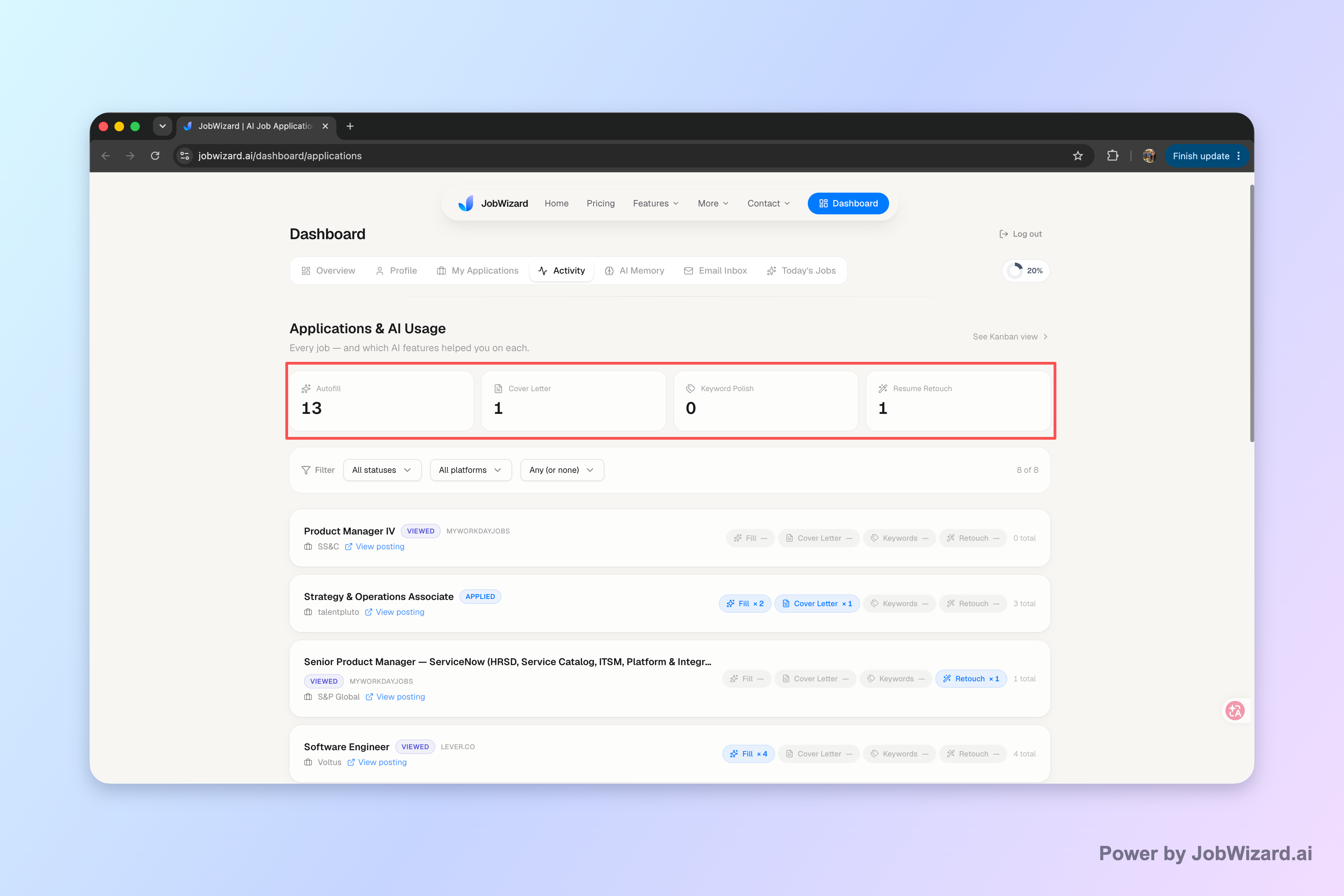
JobWizard’s Activity view shows application status and which JobWizard tools were used for each role, so you can keep context while you decide what to do next.
In JobWizard usage, automated filling supports repetitive fields quickly during the application workflow, while you review sponsorship, salary, EEO, and custom questions before submitting. That means your tracking can stay accurate to your own final review, not just an autopopulated draft.
Key takeaway: Track “Application status in process” alongside what you already did—so follow-ups are informed, not guessed.
How does “application activity” help you interpret “in process” updates?
Application activity helps you turn status labels into a timeline—so “in process” doesn’t feel random.
Instead of relying only on what the portal shows today, activity tracking connects the status with the actions you took for each role (for example, which tools were used). That makes it easier to answer questions like: “Did I already submit the application for this posting?” and “Which roles should I follow up on first?”
Key takeaway: Build a “status + next step” story per job so you can respond quickly when the employer finally updates the stage.
Why this matters (a quick reality check)
Across JobWizard usage, there are 720,000+ applications submitted and 600,000+ autofill sessions run through the platform. Autofill fills an average of about ~18 repetitive fields per application, which can reduce time spent on repetitive entries—while you still review fields like sponsorship/salary/EEO/custom questions before submitting.
That’s helpful because it supports a faster workflow, but your follow-up should still be based on the actual status you see and the actions you took. Activity tracking helps you do exactly that: fill quickly, review carefully, then track what happens next.
Key takeaway: Activity tracking supports the “fill + review + follow-up” loop so “in process” leads to next actions.
Quick reference: What “Application status in process” usually means and what to do
Use this table to translate the status language into an action you can take today.
| Displayed status (example) | Most likely meaning | What to do next |
|---|---|---|
| In process | Application is active in review/processing; final outcome not posted yet. | Track the role, confirm you have no required next-step action, and plan a polite check-in if it stays unchanged. |
| In progress | Ongoing internal review stage (sometimes narrower or stage-specific than “in process”). | Treat as active screening; watch for assessment/scheduling updates and follow up once if there’s no movement. |
| Under review (if shown) | Employer is actively evaluating your application. | Do not spam follow-ups; respond promptly if requested and keep materials ready. |
| Assessment requested (if shown) | Next step is required and will affect review timing. | Complete it quickly and add any requested supporting info. |
| Interview scheduled (if shown) | A decision progressed beyond screening. | Confirm logistics, prepare answers tailored to the job, and be ready to answer recruiter questions fast. |
| Not selected (if shown) | Final disposition posted. | Update your resume/targeting and move forward with new applications. |
Key takeaway: The action is what matters. “In process” typically calls for tracking and one well-timed follow-up—not repeated messages.
Action checklist: What you should do today if your status is “in process”
Follow this checklist to move from uncertainty to a clear plan.
- Verify the role: job title, company, and posting details match your submission.
- Confirm no next step is pending: look for assessment links or additional forms.
- Log the date + current label (especially if it’s still application status in process).
- Decide on one follow-up window based on the job posting timeline (if provided) and your applied date.
- Use a short message: one paragraph + one simple question about next steps.
- Keep applying while you wait, so your job search doesn’t stall.
Key takeaway: The best response to “in process” is organized action: track, prepare, and follow up once.
Do this automatically with JobWizard
Skip the manual work — JobWizard's Application Tracker handles this for you.
Application status in process FAQ
These answers cover the most common follow-up questions people have when their portal still says “in process.”
What does “in process” mean on a job application?
“In process” usually means your application has been received and is actively being reviewed or processed, but a final decision isn’t posted yet. The best next step is to confirm you’re using the right tracking view for that ATS (Workday/Greenhouse/Ashby/Lever) and follow any “next step” instructions the system provides.
Is “Application status in process” the same as “in progress”?
Not always. Some systems use “in progress” for internal review stages, while “in process” can be a broader umbrella like “under review” or “being processed.” Treat them as similar until you see the recruiter-facing signals (interview invite, assessment link, or a more specific stage), then adjust your follow-up timing.
How long should I wait before following up when my status is “in process”?
There isn’t one universal timeline because different employers move at different speeds and different ATSes update at different intervals. A practical approach is to track your application date, then follow up after a reasonable window (using the employer’s posted timeline if one exists) and keep your message short and specific.
What should I do if the status never changes from “in process”?
First, verify you’re tracking the correct application entry (sometimes a role has multiple postings or duplicate submissions). Then check whether the job listing includes any next-step instructions (assessment link, interview scheduling, or recruiter contact). If nothing changes after a follow-up, send one additional polite check-in or ask if there’s a preferred way to share updated materials.
Does “in process” mean I’m likely to get an interview?
“In process” indicates your application is still in the review/processing pipeline, which is generally more positive than statuses like “not selected.” However, it doesn’t guarantee an interview—teams can pause reviews, reprioritize roles, or move candidates in batches. The safest move is to keep tracking and be ready to respond quickly if a next step appears.
How can I track application status without losing updates?
Use a single application activity view that shows the status for each role and where it stands in the workflow. For example, JobWizard’s Activity view keeps application status alongside which JobWizard tools were used for each role—then you review any sponsorship/salary/EEO/custom questions before submitting.
Should I follow up with a recruiter or the company inbox when my status is “in process”?
If you have a recruiter name or contact, that’s usually the best target because your message can be more relevant. If you only have a general company inbox, a concise, role-specific follow-up still works—just avoid repeating your entire resume. In both cases, ask a simple question about the next steps or timeline.
Ready to stop guessing what “in process” means?
Keep every application—and its next step—in one place. JobWizard’s Activity view shows application status and where your application stands, so you can follow up confidently instead of refreshing endlessly.
Start with a practical system for tracking applications, then use JobWizard’s Activity view to manage application status in process updates across roles.
Frequently Asked Questions
Track all your applications in one place
JobWizard auto-tracks status changes across Workday, Greenhouse, and every major job site — free.