In Progress Application Status: What It Means, How to Check Updates, and What to Do Next
Stuck on an “in progress application status”? Here’s what it usually indicates, how to confirm updates, and exactly when to follow up—without guessing.
Free Chrome extension
Track all your applications in one place
JobWizard auto-tracks status changes across Workday, Greenhouse, and every major job site — free.
You applied for a role you genuinely want, then a few days later you see an in progress application status—and nothing changes. You start wondering: is the recruiter looking at it, did something fail, or do you just wait indefinitely?
This guide breaks down what “in progress” usually indicates across common ATS flows, how to confirm what’s happening, and when to follow up—so you’re not refreshing your inbox and guessing.
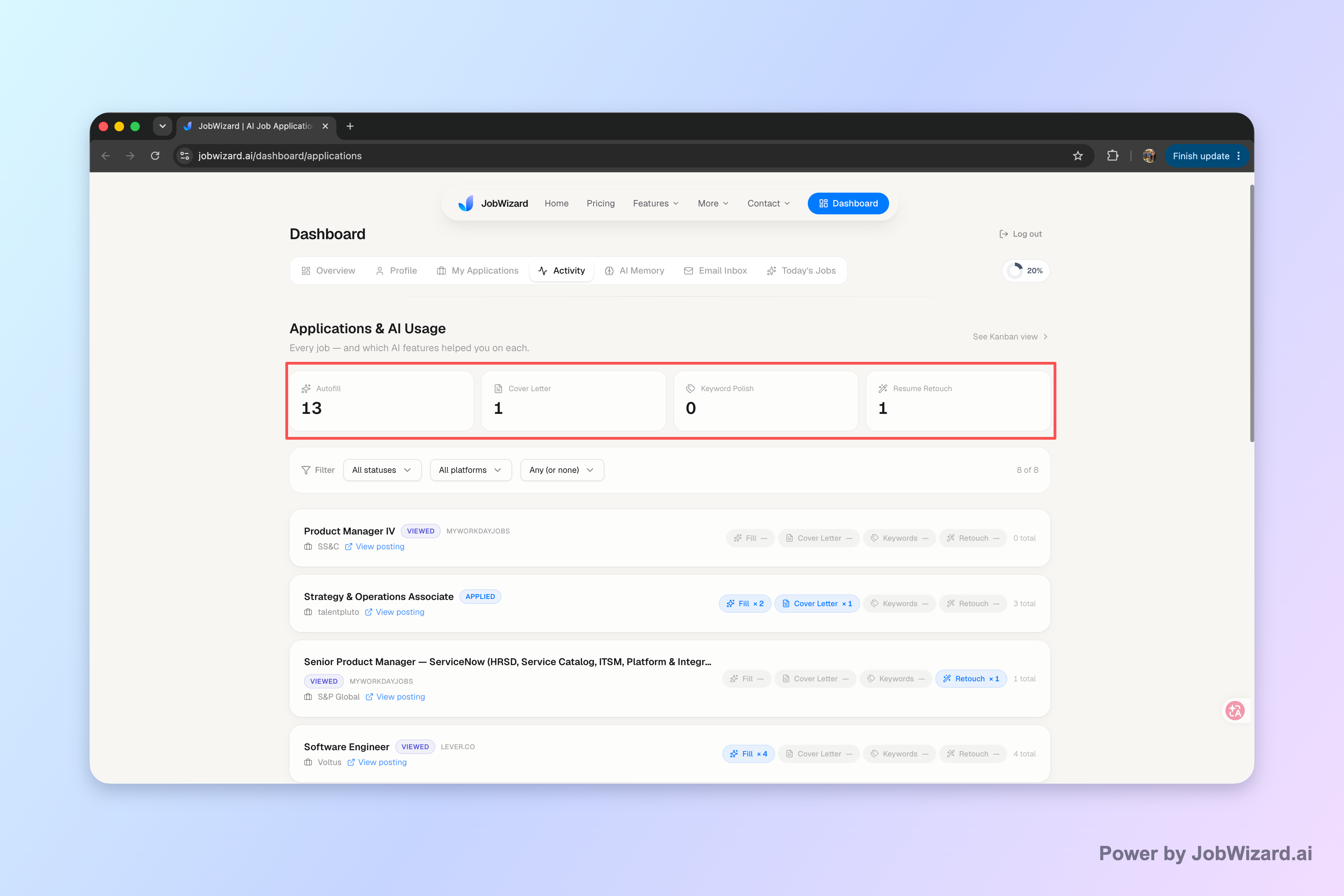
Before you act, make your application tracking simple: keep each role’s current status and your last action in one place so you can decide your next step quickly. In JobWizard, the Activity / Job Track view shows application status and which JobWizard tools were used for each role.
What does “in progress application status” mean after I apply?
In progress application status typically means your application hasn’t reached a final outcome state yet and is still moving through an active stage—like review, internal routing, or preliminary verification.
Because ATS terminology differs by company and system, “in progress” often doesn’t map to a single human meaning. Your best signal is whether the employer sends a request (interview, assessment, document request) or updates the record to a clearly defined next-step status.
Key takeaway: Treat “in progress” as “not closed out yet,” not as proof you’re advancing.
How long does an “in progress application status” usually take?
There’s no universal timeline for how long in-progress applications stay there, because each employer’s process varies and ATS updates may not be perfectly synchronized with recruiter activity.
Instead of counting days from the button you clicked, anchor your timing to practical checkpoints: when the posting closes, when your initial confirmation email was sent (if any), and whether the employer indicated review windows or hiring phases.
- After the posting deadline: If the role closes but your status is still “in progress,” that’s a normal time to check and consider a follow-up.
- After assessments are due (if listed): If there was an assessment timeline in the instructions, wait until that window passes before nudging.
- After a reasonable processing period: If nothing changes and you still care about the role, send one short follow-up rather than repeated messages.
Key takeaway: Use posting timelines and “no next step yet” as your guide—not just how many days have passed.
What does “in progress” mean in Workday?
In Workday-related flows, “in progress” usually indicates the application is still active in the hiring workflow rather than completed with a decision.
Workday status labels can differ depending on how the organization configures them. If you’re using Workday-specific tracking, the most helpful move is to pair the status label with a consistent follow-up plan and your tracker notes, so you’re not reacting to wording alone.
If you’re trying to decode Workday terminology, use this as a starting point: Workday Meaning for Job Seekers: Application Statuses, Timeframes & What to Do Next.
Key takeaway: In Workday, “in progress” is a workflow signal—map it to next steps, not just hope or fear.
What does “in process” mean vs “in progress”?
“In process” and “in progress” often sound interchangeable, but the key difference is usually that each ATS (or each employer) defines these statuses differently.
Instead of treating label changes like they always mean “good” or “bad,” treat them as updates to your application’s state machine. Then your process is the same: confirm whether you received an action request and decide whether a follow-up is warranted.
| What you see | What it usually indicates | Recommended action |
|---|---|---|
| In progress | Application is still active in review/routing; no final decision shown yet | Check for new emails/requests; track your last action; consider one follow-up after a reasonable checkpoint |
| In process | Similar “active stage” meaning, but system-specific wording | Verify whether the employer’s status legend explains it; compare against your tracker history |
| Under review | Someone (or a workflow stage) is actively evaluating the application | Keep materials ready; don’t spam follow-ups; be responsive if contacted |
| Interview / Assessment | Next step has been triggered | Confirm scheduling instructions; prepare promptly; update your tracker notes |
| Closed / Rejected / No longer under consideration | Final outcome recorded | Move on while keeping your follow-up template ready for future roles |
Key takeaway: Don’t overfit meaning to wording—use the status to choose the next action.
Why does my application still show “in progress” even after interviews?
It can happen that your visible ATS status lags behind what’s happening in reality. Recruiters may schedule interviews while the system update happens later—or during batch processing.
If you’ve received an interview invite or assessment instructions, your priority is the communication you received. Then use the status update as a confirmation, not the primary source of truth about your hiring stage.
- Check your email (and spam): Interview/assessment messages usually arrive there first.
- Save the details: Record date, recruiter contact, and any platform links in your tracker.
- Follow the instructions: Don’t wait for the status to change before confirming logistics.
Key takeaway: Trust direct invitations more than delayed dashboard labels.
How do I track “in progress” applications without losing follow-up momentum?
The real problem with “In progress application status” isn’t just waiting—it’s forgetting what you did and when, then either following up too soon or not following up at all.
Create a simple system that records: (1) the role, (2) the current status label, (3) the date you applied, and (4) what you’ve already done to follow up. If you do this consistently, “in progress” becomes a manageable state instead of an anxiety loop.
For a practical tracking workflow, start with How to Track Job Applications: A Practical System (JobWizard + Beyond). If you want something lighter, use How To Track Job Applications Without a Messy Spreadsheet (A Cleaner System), or if you prefer a structured format, see Job Tracker Spreadsheet: Build a Simple System to Track Applications and Follow Up.
Key takeaway: Tracking turns “in progress” into a decision point, not an open-ended mystery.
When should I follow up if my status remains “in progress”?
Follow-up timing should be reason-based, not emotion-based. If the employer’s posted timeline has passed or you’ve been waiting through normal processing, a single polite follow-up can be appropriate.
If the ATS status stays “in progress” with no new instructions, keep your follow-up email short and specific: reiterate your interest, reference the role clearly, and ask about next steps.
Follow-up email template (copy/paste): Subject: Follow-up on [Role Title] application — [Your Name] Hi [Hiring Manager Name/Recruiter Team], I’m writing to follow up on my application for the [Role Title] position submitted on [Date]. My application is currently showing as “in progress,” and I remain very interested in the opportunity. If there’s anything else I can provide to support the review process, I’d be happy to share it. Could you please let me know what the next steps look like and any expected timeline for decisions? Thank you for your time and consideration, [Your Full Name] [Phone] | [Email] | [LinkedIn/Portfolio]
- Do one follow-up: Keep it polite and concise; avoid repeated messages in a short window.
- Reference the role: Include the exact title and submission date.
- Ask about next steps: Your goal is a direction update, not a “yes/no.”
- Keep applying: “In progress” doesn’t block you from pursuing other opportunities.
Key takeaway: Follow up once with clarity, then let the employer lead the next communication.
How can JobWizard help with “In progress application status” updates?
JobWizard helps you act with context by keeping each application’s status and what you did for each role in one Activity view.
Specifically, the Activity / Job Track view shows application status and which JobWizard tools were used for each role. That makes it easier to review your workflow, decide whether you’ve already followed up, and choose a sensible next step—especially when everything looks stuck at “in progress.”
Key takeaway: Use one activity view to connect status + action, so “in progress” doesn’t paralyze you.
Do this automatically with JobWizard
Skip the manual work — JobWizard's Application Tracker handles this for you.
FAQ
What does “In progress application status” mean after I apply?
It usually means the employer or ATS still has your application in an active stage—often the team is reviewing, verifying, or routing it—so it hasn’t reached a decision state yet. The only way to know the exact sub-stage is to check the posting’s ATS status definitions (if provided) and your application tracker notes.
Does “in progress” mean I’m definitely being considered?
Not necessarily. “In progress” typically indicates activity on the employer side, but it doesn’t guarantee advancement. Treat it as a sign that your application hasn’t been closed out, then confirm whether any next-step actions (interview requests, assessments, or additional questions) appear.
How can I track an “in progress” status without losing track of follow-ups?
Use an application tracker that keeps each role’s current status and your last action together. In JobWizard, the Activity / Job Track view shows application status plus which JobWizard tools were used for each role, so you can review and decide what to do next before you submit anything.
When should I send a follow-up email if the status stays “in progress”?
Send a follow-up only when you have a reasonable reason to believe more information is welcome—such as after the posting’s stated timeline passes or after you’ve waited long enough for normal processing. If the ATS shows no movement at all, keep the email short, polite, and reference the role clearly while asking about the next step.
What if my ATS shows different statuses like “in progress” and “in process”?
These labels are often system-specific. Your best approach is to map each label to the employer’s own definitions (if the ATS provides them) and then track your activity consistently so you can compare changes over time rather than reacting to wording alone.
Should I assume silence is a rejection if my application is still “in progress”?
No. Silence plus an “In progress application status” commonly just means the employer hasn’t updated your record yet. However, if a role closes or you see a clear decision status change elsewhere, switch from “check and wait” to “follow up once, then move on.”
How does JobWizard help when I’m stuck on “in progress” statuses?
JobWizard helps you keep each application’s status and next-step details in one activity view. The Activity view shows application status and which JobWizard tools were used for each role, so you can review what you’ve already done and choose a sensible follow-up path before submitting anything.
Can I rely on an “in progress” status update alone to know what to do next?
No—status labels show where your application sits, but they don’t always tell you what you should do next. Use the status as a signal, then cross-check the job posting, your email for requests, and your tracker notes to decide whether a follow-up or a new application is the right move.
Ready to stop guessing?
Keep every “In progress application status” tied to an action plan. Start using JobWizard’s Activity / Job Track view to review application status and the JobWizard tools used for each role—then follow up with confidence when it’s actually time.
Get started with JobWizard and maintain a single activity view for every application so “in progress” becomes your next step, not your next worry.
Frequently Asked Questions
Track all your applications in one place
JobWizard auto-tracks status changes across Workday, Greenhouse, and every major job site — free.