In Process vs In Progress: How to Decode Job Statuses and Know Your Next Move
Confused by “in process vs in progress” on job applications? Learn what each status usually means, how to check accurately, and what to do next—without guessing.
Free Chrome extension
Track all your applications in one place
JobWizard auto-tracks status changes across Workday, Greenhouse, and every major job site — free.
You submitted an application, the portal changed, and now you’re staring at one of two labels: “in process” vs “in progress.” One sounds similar to the other—but the difference can change how you follow up, how often you check, and whether you assume anything is “bad news.”
This guide breaks down what these statuses usually mean, how to confirm what’s happening in the job’s portal, and how to stay organized while you wait. You’ll also see a simple system for tracking updates—especially helpful when you’re managing multiple roles at once.
What does “In Process” mean on a job application?
“In process” usually means the employer is still working through steps after your submission. Depending on the ATS (like Workday, Greenhouse, Ashby, or Lever), that can include review routing, internal approvals, or preliminary screening steps.
Important: in process vs in progress is often more about workflow labeling than about a universal stage-of-hiring promise. The status tells you activity exists somewhere in the system, not that you’re guaranteed to move forward.
Key takeaway: Treat “in process” as “keep monitoring,” not as “decision pending.” Verify the employer portal and track your next check date.
What does “In Progress” mean on a job application?
“In progress” typically means your application is actively being handled right now. That “handling” can be review, processing, or routing within the hiring pipeline—again, the exact meaning can vary by ATS and even by the job posting.
If you’re trying to interpret signals, look for adjacent wording if your portal shows it (examples often include “viewed,” “pending approval,” “under consideration,” or similar). Those breadcrumbs are usually more informative than the label alone.
Key takeaway: “In progress” = activity is underway. Your next move should be based on portal details and timing, not on the phrase alone.
Is “in process” the same as “in progress” for hiring?
Sometimes they’re effectively similar, but they’re not guaranteed to represent the same step. Some systems use the words loosely, while others reserve each term for distinct workflow states.
To decide what to do next, use a two-part approach:
- Check the portal status details (the exact wording, plus any nearby labels).
- Confirm with your application activity (what you submitted, when you last checked, and whether you’ve already followed up).
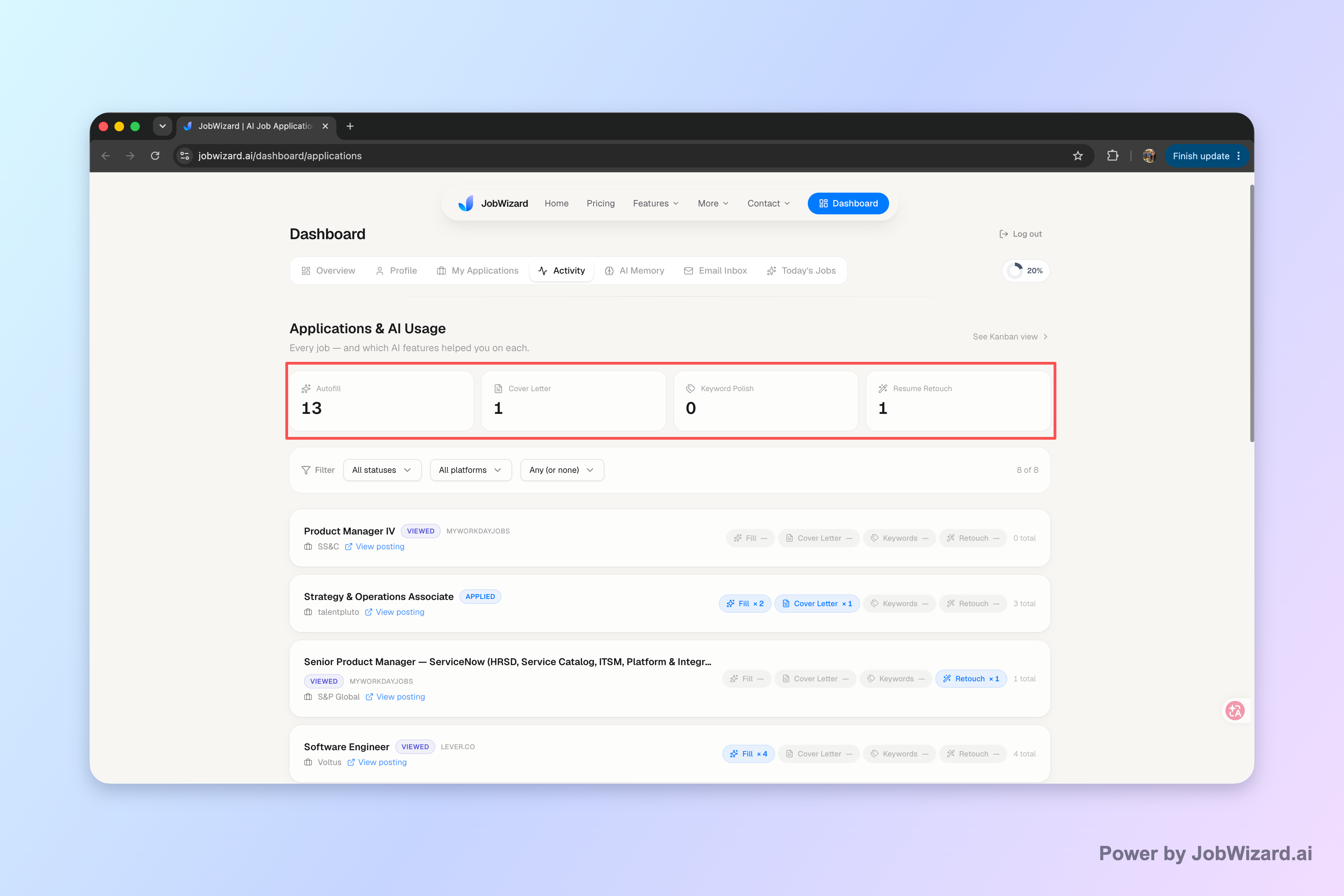
This is also where having a single place to review your roles helps. In JobWizard, the Activity view shows your application status and which JobWizard tools were used for each role, so you’re not re-guessing what happened last time.
Key takeaway: Don’t assume “in process” and “in progress” mean the same thing—use the employer’s portal text and any additional clues.
What does “in process” mean in Workday (or other ATS portals)?
In Workday-like experiences, “in process” commonly indicates the application has not reached a final disposition. That still leaves room for multiple internal steps before you see “not selected,” “rejected,” or any interview scheduling signal.
Because ATS workflows differ, your best source of truth is the employer’s own portal page tied to your application. If the portal provides an applicant experience page, treat it as the authoritative status feed.
- Re-check the application portal when time passes (especially if you’re used to hearing back quickly from certain employers).
- Watch for “viewed” or “updated” signals (if your portal shows them) rather than relying only on the “in process” label.
Key takeaway: In Workday-style systems, “in process” usually means “still moving,” not “good to go.” Keep checking for specific updates.
What does “in progress” mean in Greenhouse (and other portals)?
In Greenhouse-like portals, “in progress” generally signals your application is in the system’s active workflow. That could mean review queues, candidate matching, or internal routing.
Again, the most practical thing you can do is triangulate: match the status wording with any timestamps or secondary indicators shown in the portal, plus your own application tracker notes.
Key takeaway: In progress = active workflow. Use portal breadcrumbs and your tracking history to decide whether to follow up.
What does “pending approval” mean compared with “in process” and “in progress”?
“Pending approval” usually suggests something administrative or internal hasn’t cleared yet. In contrast, “in process” or “in progress” often implies your application is already flowing through the hiring workflow (review/routing), not merely waiting for an approval gate.
If your portal shows “pending approval,” your next step is usually different:
- Verify the exact label (don’t generalize—“pending approval” is a distinct signal).
- Wait for portal changes before sending a “status check” follow-up that might duplicate what the portal already implies.
- Follow up later with a timing question once a reasonable interval passes with no updates.
Key takeaway: “Pending approval” often points to an internal gate—be patient, then follow up with a timeline request if nothing changes.
How do I check updates when my application status says “in process” or “in progress”?
The most reliable way to check is to use the same portal page where the status is displayed. Email can lag, and screenshots from friends or generic guides can’t see your employer’s system.
Here’s a scannable routine you can use:
- Open the application portal using the link from the job post or confirmation email.
- Look for status changes and any neighboring labels (e.g., viewed, under consideration, pending approval).
- Confirm dates if provided (some portals show last updated info).
- Log what you saw so you don’t repeat the same check assumptions across roles.
If you’re juggling multiple applications, keeping everything in one place reduces confusion. JobWizard’s Activity view is designed for application tracking and review-before-submit workflows—it shows application status and which JobWizard tools were used for each role.
Key takeaway: Check the portal first, then track what you found. That’s how you stop guessing between “in process vs in progress.”
What should I do next after “in process” vs “in progress” statuses?
Your next step should be a combination of waiting strategically and staying visible with a respectful follow-up. The label alone doesn’t tell you whether you should contact the recruiter today—but it does tell you the system hasn’t finalized your application.
Use the table below as a quick mapping between common labels and what to do next.
| Application status label | What it usually means | Recommended action |
|---|---|---|
| In process | Application is moving through post-submission steps inside the hiring workflow. | Check the employer portal for updates, then schedule your next check and avoid repeated status-check emails. |
| In progress | Application is actively being handled (review/routing/processing) but not finalized. | Monitor for portal changes; if unchanged for a reasonable interval, consider a concise follow-up with a timeline question. |
| Pending approval | An internal gate must clear before further processing. | Wait for portal updates; follow up later only if the timeline is important and nothing changes. |
| Under review / under consideration | Review is underway. | Keep applying elsewhere; prepare follow-up context (projects, results, fit) for when you hear back. |
| Not retained / disposed / rejected | Application is not moving forward. | Focus energy on new applications and consider updating your resume or tailoring for similar roles. |
| Interview scheduled / interview | Hiring has progressed to scheduling. | Confirm details promptly and start preparing a role-specific story bank. |
Key takeaway: Use “in process vs in progress” as a trigger to check and track—not as a reason to spam follow-ups.
When should you follow up after “in process” vs “in progress”?
Follow up when enough time has passed that “no visible update” becomes meaningful. Since there’s no universal wait period, base it on the employer’s stated timeline (if any) and your own posting/apply date record.
Before you email, make sure you’re not repeating the same question the portal already implies. If the status is stable, your follow-up should aim for clarity: timing, next steps, or whether anything additional is needed.
Follow-up email template (copy/paste):
Subject: Follow-up on [Role Title] application
Hello [Recruiter Name/Team],
I hope you’re doing well. I’m following up on my application for the [Role Title] position submitted on [Date]. The portal currently shows the application is [in process / in progress].
If there are any updates on next steps or expected timing, I’d appreciate any guidance. Thank you for your time and consideration.
Best regards,
[Your Name][Phone] | [LinkedIn/Portfolio]
Key takeaway: Keep follow-ups short, role-specific, and framed as a timing/next-step request.
How do you keep multiple applications organized when statuses don’t change?
Organization is what turns confusing statuses into a clear process you can repeat. When labels like “in process vs in progress” appear, your goal is to avoid losing track of which role needs attention next.
Try this action checklist:
- Create one application tracker with columns for role, status, portal link, and last checked date.
- Record the exact status text (“in process” vs “in progress”) so you can compare over time.
- Write down your last follow-up and when you plan the next one (if needed).
- Keep a “next step” note per role (wait, check portal again, or follow up with a timeline question).
If you use JobWizard, you can keep these details in a single Activity view that shows application status and which JobWizard tools were used for each role—so you’re always looking at the right context before deciding what to do next.
Key takeaway: Tracking prevents status confusion from turning into wasted effort.
What does it mean if my application status is “in process” but I never hear back?
It usually means the employer hasn’t closed the loop in the system—your silence isn’t automatically a rejection. Hiring timelines vary, and some ATS statuses remain in a non-final state for extended periods while teams review candidates or coordinate approvals.
That said, you should still take action that protects your momentum:
- Continue applying while you monitor the portal.
- Follow up politely if a reasonable interval has passed and you need timeline clarity.
- Keep notes so you can quickly respond to recruiter outreach without scrambling.
Key takeaway: Silence with “in process/in progress” is common—don’t panic, but don’t stop being proactive.
Do this automatically with JobWizard
Skip the manual work — JobWizard's Application Tracker handles this for you.
FAQ: “in process vs in progress” job application statuses
What does “in process” mean on a job application?
“In process” usually means your application is moving through some internal step(s) after submission. It’s a signal to keep monitoring, but it doesn’t guarantee a decision—so you should check the employer’s portal (if available) and confirm what the next expected action is (often nothing more than waiting, plus a possible follow-up).
What does “in progress” mean on a job application?
“In progress” typically indicates the application is currently being handled—reviewed, processed, or routed—rather than being completed. Because the wording can vary by ATS (and even by role), treat it as “activity is ongoing,” then verify by checking your application portal or messages for updates and by updating your own tracker.
Is “in process” the same as “in progress” for hiring?
Not always. Some systems use these phrases interchangeably, but others separate them to reflect different steps (for example, “in process” might relate to data/eligibility checks, while “in progress” might relate to review). When you’re deciding what to do next, use the best available source of truth: the job’s portal status text plus any notes like “viewed,” “pending approval,” or similar breadcrumbs.
How long should I wait when my application says “in process” or “in progress”?
Since timing isn’t standardized across employers or ATS workflows, use the posted timeline if one exists and then switch from “waiting passively” to “checking on a schedule.” A practical approach is to confirm the employer portal first, then perform a follow-up if you’ve passed a reasonable interval without any additional movement—while keeping your follow-up respectful and role-specific.
What should I do if my status stays “in process” for weeks?
Start by re-checking the application portal (and email/spam for employer messages). If there’s no new signal, consider a brief, polite follow-up that reiterates interest and asks whether there’s an updated timeline. Also update your application tracker so you can compare roles and avoid repeatedly guessing what’s happening.
How do I check job application status accurately (portal vs email)?
Use the employer’s application portal or ATS link first, because that’s where status text like “in process” or “in progress” is updated. Then corroborate with email (including spam) and any confirmation emails or candidate messages. If you track roles in one place, you’ll know what you checked, when you checked it, and what you’ve already asked.
Should I follow up if my application is “in progress” but there’s no contact yet?
If “in progress” has stayed unchanged for a reasonable period and the employer hasn’t provided a communication cadence, a follow-up can be appropriate—especially if you can reference the role and show continued interest. Keep it concise, ask about timing, and avoid sounding demanding; the goal is to request clarity, not pressure a decision.
How can I avoid mixing up multiple job applications with different statuses?
Use an application tracker so every role has its own status, check date, and next step. JobWizard’s Activity view is built for this: it shows your application status and which JobWizard tools were used for each role, so you can review-before-submit and keep follow-ups consistent.
Next steps: keep every “in process vs in progress” job in one place with JobWizard
Stop guessing and start tracking. If you want a faster, less confusing way to manage the “in process vs in progress” statuses you see across employers, keep your roles—and their next steps—in one activity view.
JobWizard helps by showing application status and which JobWizard tools were used for each role, so you can review what you did and decide what to do next with confidence. If you’re ready to organize your pipeline, start using JobWizard’s Activity view to track each application and your next check/follow-up step.
Related reads: How to Track Job Applications: A Practical System (JobWizard + Beyond), What Does Application Status In Progress Mean? Here’s How to Check Updates and Next Steps, In Progress Application Status: What It Means, How to Check Updates, and What to Do Next, Application Status in Process: What It Means, How Long It Takes, and What to Do Next.
Frequently Asked Questions
Track all your applications in one place
JobWizard auto-tracks status changes across Workday, Greenhouse, and every major job site — free.